Closed Choice and a Uniform Low Basis Theorem
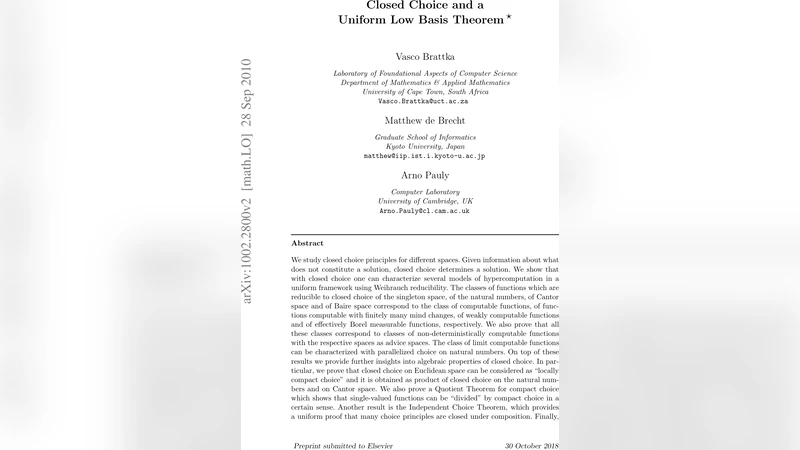
We study closed choice principles for different spaces. Given information about what does not constitute a solution, closed choice determines a solution. We show that with closed choice one can characterize several models of hypercomputation in a uniform framework using Weihrauch reducibility. The classes of functions which are reducible to closed choice of the singleton space, of the natural numbers, of Cantor space and of Baire space correspond to the class of computable functions, of functions computable with finitely many mind changes, of weakly computable functions and of effectively Borel measurable functions, respectively. We also prove that all these classes correspond to classes of non-deterministically computable functions with the respective spaces as advice spaces. Moreover, we prove that closed choice on Euclidean space can be considered as “locally compact choice” and it is obtained as product of closed choice on the natural numbers and on Cantor space. We also prove a Quotient Theorem for compact choice which shows that single-valued functions can be “divided” by compact choice in a certain sense. Another result is the Independent Choice Theorem, which provides a uniform proof that many choice principles are closed under composition. Finally, we also study the related class of low computable functions, which contains the class of weakly computable functions as well as the class of functions computable with finitely many mind changes. As one main result we prove a uniform version of the Low Basis Theorem that states that closed choice on Cantor space (and the Euclidean space) is low computable. We close with some related observations on the Turing jump operation and its initial topology.
💡 Research Summary
The paper investigates the closed‑choice operator C_X, which on a represented space X receives as input a non‑empty closed set and must output an arbitrary point of that set. By analysing C_X with respect to Weihrauch reducibility, the authors obtain a uniform classification of several hyper‑computational models.
First, they show that the computational power of C_X depends precisely on the underlying space X. For the singleton space, C_X is Weihrauch‑equivalent to ordinary computable functions. For the natural numbers ℕ, C_ℕ captures exactly the class of functions computable with finitely many mind‑changes (finite‑mind‑change computability). For Cantor space 2^ℕ, C_{2^ℕ} coincides with the class of weakly computable functions, i.e. those that can be realised by a non‑deterministic algorithm that only receives negative information about the solution. Finally, for Baire space ℕ^ℕ, C_{ℕ^ℕ} is equivalent to the class of effectively Borel‑measurable functions. Thus each of the four canonical spaces yields a distinct, well‑studied computational class.
Second, the authors connect closed choice with non‑deterministic computation equipped with an advice space. They prove that C_X is Weihrauch‑equivalent to the class of functions computable by a non‑deterministic Turing machine that receives an element of X as free advice. Consequently, the choice operator can be viewed as the “canonical” advice‑providing mechanism for its underlying space.
Third, they analyse closed choice on Euclidean space ℝ^n. By exploiting the local compactness of ℝ^n, they show that C_{ℝ^n} can be decomposed as the product C_ℕ × C_{2^ℕ}. In other words, Euclidean choice is a “locally compact choice” obtained by combining natural‑number choice (finite‑mind‑change power) with Cantor‑space choice (weak computability).
A notable structural result is the Quotient Theorem for Compact Choice: if a single‑valued function f is Weihrauch‑reducible to compact choice C_K, then there exists a function g such that f = g ∘ C_K. This shows that compact choice can be “divided out” of certain reductions, providing a useful normal form for proofs involving compact choice.
The Independent Choice Theorem establishes that the class of closed‑choice operators is closed under composition: given spaces X and Y, the composition C_X ∘ C_Y is Weihrauch‑equivalent to C_{X×Y}. This uniform closure property underlies many of the later constructions.
The paper then turns to low computability. The classical Low Basis Theorem guarantees that every non‑empty Π⁰₁ class contains a low element. The authors prove a uniform Low Basis Theorem: the closed‑choice operators on Cantor space and on Euclidean space are themselves low‑computable. In Weihrauch terms, C_{2^ℕ} ≤_W L, where L denotes the low‑computable operator. Consequently, the class of low‑computable functions contains both weakly computable functions and finitely‑mind‑change computable functions, providing a robust umbrella class.
Finally, the authors explore the relationship between the Turing jump and the initial topology induced by the jump operator. They show that the jump map is continuous precisely on the domain of low‑computable choice, linking topological properties of the jump to the computational strength of closed choice.
Overall, the work offers a comprehensive, uniform framework that ties together closed choice, various notions of hyper‑computation, non‑deterministic advice, low computability, and topological aspects of the Turing jump. By situating these concepts within Weihrauch reducibility, the paper clarifies the exact computational content of choice principles across a spectrum of spaces and reveals deep structural connections among seemingly disparate computational paradigms.
Comments & Academic Discussion
Loading comments...
Leave a Comment