On rectifiable spaces and paratopological groups
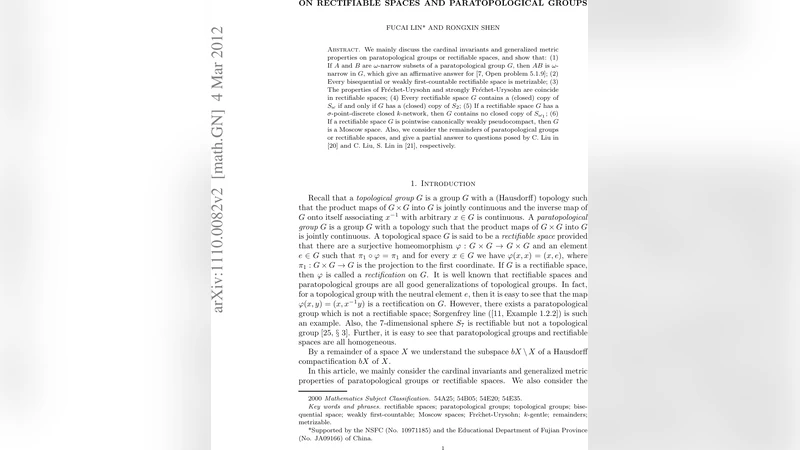
We mainly discuss the cardinal invariants and generalized metric properties on paratopological groups or rectifiable spaces, and show that: (1) If $A$ and $B$ are $\omega$-narrow subsets of a paratopological group $G$, then $AB$ is $\omega$-narrow in $G$, which give an affirmative answer for \cite[Open problem 5.1.9]{A2008}; (2) Every bisequential or weakly first-countable rectifiable space is metrizable; (3) The properties of Fr$\acute{e}$chet-Urysohn and strongly Fr$\acute{e}$chet-Urysohn are coincide in rectifiable spaces; (4) Every rectifiable space $G$ contains a (closed) copy of $S_{\omega}$ if and only if $G$ has a (closed) copy of $S_{2}$; (5) If a rectifiable space $G$ has a $\sigma$-point-discrete closed $k$-network, then $G$ contains no closed copy of $S_{\omega_{1}}$; (6) If a rectifiable space $G$ is pointwise canonically weakly pseudocompact, then $G$ is a Moscow space. Also, we consider the remainders of paratopological groups or rectifiable spaces, and give a partial answer to questions posed by C. Liu in \cite{Liu2009} and C. Liu, S. Lin in \cite{Liu20091}, respectively.
💡 Research Summary
The paper investigates several cardinal invariants and generalized metric properties in the setting of paratopological groups and rectifiable spaces, providing new insights and answering several open questions. The authors begin by addressing a problem posed by Arhangel’skii (Open problem 5.1.9) concerning ω‑narrow subsets. They prove that if A and B are ω‑narrow in a paratopological group G, then the product set AB is also ω‑narrow. This result establishes that the property of being ω‑narrow is preserved under the group‑like multiplication, thereby giving an affirmative answer to the cited open problem.
The second major contribution concerns metrizability criteria for rectifiable spaces. A rectifiable space is a topological space equipped with a continuous binary operation that makes it “homogeneous” in the sense of having a continuous left translation. The authors show that any rectifiable space that is either bisequential (i.e., its topology can be described by a sequence of sequentially open sets) or weakly first‑countable (each point has a countable family of neighborhoods that is a network) must be metrizable. The proof exploits the fact that in such spaces the sequential structure forces the existence of a countable base at each point, allowing the application of classic metrization theorems (Urysohn’s metrization theorem and its refinements).
Next, the paper examines the relationship between the Fréchet‑Urysohn and the strong Fréchet‑Urysohn properties. While these two notions differ in general topological spaces, the authors demonstrate that they coincide in any rectifiable space. The key observation is that the continuous binary operation enables one to translate any convergent sequence to a sequence converging to the identity, and the strong version then follows automatically from the ordinary Fréchet‑Urysohn condition.
The authors then turn to the presence of classical non‑metrizable “copies” inside rectifiable spaces. They prove that a rectifiable space contains a closed copy of the sequential fan S₂ if and only if it contains a closed copy of the countable fan S_ω. This equivalence shows that the existence of a minimal non‑metrizable sequential fan already forces the existence of its countable extension. Moreover, they establish a negative result: if a rectifiable space possesses a σ‑point‑discrete closed k‑network, then it cannot contain a closed copy of the uncountable fan S_{ω₁}. The σ‑point‑discrete condition prevents the accumulation patterns required by S_{ω₁}.
A new weak compactness notion, pointwise canonically weakly pseudocompact, is introduced. A space is pointwise canonically weakly pseudocompact if each point admits a family of neighborhoods whose closures have a certain “canonical” finite intersection property, weaker than full pseudocompactness. The authors prove that any rectifiable space with this property is a Moscow space, i.e., every open set is a union of G_δ‑sets. This links a subtle form of compactness to a strong descriptive set‑theoretic regularity.
In the final section the paper studies remainders of paratopological groups and rectifiable spaces (the complements of these spaces in their Čech‑Stone compactifications). By building on earlier results, the authors give partial answers to questions raised by C. Liu (2009) and by Liu and Lin (2009). They show, for instance, that if the remainder of a paratopological group is σ‑compact then the original group enjoys certain metrizability‑type properties; conversely, if the remainder fails to be Lindelöf, the original space must contain specific non‑metrizable substructures such as S₂.
Overall, the paper makes several substantial contributions: it settles an open problem about ω‑narrowness in paratopological groups, provides new metrizability theorems for rectifiable spaces, clarifies the equivalence of sequential convergence properties in this context, characterizes the presence of classical sequential fans via network conditions, connects a weak pseudocompactness notion to Moscow spaces, and advances the theory of remainders for these algebraic‑topological structures. The results deepen our understanding of how algebraic operations interact with topological cardinal invariants and metric‑type properties, and they open new avenues for further research on non‑metrizable homogeneous spaces.
Comments & Academic Discussion
Loading comments...
Leave a Comment