Fairness-Aware Scheduling in Multi-Numerology Based 5G New Radio
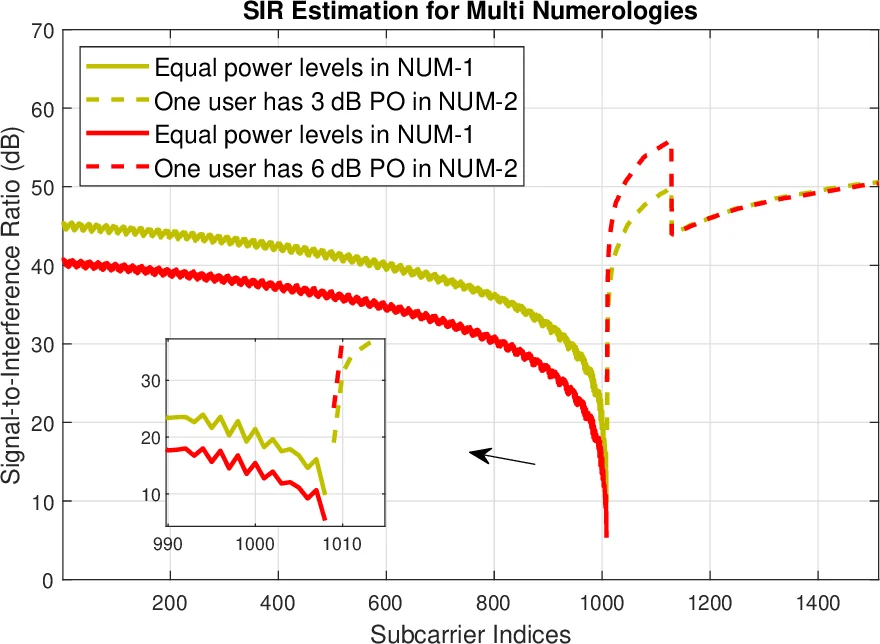
Multi-numerology waveform based 5G New Radio (NR) systems offer great flexibility for different requirements of users and services. Providing fairness between users is not an easy task due to inter-numerology interference (INI) between multiple numerologies. This paper proposes two novel scheduling algorithms to provide fairness for all users, especially at the edges of numerologies. Signal-to-noise ratio (SIR) results for multi-numerology systems are obtained through computer simulations.
💡 Research Summary
The paper addresses fairness issues that arise in 5G New Radio (NR) when multiple numerologies coexist in the same spectrum. Multi‑numerology waveforms allow different sub‑carrier spacings and cyclic prefix lengths to be used simultaneously, which is essential for supporting heterogeneous services such as eMBB, URLLC, and mMTC. However, the large side‑lobes of OFDM symbols cause inter‑numerology interference (INI), especially on the edge sub‑carriers of each numerology block. When users at the numerology edges transmit with different power levels, the resulting power offset dramatically degrades the signal‑to‑interference ratio (SIR) of those edge users, creating a fairness problem analogous to the near‑far issue in cellular networks.
The authors propose two low‑complexity scheduling algorithms that operate within a fixed guard‑band configuration, thereby preserving spectral efficiency while mitigating INI‑induced unfairness. The system model assumes two adjacent numerologies: NUM‑1 with Δf = 15 kHz and NUM‑2 with Δf = 30 kHz. Each numerology serves three users (UEs) that are synchronized and allocated contiguous bandwidth parts (BWPs). Power levels for each UE are denoted p₁,s and p₂,t for NUM‑1 and NUM‑2 respectively.
Algorithm 1 – Edge‑User Fairness Scheduling
All possible pairs (s, t) of edge users from the two numerologies are examined. The power offset PO(s, t) = |p₁,s − p₂,t| is computed for each pair, and the pair with the minimum offset (s*, t*) is selected (Eq. 2). This pair is placed at the numerology edges, minimizing the interference that each edge user experiences from the other numerology. The algorithm is applied independently to each adjacent numerology pair, making it scalable to more than two numerologies by repeated pairwise processing.
Algorithm 2 – Overall Fairness Scheduling
In addition to minimizing the offset, this algorithm also considers the absolute power levels. A threshold THₚ = r · PO(s*, t*) (r ≥ 1) is defined; all pairs whose offset is below THₚ become candidates in a set H. For each candidate, the average power (p₁,s + p₂,t)/2 is calculated, forming a vector PL. The pair with the smallest PL is finally chosen (Eq. 4) and placed at the edges. By adjusting r, the scheduler can trade off strict offset minimization for a broader set of candidate pairs, thereby improving the SIR distribution of inner users as well.
Simulation Setup
The authors conduct Monte‑Carlo simulations with 1,000 random realizations of power offsets ranging from 0 dB to 10 dB. No channel fading or noise is modeled; the focus is purely on INI. The IFFT/FFT size is 4096 for NUM‑1 and 2048 (4096/2) for NUM‑2, with a cyclic prefix ratio of 1/16. Guard bands are omitted to stress the interference problem. Edge users have 120 usable sub‑carriers each, while inner users have many more (up to 672 in some scenarios).
Four power‑offset cases are examined:
- All users equal power – baseline.
- One edge user in NUM‑2 increased by 3 dB.
- One inner user in NUM‑2 increased by 3 dB.
- Edge users in both numerologies increased symmetrically.
Results show that even modest power offsets cause SIR degradations of 2–6 dB for edge users, confirming the severity of the fairness issue. When the proposed algorithms are applied, the cumulative distribution function (CDF) of SIR for edge users shifts rightward, indicating reduced variance and higher median SIR. Algorithm 1 yields the greatest edge‑user fairness, while Algorithm 2 slightly sacrifices edge fairness to improve inner‑user SIR, demonstrating a controllable trade‑off.
Key Contributions
- Identification of power‑offset‑driven unfairness in multi‑numerology NR and its impact on edge users.
- Two practical scheduling schemes that require only O(D·E) operations (D and E are the numbers of users per numerology).
- Demonstration that fairness can be enhanced without enlarging guard bands, preserving spectral efficiency.
- Validation through extensive Monte‑Carlo simulations showing measurable SIR improvements for both edge and inner users.
Limitations and Future Work
The study focuses on two numerologies; extending the approach to three or more numerologies, possibly with overlapping bandwidths, remains open. Real‑world factors such as channel fading, mobility, and dynamic traffic loads are not considered. Integration with existing 3GPP scheduler frameworks and evaluation of computational latency in a live base‑station environment are suggested next steps.
In summary, the paper provides a clear, analytically simple, and simulation‑backed solution to a pressing fairness problem in 5G NR’s flexible numerology design, offering a pathway for standardization bodies and equipment manufacturers to improve user experience without sacrificing the spectral benefits of multi‑numerology operation.
Comments & Academic Discussion
Loading comments...
Leave a Comment