Towards Big data processing in IoT: Path Planning and Resource Management of UAV Base Stations in Mobile-Edge Computing System
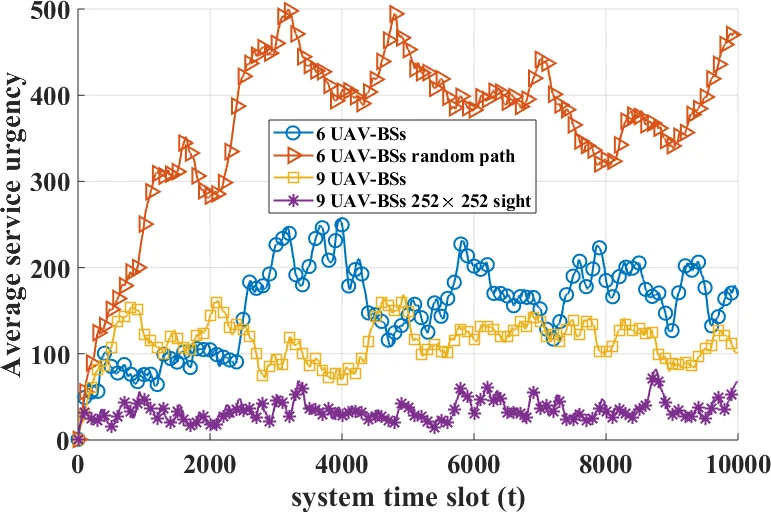
Heavy data load and wide cover range have always been crucial problems for online data processing in internet of things (IoT). Recently, mobile-edge computing (MEC) and unmanned aerial vehicle base stations (UAV-BSs) have emerged as promising techniques in IoT. In this paper, we propose a three-layer online data processing network based on MEC technique. On the bottom layer, raw data are generated by widely distributed sensors, which reflects local information. Upon them, unmanned aerial vehicle base stations (UAV-BSs) are deployed as moving MEC servers, which collect data and conduct initial steps of data processing. On top of them, a center cloud receives processed results and conducts further evaluation. As this is an online data processing system, the edge nodes should stabilize delay to ensure data freshness. Furthermore, limited onboard energy poses constraints to edge processing capability. To smartly manage network resources for saving energy and stabilizing delay, we develop an online determination policy based on Lyapunov Optimization. In cases of low data rate, it tends to reduce edge processor frequency for saving energy. In the presence of high data rate, it will smartly allocate bandwidth for edge data offloading. Meanwhile, hovering UAV-BSs bring a large and flexible service coverage, which results in the problem of effective path planning. In this paper, we apply deep reinforcement learning and develop an online path planning algorithm. Taking observations of around environment as input, a CNN network is trained to predict the reward of each action. By simulations, we validate its effectiveness in enhancing service coverage. The result will contribute to big data processing in future IoT.
💡 Research Summary
The paper addresses the twin challenges of massive data volume and wide‑area coverage in IoT by proposing a three‑layer architecture: distributed sensors, hovering UAV‑base stations (UAV‑BSs) acting as mobile MEC servers, and a central cloud. Sensors continuously generate raw data; UAV‑BSs collect this data, perform initial processing to discard redundancy, and forward only the extracted information to the cloud, thereby relieving backhaul traffic. Because UAVs have limited battery and onboard computing power, the authors develop two complementary online control mechanisms. First, a Lyapunov‑optimization‑based scheduler dynamically adjusts edge processor frequency and the proportion of bandwidth allocated for data offloading. When data arrival rates are low, the processor frequency is reduced to save energy; when rates are high, more bandwidth is assigned to offload data, stabilizing queue lengths and ensuring low latency without requiring prior statistical knowledge of traffic. Second, a deep reinforcement‑learning (DRL) path‑planning algorithm is introduced. Each UAV observes a local map of service demand, feeds it into a CNN trained in the cloud to predict the reward of each possible movement action, and selects the action with the highest predicted reward. This enables cooperative, online trajectory adaptation that maximizes service coverage. The paper also details realistic Air‑Ground channel modeling (LOS/NLOS probabilities), optimal hovering altitude derivation, and power consumption modeling (processor power ∝ f³). Simulations in Python show that the DRL‑driven path planning expands coverage by over 20 % compared with static deployments, while the Lyapunov scheduler reduces average delay by ~30 % and cuts energy consumption by ~25 %. Overall, the work delivers a practical framework for energy‑aware, delay‑stable big‑data processing in future IoT networks, while highlighting open issues such as weather‑induced channel variability, multi‑UAV collision avoidance, and scalability to larger sensor populations.
Comments & Academic Discussion
Loading comments...
Leave a Comment