Climate change impacts on large-scale electricity system design decisions for the 21st Century
Efforts to reduce climate change, but also falling prices and significant technology developments currently drive an increased weather-dependent electricity production from renewable electricity sources. In light of the changing climate, it is highly…
Authors: Smail Kozarcanin, Hailiang Liu, Gorm Bruun Andresen
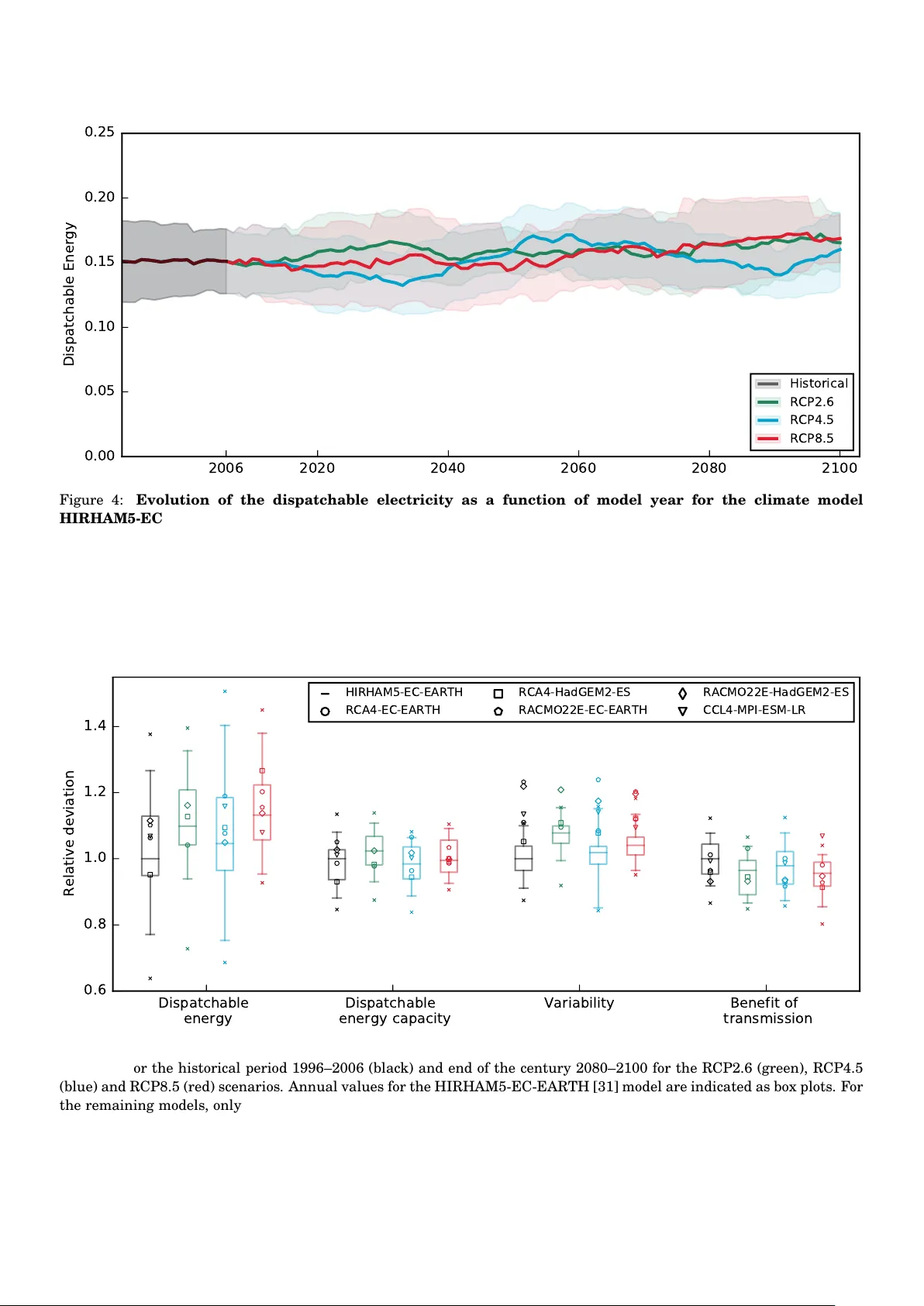
Climate change impacts on large-scale electricity system de- sign decisions for the 21st Century S . Kozarcanin 1 , H. Liu 1 and G . B . Andresen 1 1 Department of Engineering , Aarhus University , Denmark. 1 Abstract Efforts to reduce climate change, but also falling prices and significant technology de- velopments currently drive an increased weather-dependent electricity production from renewable electricity sources. In light of the changing climate, it is highly relevant to investigate the extent of weather changes that directly impacts the best system design decisions for these weather-dependent technologies. Here, we use three IPCC represen- tative CO 2 concentrations pathways for the period 2006–2100 with six high-resolution climate experiments for the European domain. Climate elements are used to calculate bias adjusted 3-hourly time series of wind and solar generation, and temperature cor- rected demand time series for 30 European countries using state-of-the-art methodology . W eather-driven electricity system analysis methodology is then applied to compare four key metrics of highly renewable electricity systems. W e find that climate change does not have a discernible impact on the key metrics of the combined electricity system dynamics, and conclude that the effect on important system design parameters can likely be ignored. 2 Significance statement Globally , electricity production from wind and solar sources are increasing significantly . The increase is primarily driven by lower costs , and by political efforts to limit climate change . Climate change, however , may significantly change the weather that drives these sources of renewable energy . W e find that the impact of climate change on a future highly renewable European electricity system is small compared to current differences from one weather year to another and compared to differences between designs , e.g ., with different levels of international power transmission lines or different mix of wind and solar generators . As a consequence , sound electricity system design decisions and academic studies based on historical weather data will not be strongly affected by climate change . 3 Introduction 1950 1980 2020 2060 2100 5 0 5 10 15 20 25 30 C O 2 - e m m i s s i o n , P g C / y r a) Historical RCP2.6 RCP4.5 RCP8.5 1950 1980 2020 2060 2100 10 11 12 13 14 15 16 T e m p e r a t u r e , o C b) Figure 1: RCP key metrics. P anel a: CO 2 emissions as a function of model year for the various projections of cli- mate outcomes. P anel b: A verage near surface temperature over Europe for the regional climate model HIRHAM5-EC- EARTH as a function of model year for identical pathways . Black, green, blue and red projections represent the histor- ical, RCP2.6, RCP4.5 and RCP8.5 pathwa ys. The global climate is currently undergoing vast changes, primarily due to anthropogenic emissions of heat-trapping gases into the atmo- sphere [1]. As a consequence, the global average surface temperature has increased since the pre-industrial ages by approximately 0.2 °C per decade. A similar rate of temperature increase is projected to occur during the first half of the 21st century [2], and at present, the changing climate is showing global impacts on natural and human systems . In this work, we focus on the impacts of a changing climate on the dynamics of a future, highly renewable , large-scale electricity system for Europe. Research on the impacts of climate change on large scale electricity systems is in its infancy and few studies have been performed in this field [3]. F or an aggregated European energy system, P . Downling [4] finds outweighing demand side impacts to the supply side on the basis of the POLES energy model. Due to global heating, the cooling demand increases while the heating demand decreases [4]. More specifically , a study conducted by Pilli-Sihvola et al. [5] shows a decreasing need for heating in Central and Northern Europe based on the SRES A2, A1B and B1 emission scenarios. Southern Europe experiences a large increase in cooling demand that in turn overcomes the decrease in heating demand [5]. This finding is in correspondence with a study on combined Germany and Austria for the last quarter of the 21st century [6]. The spatial distribution of the heating and cooling needs are further reflected in increasing needs for electricity in Southern Europe and decreasing needs in Northern Europe [7]. Individual country studies on Norwa y [8], Finland [9], Slovenia [10], Austria [11] and Switzerland [12] agree upon the latter findings. Spinoni et al. [13] shows that if population weighting is applied to the temperature profiles , the degree-day trends do not show remarkable differences during the 21st century for the RCP4.5 and RCP8.5 emission scenarios . By using the SRES A1B emission scenario, T obin et al. [14] and Barstad et al. [15] find negligible changes in the wind power potential over the Baltic Sea and the surroundings . Similar results are found by T obin et al. [16] for Europe by using the RCP4.5 and RCP8.5 emissions scenarios . McColl et al. [17] arrive at similar conclusions for the UK, Seljom et al. [8] for a study-case on Norway based on 10 climate experiments and Koch et al. [18] for Germany by using the RCP2.6 and RCP8.5 emission scenarios for the period 2031–2060. Moreover , Schlott et al. [19] discover increasing wind correlation lengths along with increasing wind power generation in the same regions of Europe by using the RCP8.5 emission scenario. T obin et al. [14] and Bloom et al. [20] project a decreasing wind power potential over the Mediterranean area by using the SRES A1B and A2 emission scenarios. Similar findings along with decreasing correlation lengths are 4 shown by Schlott et al. [19]. F or an aggregated EU27, Dowling [4] found a slight increase in the wind power production until mid-century based on the SRES A1B and E1 emission scenarios . F or a wind dominated European energy system under the impact of the RCP8.5 emission scenario, increasing needs for conventional power and stor - age are found in most of the central, north and north-west areas [21] with a more homogeneous wind power generation [22] at the end of the 21. century . Jerez et al. [23] project a decreasing solar power generation in the Scandinavian area and slight increases over Southern Europe by using the RCP4.5 and RCP8.5 emission scenarios. This is in correspondence with increased means of solar irradiation along with increased solar correlation length in large parts of Southern Europe [19]. The opposite behaviour is observed for the Northern parts of Europe [19]. F or an aggregated EU27, an increasing amount of solar PV generation is found [4]. Based on 44 electricity scenarios for Europe, Berrill et al. [24] find that large penetrations of wind and solar power emit the least C O 2 within the ensemble of scenarios and as a consequence contribute the most to climate change mitigations . W e add to the literature by investigating the key infrastructure metrics of a fully connected, highly renewable European electricity system by using the latest generation of climate projections provided by the Intergovernal P anel on Climate Change, IPCC [25]. The climate data used in this study originates from six combinations of four RCMs (Regional Climate Models), downscaling three CMIP (Coupled Model Inter -comparison Project) Phase 5 [26] GCMs (Global Climate Mod- els) under the IPCC representative concentration pathwa y scenarios, RCPs, see supplementary material. In order to represent a broad range of climate outcomes , three scenarios, RCP2.6 [27], RCP4.5 [28] and RCP8.5 [29], have been implemented into the global climate models . The climate scenarios are heavily influenced by the policy of the 2015 P aris agreement, high C O 2 emission cost policies , and no climate policies , respectively . In particular , if the goals of the P aris agreement are to become real, there is an urgent need for short and long-term action in reducing the C O 2 emissions , as explained in detail in the Emission Gap Report 2017 [30]. The underlying assumptions of the pathw ays result in C O 2 emis- sions as shown in Figure 1a. RCP2.6 and RCP4.5 project a decrease in the C O 2 emissions during the 21st century , while RCP8.5 projects an in- crease which stagnates at the end of the century . These projections are reflected in the European average temperature for , e.g ., the regional climate model HIRHAM5 [31], downscaling the global climate model ICHEC-EC-EARTH [32], from now on denoted as HIRHAM5-EC-EARTH, shown in Figure 1b. Based on the emission scenarios, 3-hourly data on climate elements with a 0 . 11° spatial resolution has been fostered on behalf of the EURO-CORDEX project [33, 34]. Figures 2 b, c and d exemplify the 2080–2100 average near -surface temperature over Europe for the future emissions scenarios based on the climate model HIRHAM5-EC-EARTH. P anel a represents the absolute temperature of the historical period 1986–2006. The most extreme temperature increases reach values of more than 6 °C. In the present study , the main source of error orig- inates from the performance of the GCMs that provides the boundary conditions for the RCMs used to calculate the time series of wind and so- lar power generation as well as electricity demand time series from which the final results are de- rived. V arious studies have engaged in tracking the evolution of CMIP5 GCMs and their prede- cessor CMIP3 GCMs by comparison to observed data, satellite data or reanalysis. In the following, we summarize the quality of the climate elements that are most important for the present study . Iqbal et al. [35] investigates the North Atlantic eddy-driven jet stream in 11 CMIP5 GCMs by evaluating the jet latitudes and wind speeds in a historical run from 1980-2004. Compared to reanalysis , typical biases between 1 ° and 2 ° are observed in the latitude mean seasonal cycle anomaly for a majority of the GCMs. The corresponding seasonal amplitude variations reach up to ± 10 ° for a few GCMs, which is an over or underestimation of about 5 ° compared 5 Figure 2: 20-year average values of the near surface temperature. The 2 m surface temperature is based on the latest generation of IPCC’s climate projections, RCP’s , for the climate model HIRHAM5-EC-EARTH. P anel a shows the average absolute temperature for the historical period along with a unique colorbar . Panels b ,c and d show the temperature increase relative to the historical period and share one colorbar . to reanalysis. But compared to identical CMIP3 GCMs , it is an improvement [36]. In addition, Iqbal et al. [35] shows a slight polew ard shift in the jet stream under the IPCC RCP4.5 and RCP8.5 induced global warming during the end of the century . This is further confirmed for 26 CMIP5 GCMs under the IPCC RCP8.5 emission scenario, which shows a poleward jet shift of ap- proximately 2 ° in the Southern Hemisphere and 1 ° in the North Atlantic and North P acific [37]. In all GCMs, the mean seasonal anomaly bias for the jet stream wind speeds is overestimated for the winter months while the opposite is the case for summer months. A majority of the GCMs are overestimating the corresponding amplitudes [35]. The jet wind speed biases are smaller in the CMIP3 GCMs compared to the CMIP5 GCMs [36]. The GCM cloud simulations, which most directly affect the solar energy yield calculated in our study , remain the major source of inaccuracy in climate predictions. Lauer et al. [38] evaluates the total amount of cloud cover , amongst other cli- mate elements , in 27 CMIP5 GCMs by comparing to satellite data covering the years 1986-2007. It is shown that the linear correlation coefficient of the GCM wise 20 year annual a verage of the total cloud amount ranges from 0.11 to 0.83 with a root mean square error of 10% to 23%. F or CMIP5 experiments , the IPCCs Fifth Assessment Report AR5 [39] presents a difference of 2 % to 3 % in regional changes of cloud fractions for the years 2081–2100 under the RCP4.5 emission scenario. F or the RCP8.5 emissions scenario, a difference of 5 % to 6 % is presented. The global radiation budget biases that are most strongly influenced by clouds are the incomming radiative shortwa ve flux at the surface along with the outgoing flux at top of the atmosphere and the reflected flux. F or a number of CMIP5 GCMs , Li et al. [40] finds regional biases ranging from − 25 Wm − 1 to more than 30 Wm − 1 for the incomming flux compared to EBAF-Surface flux radiation product for a time period 2000-2010. The multimodel global area average bias is reduced by 30% compared to CMIP3 GCMs. Sim- ilar findings are evident for the regional outgoing flux as well as reflected flux with an improvement of the multimodel global area average bias with a factor of 2 compared to CMIP3 GCM. With these consideration in mind, it is evident that CMIP5 GCMs have improved since phase 3, although room for further improvement remains . In this work we are compensating for static biases in the solar energy yield as explained in the methods section. In the present study , surface air temperatures are used to adjust the electrical demand for changes in heating and cooling needs. The GCM ability to accurately replicate this field is receiving increasing attention. A recent study by Catti- aux et al. [41] on the European domain shows 6 negatively biased winter temperatures in the North compared to ground observations [42]. P os- itively biased summer temperatures are observed in the East and Central Europe for 33 CMIP5 GCMs . F or the total European domain, the GCM ensemble mean bias is approximately − 1 °C ± 8 °C during winter months. The corresponding values for summer months are 0 . 5 °C ± 6 °C. Similar trends are found for the Northern Eurasia where the winter and summer periods show the largest biases [43]. Small improvements have been made since CMIP3 GCMs [44]. The GCM errors are taken into account by evaluating this study for a set of three different models . In the results section we compare the main results for the ensemble of GCMs . Rela- tively small deviations are observed which leads to the conclusion that the current GCMs are highly suitable for this study . Methods This section describes the method of the elec- tricity system modelling, data conversion and validation, and the electricity system key metrics. F or a detailed descriptions of these quantities one is referred to the supplementary information (SI) 2.1, 2.2 and 2.3 W eather-driven electricity system modelling was introduced for the first time by Heide et al. [45]. It is a type of top-down analysis that is particularly useful for isolating and under - standing the impact of weather dynamics on an electricity system with a large penetration of variable sources, e.g , wind and solar . But unlike most technology-rich bottom-up models, it is not well-suited for determining , e.g ., the fuel mix of conventional dispatchable production units. In this paper , we implement a simplified large-scale European electricity system, of which the supply side consists solely of wind and solar power gen- eration as well as a generic dispatchable power source, e.g ., dammed hydro power or gas turbines. The demand side consists of national electricity demand. This type of electricity system aggre- gates the country-wise wind and solar power generation profiles into system-wise profiles. The same applies for the electricity consumption profiles . The effect of power transmission in this system was introduced by Rodriguez et al. [46, 47]. The effect of climate change enters the modelling via the weather -dependent wind and solar gen- eration time series as well as the temperature dependent part of the electricity demand. State- of-art methodology has been used to convert raw wind and solar climate data into 3-hourly country-wise wind and solar capacity factor time series. These have been validated for the historical period 1986–2006 against already bias adjusted capacity factors provided by Renew- ables .ninja [48, 49] by minimizing the relative entropy (see SI 3.1 and 3.2). Hourly country-wise electricity consumption profiles ha ve been pro- vided by the European Network of Transmission System Operators for Electricity , ENTSO-e [50]. These have been corrected for effects of heating and cooling by using the degree day method (see SI 4). Additional detailed descriptions of these methods are found in the supplementary material. In the work presented here, wind and solar generator capacities have been scaled such that the EU-wide average generation over the his- torical period matches the average demand for electricity . This choice has previously been shown to describe the dynamics of a highly renew able electricity system well [45]. Due to the state of fluctuating weather events and electricity consumption behaviour , the generation and load profiles differ in most time steps. This difference is referred to as the generation-load mismatch, which is defined formally in the methods section. F or high renewable penetrations, the generation- load mismatc h means that surplus of the variable renewable electricity , VRE, will sometimes be available . This surplus may either be transported to other locations, used by new flexible consump- tion, stored for later use or simply curtailed. At other times , VRE generation is lacking and an ancillary system must balance the difference be- 7 tween supply and demand, e.g ., by a combination of conventional power plants, dispatchable re- newable electricity such as dammed hydropower , and electricity storage systems . V ariations in instantaneous generation-load mismatch across the continent drive the transmission of renew able surplus to regions with a deficit. Furthermore , the maximum negative values of the mismatch describe the need for dispatchable power capacity , and variations in the mismatch describe the need for on-demand flexible reserves . Key Metrics . The above considerations give rise to four key metrics that describe a highly renewable electricity system. These are all de- scribed formally in the methods section. The first key metric is the average dispatchable electricity delivered by the dispatc hable power generators for a fixed wind and solar penetration. It is a good indicator of the utility value of the VRES , i.e. the amount of VRE that can directly cover the demand. This metric was first introduced by Heide et al. [51]. Generally , the useful electricity can be increased by means of geographical dispersion, e.g ., by com- bining national systems to smooth out variations in both demand [52] and renewable generation [53]. W e measure this effect with the second metric which is defined as the absolute difference between balancing electricity required with and without unlimited transmission in a European power grid. W e call the metric, the absolute benefit of transmission in contrast to the relative benefit of transmission used by Becker et al. [54]. In this paper we do not detail the required transmission capacities , but note that many other studies find that it is cost efficient to build enough to harvest most of this benefit [54, 55]. The two first measures are concerned with the need for dispatchable electricity , which is closely related to , e .g ., CO2 emissions. The third and fourth key metrics indicate what is required to stabilize an electricity system based on VRES and maintain security of supply . The third metric is measured by the maximum dispatc hable capacity required during low VRE and high demand 0.00 0.10 0.20 0.30 0.40 0.50 0.60 Dispatchable Energy a) Historical RCP2.6 RCP4.5 RCP8.5 0.00 0.02 0.04 0.06 0.08 0.10 0.12 0.14 Benefit of transmission b) 0.00 0.20 0.40 0.60 0.80 1.00 1.20 1.40 Dispatchable capacity c) 0.0 0.2 0.4 0.6 0.8 1.0 Wind-solar mix 0.00 1.00 2.00 3.00 4.00 5.00 Short-term variability d) Figure 3: Key metrics as a function of the wind-solar mix for the historical and end-of-century periods. The historical period covers 1996–2006 (black) and end of the century period covers 2080–2100 for the RCP2.6 (green), RCP4.5 (blue) and RCP8.5 (red) pathways . A wind-solar mix equal to zero represents a solar only electricity system and wind-solar mix of 1 represents a wind only electricity sys- tem. The averages of the annual values are indicated with fully drawn lines , and the corresponding ranges (one sigma) are shown with dashed lines . All key metrics are unitless as described in the methods section. 8 periods . A number of studies show that VRES only provides very limited firm capacity as in Rodriguez et. al. [46]. However , this is not a good key metric as it does not capture the correlation between VRES and demand. The fourth and final key metric is the 3-hourly short-term variability of the balancing time series. This measure was shown to be a good proxy for the need for on-demand reserve capacity [56]. The variabil- ity is largely caused by meso-scale turbulence patterns that have been shown to describe the spatio-temporal characteristics of wind and solar power generation well [57]. W e note that the effect of many types of extreme weather conditions are implicitly captured by the key metrics that are calculated from the 3-hourly generation-load mismatch. F or instance, an ex- tended period of very hot weather in the RCP8.5 scenario would increase the use of dispatchable electricity and capacity as electricity demand for cooling would increase and the performance of solar panels would decrease compared to the historical scenario. Likewise, strong storms would cause wind turbines in areas with wind speeds exceeding, typically , 25 m/s to cut out abruptly , causing an increased short-term vari- ability as well as increased needs for dispatc hable electricity and capacity . Results Initially , we present results only based only on the climate model HIRHAM5-EC-EARTH. T ow ards the end, we present the robustness of the results by comparing similar findings from all six climate models. W e stress, however , that in the analysis, all six climate models have been treated identically . Overall, the different climate scenarios show a minor impact on the key metrics of a highly renewable European electricity system. This is illustrated in Figure 3, where the key metrics are shown as a function of the wind-solar mix for the end of the century period 2080–2100, where all RCPs are most developed. W e observe that the difference between average values for different climate scenarios is smaller than the correspond- ing annual variation (one sigma) in nearly all cases . In other words , annual variations within a given climate change scenario are larger than the difference between scenarios. A paired t-test reveals that, in most cases, the distributions of annual scores cannot be assumed to come from different underlying distributions, indicating that the null-hypothesis that climate change has no impact on the key metrics cannot be rejected (95% confidence). T o some extend this finding is related to the choice of generator capacities relative to demand because a decrease in demand is balanced by an independent decrease in con- sumption. This is evident from T able 1, where it can be seen that both annual demand and wind and solar generation are decreasing slightly in the future scenarios . At a 95% significant level, the annual demand and annual solar capacity factors can both be considered different for the different climate change scenarios. The wind capacity factors, on the other hand, cannot be considered different. All test scores are listed in the supporting material. The difference between the climate change sce- narios can also be compared to the difference between systems with different wind-solar mix within a scenario. This comparison reveals to what extend it is more important to choose the right wind-solar mix independently of RCPs, or if it is most important to design the electricity system for the right RCP . F or the dispatchable electricity key metric shown in Figure 3a, we find the largest difference between climate sce- narios for a wind-solar mix of 1.0. The RCP8.5 scenario has an average value of 0.165 while the corresponding number for the historical period is 0.137. However , within each of the two scenarios , the difference between a wind dominated and a solar dominated mix is significantly larger . This means that in a planning context it is more important to consider the wind-solar mix than the degree of climate change . Similar arguments can be made for the other key metrics, i.e. the benefit of transmission, the dispatchable capacity and the short-term variability . 9 Historical RCP2.6 RCP4.5 RCP8.5 〈 W 〉 20 y r 1 . 00 ± 2 . 56 · 10 − 2 0 . 98 ± 2 . 39 · 10 − 2 0 . 99 ± 3 . 65 · 10 − 2 0 . 96 ± 2 . 62 · 10 − 2 〈 S 〉 20 y r 1 . 00 ± 1 . 36 · 10 − 2 0 . 99 ± 2 . 14 · 10 − 2 0 . 98 ± 1 . 85 · 10 − 2 0 . 97 ± 3 . 00 · 10 − 2 〈 L 〉 20 y r 1 . 00 ± 4 . 59 · 10 − 3 1 . 00 ± 3 . 40 · 10 − 3 0 . 99 ± 4 . 68 · 10 − 3 0 . 98 ± 2 . 70 · 10 − 3 T able 1: 20–year average values of the normalized wind and solar power along with the normalized consump- tion. A solar -dominated electricity system requires dispatchable electricity that is slightly higher than half of the electric consumption. This is explained by the day/night pattern in which little dispatchable electricity is needed during day time and full dispatchable electricity needs are required for the night time. On the other hand, the production of wind power during both day and night time reduces the need for dispatchable electricity to less than 20% of the annual demand. These findings are in correspondence with earlier work [51]. The benefit of transmission is highly dependent on the spatial correlation lengths of the wind speeds and solar irradiance [58]. The high correlation lengths of the solar irradiance due to the systematic variability of the sun’s position in the sky give rise to low transmission benefits . Due to the production of PV power over large areas, minor needs for transmission are present. On the other hand, the smaller wind speed correlation length of approximately 600 − 1000 km, leads to areas with high wind elec- tricity production and areas with low wind power production. Under these circumstances, the need for transmission increases. The short-term variability for solar domination shows higher values in contrast to wind domination. This behaviour is due to stronger intra-day temporal variations in the solar irradiance compared to temporal variations in the wind speeds . It is further reflected in the dispatchable capacity . A number of studies focus on the end of the century period alone. However , we also explore the evolution of the key metrics towards the end of the century . In the following we focus on the dispatchable electricity for a wind-solar mix of 0.8, shown in Figure 4. Similar results can be found for the other key metrics in the supporting material. F or this case, we do not find a gradual transition from the historical reference period towards the end of the century . Instead, the trajectories of the RCPs change over time such that, e .g., the 20-year average values of each RCP cross the other trajectories multiple times . This means that the general conclusions about the relative importance of climate change on the electricity system, drawn above for the end of the century period, also hold for the transition, and it is not possible to regard specific numerical differences between RCPs as the product of a gradual evolution towards a stable climatic end-point. Rather the 20–year averages are not stable to an extent where they can be regarded as different between RCPs. A longer time window could be used instead. However , since the climate is changing during the course of the century , see Figure 1, long periods do not represent a stable climatic situation. Above, we have discussed results based on the HIRHAM5-EC-EARTH climate model. Now we turn to the five other combinations of regional and global climate models included in the study in order to establish to what extent the results are in agreement across the models. In general, we do not find identical numerical results for all models despite the fact that all time series have been bias adjusted on the same historical period against the same reference. However , the overall findings remain, independently of the models. Figure 5 shows a comparison of the four electric- ity system key metrics for the different models in the historical period as well as in the end of the century period for the RCPs. In most cases, the 20-year average values fall between the first and the third quartile of the annual variation, which means that the difference between individual RCMs is smaller than the annual difference 10 2006 2020 2040 2060 2080 2100 0.00 0.05 0.10 0.15 0.20 0.25 Dispatchable Energy Historical RCP2.6 RCP4.5 RCP8.5 Figure 4: Evolution of the dispatchable electricity as a function of model year for the climate model HIRHAM5-EC-EARTH. The historical period covers 1996–2006 (black) and the future scenarios RCP2.6 (green), RCP4.5 (blue) and RCP8.5 (red) covers the years 2006–2100. The 20 year averages of the annual values are indicated with fully drawn lines , and the corresponding ranges of the one sigma standard deviation are shown with shaded areas. All key metrics are unitless as described in the methods section. Dispatchable energy Dispatchable energy capacity Variability Benefit of transmission 0.6 0.8 1.0 1.2 1.4 Relative deviation HIRHAM5-EC-EARTH RCA4-EC-EARTH RCA4-HadGEM2-ES RACMO22E-EC-EARTH RACMO22E-HadGEM2-ES CCL4-MPI-ESM-LR Figure 5: Key metrics for six regional climate models from the EURO-CORDEX project [33, 34]. These are compared for the historical period 1996–2006 (black) and end of the century 2080–2100 for the RCP2.6 (green), RCP4.5 (blue) and RCP8.5 (red) scenarios . Annual values for the HIRHAM5-EC-EARTH [31] model are indicated as box plots. F or the remaining models, only the median values of the annual means are shown. All key metrics are unitless as described in the methods section. 11 within a given RCM. F or the variability , this is not the case. The main reason for this is that the wind and solar time series are bias adjusted such that the distribution of instantaneous values matches the reference . However , the variability depends on the correlation between consecutive hours . This difference is not directly subject to correction, which means that models are likely to behave more differently on this parameter . Conclusion The different climate c hange scenarios show a minor impact on the key metrics of a highly renewable European electricity system. On the supply side, both wind and solar power generation are affected in a way that generally reduces performance slightly as their average electricity output decreases and their variability increases with an increasing effect of climate change . However , temperature changes affect the demand for electricity stronger . In most cases, this has an opposing effect as winter demands, primarily in Northern Europe , are reduced due to the increased temperatures. As an example, increasing dispatchable electricity needs in the pathwa y with the most extreme climatic changes , RCP8.5, due to lower yields from VRES turn into decreasing needs due to lower electricity demands , and could most certainly be either reduced or increased further by impacts from sources not related to climatic conditions such as electricity efficiency measures , population change or increased electrification of , e.g ., heating and transportation sectors [59]. The findings above are in agreement with a study on Southern Africa which also shows negligible effects of climate change on the wind and solar industry [60]. In designing a future highly renewable electricity system that is robust against climate change , it is important to focus on reaching a mixture of wind and solar power generation that minimizes the need for dispatchable electricity as the climate, during the next century , does not bring prominent changes to the electricity system infrastructure key metrics . An important consequence of these findings is that for most purposes, it is not required to take into account the effect of climate change on the VRES wind and solar when designing future highly renewable electricity systems . It is advisable, however , to consider changes in the electricity demand due to climatic changes as these may indirectly affect the best generator mix, e .g., by decreasing the winter demand and increasing the summer demand. Should a stronger sector coupling, in particular between the heating, cooling and electricity sectors, be- come a reality , these climatic effects would be increased. Acknowledgement The authors wish to express their gratitude to O. B . Christensen and F . Boberg from the Danish Meteorological Institute for their contribution to understanding the climate outcomes and for sup- plying out data from the regional climate model HIRHAM5. G . Nikulin from the Swedish Mete- orological and Hydrological Institute is thanked for supplying out data from the regional climate model RCA4. E. van Meijgaard from the Royal Netherlands Meteorological Institute is thanked for supplying out data from the regional climate model RACMO22E. P . Lenzen from the German Climate Computing Center is thanked for sup- plying out data from the regional climate model CCLM4. Professor M. Greiner is thanked for fruitful discussions. A sincere thank to Mette Stig Hansen for her diligent proof reading of this paper . Thanks to Heidi Søndergaard for giving graphical inputs to the figures. Finally , thanks to the Aarhus University Research F oundation (A UFF) for providing financial support. Correspondence Correspondence and requests for materi- als should be addressed to G. B. Andresen (email: gba@eng.au.dk) or S . K ozarcanin (email: sko@eng .au.dk) 12 References 1 Gunnar Myhre, Drew Shindell, François- Marie Bréon, William Collins , J an Fu- glestvedt, Jianping Huang , Dorothy Koch, J ean-Francois Lamarque, David Lee, Blanca Mendoza, et al. Anthropogenic and natural ra- diative forcing. Climate c hange , 423:658–740, 2013. 2 James Hansen, Makiko Sato, Reto Ruedy , Ken Lo, David W Lea, and Martin Medina-Elizade. Global temperature change. Proceedings of the National Academy of Sciences , 103(39):14288– 14293, 2006. 3 Juan-Carlos Ciscar and P aul Dowling. In- tegrated assessment of climate impacts and adaptation in the Energy sector . Energy Eco- nomics , 46:531–538, 2014. 4 P aul Dowling . The impact of climate change on the European energy system. Energy P ol- icy , 60:406–417, 2013. 5 Karoliina Pilli-Sihvola, Piia Aatola, Markku Ollikainen, and Heikki Tuomenvirta. Climate change and electricity consumption – Witness- ing increasing or decreasing use and costs? Energy P olicy , 38(5):2409–2419, 2010. 6 G T otsc hnig, R Hirner , A Müller , L Kranzl, M Hummel, H-P Nachtnebel, P Stanzel, I Schicker , and H F ormayer . Climate change impact and resilience in the electricity sector: The example of Austria and Germany . Energy P olicy , 103:238–248, 2017. 7 Leonie W enz, Anders Levermann, and Max- imilian Auffhammer . North–south polariza- tion of European electricity consumption un- der future warming . Proceedings of the Na- tional Academy of Sciences , page 201704339, 2017. 8 P ernille Seljom, Eva Rosenberg, Audun Fidje , J an Erik Haugen, Michaela Meir , John Rek- stad, and Thore Jarlset. Modelling the ef- fects of climate change on the energy system – a case study of Norwa y . Energy P olicy , 39(11):7310–7321, 2011. 9 Kirsti Jylhä, J uha Jokisalo , Kimmo Ru- osteenoja, Karoliina Pilli-Sihvola, T argo Kalamees , T eija Seitola, Hanna M Mäkelä, Reijo Hyvönen, Mikko Laapas, and Achim Drebs . Energy demand for the heating and cooling of residential houses in Finland in a changing climate. Energy and Buildings , 99:104–116, 2015. 10 Mojca Dolinar , Boris V idrih, Lu ˇ cka Kajfež- Bogataj, and Sašo Medved. Predicted changes in energy demands for heating and cooling due to climate change. Physics and Chemistry of the Earth, P arts A/B/C , 35(1):100–106, 2010. 11 T ania Berger , Christoph Amann, Herbert F or- mayer , Azra K orjenic, Bernhard Pospisc hal, Christoph Neururer , and Roman Smutny . Im- pacts of climate change upon cooling and heat- ing energy demand of office buildings in Vi- enna, Austria. Energy and buildings , 80:517– 530, 2014. 12 M Christenson, H Manz, and D Gyalistras. Climate warming impact on degree-days and building energy demand in Switzerland. En- ergy Conversion and Management , 47(6):671– 686, 2006. 13 Jonathan Spinoni, Jürgen V V ogt, P aulo Bar- bosa, Alessandro Dosio, Niall McCormick, Andrea Bigano, and Hans-Martin Füssel. Changes of heating and cooling degree-da ys in Europe from 1981 to 2100. International J our - nal of Climatology . 14 Isabelle T obin, Robert V autard, Irena Ba- log , François-Marie Bréon, Sonia J erez, P aolo Michele Ruti, Françoise Thais, Math- ieu Vrac, and P ascal Yiou. Assessing cli- mate change impacts on European wind en- ergy from ENSEMBLES high-resolution cli- mate projections . Climatic Change , 128(1- 2):99–112, 2015. 15 Idar Barstad, Asgeir Sorteberg, and Michel dos-Santos Mesquita. Present and future off- shore wind power potential in northern Eu- rope based on downscaled global climate runs with adjusted SST and sea ice cover. Renew- able Energy , 44:398–405, 2012. 13 16 Isabelle T obin, Sonia J erez, Robert V autard, Françoise Thais, Erik V an Meijgaard, An- dreas Prein, Michel Déqué, Sven K otlarski, Cathrine F ox Maule, Grigory Nikulin, et al. Climate change impacts on the power genera- tion potential of a European mid-century wind farms scenario. Environmental Research Let- ters , 11(3):034013, 2016. 17 Lynsey McColl, Erika J P alin, Hazel E Thorn- ton, David MH Sexton, Richard Betts , and Ken Mylne . Assessing the potential impact of climate change on the UKâ ˘ A ´ Zs electricity network. Climatic Change , 115(3-4):821–835, 2012. 18 Hagen Koch, Stefan Vögele, Fred F Hatter - mann, and Shaochun Huang . The impact of climate change and variability on the gen- eration of electrical power. Meteorologisc he Zeitschrift , 24:173–188, 2015. 19 Markus Schlott, Kies Alexander , T om Brown, David Schlachtberger , J onas HÃ ˝ ursch, Stefan Schramm, and Martin Greiner . Impact of cli- mate change on a future highly renewable eu- ropean power system. 16th Wind Integration W or kshop (Berlin / Germany). , 2017. 20 A Bloom, V K otroni, and K Lagouvardos. Cli- mate change impact of wind energy availabil- ity in the Eastern Mediterranean using the re- gional climate model PRECIS . Natural Haz- ards and Earth System Sciences , 8(6):1249– 1257, 2008. 21 Juliane W eber , Jan W ohland, Mark Reyers, J ulia Moemken, Charlotte Hoppe, J oaquim G Pinto, and Dirk Witthaut. Impact of climate change on backup energy and storage needs in wind-dominated power systems in Europe. arXiv preprint arXiv:1711.05569 , 2017. 22 Jan W ohland, Mark Reyers, Juliane W eber , and Dirk Witthaut. More homogeneous wind conditions under strong climate change de- crease the potential for inter -state balancing of electricity in Europe. Earth System Dynam- ics , 8(4):1047, 2017. 23 Sonia Jerez, Isabelle T obin, Robert V autard, J uan P edro Montávez, J ose María López- Romero, Françoise Thais, Blanka Bartok, Ole Bøssing Christensen, Augustin Colette, Michel Déqué, et al. The impact of climate change on photovoltaic power generation in Europe. Nature communications , 6:10014, 2015. 24 P eter Berrill, Anders Arvesen, Yvonne Scholz, Hans Christian Gils , and Edgar G Hertwich. Environmental impacts of high penetration renewable energy scenarios for Europe. En- vironmental Research Letters , 11(1):014012, 2016. 25 Richard H Moss , Jae A Edmonds, Kathy A Hibbard, Martin R Manning, Steven K Rose, Detlef P V an V uuren, Timothy R Carter , Seita Emori, Mikiko Kainuma, T om Kram, et al. The next generation of scenarios for climate change research and assessment. Nature , 463(7282):747, 2010. 26 Karl E T aylor , Ronald J Stouffer , and Gerald A Meehl. An overview of cmip5 and the experi- ment design. Bulletin of the American Meteo- rological Society , 93(4):485–498, 2012. 27 Detlef P V uuren, Elke Stehfest, Michel GJ Elzen, T om Kram, J asper Vliet, Sebastiaan Deetman, Morna Isaac, Kees Klein Goldewijk, Andries Hof , Angelica Mendoza Beltran, et al. RCP2. 6: exploring the possibility to keep global mean temperature increase below 2 C. Climatic Change , 109(1-2):95–116, 2011. 28 Allison M Thomson, Katherine V Calvin, Steven J Smith, G P age K yle, April V olke, Pralit P atel, Sabrina Delgado-Arias, Ben Bond-Lamberty , Marshall A Wise, Leon E Clarke, et al. RCP4. 5: a pathway for stabi- lization of radiative forcing by 2100. Climatic change , 109(1-2):77, 2011. 29 Keywan Riahi, Shilpa Rao, V olker Krey , Che- olhung Cho, V adim Chirkov , Guenther Fis- cher , Georg Kindermann, Nebojsa Nakicen- ovic, and P eter Rafaj. RCP 8.5â ˘ A ˇ TA scenario of comparatively high greenhouse gas emis- sions . Climatic Change , 109(1-2):33, 2011. 14 30 UNEP . The Emissions Gap Report 2017. 2017. 31 Ole Bøssing Christensen, Martin Drews, J ens Hesselbjerg Christensen, Klaus Dethloff , Klaus K etelsen, Ines Hebestadt, and Anette Rinke. The HIRHAM Regional Climate Model. V ersion 5 (beta). 2007. 32 W Hazeleger , X W ang, C Severijns, S ¸ Ste- f ˘ anescu, R Bintanja, A Sterl, Klaus W yser , T Semmler , S Y ang , B V an den Hurk, et al. EC-Earth V2.2: description and validation of a new seamless earth system prediction model. Climate dynamics , 39(11):2611–2629, 2012. 33 Sven Kotlarski, Klaus Keuler , Ole Bossing Christensen, Augustin Colette, Michel Déqué, Andreas Gobiet, Klaus Goergen, Daniela J acob, Daniel Lüthi, Erik van Meijgaard, et al. Regional climate modeling on Euro- pean scales: a joint standard evaluation of the EURO-CORDEX RCM ensemble. Geoscientific Model Development , 7(4):1297–1333, 2014. 34 AF Prein, Andreas Gobiet, Heimo Truhetz, Klaus Keuler , Klaus Goergen, Claas T e- ichmann, C F ox Maule, E V an Meijgaard, M Déqué, Grigory Nikulin, et al. Precipitation in the EURO-CORDEX 0.11 ° and 0.44 ° simu- lations: high resolution, high benefits? Cli- mate dynamics , 46(1-2):383, 2016. 35 W aheed Iqbal, W ai-Nang Leung, and Abdel Hannachi. Analysis of the variability of the north atlantic eddy-driven jet stream in cmip5. Climate Dynamics , pages 1–13, 2017. 36 Abdel Hannachi, Elizabeth A Barnes , and Tim W oollings. Behaviour of the winter north at- lantic eddy-driven jet stream in the cmip3 in- tegrations . Climate dynamics , 41(3-4):995– 1007, 2013. 37 Elizabeth A Barnes and Lorenzo P olvani. Re- sponse of the midlatitude jets , and of their variability , to increased greenhouse gases in the cmip5 models. J ournal of Climate , 26(18):7117–7135, 2013. 38 Axel Lauer and Kevin Hamilton. Simulating clouds with global climate models: A compar- ison of cmip5 results with cmip3 and satellite data. J ournal of Climate , 26(11):3823–3845, 2013. 39 Matthew Collins , Reto Knutti, Julie Ar - blaster , J-L Dufresne, Thierry Fichefet, Pierre Friedlingstein, Xuejie Gao, WJ Gutowski, Tim J ohns, Gerhard Krinner , et al. Long-term cli- mate change: projections, commitments and irreversibility . 2013. 40 J-LF Li, DE W aliser , G Stephens, Seung- won Lee, T L ’Ecuyer , Seiji Kato, Norman Loeb, and Hsi-Y en Ma. Characterizing and understanding radiation budget biases in cmip3/cmip5 gcms , contemporary gcm, and re- analysis . J ournal of Geophysical Research: At- mospheres , 118(15):8166–8184, 2013. 41 Julien Cattiaux, Hervé Douville, and Y annick P eings . European temperatures in cmip5: ori- gins of present-day biases and future uncer - tainties . Climate dynamics , 41(11-12):2889– 2907, 2013. 42 Else JM V an Den Besselaar , Albert MG Klein T ank, Gerard V an Der Schrier , Mariama S Abass, Omar Baddour , Aryan FV V an Engelen, Andrea Freire, P eer Hechler , Bayu Imbang Laksono, Rudmer Jilderda, et al. International climate assessment & dataset: climate services across borders. Bul- letin of the American Meteorological Society , 96(1):16–21, 2015. 43 Chiyuan Miao , Qingyun Duan, Qiaohong Sun, Y ong Huang, Dongxian Kong, Tiantian Y ang , Aizhong Y e, Zhenhua Di, and W ei Gong. As- sessment of cmip5 climate models and pro- jected temperature changes over northern eurasia. Environmental Researc h Letters , 9(5):055007, 2014. 44 Gerard A Meehl, Thomas F Stocker , William D Collins , Pierre Friedlingstein, T Gaye, J onathan M Gregory , Akio Kitoh, Reto Knutti, J ames M Murphy , Akira Noda, et al. Global climate projections . 2007. 45 Dominik Heide, Lueder V on Bremen, Martin Greiner , Clemens Hoffmann, Markus Speck- mann, and Stefan Bofinger . Seasonal opti- 15 mal mix of wind and solar power in a future, highly renewable Europe. Renewable Energy , 35(11):2483–2489, 2010. 46 Rolando A Rodriguez, Magnus Dahl, Sarah Becker , and Martin Greiner . Localized vs. syn- chronized exports across a highly renewable pan-European transmission network. Energy , Sustainability and Society , 5(1):21, 2015. 47 Rolando A Rodriguez, Sarah Becker , Gorm B Andresen, Dominik Heide, and Martin Greiner . Transmission needs across a fully re- newable European power system. Renewable Energy , 63:467–476, 2014. 48 Iain Staffell and Stefan Pfenninger . Us- ing bias-corrected reanalysis to simulate cur - rent and future wind power output. Energy , 114:1224–1239, 2016. 49 Stefan Pfenninger and Iain Staffell. Long- term patterns of European PV output using 30 years of validated hourly reanalysis and satel- lite data. Energy , 114:1251–1265, 2016. 50 ENTSO-E. ENTSO-E at a glance. 51 Dominik Heide , Martin Greiner , Lueder V on Bremen, and Clemens Hoffmann. Re- duced storage and balancing needs in a fully renewable European power system with ex- cess wind and solar power generation. Renew- able Energy , 36(9):2515–2523, 2011. 52 Bethany A Corcoran, Nick Jenkins , and Mark Z J acobson. Effects of aggregating elec- tric load in the United States. Energy policy , 46:399–416, 2012. 53 Sarah Becker , Bethany A Frew , Gorm B An- dresen, Timo Zeyer , Stefan Schramm, Martin Greiner , and Mark Z Jacobson. F eatures of a fully renewable US electricity system: Opti- mized mixes of wind and solar PV and trans- mission grid extensions. Energy , 72:443–458, 2014. 54 Sarah Becker , Rolando A Rodriguez, Gorm B Andresen, Stefan Schramm, and Martin Greiner . Transmission grid extensions dur - ing the build-up of a fully renewable pan- European electricity supply . Energy , 64:404– 418, 2014. 55 Katrin Schaber , Florian Steinke, and Thomas Hamacher . Transmission grid extensions for the integration of variable renewable energies in Europe: Who benefits where? Energy P ol- icy , 43:123–135, 2012. 56 Hannele Holttinen, Juha Kiviluoma, Ana Es- tanqueiro, T obias Aigner , Yih-Huei W an, and Michael Milligan. V ariability of load and net load in case of large scale distributed wind power. In 10th International W orkshop on Large-Scale Integration of Wind P ower into P ower Systems as well as on T ransmission Networks f or Offshore W ind P ower F arms , Au- gust 2010. , 2010. 57 Jon Olauson, Hans Bergström, and Mikael Bergkvist. Restoring the missing high- frequency fluctuations in a wind power model based on reanalysis data. Renewable Energy , 96:784–791, 2016. 58 Joakim Widén, Nicole Carpman, V aleria Castellucci, David Lingfors , J on Olauson, Flore Remouit, Mikael Bergkvist, Mårten Grabbe, and Rafael W aters . V ariability as- sessment and forecasting of renewables: A re- view for solar , wind, wave and tidal resources . Renewable and Sustainable Energy Reviews , 44:356–375, 2015. 59 Mark Z J acobson, Mark A Delucchi, Guil- laume Bazouin, Zack AF Bauer , Christa C Heavey , Emma Fisher , Sean B Morris, Dini- ana JY Piekutowski, T aylor A V encill, and Tim W Y eskoo. 100% clean and renewable wind, w ater , and sunlight (WWS) all-sector energy roadmaps for the 50 United States. Energy & Environmental Science , 8(7):2093– 2117, 2015. 60 Charles F ant, C Adam Schlosser , and K enneth Strzepek. The impact of climate change on wind and solar resources in southern Africa. Applied Energy , 161:556–564, 2016. 16
Original Paper
Loading high-quality paper...
Comments & Academic Discussion
Loading comments...
Leave a Comment