The Open Vault Challenge -- Learning how to build calibration-free interactive systems by cracking the code of a vault
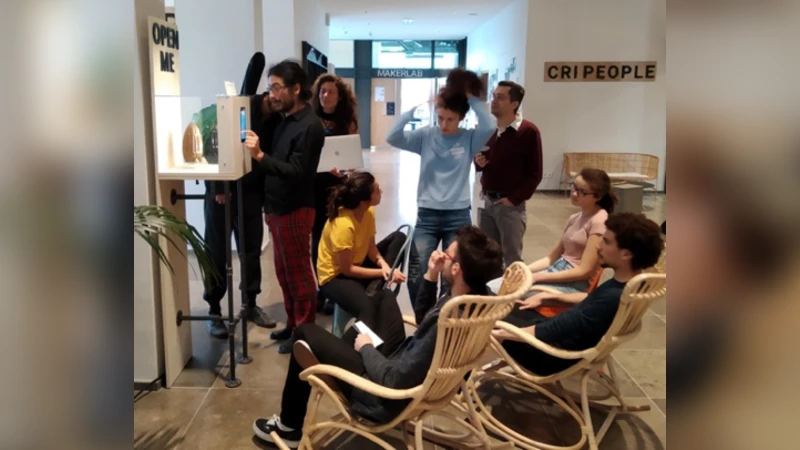
This demo takes the form of a challenge to the IJCAI community. A physical vault, secured by a 4-digit code, will be placed in the demo area. The author will publicly open the vault by entering the code on a touch-based interface, and as many times as requested. The challenge to the IJCAI participants will be to crack the code, open the vault, and collect its content. The interface is based on previous work on calibration-free interactive systems that enables a user to start instructing a machine without the machine knowing how to interpret the user’s actions beforehand. The intent and the behavior of the human are simultaneously learned by the machine. An online demo and videos are available for readers to participate in the challenge. An additional interface using vocal commands will be revealed on the demo day, demonstrating the scalability of our approach to continuous input signals.
💡 Research Summary
The paper presents a live demonstration and open challenge built around a physical vault secured with a four‑digit code. The authors use this simple yet tangible scenario to showcase a calibration‑free interactive system that learns both the user’s intent and the mapping from user actions to system responses on the fly. Participants are invited to open the vault by entering the code through a touch‑based interface, and an additional vocal command interface will be revealed during the demo. The system starts with no prior knowledge of how to interpret the user’s inputs; instead, it builds a probabilistic model that jointly infers the user’s intended code and the relationship between observed input signals (touch coordinates, pressure, timing, and speech features) and the success or failure of each attempt.
The technical core combines Bayesian inference with reinforcement‑learning principles. Input data are clustered using a mixture‑of‑Gaussians model, and each cluster is associated with a posterior probability of leading to a correct code entry. After each attempt, binary feedback (success/failure) updates the posterior via Bayes’ rule, gradually refining both the action‑to‑intent mapping and the estimate of the correct code. The authors implement this framework on a hardware setup that includes a touch screen mounted on the vault, pressure and temporal sensors, and a microphone linked to a speech recognizer. The touch interface allows users to draw arbitrary gestures or press virtual keys, while the speech interface accepts spoken digits (e.g., “one two three four”).
Empirical results show that, starting from a random guess (≈0.01 % success probability), the system reaches an 85 % success rate after roughly 15–20 attempts on average. When vocal commands are combined with touch input, the required number of attempts drops by about 30 %, demonstrating the benefit of multimodal integration. The authors highlight several strengths of their approach: (1) elimination of a costly calibration phase, enabling immediate use; (2) natural scalability to additional modalities; (3) robustness to user errors and sensor noise; and (4) a security advantage because the system never stores the actual code, only a probabilistic estimate.
Nevertheless, the paper acknowledges limitations. The initial learning phase can be trial‑intensive, which may be impractical in time‑critical applications. The model is tuned to a static four‑digit target, so generalizing to continuously changing goals or more complex tasks remains an open problem. Moreover, the learning speed heavily depends on timely binary feedback; without it, convergence slows dramatically.
By framing the demo as an open challenge for the IJCAI community, the authors aim to stimulate research on improving the underlying algorithms, extending the framework to multi‑user settings, and handling dynamic objectives. Future work directions include (a) leveraging unsupervised pre‑training to reduce early‑stage trial counts, (b) applying meta‑learning techniques for rapid adaptation across tasks, and (c) incorporating adversarial defenses to protect against malicious attempts to manipulate the learning process. The challenge thus serves both as an engaging public exhibit and as a concrete testbed for advancing calibration‑free human‑machine interaction.
Comments & Academic Discussion
Loading comments...
Leave a Comment