Influence of Initial Residual Stress on Growth and Pattern Creation for a Layered Aorta
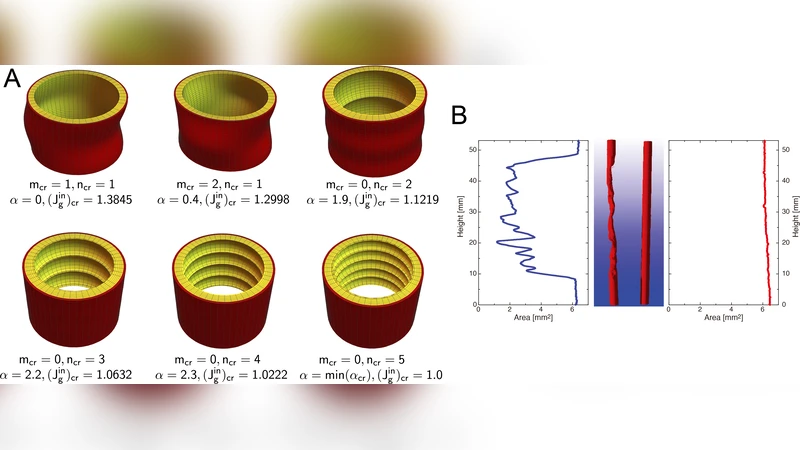
Residual stress is ubiquitous and indispensable in most biological and artificial materials, where it sustains and optimizes many biological and functional mechanisms. The theory of volume growth, starting from a stress-free initial state, is widely used to explain the creation and evolution of growth-induced residual stress and the resulting changes in shape, and to model how growing bio-tissues such as arteries and solid tumors develop a strategy of pattern creation according to geometrical and material parameters. This modelling provides promising avenues for designing and directing some appropriate morphology of a given tissue or organ and achieve some targeted biomedical function. In this paper, we rely on a modified, augmented theory to reveal how we can obtain growth-induced residual stress and pattern evolution of a layered artery by starting from an existing, non-zero initial residual stress state. We use experimentally determined residual stress distributions of aged bi-layered human aortas and quantify their influence by a magnitude factor. Our results show that initial residual stress has a more significant impact on residual stress accumulation and the subsequent evolution of patterns than geometry and material parameters. Additionally, we provide an essential explanation for growth-induced patterns driven by differential growth coupled to an initial residual stress. Finally, we show that initial residual stress is a readily available way to control growth-induced pattern creation for tissues and thus may provide a promising inspiration for biomedical engineering.
💡 Research Summary
**
The paper addresses a fundamental limitation of the widely used multiplicative decomposition (MD) growth framework, which assumes that biological tissues start from a stress‑free configuration. In reality, many soft tissues—including arteries—already possess significant residual stresses that cannot be eliminated experimentally. To incorporate this fact, the authors develop a Modified Multiplicative Decomposition Growth (MMDG) model. In MMDG the total deformation gradient F is factorised into three successive maps: an initial elastic deformation F₀ that releases the pre‑existing residual stress to a virtual stress‑free state, a growth deformation F_g that maps between two incompatible virtual configurations, and a final elastic deformation F_e that restores compatibility after growth. Thus the initial residual stress tensor τ directly participates throughout the growth process.
Experimental data from aged human aortas (Holzapfel et al.) provide layer‑specific residual stress distributions obtained via opening‑angle and bending‑angle measurements. The authors non‑dimensionalise these data, then introduce a magnitude factor α (α = 0 corresponds to a completely stress‑free reference, α = 1 reproduces the measured stress, α > 1 amplifies it). The aorta is modelled as a bi‑layer tube: the inner layer combines intima and media, the outer layer is adventitia. Shear moduli are taken as μ_in = 34.4 kPa and μ_ad = 17.3 kPa. For computational convenience the geometry is scaled down by a factor of ten (inner radius 0.5911 mm, interface 0.6724 mm, outer radius 0.7504 mm).
Growth is imposed isotropically on the inner layer with volume ratios J_in^g = 1, 1.5, 2, while the outer layer remains undeformed (J_ad^g = 1). Using the neo‑Hookean constitutive law together with the equilibrium equations, the authors derive analytical expressions for the Cauchy stress components in the current configuration (Eqs. 2‑7). The radial stress is continuous across the interface and zero at the free surfaces; circumferential and axial stresses are discontinuous but satisfy overall equilibrium.
Key findings on stress accumulation: (i) increasing J_in^g raises both circumferential and axial stresses in the inner layer and the axial stress in the outer layer; (ii) the shape of the growth‑induced stress profile is essentially independent of α, meaning that the rate at which stress builds up with growth does not depend on the initial residual stress level. However, because the total stress is the superposition of the initial stress and the growth‑induced stress, higher α leads to a higher absolute stress state throughout the wall.
Geometrical consequences: all radii (inner, interface, outer) expand with larger J_in^g, while the thickness ratio (inner‑layer thickness)/(outer‑layer thickness) remains almost constant. The magnitude of α has only a minor effect on absolute radii, but this slight difference can influence the onset of mechanical instability.
To assess pattern formation, the authors perform a linear incremental stability analysis using surface‑impedance techniques. They compute the critical growth factor at which the inner surface buckles into wrinkles. Results show that a larger initial residual stress (α = 2) lowers the critical J_in^g, i.e., the tube becomes unstable earlier because the compressive circumferential stress on the inner surface is amplified. Conversely, the tensile axial stress in the outer layer tends to stabilise the structure, illustrating a competition between layers. Thus, the interaction between pre‑existing residual stress and differential growth dictates the selection of morphogenetic patterns.
The study concludes that controlling the initial residual stress provides a practical lever for engineering desired growth‑induced patterns, without the need to finely tune growth rates or material contrasts. This insight is valuable for biomedical engineering (design of tissue‑engineered vessels, scaffolds that develop prescribed corrugations, or therapeutic modulation of arterial remodeling) and for soft‑matter manufacturing where swelling or growth‑like processes are exploited for self‑assembly and nano‑fabrication.
Comments & Academic Discussion
Loading comments...
Leave a Comment