An all-at-once Newton strategy for methane hydrate reservoir models
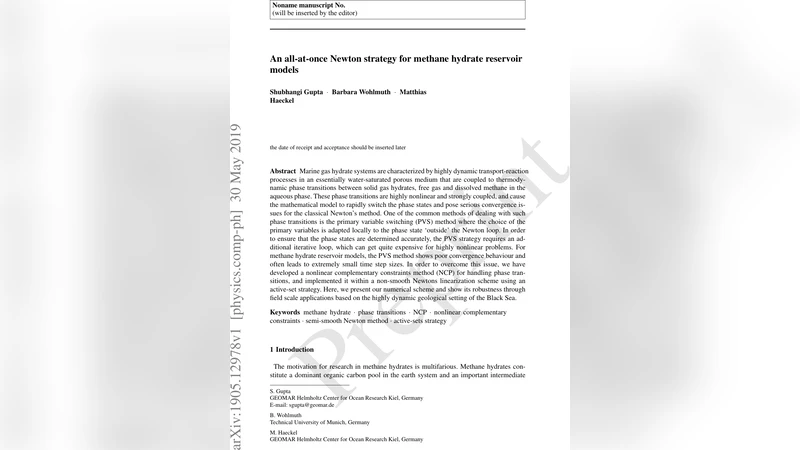
Marine gas hydrate systems are characterized by highly dynamic transport-reaction processes in an essentially water-saturated porous medium that are coupled to thermodynamic phase transitions between solid gas hydrates, free gas and dissolved methane in the aqueous phase. These phase transitions are highly nonlinear and strongly coupled, and cause the mathematical model to rapidly switch the phase states and pose serious convergence issues for the classical Newton’s method. One of the common methods of dealing with such phase transitions is the primary variable switching (PVS) method where the choice of the primary variables is adapted locally to the phase state outside the Newton loop. In order to ensure that the phase states are determined accurately, the PVS strategy requires an additional iterative loop, which can get quite expensive for highly nonlinear problems. For methane hydrate reservoir models, the PVS method shows poor convergence behaviour and often leads to extremely small time step sizes. In order to overcome this issue, we have developed a nonlinear complementary constraints method (NCP) for handling phase transitions, and implemented it within a non-smooth Newton’s linearization scheme using an active-set strategy. Here, we present our numerical scheme and show its robustness through field scale applications based on the highly dynamic geological setting of the Black Sea.
💡 Research Summary
The paper addresses the severe numerical difficulties encountered when simulating methane hydrate reservoirs, where rapid phase transitions among solid hydrate, free gas, and aqueous phases create highly nonlinear and tightly coupled equations. Traditional reservoir simulators often rely on a primary‑variable switching (PVS) strategy, which changes the set of primary unknowns outside the Newton iteration based on the local phase state. While PVS can handle phase appearance and disappearance, in hydrate systems the phase state flips frequently, leading to oscillations, drastic reductions in allowable time‑step size, and sometimes outright failure of the solver.
To overcome these limitations, the authors develop a nonlinear complementary constraints (NCP) formulation combined with a semi‑smooth Newton method and an active‑set strategy. The key idea is to cast the inequality constraints that enforce vapor‑liquid equilibrium (VLE) and phase existence (e.g., sum of mole fractions ≤ 1, saturation > 0) as complementarity conditions of the Karush‑Kuhn‑Tucker type. These complementarity relations are then expressed using semi‑smooth functions (such as the Fischer‑Burmeister or minimum functions), which are nondifferentiable but possess well‑defined generalized derivatives.
Within each Newton iteration the algorithm identifies an active set of constraints that are currently binding (i.e., the phase is present or a saturation is at its lower bound) and a complementary inactive set. The Jacobian matrix is assembled using the generalized derivatives of the active constraints, while inactive constraints contribute zero rows, preserving the sparsity pattern. This active‑set/semi‑smooth Newton approach yields a globally consistent linearization of the full coupled system—mass balances for methane, water, and salts; Darcy flow for gas and water; energy balance with heat of hydrate reaction; kinetic hydrate dissociation/formation (Kim‑Bishnoi model); and constitutive relations for capillary pressure, diffusion, and reaction surface area.
The authors implement the method in an “all‑at‑once” fashion, solving all governing PDEs and algebraic constraints simultaneously rather than using operator splitting. Time integration is performed with an adaptive step‑size controller that relies on the robust convergence of the semi‑smooth Newton scheme.
Numerical experiments are conducted on a field‑scale model of the Black Sea, incorporating realistic geological layering, temperature gradients, and salinity distributions. The NCP‑based solver is compared against a conventional PVS implementation. Results show that the new method allows time steps that are 5–10 times larger on average, reduces the total number of Newton iterations, and eliminates the convergence breakdowns observed with PVS during rapid hydrate dissociation or formation events. Phase saturation, pressure, and temperature profiles remain physically consistent, and the overall computational time is reduced by a factor of three to four.
In conclusion, the paper demonstrates that embedding phase‑transition constraints directly into the nonlinear system via NCP and solving them with a semi‑smooth Newton active‑set algorithm provides a robust, efficient alternative to primary‑variable switching for methane hydrate reservoir simulation. The approach maintains the same quadratic convergence properties of classical Newton methods while handling the non‑smoothness inherent in phase appearance/disappearance. The authors suggest future extensions to multi‑component gas mixtures (e.g., CO₂‑CH₄), non‑isothermal conditions, and large‑scale parallel implementations to further broaden the applicability of the method in carbon‑capture, energy‑production, and environmental‑risk assessments.
Comments & Academic Discussion
Loading comments...
Leave a Comment