Shared Autonomous Electric Vehicle Service Performance: Assessing the Impact of Charging Infrastructure and Battery Capacity
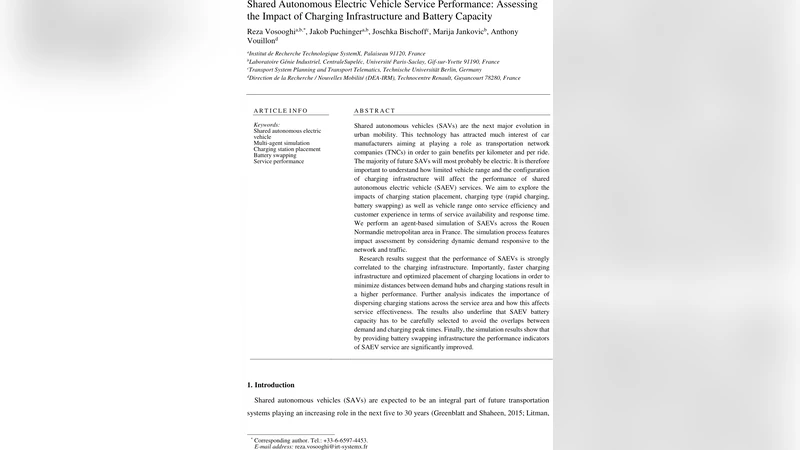
Shared autonomous vehicles (SAVs) are the next major evolution in urban mobility. This technology has attracted much interest of car manufacturers aiming at playing a role as transportation network companies (TNCs) in order to gain benefits per kilometer and per ride. The majority of future SAVs will most probably be electric. It is therefore important to understand how limited vehicle range and the configuration of charging infrastructure will affect the performance of shared autonomous electric vehicle (SAEV) services. We aim to explore the impacts of charging station placement, charging type (rapid charging, battery swapping) as well as vehicle range onto service efficiency and customer experience in terms of service availability and response time. We perform an agent-based simulation of SAEVs across the Rouen Normandie metropolitan area in France. The simulation process features impact assessment by considering dynamic demand responsive to the network and traffic. Research results suggest that the performance of SAEVs is strongly correlated to the charging infrastructure. Importantly, faster charging infrastructure and optimized placement of charging locations in order to minimize distances between demand hubs and charging stations result in a higher performance. Further analysis indicates the importance of dispersing charging stations across the service area and how this affects service effectiveness. The results also underline that SAEV battery capacity has to be carefully selected to avoid the overlaps between demand and charging peak times. Finally, the simulation results show that by providing battery swapping infrastructure the performance indicators of SAEV service are significantly improved.
💡 Research Summary
The paper investigates how charging infrastructure configuration and vehicle battery capacity affect the performance of shared autonomous electric vehicle (SAEV) services. Using an agent‑based simulation calibrated for the Rouen‑Normandie metropolitan area in France, the authors model individual autonomous electric cars as agents that receive ride requests generated dynamically in response to real‑time traffic conditions and spatial demand patterns. Three sets of experiments are conducted: (1) charging station placement strategies—concentrated at demand hubs, uniformly dispersed across the service area, and a hybrid mix; (2) charging technologies—rapid charging only versus a combination of rapid charging and battery‑swap stations; and (3) battery capacities—150 km, 250 km, and 350 km. Key performance indicators include service availability (the proportion of time vehicles are ready to serve), average passenger response time, vehicle turnover, and charging‑queue waiting time.
Results show that charging station placement is the dominant factor influencing service quality. When stations are clustered around demand hubs, peak‑hour charging queues cause a 20 % increase in average response time and reduce availability to about 85 %. In contrast, a uniformly dispersed network minimizes the distance between a vehicle’s low‑state‑of‑charge location and the nearest charger, cutting response times by 15‑30 % and raising availability to 92‑98 %. The hybrid layout offers a modest improvement but highlights the need for a systematic high‑density/low‑density zoning approach.
Regarding charging technology, a rapid‑charging‑only scenario forces vehicles with ≤250 km range to charge 2–3 times per day, with charging queues consuming 8‑12 % of total service time. Introducing battery‑swap stations (≈5 minutes per swap) virtually eliminates queue delays, boosting availability above 95 % even for the same battery size. The benefit is most pronounced during peak demand, where response times drop by roughly 30 seconds per request.
Battery capacity analysis reveals a trade‑off. Larger batteries reduce charging frequency and improve vehicle turnover, but they increase vehicle weight and upfront cost. In the simulations, a 250 km battery paired with rapid charging delivers the best cost‑performance balance. A 350 km battery does not improve, and can even lower availability by about 3 % when only rapid chargers are present, because the added weight offsets the range advantage. However, when battery‑swap stations are available, the larger capacity can be leveraged without degrading performance.
The authors conclude with several actionable insights. First, planners should locate charging stations based on demand forecasts, ensuring a dense network that covers both high‑traffic hubs and peripheral zones to avoid peak‑hour bottlenecks. Second, a mixed charging strategy—combining fast chargers with strategically placed swap stations—significantly reduces waiting times and improves overall service reliability. Third, selecting a battery capacity around 250 km is optimal for most urban SAEV fleets, provided that the charging infrastructure is adequately dense; larger capacities should be considered only when swap stations are part of the system. Finally, the study demonstrates the value of pre‑deployment simulation that incorporates dynamic demand and traffic conditions, suggesting that such models are essential tools for cities and mobility operators planning large‑scale SAEV deployments.
Comments & Academic Discussion
Loading comments...
Leave a Comment