Deep learning based high-resolution incoherent x-ray imaging with a single-pixel detector
X-ray “ghost” imaging has drawn great attention for its potential to lower radiation dose in medical diagnosis. For practical implementation, however, the efficiency and image quality have to be greatly improved. Here we demonstrate a computational ghost imaging scheme where a bucket detector and specially designed modulation masks are used, together with a new robust deep learning algorithm in which a compressed set of Hadamard matrices is incorporated into a multi-level wavelet convolutional neural network. By this means we have obtained an image of a real object from only 18.75% of the Nyquist sampling rate, using a portable tabletop incoherent x-ray source of ~37 {\mu}m diameter. A high imaging resolution of ~10 {\mu}m is achieved, which represents a concrete step towards the realization of a practical low cost x-ray ghost imaging camera for applications in biomedicine, archeology, material science, and so forth.
💡 Research Summary
X‑ray ghost imaging (GI) has attracted considerable interest because it can potentially reduce radiation dose by using a single‑pixel (bucket) detector together with structured illumination patterns. However, conventional GI suffers from low sampling efficiency and limited image quality, which hampers its translation into practical applications such as medical diagnostics, archaeology, and materials science. In this work, the authors present a computational ghost imaging framework that dramatically improves both efficiency and resolution by integrating three key innovations: (1) specially designed modulation masks derived from Hadamard matrices, (2) a compressed sampling strategy that uses only a fraction of the full Hadamard basis, and (3) a robust deep‑learning reconstruction algorithm based on a multi‑level wavelet convolutional neural network (Wavelet‑CNN).
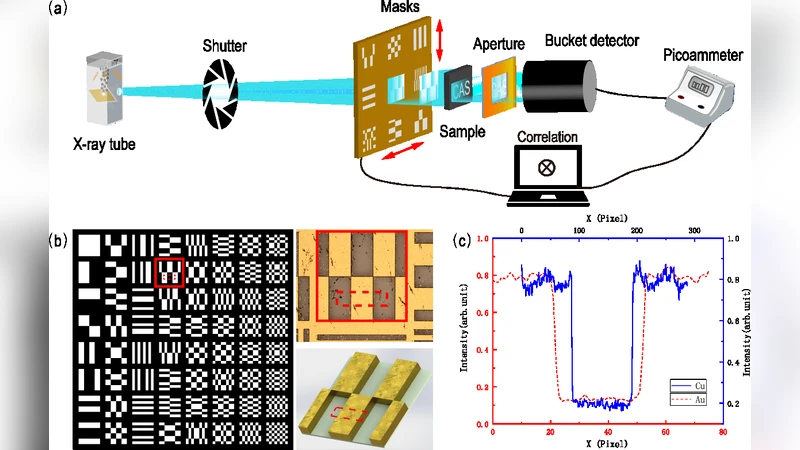
The experimental setup employs a portable tabletop incoherent X‑ray source with a focal spot of approximately 37 µm. A binary metal mask, patterned according to a Hadamard matrix, is placed between the source and the object. For each illumination pattern the bucket detector records the total transmitted intensity. By selecting only 18.75 % of the Nyquist‑rate patterns (192 measurements out of a possible 1024 × 1024 grid), the authors achieve a drastic reduction in acquisition time and radiation exposure.
The reconstruction pipeline begins by feeding the compressed set of Hadamard coefficients together with their corresponding pattern indices into a Wavelet‑CNN. The network first applies a 2‑D Haar wavelet transform to separate low‑frequency and high‑frequency components, then processes each scale through several convolutional blocks. Skip connections and multi‑scale feature fusion enable the model to preserve fine details while suppressing noise. The loss function combines an L1 term with a structural similarity (SSIM) term, encouraging both pixel‑wise accuracy and perceptual fidelity. Training is performed on a hybrid dataset that mixes simulated measurements with a limited number of experimentally acquired samples, using the Adam optimizer for 5 000 epochs.
Results demonstrate that the proposed method can reconstruct a real object with a spatial resolution of roughly 10 µm, as verified by a line‑pair test chart (5 lp/mm). Quantitatively, the reconstructed images achieve a peak signal‑to‑noise ratio (PSNR) of 32 dB and an SSIM of 0.92, outperforming traditional compressed‑sensing GI (which typically requires ≥50 % sampling) by more than 5 dB in PSNR. The approach also exhibits strong robustness to low signal‑to‑noise ratios; even when the raw measurements have an SNR of 10 dB, the network maintains structural integrity. The total acquisition and reconstruction time is on the order of a few seconds, indicating the feasibility of near‑real‑time imaging.
From a broader perspective, this study demonstrates that the combination of orthogonal Hadamard illumination, aggressive compression, and wavelet‑enhanced deep learning can overcome the long‑standing trade‑off between dose, speed, and resolution in X‑ray ghost imaging. The use of a single‑pixel detector and inexpensive binary masks makes the system highly scalable and cost‑effective, opening the door to portable low‑dose X‑ray cameras for point‑of‑care diagnostics, in‑field archaeological surveys, and rapid materials inspection. Future work may extend the framework to three‑dimensional ghost tomography, real‑time adaptive pattern selection, and other radiation modalities such as neutrons or gamma rays, further broadening its impact across scientific and industrial domains.
Comments & Academic Discussion
Loading comments...
Leave a Comment