Variational approximations of soliton dynamics in the Ablowitz-Musslimani nonlinear Schr"odinger equation
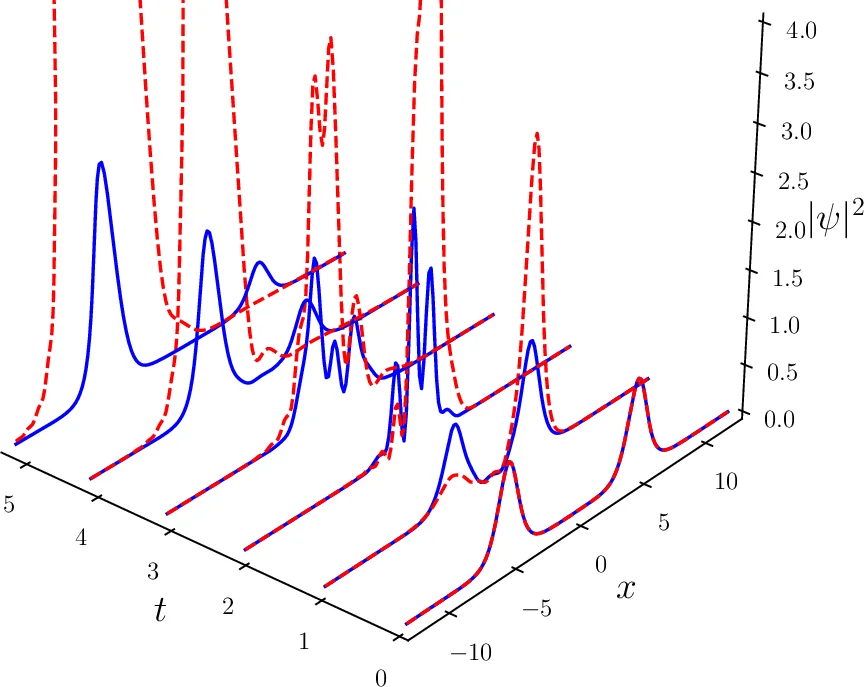
We study the integrable nonlocal nonlinear Schr"odinger equation proposed by Ablowitz and Musslimani, that is considered as a particular example of equations with parity-time ($\mathcal{PT}$) symmetric self-induced potential. We consider dynamics (including collisions) of moving solitons. Analytically we develop a collective coordinate approach based on variational methods and examine its applicability in the system. We show numerically that a single moving soliton can pass the origin and decay or be trapped at the origin and blows up at a finite time. Using a standard soliton ansatz, the variational approximation can capture the dynamics well, including the finite-time blow up, even though the ansatz is relatively far from the actual blowing-up soliton solution. In the case of two solitons moving towards each other, we show that there can be a mass transfer between them, in addition to wave scattering. We also demonstrate that defocusing nonlinearity can support bright solitons.
💡 Research Summary
This paper investigates the dynamics of moving solitons in the integrable nonlocal nonlinear Schrödinger equation introduced by Ablowitz and Musslimani, a prototypical PT‑symmetric model with a self‑induced potential. The authors develop a collective‑coordinate (variational) framework to reduce the partial differential equation
(i\psi_t+\frac12\psi_{xx}+\sigma\psi^{2}\psi^{*}(-x,t)=0)
to a set of ordinary differential equations governing a few time‑dependent parameters. Two trial functions are employed: a Gaussian envelope (Eq. 3) and a hyperbolic‑secant (sech) profile (Eq. 6). For the Gaussian ansatz the variational procedure yields six coupled ODEs (Eqs. 5a‑5f) for amplitude, phase, width, chirp, linear momentum and centre‑of‑mass. These equations capture well the propagation of a solitary wave that passes through the origin with a large initial velocity, regardless of the sign of the nonlinearity (focusing σ=+1 or defocusing σ=−1). When the initial velocity is small, numerical simulations show that the soliton can become trapped near the origin and subsequently blow up in finite time. The Gaussian variational model reproduces the trapping but fails to describe the rapid amplitude growth associated with blow‑up.
To overcome this limitation the authors adopt a sech ansatz, which is known to resemble the exact blow‑up solution. The corresponding variational equations (Eqs. 7a‑7f) involve hyperbolic functions and more intricate coupling terms. With this choice the variational dynamics qualitatively reproduce the finite‑time blow‑up, the rapid shift of the centre, and the subsequent dispersion after the soliton passes the origin. The agreement improves when the initial position is close to the origin and the initial velocity is modest, reflecting the fact that the sech profile is a better approximation of the true solution in that regime.
The paper then extends the variational approach to the interaction of two solitons. Each soliton is represented by a separate sech ansatz and the total field is taken as their superposition (Eq. 8). Assuming the solitons are initially well separated, symmetric with respect to the origin, and have nearly identical parameters, the authors derive a second set of coupled ODEs (Eqs. 14a‑14f) describing the evolution of amplitudes, phases, widths, chirps, momenta and positions of both solitons. Numerical experiments confirm that the variational model accurately follows the pre‑collision dynamics, predicts a mass (amplitude) transfer between the solitons, and reproduces the scattering and post‑collision separation. However, during the actual collision the variational description underestimates the strength of the interaction, because the simple superposition ansatz cannot capture the strong interference and rapid deformation of the waveforms.
An unexpected finding is that bright solitons also exist in the defocusing regime (σ=−1) of the nonlocal NLS, a property that the variational framework captures equally well for both Gaussian and sech trial functions. This highlights the distinctive nature of the nonlocal equation, where PT symmetry allows bright structures even when the local NLS would only support dark solitons.
The authors solve the original PDE using a fourth‑order Runge‑Kutta time integrator combined with a pseudospectral (FFT) discretisation of the Laplacian on a domain large enough (|x|≥30) to avoid boundary effects, with Δx=0.1 and Δt=0.005. The variational ODEs are integrated with the same scheme, and the time‑dependent parameters are inserted back into the trial functions to reconstruct the spatial profiles for comparison. Overall, the variational method provides a low‑dimensional, physically transparent description of soliton motion, trapping, blow‑up, and collisions in the nonlocal NLS, while its accuracy deteriorates in regimes of strong nonlocal interaction (near the origin during collisions or blow‑up). The paper suggests that future work could improve the ansatz (e.g., multi‑parameter or adaptive shapes) or incorporate higher‑order variational corrections to better capture the highly nonlinear, nonlocal dynamics.
Comments & Academic Discussion
Loading comments...
Leave a Comment