Solving Random Systems of Quadratic Equations with Tanh Wirtinger Flow
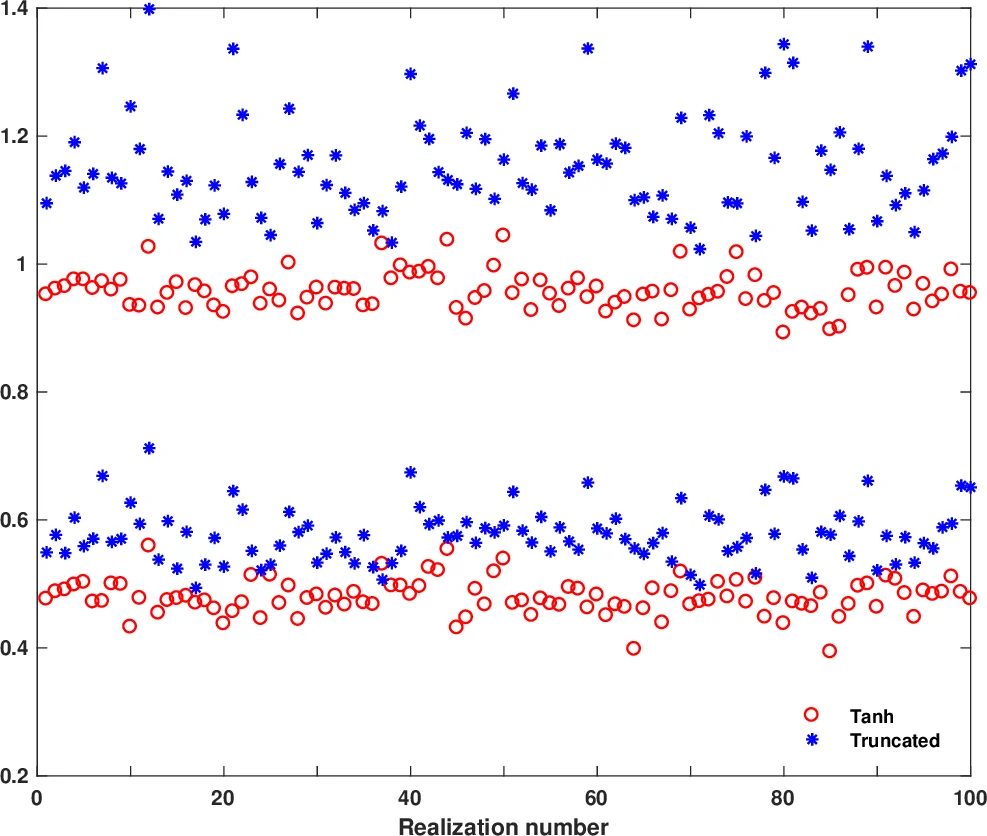
Solving quadratic systems of equations in n variables and m measurements of the form $y_i = |a^T_i x|^2$ , $i = 1, …, m$ and $x \in R^n$ , which is also known as phase retrieval, is a hard nonconvex problem. In the case of standard Gaussian measurement vectors, the wirtinger flow algorithm Chen and Candes (2015) is an efficient solution. In this paper, we proposed a new form of wirtinger flow and a new spectral initialization method based on this new algorithm. We proved that the new wirtinger flow and initialization method achieve linear sample and computational complexities. We further extended the new phasing algorithm by combining it with other existing methods. Finally, we demonstrated the effectiveness of our new method in the low data to parameter ratio settings where the number of measurements which is less than information-theoretic limit, namely, $m < 2n$, via numerical tests. For instance, our method can solve the quadratic systems of equations with gaussian measurement vector with probability $\ge 97%$ when $m/n = 1.7$ and $n = 1000$, and with probability $\approx 60%$ when $m/n = 1.5$ and $n = 1000$.
💡 Research Summary
**
The paper addresses the phase‑retrieval problem of recovering a real‑valued signal (x\in\mathbb R^{n}) from quadratic measurements (y_i=|a_i^{\top}x|^{2}) with i.i.d. Gaussian sensing vectors (a_i\sim\mathcal N(0,I_n)). While the original Wirtinger Flow (WF) and its truncated variant (TWF) achieve optimal linear sample and computational complexities, their empirical success deteriorates sharply when the measurement‑to‑dimension ratio (m/n) drops below the information‑theoretic limit of 2. To overcome this limitation, the authors propose a new family of algorithms called Tanh‑Wirtinger Flow (TanhWF) together with a novel spectral initialization and a hybrid scheme that incorporates the Reweighted Amplitude Flow (RAF) weighting.
Key technical contributions
- Data‑dependent non‑linear weighting – Starting from the joint Gaussian distribution of the true inner product (a_i^{\top}x) and the current estimate (a_i^{\top}z), the authors derive a conditional likelihood (p(a_i^{\top}z\mid|a_i^{\top}x|)). Maximizing the summed log‑likelihood yields an objective whose gradient naturally contains a factor
\
Comments & Academic Discussion
Loading comments...
Leave a Comment