Non-equilibrium fluctuations of a semi-flexible filament driven by active cross-linkers
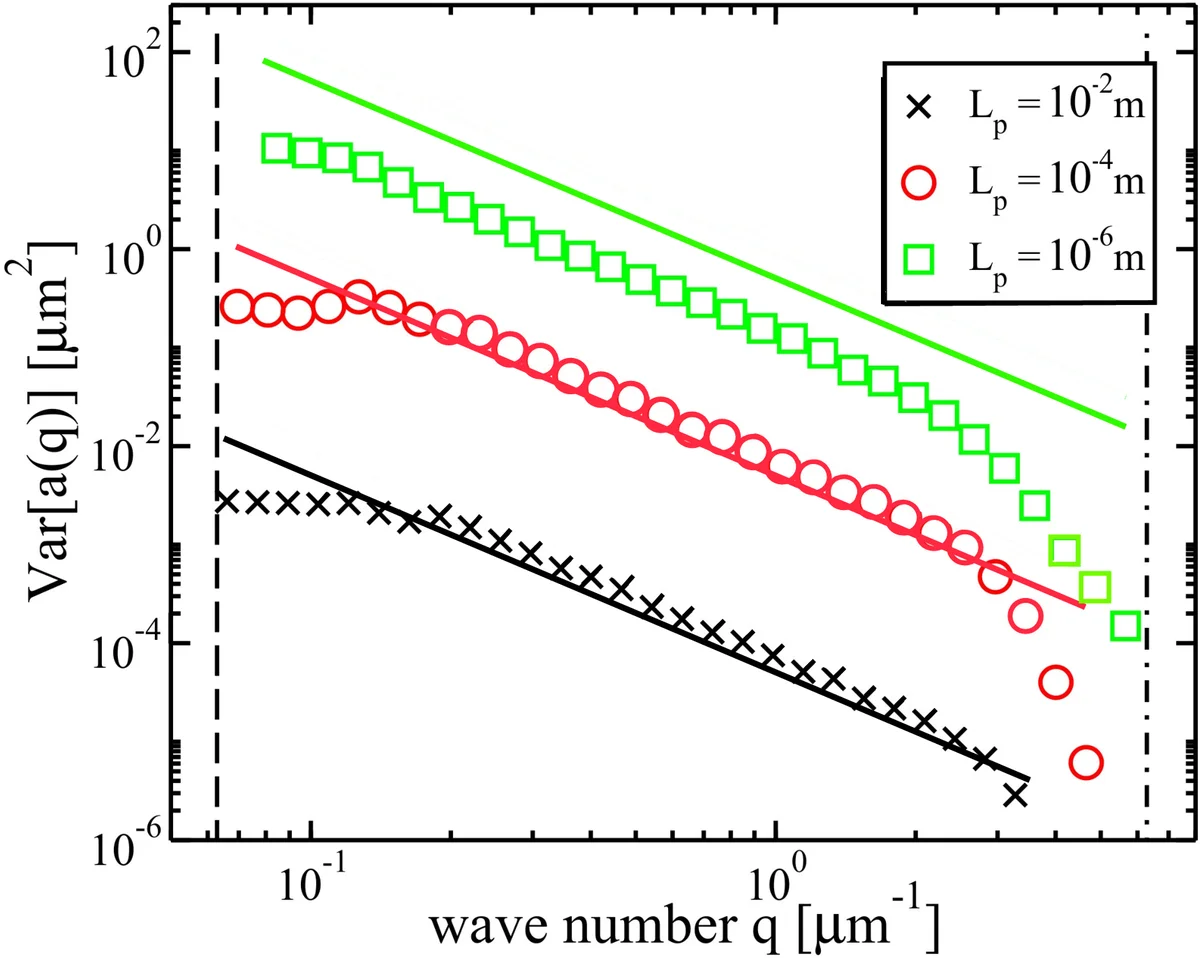
The cytoskeleton is an inhomogeneous network of semi-flexible filaments, which are involved in a wide variety of active biological processes. Although the cytoskeletal filaments can be very stiff and embedded in a dense and cross-linked network, it has been shown that, in cells, they typically exhibit significant bending on all length scales. In this work we propose a model of a semi-flexible filament deformed by different types of cross-linkers for which one can compute and investigate the bending spectrum. Our model allows to couple the evolution of the deformation of the semi-flexible polymer with the stochastic dynamics of linkers which exert transversal forces onto the filament. We observe a $q^{-2}$ dependence of the bending spectrum for some biologically relevant parameters and in a certain range of wavenumbers $q$. However, generically, the spatially localized forcing and the non-thermal dynamics both introduce deviations from the thermal-like $q^{-2}$ spectrum.
💡 Research Summary
In this paper the authors develop a quantitative model for the non‑equilibrium bending fluctuations of a semi‑flexible filament (SFF) that is acted upon by a finite set of cross‑linkers. The filament is treated as a two‑dimensional elastic rod with bending energy E = k∫(∂θ/∂s)² ds, where k is the bending rigidity expressed in units of kBT. Periodic boundary conditions are imposed so that the filament forms a closed ring, eliminating overall rotation.
Two classes of cross‑linkers are considered. Thermal linkers are permanently attached to the filament and step stochastically along a perpendicular background lattice of spacing d_mesh. Each step is accepted with Metropolis probability min(1, exp(‑ΔE/kBT)), guaranteeing detailed balance and thus thermal equilibrium statistics. Active linkers, in contrast, bind and unbind with rates ω_a and ω_d(F_SFF) = ω_d⁰ exp(|F_SFF|/F_d), where F_SFF is the load force exerted by the filament on the linker. Once bound, an active linker steps in a fixed direction along the background filament with a load‑dependent rate p(F_SFF). The stepping rate decreases when the load opposes the stepping direction and stops at a stall force F_s. The linkers are connected to the filament by a flexible “rope” of maximal extension l_max; only when the rope is stretched do they exert a transverse force on the filament.
The core of the method is a semi‑analytical solution for the filament shape between any two consecutive pulling linkers located at positions x_i and x_{i+1}. Assuming no overhang and small slopes, the shape u_i(x) that minimizes the bending energy on the interval
Comments & Academic Discussion
Loading comments...
Leave a Comment