arXiv and the Symbiosis of Physics Preprints and Journal Review Articles
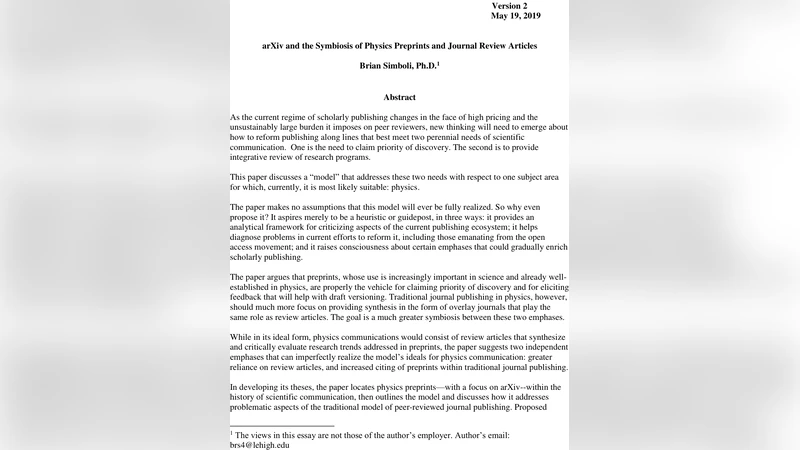
New thinking needs to emerge about how to reform publishing along lines that best meet two perennial needs of scientific communication. This paper discusses a model that addresses these two needs with respect to physics. Given the considerable barriers that its realization in pristine form faces, the model aspires merely to be a heuristic or guidepost. It provides an analytical framework for criticizing aspects of the current publishing ecosystem, helps diagnose problems in current efforts to reform it, including those emanating from the open access movement, and raises consciousness about certain emphases that could gradually enrich scholarly publishing. [VERSION 2 , 5/19/2019; SUCCESSIVE REVISIONS WILL OCCUR THROUGHOUT 2019.]
💡 Research Summary
The paper offers a critical examination of the current scholarly publishing system in physics and proposes a symbiotic model that leverages arXiv preprints together with traditional journal review articles. It begins by identifying two perennial needs of scientific communication: establishing priority for discoveries and providing integrative reviews of research programs. The author argues that preprints are ideally suited to satisfy the first need, offering rapid, open dissemination, versioning, and community feedback, while journals should evolve to focus on the second need by acting as overlay platforms that synthesize, critique, and contextualize the body of work already available as preprints.
The manuscript outlines the systemic problems of the traditional journal publishing (TJP) model—ever‑rising subscription and article processing charges, a glut of articles, the heavy human‑resource burden on peer reviewers, slow publication timelines, and excessive specialization. It contends that physics, with its long‑standing arXiv infrastructure, is uniquely positioned to experiment with reforms that could alleviate these issues.
To operationalize the proposed symbiosis, the author suggests a suite of enhancements to arXiv: (1) overlay‑journal notification services that alert readers when new preprints match the scope of existing review journals; (2) integration of datasets and reproducibility metadata; (3) bibliometric dashboards and text‑mining tools for trend analysis; (4) automated email alerts for new content; (5) visualizations of citation networks and research clusters; (6) commenting and annotation capabilities to enable post‑publication discussion; (7) finer‑grained classification schemes or thesauri to improve discoverability; (8) standardized manuscript templates and uniform styling; (9) explicit labeling of review articles; (10) modestly expanded moderation to ensure basic quality without creating prohibitive barriers; and (11) a direct submission pipeline from arXiv to participating overlay journals.
The paper also examines structural barriers that impede the adoption of a preprint‑centric model: commercial and society interests tied to subscription revenue, university expenditures on TJP, tenure and promotion criteria that prioritize journal counts, a cultural tendency toward “ahistoricity” that undervalues the historical context of research, and conservative editorial policies. It argues that librarians can play a pivotal role in mitigating these obstacles by managing metadata, providing alert services, educating researchers about the benefits of preprints, and negotiating with publishers and consortia.
While the focus remains on physics, the author notes that the emergence of “‑Xiv” servers in other quantitative fields (e.g., bio‑Xiv, chem‑Xiv) suggests broader applicability. The model is presented not as a fully realizable ideal but as a heuristic guidepost for incremental change. By gradually enhancing arXiv’s functionality and encouraging journals to adopt a review‑oriented, overlay approach, the scholarly communication ecosystem could achieve lower costs, reduced article overload, lighter peer‑review burdens, and faster dissemination of results, thereby meeting the two core needs of scientific communication in a more sustainable and efficient manner.
Comments & Academic Discussion
Loading comments...
Leave a Comment