The Geometry of Synchronization Problems and Learning Group Actions
We develop a geometric framework that characterizes the synchronization problem --- the problem of consistently registering or aligning a collection of objects. The theory we formulate characterizes the cohomological nature of synchronization based o…
Authors: Tingran Gao, Jacek Brodzki, Sayan Mukherjee
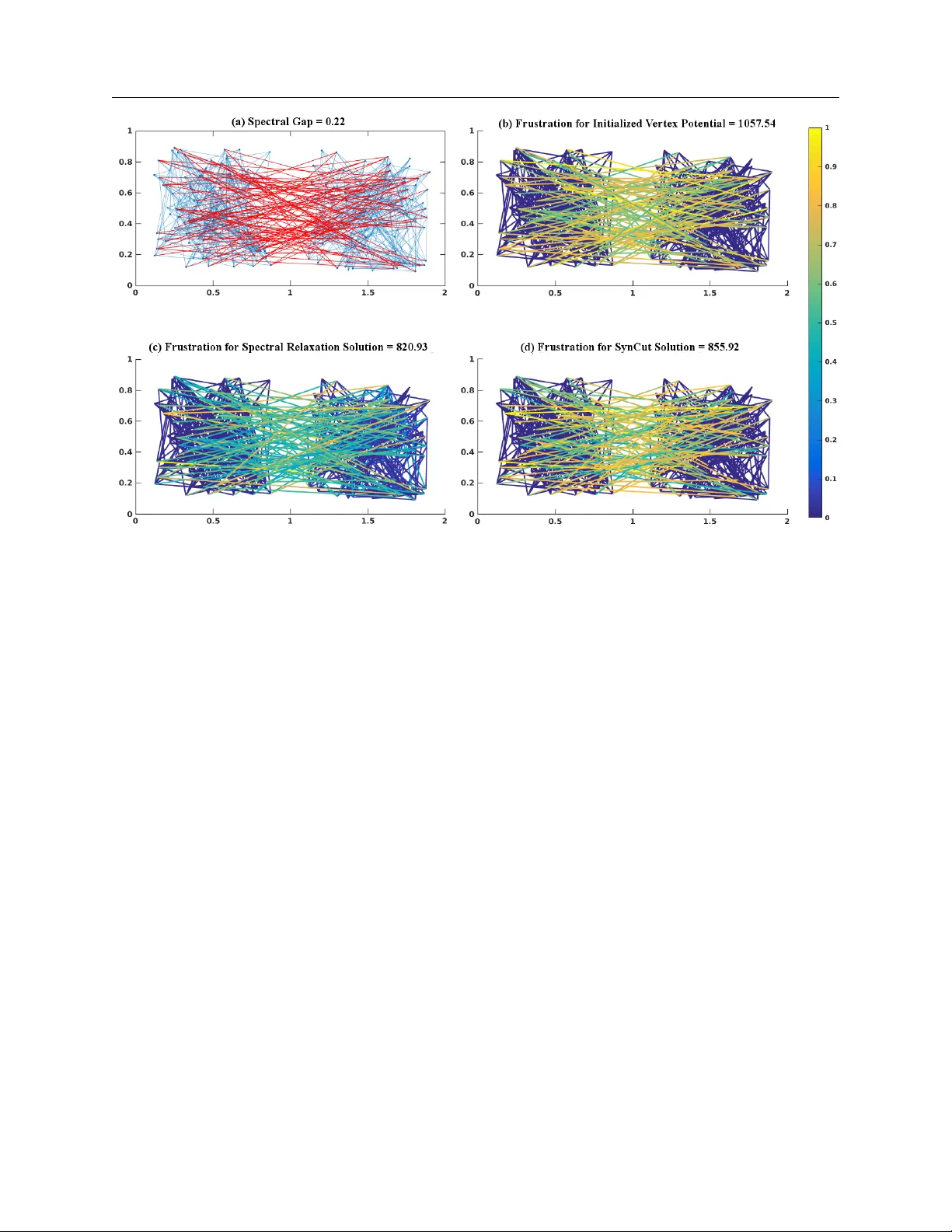
The Geometry of Sync hronization Problems and Learning Group Actions Tingran Gao · Jacek Bro dzki · Sa yan Mukherjee Received: 16 April 2018 / Accepted: 29 April 2019 Abstract W e dev elop a geometric framework, based on the classical theory of fibre bundles, to c harac- terize the cohomological nature of a large class of synchr onization-typ e pr oblems in the context of graph inference and combinatorial optimization. W e identify each synchronization problem in top ological group G on connected graph Γ with a flat principal G -bundle ov er Γ , thus establishing a classification result for sync hronization problems using the representation v ariet y of the fundamental group of Γ into G . W e then dev elop a twisted Ho dge theory on flat vector bundles asso ciated with these flat principal G -bundles, and pro vide a geometric realization of the gr aph c onne ction L aplacian as the low est-degree Ho dge Laplacian in the twisted de Rham-Ho dge co chain complex. Motiv ated by these geometric intuitions, we prop ose to study the problem of le arning gr oup actions — partitioning a collection of ob jects based on the local synchroniz- abilit y of pairwise corresp ondence relations — and provide a heuristic sync hronization-based algorithm for solving this type of problems. W e demonstrate the efficacy of this algorithm on sim ulated and real datasets. Keyw ords synchronization problem · fibre bundle · holonom y · Ho dge theory · graph connection Laplacian Mathematics Sub ject Classification (2010) 05C50 · 62-07 · 57R22 · 58A14 1 Introduction Ov er the past century , concepts from differential geometry hav e had a strong impact on probabilit y theory , statistical inference, and machine learning [37, 48, 64, 108, 126]. Two central geometric concepts used in these fields ha v e b een differen tial operators (e.g. the Laplace–Beltrami operator [16]) and Riemannian metrics (e.g. Fisher information [64]). In particular, the researc h program of manifold learning studies dimension reduction through the lens of differen tial-geometric quantities and in v arian ts, and designs data compression algorithms TG gratefully ac kno wledges partial support from Simons Math+X In vestigators Award 400837, DARP A D15AP00109, NSF IIS 1546413, and an AMS-Simons T ra vel Grant; JB w ould lik e to ac knowledge the support for this w ork by the EPSRC grants EP/I016945/1 and EP/N014189/1; SM would like to ackno wledge supp ort from NSF DMS 16-13261, NSF IIS 1546331, NSF DMS-1418261, NSF I IS-1320357, NSF DMS-1045153, and HFSP RGP0051/2017. Tingran Gao Committee on Computational and Applied Mathematics, Department of Statistics, Universit y of Chicago, Chicago, IL 60637, USA E-mail: tingrangao@galton.uchicago.edu Jacek Bro dzki Department of Mathematical Sciences, Universit y of Southampton, Southampton SO17 1BJ, E-mail: j.bro dzki@soton.ac.uk Say an Mukherjee Departments of Statistical Science, Mathematics, Computer Science, and Bioinformatics & Biostatistics, Duke University , Durham, NC 27708, USA E-mail: say an@stat.duk e.edu 2 Tingran Gao, Jacek Bro dzki, and Say an Mukherjee that preserv e in trinsic geometric information suc h as geodesic distances [145], affine connections [128], second fundamen tal forms [54], and heat kernels [15, 42, 43]. The underlying hypothesis of these tec hniques is that the data lie appro ximately on a smo oth manifold (often embedded in an am bien t Euclidean space), a scenario facilitating inference due to smo othly controllable transitions betw een observed and unseen data. F or practical purp oses, discrete analogues of the inheren tly smooth theory of differential geometry ha ve also been explored in fields ranging from geometry pro cessing [18, 49], finite elemen t methods [6], to sp ectral graph theory [38] and diffusion geometry [41, 136]. Bey ond the manifold assumption, geometric ob jects can b e handled with “softer” to ols such as top ology: top ological data analysis techniques [33, 57] hav e b een developed to study datasets based on their persistent homology . F or smo oth manifolds, it is w ell known that the singular cohomology and de Rham cohomology are isomorphic, indicating that some topological information can b e read off from the differen tial structure of geometric ob jects. Carrying the de Rham theory b eyond the manifold setting has attracted the interest of geometers and physicists: synthetic differential geometry [92, 93] defines group-v alued differen tial forms on “formal manifolds” (generalized notion of smo oth spaces for whic h infinitesimal neighborho o ds are sp ecified axiomatically), based on which an analog of the classical de Rham theory can b e established [63]; noncom- m utative differen tial geometry [45, 46, 106] builds up on the observ ation that muc h of differential geometry can b e formulated in terms of the algebra of smooth functions defined on smo oth manifolds, and replaces this algebra with noncommutativ e ones — differential forms can then b e extended to “noncommutativ e spaces” along with homology and cohomology of m uc h more general ob jects. Discrete analogs of the Ho dge Laplacian, a second order differen tial operator closely related to de Rham theory , ha v e been proposed for sim- plicial complexes and graphs [85, 101, 121, 122, 140]; its non-comm utative coun terpart for 1-forms on graphs ha ve recently b een explored in [107]. Bridging recent developmen ts applying differential geometry and top ology in probability and statisti- cal sciences, the problem of synchr onization [13, 154] arise in a v ariet y of fields in computer science (e.g. computer vision [10] and geometry processing [91]), signal processing (e.g. sensor netw ork lo calization [51]), com binatorial optimization (e.g. non-comm utative Grothendiec k inequality [12]), and natural sciences (e.g. cry o-electron microscop y [11, 130, 138] and geometric morphometrics [66]). The data given in a sync hroniza- tion problem include a connected graph that enco des similarit y relations within a collection of ob jects, and pairwise corresp ondences — often realized as elements of a transformation group G — characterizing the nature of the similarit y betw een a pair of ob jects link ed directly b y an edge in the relation graph. The general goal of the problem is to adjust the pairwise corresp ondences, which often suffer from noisy or incomplete measuremen ts, to obtain a globally consisten t c haracterization of the pairwise relations for the en tire dataset, in the sense that un veiling the transformation b et ween a pair of ob jects far-apart in the relation graph can b e done by comp osing transformations along consecutiv e edges on a path connecting the t wo ob jects, and the resulting comp osed transformation is indep enden t of the c hoice of the path. (A precise definition of a sync hronization problem will b e provided b elo w; see Section 1.1.) This pap er stems from our attempt to gain a deep er understanding of the geometry underlying synchronization problems. Whereas previous works [136, 137] in this direction build up on manifold assumptions, the p oint of view w e adopt here is synthetic and noncomm utativ e: w e will see that inference is p ossible due to rigidit y rather than smoothness. The remainder of this section giv es a formal definition of sync hronization problems, as w ell as a geometric in terpretation in the language of fibre bundles. The fibre bundle in terpretation is elementary but has not b een presented in the literature of sync hronization problems, to our knowledge. W e then state the main results, discuss related w orks, and describ e the organization of the paper. 1.1 A Fibre Bundle Interpretation of Sync hronization Problems W e begin with a standard formulation of the sync hronization problem originated in a series of w orks b y A. Singer and collab orators [134, 130, 13, 154, 21, 11]. Let Γ = ( V , E , w ) b e an undirected weigh ted graph with v ertex set V , edge set E , and w eights w ij for each ( i, j ) ∈ E . Assume G is a top ological group acting on a normed vector space F . Giv en a map ρ : E → G from the edges of Γ to the group G satisfying ρ ij = ρ − 1 j i , the ob jectiv e of a F -synchr onization pr oblem over Γ with r esp e ct to ρ is to find a map f : V → F satisfying the constrain ts f i = ρ ij f j ∀ ( i, j ) ∈ E . (1) The Geometry of Synchronization Problems and Learning Group Actions 3 T able 1 Notations used throughout this pap er Γ graph V vertex set of Γ E edge set of Γ n or | V | num ber of vertices of the graph Γ m or | E | num ber of edges of the graph Γ w ij weigh t on edge ( i, j ) ∈ E d i weigh ted degree on vertex i ∈ V , defined as d i = P j :( i,j ) ∈ E w ij G topological group e identit y elemen t of G G δ group G equipp ed with discrete top ology K scalar field R or C F v ector space on K that is a representation space of G d or dim F dimension of the vector space F h· , ·i F inner pro duct on F U = { U i | 1 ≤ i ≤ | V |} open cov er of Γ in which U i is the star of vertex i ∈ V C 0 ( Γ ; G ) G -v alued 0-cochain on Γ , or the set of all vertex p otentials on Γ C 1 ( Γ ; G ) G -v alued 1-cochain on Γ , or the set of all edge p otentials on Γ C 0 ( Γ ; F ) F -v alued 0-co chain on Γ B ρ synchronization principal bundle (a flat principal G -bundle on Γ ) asso ciated with ρ ∈ C 1 ( Γ ; G ) B ρ [ F ] flat asso ciated F -bundle of B ρ hol ρ holonomy homomorphism on B ρ , from π 1 ( Γ ) to G Hol ρ ( Γ ) holonomy of the synchronization principal bundle B ρ Ω 0 i ( Γ ; B ρ [ F ]) constant twisted lo cal 0-forms of B ρ [ F ] on U i , i.e. constant lo cal sections of B ρ [ F ] on U i Ω 0 ( Γ ; B ρ [ F ]) locally constan t t wisted global 0-forms of B ρ [ F ], i.e. locally constan t global sections of B ρ [ F ] Ω 1 i ( Γ ; B ρ [ F ]) constant twisted lo cal 1-forms of B ρ [ F ] on U i Ω 1 ( Γ ; B ρ [ F ]) locally constant twisted global 1-forms of B ρ [ F ] [ f ] vector in K nd representing f ∈ C 0 ( Γ ; F ) d ρ ρ -twisted differential where ρ ∈ C 1 ( Γ ; G ), from C 0 ( Γ ; F ) to Ω 1 ( Γ ; B ρ [ F ]) δ ρ ρ -twisted co differential where ρ ∈ C 1 ( Γ ; G ), from Ω 1 ( Γ ; B ρ [ F ]) to C 0 ( Γ ; F ) ∆ (0) ρ ρ -twisted Ho dge Laplacian of degree 0 ∆ (1) ρ ρ -twisted Ho dge Laplacian of degree 1 H 0 ρ ( Γ ; B ρ [ F ]) The 0th twisted cohomology group for B ρ [ F ], where ρ ∈ C 1 ( Γ ; G ) ν ( S ) frustration of the subgraph of Γ spanned by the vertex subset S ⊂ V If no suc h map f exists, the synchronization problem consists of finding a map f from V to F that satisfies the constrain ts as m uch as possible, in the sense of minimizing the frustr ation η ( f ) = 1 2 X i,j ∈ V w ij k f i − ρ ij f j k 2 F X i ∈ V d i k f i k 2 F , (2) where k·k F is a norm defined on F , and d i = P j :( i,j ) ∈ E w ij is the weigh ted degree at vertex i . In the terminology of [13], ρ is an e dge p otential and f is a vertex p otential ; a vertex potential is said to satisfy a giv en edge p otential if all equalities in (1) hold. V arying the choice of group G and field F results in different realizations of the sync hronization problem [135, 138, 147, 130, 154, 13, 21], as will b e elaborated in Section 1.3. Since we will frequen tly refer to the set of all edge and vertex p oten tials on a graph, let us in tro duce the follo wing notations to ease our exp osition: let C 0 ( Γ ; G ), C 1 ( Γ ; G ) denote respectively the set of all G -v alued v ertex and edge p oten tials on Γ , i.e. C 0 ( Γ ; G ) := { f : V → G } , C 1 ( Γ ; G ) := ρ : E → G | ρ ij = ρ − 1 j i , ∀ ( i, j ) ∈ E . (3) F or cohomological reasons that will b ecome clear in Section 2, we will also call C 0 ( Γ ; G ) and C 1 ( Γ ; G ) the G -value d 0 - and 1 -c o chains on Γ , resp ectiv ely . Similarly , let C 0 ( Γ ; F ) := { f : V → F } (4) denote the set of all F -v alued vertex potentials on Γ . Throughout this pap er, a G -v alued edge p otential ρ ∈ Ω 0 ( Γ ; G ) is said to b e synchr onizable if there exists a G -v alued v ertex p otential f ∈ Ω 0 ( Γ ; G ) satisfying 4 Tingran Gao, Jacek Bro dzki, and Say an Mukherjee f i = ρ ij f j , ∀ ( i, j ) ∈ E , i.e. (1) is satisfied with F = G . Generally , an F -v alued vertex p oten tial satisfying (1) will b e referred to as a solution to the F -synchr onizable pr oblem over Γ with r esp e ct to ρ , or simply F -value d synchr onization solution . Clearly , ρ is synchronizable if and only if a G -v alued synchronization solution exists. When F = G , i.e. when we consider the action of G on itself, a sync hronizable edge potential can b e realized geometrically as a flat 1 principal bundle that is isomorphic to a product space in its en tirety , i.e. a trivial 2 flat principal bundle, as will b e explained in Prop osition 1.1 and Prop osition 1.2 b elow; this observ ation forms the backbone of the entire geometric framew ork we develop in this pap er. When the fibre bundle is differen tiable, this notion of flatness is equiv alent to the existence of a flat connection on the bundle, whic h is essentially a special case of the Riemann-Hilb ert corresp ondence [59]. The main results of this pap er build up on extending further and deeper the analogy b etw een the geometry of synchronization problems and fibre bundles. Prop osition 1.1 and Prop osition 1.2 characterize the basic building blo ck for the geometric formulation of synchronization problems. W e will develop the principal bundle in the generalit y of top ological spaces that includes smo oth structures as particular cases. F ollo wing Steenro d [141], a fibre bundle is a quintuple E = ( E , M , F, π , G ) where E , M , F are top ological spaces, referred to as the total sp ac e , b ase sp ac e , and fibr e sp ac e , resp ectively; π : E → M is a contin uous surjectiv e map, called the bund le pr oje ction , and M adopts an op en cov er { U i } with homeomorphisms φ i : U i × F → π − 1 ( U i ) b etw een each π − 1 ( U i ) ⊂ E and the pro duct space U i × F , such that π π − 1 ( U i ) is the comp osition of φ i with pro j 1 : U i × F → U i , the canonical pro jection on to the first factor of the product space. In other words, the follo wing diagram is comm utative: π − 1 ( U i ) U i × F U i φ i π Pro j 1 The op en co ver { U i } and the homeomorphisms { φ i } together pro vides a system of lo c al trivializations for the fibre bundle E . Moreov er, G is a top ological transformation group on F enco ding the compatibility of “c hange-of-co ordinates” on M , with resp ect to the provided lo cal trivializations, in the following sense: at ev ery x ∈ U i ∩ U j 6 = ∅ , the restriction of the comp osed map φ − 1 i ◦ φ j : U j × F → U i × F on { x } × F , whic h necessarily gives rise to a homeomorphism from { x } × F to itself by definition, is canonically identified with a group element g ij ( x ) ∈ G , and the map g ij : U i ∩ U j → G is contin uous. The topological group G is called the structur e gr oup of the fibre bundle E . The notation F x is often used to denote π − 1 ( x ) for x ∈ M , and referred to as the fibr e over x ∈ M . It is straigh tforward to c hec k from these definitions that g ii ( x ) = e ∀ x ∈ U i (5) g ij ( x ) = g − 1 j i ( x ) ∀ x ∈ U i ∩ U j (6) g ij ( x ) g j k ( x ) = g ik ( x ) ∀ x ∈ U i ∩ U j ∩ U k (7) where e is the iden tity elemen t of the structural group G . The family of con tin uous maps { g ij : U i ∩ U j → G } is called a system of c o or dinate tr ansformations for the fibr e bund le E . Interestingly , essentially all information for determining the fibre bundle E is enco ded in the co ordinate transformations, as the follo wing theorem indicates: Theorem 1.1 (Steenro d [141] § 3.2) If G is a top olo gic al tr ansformation gr oup of F , U j is an op en c over of M , { g ij } is a family of c ontinuous maps fr om e ach non-empty interse ction U i ∩ U j to G satisfying (5) , (6) , (7) , then ther e exists a fibr e bund le E with b ase sp ac e M , fibr e F , structur al gr oup G , and c o or dinate tr ansformations { g ij } . Any two such fibr e bund les ar e e quivalent to e ach other. The precise definition for tw o fibre bundles with the same base space, fibre space, and structural group to b e equiv alen t can b e found in [141, § 2.4], but w e will also cov er it in Section 2.1. Notice that the conditions 1 Recall (see, e.g. [146, § 2]) that a fibre bundle π : B → X , with total space B and base space X , is said to b e flat if it admits a system of lo cal trivializations with lo cally constant bundle co ordinate transformations. 2 Note that a flat bundle is not necessarily trivial (i.e. isomorphic to a pro duct space) — the fundamental group of the base space plays a central role in this developmen t (see e.g. [116, Chapter 2]). The Geometry of Synchronization Problems and Learning Group Actions 5 (5), (6), (7) are reminiscent of the characterization for the synchronizabilit y (1) of a G -v alued edge p oten tial on a connected graph: if ρ satisfies (1) for a map f : V → G , then ρ ij = f i f − 1 j on each edge ( i, j ) ∈ E , which certainly satisfies ρ ii = e ∀ i ∈ V , ρ ij = ρ − 1 j i ∀ ( i, j ) ∈ E , ρ ij ρ j k = ρ ik ∀ ( i, j ) , ( j, k ) , ( i, k ) ∈ E . (8) As the following Proposition 1.1 establishes, viewing the graph Γ as a top ological space, an appropriate op en cov er of Γ can be found such that any synchronizable edge p oten tial can b e realized as co ordinate transformations of a fibre bundle with base space Γ and the top ological group G serving b oth as the fibre space and the structure group. A fibre bundle with its structural group as fibre t yp e is called a princip al bund le . Moreov er, any suc h principal bundle m ust also b e flat, as the bundle co ordinate transformations tak e constan t v alues on every non-empty intersection of sets in the op en co ver. The following simple concepts from com binatorial graph theory and algebraic topology (see, e.g. [14, 20]) will be needed for the statement and proof of Prop osition 1.1: 1) The n -skeleton of a simplicial complex K is the subcomplex of K consisting of all j -dimensional faces for 0 ≤ j ≤ n ; 2) The supp ort of a simplicial complex K is the underlying top ological space of K ; 3) The star neighb orho o d of a vertex v in a simplicial complex K is the union of all closed simplices in K con taining v as a vertex; 4) A clique c omplex of a graph Γ = ( V , E ) is the simplicial complex with all complete subgraphs of Γ as its faces. Prop osition 1.1 L et G b e a top olo gic al gr oup, Γ = ( V , E ) a c onne cte d undir e cte d gr aph, and ρ : E → G a map satisfying ρ ij = ρ − 1 j i for al l ( i, j ) ∈ E . Denote X for the 2 -skeleton of the clique c omplex of the gr aph Γ , X the supp ort of X , and U = { U i | 1 ≤ i ≤ | V |} for an op en c over of X in which U i is the interior of the star of vertex i . Then ρ is synchr onizable over G if and only if ther e exists a flat trivial princip al fibr e bund le π : P ρ → X with structur e gr oup G and a system of lo c al trivializations define d on the op en sets in U with c onstant bund le tr ansition functions ρ ij on non-empty U i ∩ U j . A pro of of Prop osition 1.1 can b e found in App endix A. The key idea is to view Γ as the 1-skeleton of its asso ciated clique complex, and use the op en cov er consisting of star neighborho o ds of eac h vertex. A similar construction of “Cryo-EM complex” has b een used in [158] to classify data input to Cry o-EM problems, an imp ortan t application of sync hronization tec hniques. Ho wev er, it is imp ortan t to notice that the con verse to Prop osition (1.1) is not true in general; more precisely , an edge p otential satisfying (8), which necessarily sp ecifies a flat principal bundle ov er Γ , need not b e synchronizable. F or a simple example, consider a square graph Γ consisting of a four v ertices 1, 2, 3, 4 and four edges (1 , 2), (2 , 3), (3 , 4), (4 , 1), forming a closed simple lo op but without any triangles enclosed b y three edges. An edge p otential satisfying ρ ij = ρ − 1 j i on all edges clearly satisfies all equalities in (8) since no consistency needs to b e chec k ed on edge triplets, but it is easy to find ρ violating the equality ρ 12 ρ 23 ρ 34 ρ 41 = e which must be obeyed b y any synchronizable edge p otential, pro vided that the group G is not trivial. The lesson is that the compatibilit y conditions (8) are of a lo cal nature, in the sense that the cycle-c onsistency (b orrowing a term from geometry processing of shape collections [119, 82] that describes a compatibility constraint analogous to the last equalit y in (8)) is imp osed only on triangles comp osed of edge triplets; in contrast, synchronizabilit y requires a stronger notion of “global” cycle-consistency for the op eration of comp osing group elemen ts along loops of arbitrary length and topology on he graph. In a certain sense, fibre bundles are the geometric mo dels realizing edge p oten tials that are “locally synchronizable.” Prop osition 1.1 is our first attempt at understanding the geometric mechanism of sync hronization prob- lems. The assumption of the synchronizabilit y of ρ significan tly restricts the range of applicabilit y of this geometric analogy: in most scenarios of interest, the synchronizabilit y of an edge p otential is the goal rather than the starting point for a sync hronization problem. F ortunately , it is p ossible to extend the fibre bundle analogy b ey ond the sync hronizabilit y assumption in Proposition 1.1, b y restricting the model base space from the 2-skeleton of the clique complex of the graph to the 1-skeleton, and adjust the op en cov er U accordingly: if w e define an op en co ver U on the graph Γ (which as a topological space is canonically identified with the 1-sk eleton of its clique complex) in whic h eac h open set U i co vers only v ertex i and the in terior of all edges adjacen t to it, then U i ∩ U j 6 = ∅ if and only if ( i, j ) ∈ E , and any triple in tersection of op en sets in U is 6 Tingran Gao, Jacek Bro dzki, and Say an Mukherjee empt y . In consequence, any system of bundle co ordinate transformations defined on U by a G -v alued edge p oten tial ρ automatically satisfies (5), (6), (7), and sp ecifies a flat principal G -bundle ov er Γ , denoted as B ρ , regardless of synchronizabilit y . This is also consisten t with the definition of v ector bundles on graphs in [90]. Clearly , when ρ is sync hronizable, B ρ is the restriction of the principal G -bundle P ρ in Prop osition 1.1 to the 1-sk eleton of the base space Γ , therefore trivial as w ell. Con versely , if B ρ is trivial, b y [141, § 2.10 or § 4.3], there exists a map f : Γ → G assigning a constant v alue f i for all p oints x ∈ U i suc h that ρ ij = f i f − 1 j for all U i ∩ U j 6 = ∅ , which gives rise to a map f : V → G by restriction to the vertex set V of Γ ; this verifies all constrain ts in (1) and establishes the synchronizabilit y of the edge p oten tial ρ . Consequently , the trivialit y of B ρ and P ρ implies each other, both are equiv alent to the synchronizabilit y of ρ . W e summarize these observ ations in Proposition 1.2 and formally define the synchr onization princip al bund le B ρ , whic h will b e of cen tral imp ortance for the geometric framew ork we develop in the rest of this pap er. Prop osition 1.2 L et G b e a top olo gic al gr oup, Γ = ( V , E ) a c onne cte d undir e cte d gr aph, and ρ : E → G a map satisfying ρ ij = ρ − 1 j i for al l ( i, j ) ∈ E . Write U = { U i | 1 ≤ i ≤ | V |} for an op en c over of Γ in which U i is the union of the single vertex set { i } with the interior of al l e dges adjac ent to the vertex i . Then ρ defines a flat princip al G -bund le B ρ over Γ with a system of lo c al trivializations define d on the op en sets in U with c onstant bund le tr ansition functions ρ ij on non-empty U i ∩ U j . F urthermor e, ρ is synchr onizable if and only if B ρ is trivial. Definition 1.1 (Sync hronization Principal Bundle) The fibre bundle B ρ asso ciated with the connected graph Γ and edge p otential ρ as characterized in Prop osition 1.2 is called a synchr onization princip al bund le of e dge p otential ρ over Γ , or a synchr onization princip al bund le for short. In practice, it is often more con venien t to w ork with B ρ rather than P ρ , not only since non-synchronizable edge p oten tials are muc h more prev alent, but also b ecause noisy or incomplete measurements almost alwa ys cause the observed group elements ρ ij ∈ G to b e non-sync hronizable. Solving for a G -v alued sync hronization solution can thus b e viewed as an approach to “denoising” or “filtering” those observed transformations ρ ij , as was already implicit in many applications [13, 12]. In the sense of Proposition 1.2, these problems can b e in terpreted as inference on the structure of flat principal bundles. Most sync hronization problems in practice [135, 138, 130, 147] considers vertex p otentials v alued in G , the same top ological group in whic h the prescrib ed edge p otential takes v alue, p ertaining to the principal bundle picture (i.e. F = G ) discussed in Prop osition 1.1 and Prop osition 1.2. Our fibre bundle interpretation naturally includes more general synchronization problems in which the vertex p oten tials tak es v alues in F 6 = G as well, by relating the synchronizabilit y of an edge p otential to the existence of global sections on an asso ciate d F -bund le P ρ × η F or B ρ × η F , where η : G × F → F denotes the action of G on F . Essen tially , an asso ciated F -bundle P ρ × η F (or B ρ × η F ) is constructed using the same pro cedure as the principal bundle P ρ (or B ρ ), but with fibre F instead of G . The associated bundles P ρ × η F , B ρ × η F are thus also flat (but not necessarily trivial), since their bundle co ordinate transformations are equiv alen t to those of their principal bundle, up to the represen tation induced by the action η . A ma jor difference b etw een working with an asso ciated bundle and the principal bundle is that the co cycle condition ρ kj ρ j i = ρ ki ma y still not b e satisfied in the presence of a v ertex potential f : V → F satisfying (1), as elements in F can not b e “inv erted” in general; another imp ortant difference is the relation b et ween trivialit y and global sections: whereas a principal bundle P ρ or B ρ is trivial if and only if one global section exists, which amounts to finding one solution to the synchronization problem ov er Γ with resp ect to ρ , an asso ciated bundle may admit one or more global sections y et still b e non-trivial. F or instance, a vector bundle alwa ys admits the zero global section, regardless of its triviality . It turns out that establishing the sync hronizability of an edge p oten tial through the triviality of an asso ciated bundle requires finding “sufficien tly many” global sections of an asso ciated bundle, or in terms of synchronization problems, “sufficien tly man y” solutions satisfying (1). This is also reflected in the twisted Ho dge theory w e dev elop in Section 2.2. Ev en though finding enough global sections seems to b e more w ork, in practice it could b e m uch easier to find a set of global sections on the asso ciated bundle than to find ev en only one global section on the principal bundle, as the action of G on the space F introduces additional information from both geometric and practical p oin ts of view. Since the flat F -bundle associated with B ρ will be essen tial for Section 2.2, w e in troduce the following definition: The Geometry of Synchronization Problems and Learning Group Actions 7 Definition 1.2 (Sync hronization Asso ciated Bundle) The flat F -bundle on Γ asso ciated with the flat principal bundle B ρ b y the action of G on F is called a synchr onization asso ciate d F -bund le of e dge p otential ρ over Γ , or synchr onization asso ciate d bund le for short, denoted as B ρ [ F ]. W e close this preliminary section dra wing analogy b etw een synchronization problems and fibre bundles b y clarifying the relation among, and the geometric implications of, some v arian ts of the optimization for- m ulation of sync hronization problems. Giv en a graph Γ = ( V , E ) and a G -v alued edge p otential ρ , a direct translation of the goal of finding an F -v alued vertex p oten tial f satisfying (1) as muc h as p ossible is to solve min f : V → F X ( i,j ) ∈ E Cost F ( ρ ij f j , f i ) , (9) where Cost F : F × F → [0 , ∞ ) is a cost function on F (e.g., derived from a distance or a norm). When w e seek multiple solutions to an F -sync hronization problem o ver Γ with prescrib ed edge p otential ρ , it is natural to imp ose the additional constraints that the solutions should b e sufficiently different from each other; in the presence of a Hilb ert space structure on F , it is con venien t to imp ose orthogonality constraints b et ween pairs of solutions to obtain linearly indep endence. With additional normalization constraints to fix the issue of identifiabilit y , this exactly translates in to the sp ectral relaxation algorithm in [13]. If the prescrib ed edge p otential is sync hronizable, its synchronizabilit y will b e confirmed once a sufficien t num b er of synchronization solutions can b e collected, where the actual num b er dep ends on the prop erty of the group G as well as its action on F ; if not, a sync hronizable edge potential can b e constructed from sufficien tly man y F -v alued “approximate solutions” that minimize the ob jectiv e function in (9) as muc h as p ossible. The case G = F corresp onds to the optimization problem min f : V → G X ( i,j ) ∈ E Cost G ( ρ ij f j , f i ) . (10) whic h, in the case the Cost G is G -in v ariant, is equiv alen t to min f : V → G X ( i,j ) ∈ E Cost G ρ ij , f i f − 1 j . (11) If ρ is synchronizable, a minimizer of (10) (resp. (9)) attaining zero ob jectiv e v alue can b e geometrically realized as a global section of the sync hronization principal bundle B ρ (resp. P ρ ); such a minimizer implies the triviality of the principal bundle B ρ (resp. P ρ ), but not necessarily so in general for the asso ciated bundle B ρ × η F (resp. P ρ × η F ). If ρ is not sync hronizable, the minimum v alues of (10), (11), and (9) are all greater than zero, and minimizer of (10) or (11) can be view ed as a “denoised” or “filtered” version of a trivial flat principal bundle underlying the dataset. 1.2 Main Contributions In this section we give a brief o verview of our main contribution. W e will motiv ate the tw o ingredients of the geometric framework developed in Section 2, namely , holonomy representation and Ho dge theory , b y demonstrating preliminary versions of our formulation that lead to weak er conclusions or incomplete geometric pictures, then sk etch the full approaches adopted in Section 2. Finally , w e draw the link betw een the geometric framework and the prop osal of the le arning gr oup actions (LGA) problem. 1.2.1 Holonomy of Synchr onization Princip al Bund les Consider B ρ , the sync hronization principal bundle arising from a G -sync hronization problem ov er a con- nected graph Γ = ( V , E ) with resp ect to ρ ∈ C 1 ( Γ ; G ). Fix an arbitrary vertex v ∈ V , and denote the set of all v -based lo ops in Γ (lo ops with v as b oth the starting and ending v ertex) as Ω v ; Ω v carries a natural group structure by the composition of v -based loops. Now the procedure of taking the pro duct of the v alues of ρ along the consecutiv e edges in the lo op sp ecifies a group homomorphism from Ω v in to G . Denote the image of this group homomorphism by H v , whic h is necessarily a finitely generated subgroup of G since Γ 8 Tingran Gao, Jacek Bro dzki, and Say an Mukherjee is a finite graph. The simple but imp ortant observ ation here is that H v is the trivial subgroup of G if and only if ρ is synchronizable. The group H v is the analogy of the holonomy gr oup b ase d at v in differential geometry , if we view ρ ij on edge ( i, j ) as the p ar al lel-tr ansp ort b etw een fibres of B ρ at i, j ∈ V . Section 2.1 is devoted to a deep er and more systematic treatment of the group homomorphism from lo ops in Γ to the structure group G . W e will define Hol ρ ( Γ ), the holonomy of the synchronization prin- cipal bundle B ρ (indep enden t of the choice of the base vertex v ), as well as an equiv alence relation on C 1 ( Γ ; G ) induced b y a right action of C 0 ( Γ ; G ) (which is treated implicitly when solving synchroniza- tion problems in practice), and establish a corresp ondence b etw een Hol ρ ( Γ ) and the equiv alence class in C 1 ( Γ ; G ) /C 0 ( Γ ; G ) to whic h ρ ∈ C 1 ( Γ ; G ) b elongs. In particular, trivial holonomy Hol ρ ( Γ ) corresp onds to the orbit in C 1 ( Γ ; G ) /C 0 ( Γ ; G ) consisting precisely of all synchronizable edge p oten tials. This corre- sp ondence will be form ulated in Theorem 2.1 as betw een C 1 ( Γ ; G ) /C 0 ( Γ ; G ) and Hom ( π 1 ( Γ ) , G ) /G , the r epr esentation variety of the fundamental group of Γ into G . 1.2.2 Twiste d De Rham Cohomolo gy of Synchr onization Asso ciate d V e ctor Bund les The gr aph c onne ction L aplacian (GCL) for an F -sync hronization problem ov er graph Γ with resp ect to ρ ∈ Ω 1 ( Γ ; G ) is a linear operator on Ω 0 ( Γ ; F ) defined as ( L 1 f ) i := 1 d i X j :( i,j ) ∈ E w ij ( f i − ρ ij f j ) , ∀ i ∈ V , ∀ f ∈ C 0 ( Γ ; F ) . If F is a v ector space and G has a matrix represen tation on F , GCL can b e written as a block matrix in whic h the ( i, j )-th blo ck is the matrix representation of ρ ij , if ( i, j ) ∈ E . GCL essentially carries all information of a sync hronization problem and is of cen tral imp ortance to the sp ectral and SDP relaxation algorithms for synchronization. Our motiv ation for Section 2.2 w as to provide a cohomological interpretation for GCL, in the hop e of realizing it geometrically as a Ho dge Laplacian in a co chain complex, inspired by a similar geometric realization of the gr aph L aplacian (in the con text of algebraic and sp ectral graph theory) as a Ho dge Laplacian on degree-zero forms in discrete Ho dge theory (see App endix B). Note that GCL reduces to the graph Laplacian if the group G is a scalar field. In the literature of differential geometry , twiste d differ ential forms on a flat vector bundle E can b e in tuitively thought as bundle-v alued differential forms on the base manifold. The twisted Ho dge theory w e develop in Section 2.2 defines t wo discrete differential op erators that are formal adjoints of each other b et ween c onstant twiste d lo c al 0 -forms and c onstant twiste d lo c al 1 -forms on the synchronization asso ciated F -bundle B ρ [ F ] , namely the ρ -twiste d differ ential d ρ and the ρ -twiste d c o differ ential δ ρ , suc h that GCL can b e written as the comp osition δ ρ d ρ . Provisionally , by identifying each f ∈ C 0 ( Γ ; F ) naturally with a collection of constant t wisted lo cal 0-forms — one for each op en set U i ∈ U — a coarse approximation of our construction can b e written as ( d ρ f ) ij ∼ f i − ρ ij f j , ∀ f ∈ C 0 ( Γ ; F ) , ( δ ρ ω ) i ∼ 1 d i X j :( i,j ) ∈ E w ij ω ij , ∀ ω ∈ C 1 ( Γ ; F ) := { ω : E → F | ω ij = − ω j i ∀ ( i, j ) ∈ E } , from which it can be easily chec k ed that L 1 = δ ρ d ρ on C 0 ( Γ ; F ). The main conceptual difficulty with this natural form ulation is that “ d ρ f ” defined as such does not p ossess the skew-symmetry desired for 1-forms, since in general f j − ρ j i f j = − ρ j i ( f i − ρ ij f j ) 6 = − ( f i − ρ ij f j ) . (12) The framework we dev elop in Section 2.2 circumv ent this skew-symmetry issue with 1-forms by defining f i − ρ ij f j as the representation of d ρ f , a twiste d glob al 1 -form defined ov er the entire graph Γ , in the system of lo cal trivializations of B ρ [ F ] ov er the op en co v er U . W e then define the ρ -twiste d c o differ ential δ ρ that is the formal adjoint of d ρ with resp ect to inner pro ducts naturally sp ecified on the space of twisted lo cal 0- and 1-forms, and realize the graph connection Laplacian L 1 as the degree-zero Ho dge Laplacian δ ρ d ρ : C 0 ( Γ ; G ) → C 0 ( Γ ; G ) in the twisted de Rham co chain complex (41). These constructions lead to t wo different characterizations of the synchronizabilit y of ρ , one in Prop osition 2.3 with a t wisted de Rham cohomology group, and the other through a Hodge-type decomposition of C 0 ( Γ ; F ) follo wing Theorem 2.2. The Geometry of Synchronization Problems and Learning Group Actions 9 This twisted Ho dge theory also provides geometric insigh ts for the GCL-based sp ectral relaxation algorithm and Cheeger-t ype inequalities in [13], as we will elaborate in Section 2.2.4. 1.2.3 L e arning Gr oup A ctions via Synchr onizability Fibre bundles are top ological spaces that are pro duct spaces lo cally but not necessarily globally . How ever, w e can still lo ok for maximal op en subsets of the base space on which the fibre bundle is trivializable, and seek a decomp osition of the base space into the union of such “maximal trivializable subsets.” This in tuition motiv ated us to consider applying synchronization tec hniques to partition a graph in to connected comp onen ts, based on the synchronizabilit y of a prescrib ed edge p oten tial in addition to the connectivity of the graph. In Section 3.1, we define the general problem of le arning gr oup actions (LGA) for a set X , equipp ed with an action by group G , as searching for a partition of X into a sp ecified num b er of subsets and learning a new group action on X that is cycle-consisten t within eac h partition; the cycle-consistency need not b e maintained for a cycle of actions across multiple partitions. The LGA problem is then sp ecialized to the setting of synchronization problems ( le arning gr oup actions by synchr onization , or LGAS), for which w e define a quantit y that measures the p erformance of graph partitions based on the synchronizabilit y of a fixed edge p otential on the entire graph Γ , motiv ated b y the classical normalized graph cut algorithm. Finally , w e propose in Section 3.2 a heuristic algorithm for LGAS, building upon iteratively applying existing sync hronization tec hniques hierarc hically and p erforming spectral clustering on the edge-wise frustration. 1.3 Broader Context and Related W ork The sync hronization problem has b een studied for a v ariet y of choices of top ological groups G and spaces F . T ypically these formulations fall into our principal bundle setting and require an underlying manifold structure. W e give a brief summary for the corresp ondences b et ween c hoices of G and F in our framework and the practical instances in the sync hronization literature: In [13] G = F = O ( d ) and G = O ( d ), F = S d − 1 are studied; the case G = F = SO ( d ) is examined in [21, 154]; orientation detection or G = F = O (1) is considered in [135]; cryo-electron microscop y concerns G = F = SO (2) [130, 138]; globally aligning three- dimensional scans is the case where G = F = SO (3), and so is [147]. Our formulation of the synchronization problem considers a broader class of geometric structure than what has b een prop osed in the literature. Sp ecifically , we do not require a manifold assumption (as the problem is mo deled on top ological spaces), or a principal bundle structure (as we can work with any asso ciated bundle), or compact and/or commutativ e structure groups. F or comparison, the vector and principal bundle framew ork developed in [136, 137] relies on manifold assumptions for the base, fibre, and total space, as w ell as an (extrinsic) isometric em b edding into an ambien t Euclidean space for lo cally estimating tangent spaces and parallel-transports; similarly for recen t w ork [67] extending this geometric framework to smo oth bundles with general fibre types. Both V ector Diffusion Maps (VDM) [136] and Horizontal Diffusion Maps (HDM) [67] can b e viewed as attempts at combining the idea of synchronization with diffusion geometry [41, 42, 43]. The geometry underlying the synchronization problem related to cryo-electron microscopy [130, 138] can b e describ ed using the language of SO (2)-principal bundles, as recen tly demonstrated in [158], with a ˇ Cec h cohomology approach through Leray’s Theorem whic h dep ends essentially on the commutativit y of the structure group SO (2), whereas most sync hronization problems of practical in terest in v olve noncommutativ e structure groups. The Non-Unique Games (NUG) and SDP relaxation framework established in [11, 10] assumes the compactness of the structure group G , and resorts to a compactification pro cedure that maps a subset of G to another compact group for sync hronization problems ov er non-compact groups such as the Euclidean group in the motion estimation problem in computer vision [110, 78]. The graph t wisted Ho dge theory w e develop in Section 2.2 also has ties to recent developmen ts in discrete Ho dge theory [85, 101, 117, 121, 122, 140]. In [90] Laplacians on one- and tw o-dimensional vector bundles on graphs were used to understand the relation b etw een graphs embedded on surfaces and cycle ro oted spanning forests, generalizing the relation b etw een spanning trees and graph Laplacians. V arian ts of the graph Laplacian ha ve b een used to relate ranking problems to synchronization problems in [50, 62]; a com binatorial Laplacians based on a discrete Ho dge theory on directed graphs has been successfully applied to decomp ose ranking problems and games into “gradien t-like” v ersus “cyclic” comp onents in [85, 32], and 10 Tingran Gao, Jacek Bro dzki, and Say an Mukherjee to visualize directed netw orks in [61]. Discrete Laplacians on simplicial complexes hav e been prop osed, and sp ectral prop erties such as Cheeger inequalities and stationary distributions of random walks hav e b een examined in a series of pap ers [85, 101, 117, 121, 122, 140]. The co cycle conditions (8) are also characterized in geometry pro cessing and computer vision recently for analysis of shap e or image collections [119, 82, 153, 83], where they are also kno wn as cycle-c onsistency c onditions . The geometric and top ological to ols we utilize in this pap er, namely those inv olving the top ology and geometry of fibre bundles, are cov ered in most standard textb o oks, e.g. [141, 144, 20]. After Milnor’s semi- nal work on flat connections on a Riemannian manifold [114], the relation b etw een flat bundles and their holonom y homomorphisms b ecame widely known [87, 104, 71, 148, 47] and is still attracting interests of mo d- ern mathematical physicists (e.g. Higgs bundles and representation of the fundamental group [79, 131]). In a completely top ological setup, flat bundles can b e c haracterized as fibrations with a homotopy-in v arian t lifting prop erty (a top ological analogue of parallel-transp ort in differential geometry); essentially the same corresp ondence b etw een flat bundles and holonomy homomorphisms is already known to Steenro d [141] and referred to as characteristic classes of flat bundles [56, 104, 71, 59]. In a broader con text, the corresp ondence b et ween flat bundles (integrable connections) and lo cal systems (lo cally constant shea ves) is a sp ecial case of the Riemann-Hilb ert c orr esp ondenc e , a higher-dimensional generalization of Hilb ert’s tw en ty-first problem [19, 5]. This corresp ondence fostered imp ortan t developmen ts in algebraic geometry , including D -mo dules [88, 89, 111, 112] and Deligne’s w ork on in tegrable algebraic connections [52]. Understanding the represen ta- tion v arieties of the fundamen tal groups of Riemann surfaces in to Lie groups has b een of interest to algebraic geometers, geometric top ologists, and representation theorists in the past decades [98, 72]. The rest of this pap er is organized as follows. Section 2 establishes the geometric framework for synchro- nization problems, relating the sync hronizability of an edge p otential ρ to (a) the trivialit y of the holonom y of the flat principal bundle B ρ , in Section 2.1; (b) the dimension of the zero-th degree t wisted cohomology group of a ρ -twisted de Rham co chain complex, as w ell as the dimension of the k ernel of the zero-th de- gree twisted Ho dge Laplacian, in Section 2.2. Section 3 defines the problem of learning group actions, and prop oses SynCut, a heuristic algorithm based on synchronization and graph sp ectral tec hniques. Numerical sim ulations indicating the effectiveness of SynCut is p erformed on syn thetic datasets in Section 3.3 and on a real dataset of a collection of anatomical surfaces in Section 4. A few problems of p otential interest are listed in Section 5 for future exploration. 2 Synchronization as a Cohomology Problem This section concerns t wo geometric aspects of the synchronization problem. Section 2.1 links the sync hro- nizabilit y of an edge p otential to the triviality of the holonomy group of a flat principal bundle. Section 2.2 establishes a discrete twisted Ho dge theory that naturally realizes the graph connection Laplacian as the lo west-order Ho dge Laplacian of a t wisted de Rham cochain complex. The obstruction to sync hronizabilit y of an edge p otential turns out to b e a cohomology group in the twisted de Rham complex; the degeneracy of this cohomology group is reflected in the spectral information of the twisted Ho dge Laplacian, which also pro vides a geometric in terpretation for the relaxation techniques used in solving synchronization problems. 2.1 Holonom y and Sync hronizability The tw o main results in this section, Corollary 2.1 and Theorem 2.1, relate the synchronizabilit y of an edge p otential ρ to the trivialit y of the holonom y group of the synchronization principal bundle B ρ . Our motiv ation is as follo ws. Recall from Prop osition 1.2 that G -sync hronization problems on a fixed graph Γ with different edge p otentials are in one-to-one corresp ondence with flat principal G -bundles ov er Γ , and the synchronizabilit y of an edge p otential translates into the triviality of the bundle; whereas the one-to-one corresp ondence is stated at the level of lo cal co ordinates in Prop osition 1.2, the triviality of the principal bundle is a prop erty of the equiv alence classes of flat principal G-bundles, which suggests the same lev el of abstraction for synchronizabilit y . As will b e precisely stated later in this subsection, (appropriately defined) equiv alence classes of edge potentials form the mo duli sp ac e of flat G -bundles on Γ , and a giv en edge p otential is synchronizable if and only if it b elongs to the same equiv alence class as the trivial edge p otential that assigns eac h edge of Γ the iden tit y elemen t e ∈ G . The holonomy gr oup , or the equiv alence classes of holonomy The Geometry of Synchronization Problems and Learning Group Actions 11 homomorphisms from the fundamental group of Γ to the structure group G , is a faithful representation of the mo duli space of flat principal G -bundles on Γ ; we thus will be able to detect the synchronizabilit y of an edge potential through the trivialit y of the associated holonomy group. This argumen t is reminiscen t of classical classification theorems of (1) principal bundles with disconnected structure groups in topology (see e.g. [141, § 13.9]); (2) flat connections in differential geometry (see e.g. [144, § 13.6]); and (3) holomorphic v ector bundles of fixed rank and degree (see e.g. [156, Appendix § 2.1]) in complex geometry . F or f ∈ C 0 ( Γ ; G ), ρ ∈ C 1 ( Γ ; G ), we say that f and ρ ar e c omp atible on e dge ( i, j ) ∈ E if f i = ρ ij f j , and that f and ρ ar e c omp atible on gr aph Γ if they are compatible on every edge in Γ . Recall from Definition 1.1 that we write B ρ for the sync hronization principal bundle asso ciated with ρ ∈ C 1 ( Γ ; G ), as describ ed in Prop osition 1.2. Equiv alen tly , it is often conv enien t to view B ρ as a G δ -bundle on Γ , where G δ is the same group as G but equipp ed with the discrete top ology . F or ρ, ˜ ρ ∈ Γ , the G δ -bundles B ρ , B ˜ ρ are e quivalent , denoted as B ρ ∼ B ˜ ρ , if a bund le map (see [141, § 2.5]) exists betw een B ρ and B ˜ ρ that induces the identit y map on the base space Γ . Since B ρ , B ˜ ρ ha ve the same base space, fibre, and structure group, recall from [141, Lemma 2.10] that they are equiv alen t if and only if there exist contin uous functions λ i : U i → G δ defined on each U i ∈ U such that ˜ ρ ij = λ i ( x ) − 1 ρ ij λ j ( x ) , ∀ x ∈ U i ∩ U j 6 = ∅ . Since the top ology on G δ is discrete and U i is connected, λ i is constant on U i , and defines a vertex p oten tial b y setting f i := λ i ( v i ), where v i ∈ U i is the i th v ertex of Γ . This prov es the following lemma: Lemma 2.1 Two e dge p otentials ρ, ˜ ρ ∈ C 1 ( Γ ; G ) define e quivalent flat princip al G -bund les on Γ if and only if ther e exists f ∈ C 0 ( Γ ; G ) such that ˜ ρ ij = f − 1 i ρ ij f j , ∀ ( i, j ) ∈ E . (13) In other wor ds, e quivalenc e classes of flat princip al G -bund les on Γ determine d by e dge p otentials (thr ough Pr op osition 1.2) ar e in one-to-one c orr esp ondenc e with e quivalenc e classes in the orbit sp ac e C 1 ( Γ ; G ) /C 0 ( Γ ; G ) , wher e the right action of C 0 ( Γ ; G ) on C 1 ( Γ ; G ) is define d as [ f ( ρ )] ij := f − 1 i ρ ij f j , ∀ ( i, j ) ∈ E . (14) R emark 2.1 The orbit space C 1 ( Γ ; G ) /C 0 ( Γ ; G ) is exactly the first c ohomolo gy set ˇ H 1 (( Γ , U ) , G ) for the sheaf of germs of lo cally constant G -v alued functions ov er Γ with resp ect to the op en cov er U , where G is p ossibly nonabelian. It is thus not surprising that the orbit space should iden tify naturally with isomorphism classes of flat principal G -bundles o ver Γ (see e.g. [30, Proposition 4.1.2] or [113, § 8.1]). A p ath in Γ is a collection of consecutive edges in Γ . If all edges in path γ are orien ted consisten tly , w e sa y γ is an oriented path. F or an y oriented path γ , define γ − 1 the r everse of γ as the path in Γ consisting of the same consecutive edges in γ listed in the opp osite order and with all orientations reversed. F or an orien ted path γ consisting of consecutiv e edges { ( i 0 , i 1 ) , ( i 1 , i 2 ) , · · · , ( i N − 1 , i N ) } set hol ρ ( γ ) = ρ i N ,i N − 1 ρ i N − 1 ,i N − 2 · · · ρ i 2 ,i 1 ρ i 1 ,i 0 − 1 = ρ i 0 , 1 ρ i 1 ,i 2 · · · ρ i N − 2 ,i N − 1 ρ i N − 1 ,i N ∈ G, (15) then hol ρ maps paths in Γ to elements of group G . F or tw o oriented paths γ , γ 0 suc h that the ending vertex of γ coincides with the starting vertex of γ 0 , define γ ◦ γ 0 as the orien ted path constructed b y concatenating γ 0 with γ . It is then straightforw ard to verify by definition that hol ρ γ − 1 = hol ρ ( γ ) − 1 , hol ρ ( γ ◦ γ 0 ) = hol ρ ( γ ) hol ρ ( γ 0 ) . (16) If an orien ted path starts and ends at the same vertex v , we call it an oriente d lo op b ase d at vertex v . Denote Ω v for all lo ops based at v ∈ V in Γ , including the single vertex set { v } view ed as the identit y lo op based at v . Clearly , Ω v carries a group structure with the lo op concatenation and reversion op erations. The equalities in (16) ensures hol ρ ( { v } ) = e and that hol ρ : Ω v → G is a group homomorphism. Moreov er, since graph Γ do es not contain an y 2-simplices, tw o oriented lo ops based at v are homotopic if and only if they differ b y a collection of disconnected trees in Γ , in whic h every tree gets mapp ed to e ∈ G under the map hol ρ ; the map hol ρ : Ω v → G thus descends naturally to a map to G from π 1 ( Γ , v ), the fundamental gr oup of Γ b ase d at v . Unless confusions arise, we shall also denote the descended map as hol ρ for simplicity of notation. Lemma 2.2 b elo w summarizes these discussions. 12 Tingran Gao, Jacek Bro dzki, and Say an Mukherjee Lemma 2.2 The map hol ρ : π 1 ( Γ , v ) → G define d in (15) is a gr oup homomorphism. In p articular, the image of this homomorphism is a sub gr oup of G . W e will refer to the group homomorphism hol ρ : π 1 ( Γ , v ) → G as the holonomy homomorphism at v ∈ Γ for a G -synchronization problem with prescrib ed edge p otential ρ ∈ C 1 ( Γ ; G ). Define the holonomy gr oup at v ∈ Γ of edge p otential ρ as the image Hol ρ ( v ) := hol ρ ( π 1 ( Γ , v )) . F rom a differen t p oint of view, Lemma 2.2 assigns an element of Hom ( π 1 ( Γ , v ) , G ) to each element of C 1 ( Γ ; G ), where Hom ( π 1 ( Γ , v ) , G ) is the set of group homomorphisms from π 1 ( Γ , v ) to G . Lemma 2.3 If Γ is c onne cte d, the holonomy gr oups Hol ρ ( v ) , Hol ρ ( w ) at v , w ∈ V ar e c onjugate to e ach other as sub gr oups of G . Pr o of Let γ b e a path in Γ connecting vertex v to vertex w . The fundamental groups of Γ based at v , w are related b y conjugation π 1 ( Γ , v ) = γ − 1 π 1 ( Γ , w ) γ , thus Hol ρ ( v ) = Hol ρ γ − 1 π 1 ( Γ , w ) γ = Hol ρ γ − 1 Hol ρ ( π 1 ( Γ , w )) Hol ρ ( γ ) = Hol ρ ( γ ) − 1 Hol ρ ( w ) Hol ρ ( γ ) . Define the holonomy of ρ ∈ C 1 ( Γ ; G ) on a connected graph Γ as the follo wing conjugacy class (orbit of the action b y conjugation) of subgroups of G : Hol ρ ( Γ ) := g − 1 Hol ρ ( v ) g for all g ∈ G, and an arbitrarily c hosen but fixed v ertex v ∈ V . (17) By Lemma 2.3, the definition of Hol ρ ( Γ ) is indep endent of the choice of a fixed base v ∈ V . W e say that the holonom y of ρ ∈ C 1 ( Γ ; G ) is trivial on a connected graph Γ if Hol ρ ( Γ ) contains only the trivial subgroup { e } for all g ∈ G . Under the connectivit y assumption of Γ , the triviality of the global inv ariant Hol ρ ( Γ ) can b e completely determined by its seemingly “lo cal” counterparts; see Lemma 2.4 b elow. Of course, holonomy is not lo cal in nature, as Hol ρ ( v ) enco des the information of all oriented loops based at vertex v and in principle “touc hes” the en tire space Γ . Lemma 2.4 If Γ is c onne cte d, the fol lowing statements ar e e quivalent: (i) Hol ρ ( Γ ) is trivial; (ii) Hol ρ ( v ) = { e } for some vertex v ∈ V ; (iii) Hol ρ ( v ) = { e } for al l vertic es v ∈ V . Similar to the definition of Hol ρ ( Γ ) in (17), the fundamental group π 1 ( Γ ) of a connected graph Γ is also determined by the fundamen tal group π 1 ( Γ , v 0 ) at any v ertex v 0 ∈ V up to conjugacy classes. Therefore, Lemma 2.2 and Lemma 2.3 together assign to each ρ ∈ C 1 ( Γ ; G ) an equiv alence class in Hom ( π 1 ( Γ ) , G ) /G , in whic h G acts on Hom ( π 1 ( Γ ) , G ) b y the inner automorphisms of G φ 7→ g − 1 φg , ∀ φ ∈ Hom ( π 1 ( Γ ) , G ) , g ∈ G. In other w ords, Lemma 2.2 and Lemma 2.3 guaran tee a w ell-defined map Hol : Ω 1 ( Γ ; G ) → Hom ( π 1 ( Γ ) , G ) /G . F urthermore, note in equation (15) that Hol is inv ariant under the righ t action (14) of C 0 ( Γ ; G ) on C 1 ( Γ ; G ), thus Hol naturally descends to a map from C 1 ( Γ ; G ) /C 0 ( Γ ; G ) to Hom ( π 1 ( Γ ) , G ) /G . The space Hom ( π 1 ( Γ ) , G ) /G is known as the r epr esentation variety of the fundamental group of Γ (the free pro duct of a finite num b er of copies of Z ) into G . T o simplify the exp osition, we shall use the same nota- tion Hol to denote its quotient map induced b y the canonical pro jection C 1 ( Γ ; G ) → C 1 ( Γ ; G ) /C 0 ( Γ ; G ). Theorem 2.1 b elo w establishes the bijectivit y of the quotien t map. Theorem 2.1 If Γ is c onne cte d, the map Hol : C 1 ( Γ ; G ) /C 0 ( Γ ; G ) → Hom ( π 1 ( Γ ) , G ) /G define d as Hol ([ ρ ]) = [hol ρ ] is bije ctive. Mor e over, Hom ( π 1 ( Γ ) , G ) /G is in one-to-one c orr esp ondenc e with e quivalenc e classes of flat princip al G -bund les B ρ with ρ ∈ C 1 ( Γ ; G ) . The Geometry of Synchronization Problems and Learning Group Actions 13 Pr o of W e construct an in v erse of Hol from Hom ( π 1 ( Γ ) , G ) /G back to C 1 ( Γ ; G ) /C 0 ( Γ ; G ). Fix an arbitrary v ertex v 0 ∈ Γ , and let χ : π 1 ( Γ , v 0 ) → G b e a group homomorphism. By the connectivity of Γ , eac h v ertex v i ∈ V of Γ is connected to v 0 through an oriented path γ 0 i ; we orient these paths so they all start at vertex v 0 , and enforce γ 00 = { v 0 } . Assign to eac h edge ( i, j ) ∈ E an element ρ ij of the group G defined b y ρ ij := χ γ 0 i ◦ ( i, j ) ◦ γ − 1 0 j . (18) Clearly , ρ ij = ρ − 1 j i follo ws from the fact that χ is a group homomorphism; so do es ρ ii = e for all vertices v i ∈ V . Of course, an edge p otential ρ defined as in (18) depends on the choice of the orien ted paths { γ 0 i } ; this dependence is remov ed after passing to the orbit space [ ρ ] ∈ C 1 ( Γ ; G ) /C 0 ( Γ ; G ). In fact, let { ˜ γ 0 i } be an arbitrary choice of | V | orien ted paths connecting v 0 to eac h vertex of Γ satisfying ˜ γ 00 = { v 0 } , then ˜ ρ ij = χ ˜ γ 0 i ◦ ( i, j ) ◦ ˜ γ − 1 0 j = χ ˜ γ 0 i ◦ γ − 1 0 i χ γ 0 i ◦ ( i, j ) ◦ γ − 1 0 j χ γ 0 j ◦ ˜ γ − 1 0 j = χ γ 0 i ◦ ˜ γ − 1 0 i ρ ij χ γ 0 j ◦ ˜ γ − 1 0 j , i.e., as elements in C 1 ( Γ ; G ), ˜ ρ differs from ρ b y an action of the v ertex potential f ∈ C 0 ( Γ ; G ) defined as f i := χ γ 0 i ◦ ˜ γ − 1 0 i , ∀ v i ∈ V . Therefore, (18) uniquely specifies an element [ ρ ] in C 1 ( Γ ; G ) /C 0 ( Γ ; G ) for any χ ∈ Hom ( π 1 ( Γ ) , G ). It remains to show that Hol ([ ρ ]) differs from χ b y an inner automorphism of G . T o see this, let ω b e an arbitrary oriented lo op on Γ based at v 0 consisting of consecutive edges ( v 0 , v i 1 ) , ( v i 1 , v i 2 ) , · · · , ( v i N , v 0 ), where N is some nonnegative integer. Using γ 00 = { 0 } and γ − 1 0 i ◦ γ 0 i = { v 0 } for any v i ∈ V , w e ha v e hol ρ ( ω ) = ρ 0 ,i N ρ i N ,i N − 1 · · · ρ i 2 ,i 1 ρ i 1 , 0 − 1 = ρ 0 ,i 1 ρ i 1 ,i 2 · · · ρ i N − 1 ,i N ρ i N , 0 = χ γ 00 ◦ ( v 0 , v i 1 ) ◦ γ − 1 0 ,i 1 χ γ 0 ,i 1 ◦ ( v i 1 , v i 2 ) ◦ γ − 1 0 ,i 2 · · · χ γ 0 ,i N − 1 ◦ v i N − 1 , v i N ◦ γ − 1 0 ,i N χ γ 0 ,i N ◦ ( v i N , v 0 ) ◦ γ − 1 00 = χ ( { v 0 } ) χ (( v 0 , v i 1 ) ◦ ( v i 1 , v i 2 ) ◦ · · · ◦ ( v i N , v 0 )) χ ( { v 0 } ) − 1 = χ ( ω ) . This calculation is clearly indep endent of the c hoices of orien ted paths { ˜ γ 0 i } . Th us Hol maps [ ρ ] exactly to χ , an elemen t of Hom ( π 1 ( Γ , v 0 ) , G ); the indep endence of Hol ([ ρ ]) as an element of Hom ( π 1 ( Γ ) , G ) /G with resp ect to the c hoice of the base p oin t v 0 follo ws from an essentially identical argumen t as given in the pro of of Lemma 2.3. The last statemen t follo ws from Lemma 2.1. Theorem 2.1 is closely related to classification theorems of flat connections and principal bundles with disconnected structure group (see, e.g. [144, § 13.6]) and [141, § 13.9]). The synchronizabilit y of an edge p oten tial ρ on connected graph Γ , whic h is equiv alent to the triviality of B ρ (c.f. Prop osition 1.2), can no w b e interpreted as the corresp onding conjugacy class of Hom ( π 1 ( Γ ) , G ). In fact, the conjugacy class corresp onding to trivial bundles B ρ is also trivial and reflects the trivialit y of the holonomy of Γ . The pro of of Corollary 2.1 further develops this observ ation. Corollary 2.1 F or a c onne cte d gr aph Γ and top olo gic al gr oup G , an e dge p otential ρ ∈ C 1 ( Γ ; G ) is syn- chr onizable if and only if Hol ρ ( Γ ) is trivial. Pr o of Note that ρ ∈ C 1 ( Γ ; G ) is sync hronizable (see (1)) if and only if there exists f ∈ C 0 ( Γ ; G ) suc h that f − 1 i ρ ij f j = e ∈ G ∀ ( i, j ) ∈ E , where e is the identify element of the structure group G . This is equiv alen t to saying that [ ρ ] = [ e ] ∈ C 1 ( Γ ; G ) /C 0 ( Γ ; G ) , where e ∈ C 1 ( Γ ; G ) is defined as e ij = e ∈ G for all ( i, j ) ∈ E , (19) whic h b y Theorem 2.1 implies Hol ([ ρ ]) = Hol ([ e ]) = Id e ∈ Hom ( π 1 ( Γ ) , G ) /G, where Id e : π 1 ( Γ ) → G is the constant map sending all oriented lo ops in Γ to the iden tity elemen t e ∈ G . The conclusion follows immediately b y noting that Hol ([ ρ ]) = Id e ⇔ for an y v ∈ V , hol ρ ( ω ) = e for all orien ted loops ω based at v ⇔ Hol ρ ( v ) = { e } for all vertices v ∈ V ⇔ Hol ρ ( Γ ) is trivial where for the last equiv alence we inv oked Lemma 2.4. 14 Tingran Gao, Jacek Bro dzki, and Say an Mukherjee Corollary 2.1 on its own can b e deriv ed from an elemen tary argumen t. In fact, without descending hol ρ from Ω v to π 1 ( Γ , v ), we can still define Hol ρ ( v ) as the image hol ρ ( Ω v ), though hol ρ is not injectiv e as a group homomorphism from Ω v to G . The triviality of Hol ρ ( v ) still implies the existence of a vertex p oten tial f ∈ C 0 ( Γ ; G ) compatible with ρ ∈ C 1 ( Γ ; G ) (simply b y setting f i = e on an arbitrarily chosen v i ∈ V and progressiv ely propagating v alues of f to neighboring v ertices), and vic e versa . The exp osition in this section, cen tered around Theorem 2.1, extends b eyond this elementary argument and strives to unv eil a complete geometric picture underlying the “corresp ondence betw een trivialities” discussed in Corollary 2.1. In future w ork w e intend to pursue nov el synchronization algorithms based on metric and symplectic structures on the moduli space of flat bundles (see, e.g. [7, 155, 80]). 2.2 A Twisted Hodge Theory for Sync hronization Problems In this section w e relate sync hronization to the first cohomology of a de Rham cochain complex on Γ with co efficien ts twisted by a representation space F of the structure group G . This can b e in terpreted as an instance of the standard de Rham cohomology of flat bundles (see e.g. [157, 70, 132, 133]). The fibre bundles considered in this section are vector bundles (with fibre type F ) asso ciated with the principal bundle studied in Section 2.1. When the v ector space F is equipp ed with a metric, the vector bundle inherits a compatible metric, with whic h a t wisted Ho dge Laplacian can b e constructed; sp ecial cases of this twisted Laplacian in the low est degree include the connection Laplacian [136, 13]. In this setting, synchronizabilit y is realized as a condition on the dimension of the null space of the lo west degree t wisted Ho dge Laplacian, t his is reminiscen t of the classical Riemann-Hilb ert corresp ondence betw een flat connections and lo cally constan t sheav es. The sp ectral information of the twisted Ho dge Laplacian serv es as a quantification of the the level of obstruction to sync hronizabilit y . 2.2.1 Flat Asso ciate d Bund les and Twiste d Zer o-F orms Let B ρ b e the sync hronization principal bundle on Γ asso ciated with ρ ∈ C 1 ( Γ ; G ), as in Prop osition 1.2, and F b e a topological space on whic h G acts on the left as a topological transformation group. Denote the action of G on F as τ : G → Aut ( F ). Consider the righ t action of G on B ρ × F as ( p, v ) 7− → pg , τ g − 1 v . The orbit space of this action, con v entionally denoted as B ρ × G F or B ρ [ F ], is referred to as the F -bund le asso ciate d with princip al bund le B ρ , or asso ciate d F -bund le for short. W e will denote the bundle pro jection as π : B ρ [ F ] → Γ , and denote B ρ [ F ] x := π − 1 ( x ) for the fibr e over x ∈ Γ . Strictly sp eaking, the graph Γ should b e distinguished from its underlying top ological space, but w e use the same notation Γ for b oth as long as the meaning is clear from the context. The same op en cov er U of Γ that trivializes B ρ also trivializes B ρ [ F ]. In fact, the bundle transition function of B ρ [ F ] on an y nonempty U i ∩ U j is the constan t map U i ∩ U j → τ ( ρ ij ) ∈ Aut ( F ), where U i ∩ U j → ρ ij is the constant bundle transition function from U i to U j for B ρ . Consequently , the associated bundle B ρ [ F ] is also flat. Unless confusions arise, w e shall refer to B ρ [ F ] as the flat asso ciate d F -bund le of B ρ , and denote the lo cal trivialization of the asso ciated bundle ov er U i ∈ U using the same notation φ i : U i × F → B ρ [ F ] as for the principal bundle B ρ . In the con text of synchronization problems, the most relev an t asso ciated bundles are those with fibre F b eing a v ector space and structure group G b eing the general linear group GL ( F ). These types of fibre bundles are commonly referred to as ve ctor bund les . W e will focus on flat associated vector bundles for the rest of the section, though the definition of fibr e pr oje ctions and se ctions extend literally to general fibre bundles. F or simplicity of presen tation, we will omit the notation τ and write the bundle transition functions again as ρ ij (instead of τ ( ρ ij )), since its action on a vector space F is simply matrix-vector multi plication. W e no w focus on se ctions , the analog of “functions” on smooth manifolds but with v alues in fibre bundles. F or a general fibre bundle E → B , a lo c al se ction s : U → E | U of E on an op en set U of the base space B is a contin uous map from U to E | U suc h that π ◦ s is identified on U . A glob al se ction of E is a lo cal section defined on the entire base space B . W e shall enco de the data of synchronization problems in to the language of sections of flat asso ciated bundles. The discrete nature of the problem naturally motiv ates us to The Geometry of Synchronization Problems and Learning Group Actions 15 consider sp ecial classes of local and global sections that are “constant” within each op en set in U , in a sense to b e made clear so on in local coordinates. The follo wing notion of fibr e pr oje ction is introduced to simplify notations in v olving local coordinates. Definition 2.1 F or an y i ∈ V , define the fibr e pr oje ction ov er U i ∈ U , denoted as p i : B ρ [ F ] U i = π − 1 ( U i ) − → F , (20) as the comp osition of φ − 1 i : B ρ [ F ] U i → U i × F with the canonical pro jection U i × F → F . F or any x ∈ U i , the restriction of p i to the fibre B ρ [ F ] x , denoted as p i,x : B ρ [ F ] x → F , is (b y definition) sim ultaneously a homeomorphism betw een top ological spaces and an isomorphism b etw een vector spaces. Definition 2.2 (Constan t Lo cal Sections) A c onstant lo c al se ction s : U i → B ρ [ F ] U i of the bundle B ρ [ F ] on open set U i ∈ U is a local section of B ρ [ F ] such that p i,x ( s ( x )) is a constant elemen t of F for all x ∈ U i . W e refer to the linear space of all constan t local sections on U i ∈ U as c onstant twiste d lo c al 0 -forms on U i , denoted as Ω 0 i ( Γ ; B ρ [ F ]). Clearly , a constant local section s ∈ Ω 0 i ( Γ ; B ρ [ F ]) is unambiguously determined b y ev aluating s at v ertex i , or equiv alen tly by reading off the fibre pro jection image s i := p i ( s ( i )). W e denote this characterization of s as p i ( s ( x )) ≡ s i , ∀ x ∈ U i , s ∈ Ω 0 i ( Γ ; B ρ [ F ]) . (21) When we consider x ∈ U i ∩ U j where U i ∩ U j 6 = ∅ (i.e. when ( i, j ) ∈ E ), it will b e conv enien t to note that the fibre pro jection p j ev aluates s ( x ) to p j ( s ( x )) = p j ◦ p − 1 i ( p i ( s ( x ))) ≡ ρ j i s i . This can b e understo o d as a “c hange-of-coordinates” form ula for constant lo cal sections. Let C 0 ( Γ ; F ) := { f : V → F } denote the linear space of F -value d 0 -c o chains on graph Γ . Every element f of C 0 ( Γ ; F ) defines a collection of constan t lo cal sections f ( i ) : U i → π − 1 ( U i ) | U i ∈ U , one for each U i ∈ U with f ( i ) ( x ) := p − 1 i,x ( f i ) , ∀ x ∈ U i . (22) W e th us hav e the canonical iden tification C 0 ( Γ ; F ) = Y i ∈ V Ω 0 i ( Γ ; B ρ [ F ]) . (23) Of course, the constant lo cal sections f ( i ) sp ecified b y f ∈ C 0 ( Γ ; F ) generally do not give rise to a global section of the bundle B ρ [ F ], unless they “patc h together” seamlessly on ev ery nonempt y in tersection U i ∩ U j , satisfying the condition p − 1 i,x ( f i ) = f ( i ) ( x ) = f ( j ) ( x ) = p − 1 j,x ( f j ) , ∀ x ∈ U i ∩ U j ⇔ f i = p i,x ◦ p − 1 j,x ( f j ) = ρ ij f j , ∀ x ∈ U i ∩ U j . (24) The right hand side of (24) is recognized as a solution to the sync hronization problem with prescrib ed edge p oten tial ρ . W e ha ve thus prov ed the follo wing Lemma. Lemma 2.5 The c onstant lo c al se ctions sp e cifie d by f ∈ C 0 ( Γ ; F ) define a glob al se ction on B ρ [ F ] if and only if f i = ρ ij f j , ∀ ( i, j ) ∈ E , (25) i.e., if and only if the vertex p otential f : V → F is a solution to the F -synchr onization pr oblem over Γ with r esp e ct to the e dge p otential ρ ∈ C 1 ( Γ ; G ) . When condition (25) is satisfied, the resulting global section constructed from constant local sections is sp ecial among all global sections of B ρ [ F ] in that its restriction to each U i has constan t image under fibre pro jection ov er U i . This type of global section will b e of ma jor interest in the remainder of this section. Definition 2.3 (Lo cally Constant Global Section) A global section s : Γ → B ρ [ F ] is said to b e lo c al ly c onstant if p i ( s ( x )) ≡ const . ∀ x ∈ U i . (26) The linear space of all lo cally constant global sections on B ρ [ F ] will b e called lo c al ly c onstant twiste d glob al 0 -forms on Γ , denoted as Ω 0 ( Γ ; B ρ [ F ]). 16 Tingran Gao, Jacek Bro dzki, and Say an Mukherjee Naturally , Ω 0 ( Γ ; B ρ [ F ]) em beds into C 0 ( Γ ; F ) b y Ω 0 ( Γ ; B ρ [ F ]) → Y i ∈ V Ω 0 i ( Γ ; B ρ [ F ]) = C 0 ( Γ ; F ) s 7− → ( s | U 1 , · · · , s | U n ) (27) where n = | V | stands for the total n umber of vertices in Γ . The ob jectiv e of a F -synchronization problem o ver Γ with resp ect to ρ ∈ C 1 ( Γ ; G ) can be interpreted in this geometric framew ork as searching for an elemen t of Ω 0 ( Γ ; B ρ [ F ]) in the feasible domain C 0 ( Γ ; F ). The existence of global sections is crucial information for the structure of a fibre bundle. F or principal bundles B ρ considered in Section 2.1, a single global section dictates the trivialit y of the bundle. Though the triviality of a principal bundle is equiv alent to its asso ciated v ector bundle (see Proposition 2.1), B ρ [ F ] is trivial if and only if it admits d = dim F global sections s 1 , · · · , s d that are line arly indep endent in the sense that s 1 x , · · · , s d x on eac h fibre F x are linearly indep enden t as vectors in F (c.f. [115, Theorem 2.2]). A collection of linearly independent global sections are said to form a glob al fr ame (see e.g. [100, Chapter 5]) for the vector bundle, since they define a basis (frame) for each fibre. As will be established in Proposition 2.1, the fact that the bundle B ρ [ F ] is flat further reduces its trivialit y to finding d linearly independent locally constan t global sections, for which linear indep endence only needs to be chec k ed at the vertices of Γ . More precisely , adopting notation s i := p i ( s ( i )) , ∀ i ∈ V for an arbitrary section s of B ρ [ F ], w e define the linear indep endence of lo cally constant global sections of B ρ [ F ] as follows. Definition 2.4 A collection of k (1 ≤ k ≤ d = dim F ) lo cally constant global sections s 1 , · · · , s k ∈ Ω 0 ( Γ ; B ρ [ F ]) are said to b e line arly indep endent if s 1 i , · · · , s k i are linearly indep enden t as vectors in F at ev ery vertex i ∈ V . By the em bedding (27), an y s ∈ Ω 0 ( Γ ; B ρ [ F ]) can be equiv alently encoded in to a v ector of dimension nd , where d = dim F and n = | V | stands for the n um b er of vertices of Γ . In fact, just as for an y v ertex p oten tial in C 0 ( Γ ; F ), one simply needs to vertically stack the column vectors { s i = p i s ( i ) | i ∈ V } , the fibre pro jection images of s at each vertex. W e shall write [ s ] for suc h a v ector of length nd that enco des s ∈ Ω 0 ( Γ ; B ρ [ F ]), and refer to the v ector as the r epr esentative ve ctor of the section. The linear independence of lo cally constan t global sections is easily seen to be equiv alent to the linear indep endence of the represen tativ e vectors of length nd , as the follo wing Lemma clarifies. Lemma 2.6 A c ol le ction of k ( 1 ≤ k ≤ d = dim F ) lo c al ly c onstant glob al se ctions s 1 , · · · , s k ar e line arly indep endent if and only if s 1 , · · · , s k ar e line ar indep endent as ve ctors of length nd . Pr o of Since B ρ [ F ] is a flat bundle and the graph Γ is assumed connected, the linear indep endence of lo cally constant global sections s 1 , · · · , s k is equiv alen t to the linear indep endence of vectors s 1 i , · · · , s k i at an y vertex i : since ρ j i ∈ G are all inv ertible, vectors s 1 i , · · · , s k i are linearly indep endent if and only if s 1 j = ρ j i s 1 i , · · · , s k j = ρ j i s k i are linearly indep endent. F or definiteness, let us fix i = 1. W rite S for the nd -by- k matrix with s j as its j th column, S 1 for the d × k matrix with s j 1 as its j th column, e = [1 , · · · , 1] > for the column v ector of length d with all entries equal to one, and P for the nd -b y- nd blo c k diagonal matrix with ρ j 1 at its j th diagonal blo c k (adopting the conv en tion ρ 11 = I n × n ). The conclusion follo ws from the matrix iden tity S = P ( e ⊗ S 1 ) and rank ( S ) = rank [1 , · · · , 1] > · rank ( S 1 ) = rank ( S 1 ) . R emark 2.2 Note that the equiv alence of tw o notions of linear indep endence only holds if w e already kno w that s 1 , · · · , s k are global sections. F or general f 1 , · · · , f k ∈ C 0 ( Γ ; F ) that are linearly indep endent as nd - v ectors, their corresp onding represen tatives in Q i ∈ V Ω 0 i ( Γ ; B ρ [ F ]) do not necessarily define global sections, nor are they in general linearly indep endent as constant lo cal sections on each U i . A simple example is to consider a graph Γ consisting of t wo vertices V = { v 1 , v 2 } and only one edge connecting them, F = R 2 , and G is the trivial group consisting of only the 2 × 2 identit y matrix: vectors f 1 = (1 , 0 , 1 , 0) > and f 2 = (1 , 0 , 0 , 1) > are linearly indep endent as vectors in R 4 but do not define linearly indep endent constant lo cal sections on U 1 . The Geometry of Synchronization Problems and Learning Group Actions 17 With all essential concepts presented, we are ready to establish our main observ ation in this subsection. Prop osition 2.1 L et G b e a top olo gic al tr ansformation gr oup acting on a (r e al or c omplex) d -dimensional ve ctor sp ac e F on the left, Γ = ( V , E ) b e a c onne cte d undir e cte d gr aph, and ρ ∈ C 1 ( Γ ; G ) a G -value d e dge p otential. The fol lowing statements ar e e quivalent: (i) B ρ is trivial; (ii) B ρ admits a glob al se ction; (iii) B ρ [ F ] is trivial; (iv) B ρ [ F ] admits d = dim F line arly indep endent lo c al ly c onstant glob al se ctions. Pr o of The equiv alence of (i) and (iii) follows from [141, Theorem 4.3]. The equiv alence (i) ⇔ (ii) follows from standard differential geometry , see e.g. [141, 115]; similarly standard is the equiv alence b etw een (iii) and the existence of n linearly indep endent global sections on B ρ [ F ]. T o show the equiv alence (iv) ⇔ (iii), it suffices to pro ve that a trivial flat v ector bundle B ρ [ F ] admits d linearly independent global sections that are also lo cally constant. T o see this, recall from Prop osition 1.2 and Corollary 2.1 that B ρ [ F ] is trivial ⇔ B ρ is trivial ⇔ Hol ([ ρ ]) is trivial ⇔ ∃ g ∈ Ω 0 ρ ( Γ ; G ) s.t. g − 1 i ρ ij g j = e ∀ ( i, j ) ∈ E ⇔ ∃ g ∈ Ω 0 ρ ( Γ ; G ) s.t. ρ ij = g i g − 1 j ∀ ( i, j ) ∈ E . Let { e 1 , · · · , e d } be a basis for F , and for each k = 1 , · · · , d define s k : Γ → B ρ [ F ] as s k ( x ) = p − 1 i,x ( g i e k ) ∀ x ∈ U i . It is straigh tforward to verify by definition that s k is a w ell-defined global section and is lo cally constant. That s 1 , · · · , s d are linearly independent as global sections follows from the fact that p i,x : F → B ρ [ F ] x are isomorphisms betw een vector spaces. R emark 2.3 The global section in (ii) is also “locally constan t” in a sense analogous to Definition 2.3 but for principal bundles; w e do not in tro duce this definition here since global sections on principal bundles will not be pursued directly in this w ork. Prop osition 2.1 points out an alternative approac h for determining the synchronizabilit y of an edge p oten tial ρ ∈ C 1 ( Γ ; G ), at least when G is a matrix group GL ( F ): it suffices to chec k the existence of d = dim F linearly indep endent lo cally constan t global sections on the flat asso ciated vector bundle B ρ [ F ]. Suc h existence can be stated as a cohomological obstruction. W e will pursue such a formulation in the next section. In Section 2.2.3 we will utilize the inner pro duct structure on F to reduce the structure group of a GL ( F )-bundle to O ( d ) or U ( d ), as commonly seen in synchronization problems [12, 13, 34]. If the underlying fibre bundle is orien table, the same pro cedures further reduce the structure group to SO ( d ) or SU ( d ), corresponding to synchronization problems considered in [138, 154]. 2.2.2 Twiste d One-F orms and De Rham Cohomolo gy In a smooth category , sections on a fibre bundle can b e differen tiated by a c ovariant derivative . The resulting ob ject is a sk ew-symmetric “direction-dep enden t” section on the same bundle, or equiv alen tly a section of a new fibre bundle whic h is the tensor pro duct of the original fibre bundle with the bundle of 1-forms on the base manifold. W e shall generalized this picture to the discrete/combinatorial setting for flat associated bundles B ρ [ F ] that naturally arise in sync hronization problems. Recall from discrete Ho dge theory [49, 101, 53, 85, 86] that discrete 0-forms and 1-forms on a graph Γ are defined as Ω 0 ( Γ ) := { f : V → K } , Ω 1 ( Γ ) := { ω : E → K | ω ij = − ω j i ∀ ( i, j ) ∈ E } , where K = C or R , which we will assume to b e the num b er field for the v ector space F . Let us define a lo cal v ersion of Ω 1 ( Γ ) b y Ω 1 i ( Γ ) := { ω : N i → K | ω j k = − ω kj ∀ ( j, k ) ∈ N i } , where N i := { ( j, k ) ∈ E | j = i or k = i } . (28) 18 Tingran Gao, Jacek Bro dzki, and Say an Mukherjee In other words, elements of Ω 1 i ( Γ ) are restrictions of elemen ts of Ω 1 ( Γ ) to U i . By a partition of unit y argumen t, it is straigh tforward to iden tify Ω 1 ( Γ ) with ( ω (1) , · · · , ω ( n ) ∈ Y i ∈ V Ω 1 i ( Γ ) ω ( i ) ij = ω ( j ) ij (= − ω ( j ) j i = − ω ( i ) j i ) ) . (29) Definition 2.5 (Constan t Lo cal 1 -forms) A c onstant twiste d lo c al 1 -form on op en set U i ∈ U is a lo cal section of Ω 0 i ( Γ ; B ρ [ F ]) ⊗ Ω 1 i ( Γ ). Equiv alently , a constant t wisted lo cal 1-form on U i is a map ω : U i × N i → B ρ [ F ] suc h that: (i) F or an y ( j, k ) ∈ N i , ω j k : U i → B ρ [ F ] is a constan t local section on U i , i.e. p i,x ( ω ij ( x )) ≡ const.; (ii) F or an y x ∈ U i and an y U j ∈ U such that U i ∩ U j 6 = ∅ , ω ij ( x ) = − ω j i ( x ). W e denote the linear space of all constan t t wisted local 1-forms on U i as Ω 1 i ( Γ ; B ρ [ F ]). A similar notion of globally defined twisted 1-forms will also b e of interest. In the discrete setting of sync hronization problems, it suffices to consider t wisted global 1-forms that are locally constan t under fibre pro jections. Definition 2.6 (Lo cally Constan t Global 1 -forms) A lo c al ly c onstant twiste d glob al 1 -form is a section of the tensor pro duct bundle Ω 0 ( Γ ; B ρ [ F ]) ⊗ Ω 1 ( Γ ). In other w ords, a locally constan t t wisted global 1-form is a map ω : { ( i, ( j, k )) | i ∈ V , ( j, k ) ∈ N i } → B ρ [ F ] suc h that: (i) F or an y U i ∈ U , ω | U i is a constant twisted lo cal 1-form on U i ; (ii) F or an y x ∈ U i ∩ U j 6 = ∅ , p i,x ( ω | U i ( x )) = ρ ij p j,x ω | U j ( x ) . W e denote the linear space of all lo cally constant twisted global 1-forms on Γ as Ω 1 ( Γ ; B ρ [ F ]). The definition of Ω 1 ( Γ ; B ρ [ F ]) already characterized the condition under which a given collection of constan t twisted lo cal 1-forms ω ( i ) ∈ Ω 1 i ( Γ ; B ρ [ F ]) , one for each U i ∈ U , can b e patc hed to form a lo cally constan t twisted global 1-form. Similar to (24), it suffices to chec k the compatibility under “c hange of coordinates”. Lemma 2.7 A c ol le ction of c onstant twiste d lo c al 1 -forms ω ( i ) ∈ Ω 1 i ( Γ ; B ρ [ F ]) defines a lo c al ly c onstant twiste d glob al 1 -form if and only if p i,x ω ( i ) ij ( x ) = ρ ij p j,x ω ( j ) ij ( x ) , ∀ ( i, j ) ∈ E . (30) Sinc e b oth sides of e quality (30) ar e c onstants, we shal l simplify (30) as p i ω ( i ) ij = ρ ij p j ω ( j ) ij , ∀ ( i, j ) ∈ E . (31) A significan t difference b et ween Ω 1 ( Γ ; B ρ [ F ]) and Ω 0 ( Γ ; B ρ [ F ]) is that a locally constan t t wisted global 1-form do es not naturally arise from an F -v alued 1-co c hain in C 1 ( Γ ; F ) := { ω : E → F | ω ij = − ω j i } , and these co c hains play an esse n tial role in the discrete Ho dge theory . F or instance, if we set ω ( i ) ij ( x ) := p − 1 i,x ( ω ij ) =: − ω ( i ) j i ( x ) for all x ∈ U i , then ω ( i ) | i ∈ V giv es rise to a t wisted global 1-form if and only if ω ij = p i,x ω ( i ) ij ( x ) = ρ ij p j,x ω ( j ) ij ( x ) = − ρ ij p j,x ω ( j ) j i ( x ) = − ρ ij ω j i , ∀ ( i, j ) ∈ E , a condition that is generally not satisfied unless ρ ij ≡ e ∈ G for all ( i, j ) ∈ E . This observ ation indicates that C 1 ( Γ ; F ) is not a geometric ob ject naturally asso ciated with the structure of the vector bundle B ρ [ F ], but rather a sp ecial case of Ω 1 ( Γ ; B ρ [ F ]) when the vector bundle B ρ [ F ] is trivial. In this case ρ ij = g i g − 1 j , ∀ ( i, j ) ∈ E for a G -v alued vertex p otential g : V → G and the “gauge-transformed” constant twisted The Geometry of Synchronization Problems and Learning Group Actions 19 lo cal 1-forms p − 1 i,x ( g i ω ij ) | i ∈ V , ( i, j ) ∈ E satisfy the compatibility condition (30). Exploring the action of the gauge group on t wisted forms will be considered in the future. With an appropriate notion of twisted 1-forms, we are ready to define the t wisted differen tial op erator on twisted 0-forms. This operation is a discrete analog of the cov ariant deriv ativ es for smo oth fibre bundles, and in the mean while, a fibre bundle analog of the discrete exterior deriv ativ e in discrete Hodge theory . Definition 2.7 (Twisted Differen tial on Twisted 0 -Co c hains) F or ρ ∈ C 1 ( Γ ; G ) and U i ∈ U , the ρ -twiste d differ ential is a linear operator taking an y f ∈ C 0 ( Γ ; F ) = Q i ∈ V Ω 0 i ( Γ ; B ρ [ F ]) to a collection of n constan t twisted lo cal 1-forms, one for eac h U i ∈ U d ρ : Y i ∈ V Ω 0 i ( Γ ; B ρ [ F ]) − → Y i ∈ V Ω 1 i ( Γ ; B ρ [ F ]) f 7− → ( d ρ f ) (1) , · · · , ( d ρ f ) n where eac h ( d ρ f ) ( i ) ∈ Ω 1 i ( Γ ; B ρ [ F ]) is defined as ( d ρ f ) ( i ) ij ( x ) := p − 1 i,x ( f i − ρ ij f j ) =: − ( d ρ f ) ( i ) j i ( x ) , ∀ U i ∈ U , ∀ x ∈ U i ∩ U j 6 = ∅ , f ∈ Ω 0 ρ ( Γ ; F ) . (32) Though d ρ is defined as a linear operator mapping into a collection of constan t t wisted lo cal 1-forms, a somewhat surprising fact is that these constant twisted lo cal 1-forms do patch together to form an elemen t of Ω 1 ( Γ ; B ρ [ F ]). Prop osition 2.2 The twiste d differ ential d ρ maps C 0 ( Γ ; F ) into Ω 1 ( Γ ; B ρ [ F ]) . Pr o of It suffices to c heck (31) for the collection of constant t wisted local 1-forms n ( d ρ f ) ( i ) i = 1 , · · · , n o . In fact, p i ( d ρ f ) ( i ) ij = f i − ρ ij f j = − ρ ij ( f j − ρ j i f i ) = − ρ ij p j ( d ρ f ) ( j ) j i = ρ ij p j ( d ρ f ) ( j ) ij ∀ ( i, j ) ∈ E . Since the graph Γ (viewed as a simplicial complex) do es not con tain any 2-simplices, d ρ is the only differen tial needed for sp ecifying the ρ -twiste d chain c omplex 0 − → C 0 ( Γ ; F ) d ρ − → Ω 1 ( Γ ; B ρ [ F ]) − → 0 . (33) The only non-trivial cohomology group in this de Rham-type chain complex is at the 0-th order H 0 ρ ( Γ ; B ρ [ F ]) := ker d ρ . Prop osition 2.3 k er d ρ = Ω 0 ( Γ ; B ρ [ F ]) . Pr o of Note in the definition (32) that f ∈ k er d ρ ⇔ f i = ρ ij f j , ∀ ( i, j ) ∈ E . The conclusion then follo ws from Lemma 2.5. By Prop osition 2.1, detecting the synchronizabilit y of ρ ∈ C 1 ( Γ ; G ) no w reduces to chec king if dim ker d ρ = dim F holds. F urthermore, in scenarios where this dimension equalit y do es not hold, dim ker d ρ still provides a quantitativ e measure for the extent to which sync hronizabilit y fails. In this sense, the cohomology group H 0 ρ ( Γ ; F ) serv es as the opposite of a “top ological obstruction” to the synchronizabilit y of ρ ∈ C 1 ( Γ ; G ). 20 Tingran Gao, Jacek Bro dzki, and Say an Mukherjee 2.2.3 Twiste d Ho dge The ory and Synchr onizability In the remainder of this section, w e will fo cus on flat asso ciated bundles B ρ [ F ] with the vector space F equipp ed with an inner product h· , ·i F : F × F → K , where K = C or R dep ending on the v ector space F . This inner pro duct on F will be further assumed with G -invarianc e , in the sense that h g x, g y i F = h x, y i F ∀ x, y ∈ F , g ∈ G. In the terminology of representation theory , we assume that the representation of G on F is unitary (c.f. [25, § II.1]). This inner product in tro duces other related concepts into the geometric framew ork: – F is equipped with a G -inv ariant norm k x k F = h x, x i F for all x ∈ F , whic h further induces an operator norm on G via duality k g k := sup m ∈ F k m k6 =0 k g m k k m k , ∀ g ∈ G. F or simplicit y , we will use the same notation for the norm on F and the dual norm on G . – F or an y g ∈ G , its formal adjoint with resp ect to the inner product h· , ·i F , denoted as g ∗ , is defined as h g x, y i = h x, g ∗ y i ∀ x, y ∈ F . Note that k g ∗ k = k g k for any g ∈ G . – The t wisted 0-cochains C 0 ( Γ ; F ) and locally constant twisted global 1-forms Ω 1 ( Γ ; B ρ [ F ]) are equipped with inner pro ducts and norms induced from the G -inv ariant inner pro duct h· , ·i F , as follows: h f , g i := X i ∈ V d i h f i , g i i F , ∀ f , g ∈ C 0 ( Γ ; F ) (34) h ω , η i := 1 2 X i ∈ V X j :( i,j ) ∈ E w ij D p i ω ( i ) ij , p i η ( i ) ij E F , ∀ ω , η ∈ Ω 1 ( Γ ; B ρ [ F ]) (35) k f k := h f , f i 1 2 , k ω k := h ω , ω i 1 2 , ∀ f ∈ C 0 ( Γ ; F ) , ω ∈ Ω 1 ( Γ ; B ρ [ F ]) (36) where w ij is the weigh t on edge ( i, j ) ∈ E and d i = P j :( i,j ) ∈ E w ij is the weigh ted degree of vertex v i . Note that by the G -inv ariance of h· , ·i F the sum in (35) can b e equiv alently written as (see Appendix A for a quick calculation) h ω , η i = X ( i,j ) ∈ E w ij D p i ω ( i ) ij , p i η ( i ) ij E F . (37) Through lo cal trivializations, an inner pro duct on the vector space F also induces a bund le metric on B ρ [ F ], i.e., a section of the second symmetric p ow er of the dual bundle of B ρ [ F ] which restricts to eac h fibre as a symmetric p ositive definite quadratic form. As is well known (see e.g. [144, Chapter 7]), a bundle metric can b e used to reduce the structure group of a v ector bundle from GL ( F ) to O ( d ) or U ( d ), where d = dim ( F ). It suffices to consider global sections of B ρ [ F ] for ρ ∈ C 1 ( Γ ; O ( d )) or ρ ∈ C 1 ( Γ ; U ( d )) for man y synchronization problems of practical interest [13, 12, 34], instead of requiring ρ ∈ C 1 ( Γ ; GL ( d ; R )) or ρ ∈ C 1 ( Γ ; GL ( d ; C )). Other imp ortan t types of sync hronization problem in volving SO ( d ) and SU ( d ) can b e treated in this geometric framework as determining global sections of orientable v ector bundles (see e.g. [144, Chapter 7] or [20, Proposition 6.4]). Also note that ρ − 1 ij = ρ ∗ ij for edge p otentials in all these sp ecial matrix groups. Since the bundle reduction allo ws us to fo cus only on sync hronization problems with orthogonal or unitary matrices, without loss of generalit y , we will alw ays assume the edge potentials satisfy ρ j i = ρ − 1 ij = ρ ∗ ij for all ( i, j ) ∈ E . The same is assumed in [13, 12]. The inner pro duct structures on C 0 ( Γ ; F ) and Ω 1 ( Γ ; B ρ [ F ]) enable us to define the ρ -twiste d c o differ en- tial δ ρ : Ω 1 ( Γ ; B ρ [ F ]) → C 0 ( Γ ; F ), the formal adjoin t op erator of the twisted differential d ρ : C 0 ( Γ ; F ) → Ω 1 ( Γ ; B ρ [ F ]) in the chain complex (33), even tually leading to a t wisted Ho dge theory for synchronization problems. The definition of δ ρ is consistent with the discrete divergence op erator in discrete Ho dge theory [85, 86]: δ ρ : Ω 1 ( Γ ; B ρ [ F ]) − → C 0 ( Γ ; F ) θ 7− → ( δ ρ θ ) U 1 , · · · , ( δ ρ θ ) U n (38) The Geometry of Synchronization Problems and Learning Group Actions 21 where eac h ( δ ρ θ ) U i ∈ is defined b y ( δ ρ θ ) U i ( x ) = p − 1 i,x 1 d i X j :( i,j ) ∈ E w ij p i θ ( i ) ij ∀ x ∈ U i , θ ∈ Ω 1 ( Γ ; B ρ [ F ]) (39) or equiv alently ( δ ρ θ ) i = p i ( δ ρ θ ) U i ( i ) = 1 d i X j :( i,j ) ∈ E w ij p i θ ( i ) ij ∀ i ∈ V , θ ∈ Ω 1 ( Γ ; B ρ [ F ]) . (40) Prop osition 2.4 With r esp e ct to the inner pr o ducts (34) and (35) , the twiste d c o differ ential δ ρ : Ω 1 ( Γ ; B ρ [ F ]) → C 0 ( Γ ; F ) define d by (39) is the formal adjoint of the twiste d differ ential d ρ : C 0 ( Γ ; F ) → Ω 1 ( Γ ; B ρ [ F ]) define d by (32) . Pr o of Note that for any f ∈ C 0 ( Γ ; F ), θ ∈ Ω 1 ( Γ ; B ρ [ F ]), h f , δ ρ θ i = X i ∈ V d i * f i , 1 d i X j :( i,j ) ∈ E w ij p i θ ( i ) ij + F = X i ∈ V X j :( i,j ) ∈ E D f i , w ij p i θ ( i ) ij E F = X ( i,j ) ∈ E hD f i , w ij p i θ ( i ) ij E F + D f j , w j i p j θ ( j ) j i E F i = X ( i,j ) ∈ E D f i , w ij p i θ ( i ) ij E F + X ( i,j ) ∈ E D f j , w j i p j θ ( j ) j i E F =: ( I ) + ( I I ) . W e k eep the term ( I ) intact and manipulate term ( I I ) using w ij = w j i and the G -inv ariance of h· , ·i F : ( I I ) = X ( i,j ) ∈ E D ρ ij f j , w j i ρ ij p j θ ( j ) j i E F ( ∗ ) = = X ( i,j ) ∈ E D ρ ij f j , w ij p i θ ( i ) j i E F ( ∗∗ ) = = − X ( i,j ) ∈ E D ρ ij f j , w ij p i θ ( i ) ij E F , where we used ρ ij p j θ ( j ) j i = p i θ ( i ) j i (the compatibility condition (31)) at ( ∗ ), and the skew-symmetry θ ( i ) j i = − θ ( i ) ij at ( ∗∗ ). Re-combining ( I ) and ( I I ), w e conclude that h f , δ ρ θ i = ( I ) + ( I I ) = X ( i,j ) ∈ E D f i , w ij p i θ ( i ) ij E F − X ( i,j ) ∈ E D ρ ij f j , w ij p i θ ( i ) ij E F = X ( i,j ) ∈ E D f i − ρ ij f j , w ij p i θ ( i ) ij E F = X ( i,j ) ∈ E w ij D p i ( d ρ f ) ( i ) ij , p i θ ( i ) ij E F = h d ρ f , θ i . The c hain complex (33) is now also equipped with formal adjoin ts: 0 − − → ← − − C 0 ( Γ ; F ) d ρ − − → ← − − δ ρ Ω 1 ( Γ ; B ρ [ F ]) − − → ← − − 0 . (41) Tw o twiste d Ho dge L aplacians can b e constructed from this chain complex: ∆ (0) ρ := δ ρ d ρ : C 0 ( Γ ; F ) − → C 0 ( Γ ; F ) , (42) ∆ (1) ρ := d ρ δ ρ : Ω 1 ( Γ ; B ρ [ F ]) − → Ω 1 ( Γ ; B ρ [ F ]) . (43) It is straigh tforw ard to see from these definitions that both t wisted Laplacians are p ositiv e definite. In view of Hodge theory , it w ould be of in terest to in vestigate the harmonic forms in the complex (41), the kernels of ∆ (0) ρ and ∆ (1) ρ . Lemma 2.8 k er d ρ = k er ∆ (0) ρ and ker δ ρ = k er ∆ (1) ρ . 22 Tingran Gao, Jacek Bro dzki, and Say an Mukherjee Pr o of Clearly k er d ρ ⊂ k er ∆ (0) ρ . F or the rev erse inclusion, note that by adjointness 0 = D f , ∆ (0) ρ f E = k d ρ f k 2 ∀ f ∈ k er ∆ (0) ρ , whic h implies d ρ f = 0. The equality inv olving ker ∆ (1) ρ follo ws from a similar argumen t. The follo wing decomp osition results follow from standard Ho dge-theoretic argumen ts. Theorem 2.2 C 0 ( Γ ; F ) = ker ∆ (0) ρ ⊕ im δ ρ = k er d ρ ⊕ im δ ρ , Ω 1 ( Γ ; B ρ [ F ]) = im d ρ ⊕ k er ∆ (1) ρ = im d ρ ⊕ k er δ ρ . Pr o of W e only present the pro of for the decomp osition of C 0 ( Γ ; F ); the decomp osition for Ω 1 ( Γ ; F ) is similar. First note that b oth C 0 ( Γ ; F ) and Ω 1 ( Γ ; B ρ [ F ]) are finite dimensional. The subspace ker d ρ and im δ ρ are orthogonal with respect to the inner product (34), since if f ∈ ker d ρ and δ ρ θ ∈ im δ ρ , h f , δ ρ θ i = h d ρ f , θ i = 0 . It remains to prov e that each f ∈ C 0 ( Γ ; F ) can b e decomp osed in to a linear combination of elements in ker ∆ (0) ρ and im δ δ . If d ρ f = 0, the decomp osition is trivial. Otherwise, consider the following P oisson equation: ∆ (1) ρ θ = d ρ f . (44) W e claim that equation (44) has a solution θ ∈ Ω 1 ( Γ ; B ρ [ F ]) as long as d ρ f 6 = 0. In fact, by F redholm alternativ e (see e.g. an exposition for the finite dimensional case in [101] which suffices for our purp ose), if d ρ f / ∈ im ∆ (1) ρ , then d ρ f ∈ k er ∆ (1) ρ = k er δ ρ ; ho w ever, d ρ f ⊥ k er δ ρ since h d ρ f , ω i = h f , δ ρ ω i = 0 ∀ ω ∈ ker δ ρ . This pro v es that (44) has a solution θ ∈ Ω 1 ( Γ ; B ρ [ F ]) for d ρ f 6 = 0. W e can th us split f ∈ C 0 ( Γ ; F ) in to f = ( f − δ ρ θ ) + δ ρ θ , in whic h δ ρ θ ∈ im δ ρ , and f − δ ρ θ ∈ k er d ρ since d ρ ( f − δ ρ θ ) = d ρ f − d ρ δ ρ θ = d ρ f − ∆ (1) ρ θ = 0 . R emark 2.4 Prop osition 2.3 and Theorem 2.2 completely characterized the em b edding (27): the orthogonalit y complemen t (with resp ect to the inner pro duct (34)) of the linear space of solutions to the F -synchronization problem on Γ with respect to ρ ∈ Ω 1 ( Γ ; G ) is exactly the image of the t wisted codifferential (39). In fact, one recognizes from C 0 ( Γ ; F ) = ker ∆ (0) ρ ⊕ im δ ρ , k er ∆ (0) ρ = ker d ρ , and H 0 ρ ( Γ ; B ρ [ F ]) = ker d ρ the w ell-kno wn Ho dge theorem H 0 ρ ( Γ ; B ρ [ F ]) = ker ∆ (0) ρ . 2.2.4 Gr aph Conne ction L aplacian and Che e ger-T yp e Ine qualities for Gr aph F rustr ation In this section, w e connect our geometric framework to the computational aspects of sync hronization algo- rithms. As pointed out in Section 2.2.2, for cases where G = O ( d ) or G = U ( d ), the synchronizabilit y of an edge p otential ρ ∈ C 1 ( Γ ; G ) is equiv alen t to whether or not the equality dim ker d ρ = d holds. Lemma 2.8 reduces the sync hronizability further to the dimension of ker ∆ (0) ρ . With iden tification (23), it can b e noticed that ∆ (0) ρ is exactly the gr aph c onne ction L aplacian (GCL) in the literature of synchronization problems, random matrix theory , and manifold learning (see e.g. [136, 13, 97, 58]). Recall from [13] that the graph connection Laplacian for graph Γ and edge p otential ρ ∈ C 1 ( Γ ; G ) is defined as L 1 = D 1 − W 1 (45) where W 1 ∈ K nd × nd is a n × n blo c k matrix with w ij ρ ij ∈ K d × d at its ( i, j )th blo ck, and D 1 ∈ K nd × nd is blo c k diagonal with d i I d × d ∈ K d × d at its ( i, i )th block. T o see that ∆ (0) ρ coincides with L 1 , notice that D f , ∆ (0) ρ f E = k d ρ f k 2 = X ( i,j ) ∈ E w ij k f i − ρ ij f j k 2 = 1 2 X i,j ∈ V w ij k f i − ρ ij f j k 2 = 1 2 [ f ] > L 1 [ f ] , ∀ f ∈ C 0 ( Γ ; F ) . Theorem 2.2 translates into this combinatorial setting as a decomp osition result for the matrix L 1 , as presen ted below in Prop osition 2.5. W e denote n = | V | and m = | E | for the graph Γ = ( V , E ). The Geometry of Synchronization Problems and Learning Group Actions 23 Prop osition 2.5 The gr aph c onne ction L aplacian L 1 ∈ K nd × nd admits a de c omp osition L 1 = [ δ ρ ] [ d ρ ] , [ δ ρ ] ∈ K nd × md , [ d ρ ] ∈ K md × nd , (46) wher e [ d ρ ] is an m -by- n blo ck matrix in which the ( i, j ) th blo ck is given by [ d ρ ] ij = I d × d if e dge i starts at vertex j , − w kj ρ kj if e dge i starts at vertex k and ends at vertex j , 0 otherwise , (47) and [ δ ρ ] is an n -by- m blo ck matrix in which the ( i, j ) th blo ck is given by [ δ ρ ] ij = w ik d i I d × d if e dge j starts at vertex i and ends at vertex k , 0 otherwise . (48) Note that her e e ach e dge ( i, j ) app e ars twic e in E with opp osite orientations. The Ho dge decomp osition (46) immediately leads to the following observ ation, which reflects the geo- metric fact that there do not exist more than n = dim F linearly indep endent global sections on the v ector bundle B ρ [ F ]. Prop osition 2.6 The dimension of the nul l eigensp ac e of L 1 c an not exc e e d n , the dimension of b oth the c olumn sp ac e of [ d ρ ] and the r ow sp ac e of [ δ ρ ] . By Lemma 2.6, if there are d linearly indep endent v ectors in the k ernel space of L 1 , then they giv e rise to d lo cally constant global sections on B ρ [ F ] that are also linearly indep endent as global sections, which indicates the trivialit y of the vector bundle B ρ [ F ] and the synchronizabilit y of ρ ∈ C 1 ( Γ ; G ). Note that an analogy of this result for graphs with multiple connected comp onen ts also holds, though w e assumed Γ is connected throughout this paper: a graph with k ≥ 1 connected components and a prescrib ed O ( d )-v alued edge potential is sync hronizable if and only if the dimension of the n ull eigenspace of L 1 is kd . This geometric picture is consistent with the main sp ectral relaxation algorithm [13, Algorithm 2.5] when the edge p oten tial is sync hronizable. Basically , the spectral relaxation pro cedure w orks as follows: first, extract d eigenv ectors x 1 , · · · , x d corresp onding to the smallest d eigen v alues of L 1 ; second, form the nd × d matrix X = x 1 , · · · , x d and split it v ertically into n blo cks X 1 , · · · , X n of equal size d × d ; finally , find the closest orthogonal matrix O i to eac h X i b y p olar decomposition, and construct the desired synchronizing vertex p otential f ∈ C 0 ( Γ ; O ( d )) b y setting f i = O i . Since ker ∆ (0) ρ = d for an y sync hronizable edge potential ρ , the d eigen vectors x 1 , · · · , x d of L 1 all lie in the null eigenspace of L 1 , which provide exactly the d linearly indep enden t global sections needed to trivialize the vector bundle; all that remains for obtaining a desired synchronizing vertex potential is to rescale the columns of each block X i ∈ K d × d to achiev e orthonormalit y , which is exactly what is done in the polar decomp osition step when ρ is synchronizable. The twisted cohomology framew ork dev elop ed in this section suggests the follo wing impro vemen ts when applying the spectral relaxation algorithm for determining sync hronizability of a given edge potential: (1) Instead of c hecking dim ker ∆ (0) ρ , one can simply c heck dim k er d ρ or dim k er δ ρ (whic h gives dim im δ ρ ). Both [ d ρ ] and [ δ ρ ] matrices are muc h smaller in size compared with L 1 , and the dimension can b e determined b y QR decomp osition rather than the more expensive eigen-decomp osition; (2) Instead of p erforming p olar decomp osition for each d × d blo ck X i , which inv olv es the relatively more exp ensiv e SVD, it suffices to inv ok e a Gram-Schmidt orthonormalization. If synchronizabilit y of ρ is confirmed b y the dimension test in a previous step, the Gram-Sc hmidt procedure can be p erformed for the entire matrix X ∈ K nd × d in one pass (with a minor mo dification of k eeping the columns to hav e norm n instead of 1), as opp osed to b eing carried out for eac h individual blo c k X i . R emark 2.5 The Ho dge decomp osition (46) also suggests an alternativ e approach to obtaining n linearly indep enden t locally constan t global sections on B ρ [ F ]: instead of directly solving for the null eigenspace of L 1 , we can lo ok for the orthogonal complement of im [ δ ρ ]. Note, how ev er, that the domain of [ δ ρ ] should not b e taken as the entire K md , since δ ρ is defined on Ω 1 ( Γ ; B ρ [ F ]), in which elements satisfy the compatibility condition (31). Constructing suc h a basis matrix B ∈ K md × md and computing the orthogonal complement of the column space of [ δ ρ ] B turns out not to b e muc h simpler than finding the orthogonal complement of L 1 (i.e. finding the n ull eigenspace of L 1 directly). 24 Tingran Gao, Jacek Bro dzki, and Say an Mukherjee In the more general setting where the edge p oten tial ρ is not assumed synchronizable, the geometric picture b ecomes m uch more inv olved. Of central imp ortance to the relaxation algorithms and Cheeger in- equalities in [13] is to minimize the frustr ation of a graph Γ with respect to a prescribed group potential: ν ( Γ ) = inf g ∈ C 0 ( Γ ; O ( d )) ν ( g ) = inf g ∈ C 0 ( Γ ; O ( d )) 1 2 d 1 v ol ( Γ ) X i,j ∈ V w ij k g i − ρ ij g j k 2 F , where v ol ( Γ ) = X i ∈ V d i . (49) As sho wn in (the proof of ) Proposition 2.1, an O ( d )-v alued edge potential ξ ∈ C 1 ( Γ ; O ( d )) is sync hronizable if and only if there exists g ∈ C 0 ( Γ ; O ( d )) such that ξ ij = g i g − 1 j for all ( i, j ) ∈ E . The frustration ν ( Γ ) defined in (49) can thus b e rewritten as ν ( Γ ) = 1 2 d 1 v ol ( Γ ) inf g ∈ C 0 ( Γ ; O ( d )) X i,j ∈ V w ij g i g − 1 j − ρ ij 2 F = 1 2 d 1 v ol ( Γ ) inf ξ ∈ C 1 sync ( Γ ; O ( d )) X i,j ∈ V w ij k ξ ij − ρ ij k 2 F , where w e define C 1 sync ( Γ ; O ( d )) := ξ ∈ C 1 ( Γ ; O ( d )) ξ sync hronizable = ξ ∈ C 1 ( Γ ; O ( d )) Hol ξ ( Γ ) is trivial . Therefore, in the fibre bundle framew ork, a synchronization problem asks for a sync hronizable edge p otential that is “as close as possible” to a prescribe d edge potential, or geometrically speaking, for a trivial flat bundle “as close as p ossible” to a giv en flat bundle. One approach, from the p oin t of view of Prop osition 2.1, is to find d linearly indep endent co c hains in C 0 Γ ; R d that are “as close as p ossible” to b eing a global frame of B ρ R d in the sense of minimizing the frustr ation of a S d − 1 -value d c o chain η ( f ) = D f , ∆ (0) ρ f E k f k 2 = 1 2 X i,j ∈ V w ij k f i − ρ ij f j k 2 X i ∈ V d i k f i k 2 = 1 2v ol ( Γ ) [ f ] > L 1 [ f ] , ∀ f ∈ C 0 Γ ; S d − 1 , k f k 6 = 0 , whic h equals zero if and only if f defines a global section on B ρ R d (the constraint k f k 6 = 0 is also in- disp ensable from a geometric p oint of view, as an y v ector bundle trivially admits the constant zero global section). This provides a geometric in terpretation of the sp ectral relaxation algorithm in [13]. F rom a per- turbation p oint of view, the magnitudes of the smallest n eigenv alues of ∆ (0) ρ measure the deviation from degeneracy of the d -dimensional eigenspace of lo w est frequencies, and can thus b e in terpreted as the extent to which B ρ R d deviates from admitting d linearly independent global sections and b eing a trivial bun- dle. The Cheeger-type inequality established in [13] quantitativ ely confirms this geometric intuition relating ν ( Γ ) to the magnitude of d smallest eigenv alues of D − 1 1 L 1 (the random walk v ersion of the graph connection Laplacian): 1 d d X k =1 λ k D − 1 1 L 1 ≤ ν ( Γ ) ≤ C d 3 λ 2 ( L 0 ) d X k =1 λ k D − 1 1 L 1 , (50) where C > 0 is a constan t, λ 2 ( L 0 ) is the sp ectral gap of Γ asso ciated with the graph Laplacian L 0 , and λ k D − 1 1 L 1 is the k th smallest eigen v alue of D − 1 1 L 1 . (The actual version stated in [13] is for the smallest d eigen v alues of the normalized graph connection Laplacian D − 1 / 2 1 L 1 D − 1 / 2 1 , but note that D − 1 / 2 1 L 1 D − 1 / 2 1 has the same eigenv alues as D − 1 1 L 1 .) Classical Cheeger inequalities [35, 3, 39] relate isop erimetric constants or cuts on graphs and manifolds to the sp ectral gap of a graph Laplacian or Laplace-Beltrami op erator. There hav e b een Cheeger-type inequalities for simplicial complexes with the ob jective of understanding high-dimensional generalization of expander graphs [117, 121, 122, 140]. These results are all concerned with partitioning graphs, manifolds, or simplicial complexes. The Cheeger-t yp e inequalit y in equation (50) differs from standard Cheeger inequalities in that the co c hains are group- or vector-v alued. In addition, the frustration ν ( Γ ) is not related with any optimalily for graph partitioning — in the sense of Prop osition 2.1, ν ( Γ ) measures the triviality of a fibre bundle as a whole. The algorithm we will prop ose in Section 3 is an attempt to address the graph cut problem based on the sync hronizabilit y of the partitions resulted. The Geometry of Synchronization Problems and Learning Group Actions 25 3 Learning Group Actions by Synchronization In this section w e specify an algorithm for learning group actions from observ ations based on sync hronization. W e also use sim ulations to provide some insigh t tow ards the p erformance of the algorithm. 3.1 Motiv ation and General F orm ulation W e first state some basic terminology from the general theory of group actions that will b e used extensiv ely . If G is a group and X is a set, a left gr oup action of G on X is a map φ : G × X → X : ( g , x ) 7→ φ ( g , x ) suc h that φ ( e, x ) = x, ∀ x ∈ X if e is the identit y element of G and φ ( g , φ ( h, x )) = φ ( g h, x ) , ∀ x ∈ X, ∀ g , h ∈ G. T o simplify notation, we will abbreviate φ ( g , x ) as g .x . The orbit of any element x ∈ X under the action of G is defined as the set G.x := { g .x | g ∈ G } . If w e introduce an equiv alence relation on X by setting x ∼ y ⇔ x = g .y for some g ∈ G, then clearly x ∼ y if and only if G.x = G.y . The set X is naturally partitioned into the disjoin t unions of orbits, and each orbit Y is an invariant subset of X under the action of G in the sense that G.Y ⊂ Y . If for an y pair of distinct elemen ts x, y of X there exists g ∈ G such that g .x = y , w e sa y that the action of G on X is tr ansitive . Note that the total space X is an inv ariant subset in its o wn right, and the action of G on eac h orbit is ob viously transitive. I f the set X is finite and there exists a constant time procedure to verify whether any tw o elements are equiv alen t under transformations, the problem of partitioning X into disjoint subsets of orbits can b e solv ed in p olynomial time complexity with respect to the size of X . In practice we are often in terested in classification or clustering tasks which can be framed as follows: giv en a dataset X = { x 1 , · · · , x n } of n ob jects, find a corresp ondence or transformation b et ween eac h pair of distinct ob jects. W e will see these pairwise correspondences often pla y the role of nuisance v ariables and one needs to “quotien t out” the influence of these v ariables in do wnstream analysis (e.g. for most practical applications of synchronization problems [138, 147, 10] and alignment problems in statistical shap e analysis [24]). The in tuition as to why some of these pairwise correspondences are nuisance v ariables one can often with greater fidelity transform one ob ject into another via intermediary transformations to other ob jects rather than a direct transformation betw een ob jects. Sometimes, for instance in the analysis of a collection of shap es in computer graphics [84, 119, 82, 36, 91, 109] and group-wise registration in automated geometric morphometrics [23, 2, 102, 103, 94], the pairwise transformations con tains crucial information and are imp or- tan t on their own righ t. A common challenge in b oth of the ab ov e problems is that the fidelity of pairwise comparisons can b e extremely v ariable ov er the data. W e illustrate this challenge using the example of com- puting con tin uous Pro crustes distances b et ween disk-type shapes [2] in automated geometric morphometrics. The core of the algorithm is an efficien t strategy for searc hing the M¨ obius transformation group of the unit disk to obtain a diffeomorphism betw een the shap es that minimizes an energy functional. It has b een ob- serv ed that for similar shap es (in the sense of ha ving a small pairwise distance), the resulting diffeomorphism is often of high quality and can reflect the correspondence of biological traits. If the shape pair is highly dissimilar, the diffeomorphism tends to suffer from v arious structural errors (see e.g. [65] and [66, Chapter 5]). Similar issues hav e also b een observ ed in the field of non-rigid shap e registration in geometric pro cessing — successful feature extraction and matc hing tec hniques for near-isometric shap es ab ound [143, 8, 27, 127, 95, 99], whereas registering shap e pairs with large deformation is still considered a difficult op en problem [26, 96, 1]. Recently , a series of works [119, 84, 82, 36, 91, 109] prop osed to jointly compute all pairwise corre- sp ondences within a collection sub ject to “consistency constraints” that require the composition of resulted maps along an y cycle within the collection be appro ximately the iden tity map. The idea in this approach is that pairwise correspondences b et ween dissimilar shap es are implicitly appro ximated b y concatenating man y corresp ondences b etw een similar shap es with the individual correp ondences hav e high fidelit y , thus av oiding directly solving non-conv ex optimization problems with large num b ers of lo cal minimizers. Similar ideas can also be found in recent progress in automated geometric morphometrics where a Minimum Sp anning T r e e 26 Tingran Gao, Jacek Bro dzki, and Say an Mukherjee (MST) provides the concatenating of corresp ondences [24, 151, 65]. It has b een observ ed by morphologists that cycle-consistent constrain ts are more often satisfied for a collection of samples within a sp ecies versus samples across a v ariety of species, suggesting that inconsistency ma y b e used for sp ecies clustering. Motiv ated b y the ab ov e algorithms and approac hes, we propose to study the follo wing general problem of L e arning Gr oup A ctions (LGA): Problem 3.1 (Learning Group Actions) Given a group G acting on a set X , sim ultaneously learn a new action of G on X and a partition of X into disjoin t subsets X 1 , · · · , X K , such that the new action is as close as p ossible to the giv en action and cycle-consisten t on each X i (1 ≤ i ≤ K ). The LGA problem can also be understo o d as a v ariant of the classical clustering problem, in which the coarse-graining is based on the cycle-consistency of group actions rather than pairwise similarit y or spatial configuration of elements in the dataset. A solution of the LGA problem provides not only a partition of the input dataset but also cycle-consisten t group actions within each cluster. It is useful to notice that all group elemen ts implemented as pairwise actions within the same partition X i form a subgroup of G ; the LGA problem can thus also be considered as “learning” subgroups of a prescrib ed “ambien t group” that optimally fit a given dataset X . In other w ords, b y solving an LGA problem w e iden tify the “correct” transformation group for a dataset, which in most practical situations are m uch more tigh tly adapted to the given data than the potentially massive group of all possible transformations G . Example 3.1 If the set X is a ve ctor sp ac e and we se ek a dir e ct sum de c omp osition X = L K i =1 X i inste ad of a p artition X = S K i =1 X i , the LGA pr oblem r e duc es to the se ar ch for al l irr e ducible G -subr epr esentations of X . Example 3.2 Consider a p oint set X = { x 1 , · · · , x n } e quipp e d with a lab eling map S : X → {± 1 } that assigns to e ach x i either value +1 or − 1 . We say x i has p ositiv e spin if S ( x i ) = 1 and has negativ e spin if S ( x i ) = − 1 . L et G = {± 1 } act on X tr ansitively as ( g j i , x i ) 7→ x j , g j i = S ( x j ) S ( x i ) . Supp ose the spin of e ach p oint in X (i.e. the lab el map S ) is unknown, but we have ful l ac c ess to the gr oup actions { g ij } , we c an r e c onstruct S — up to flipping lab els ± 1 — by sp e ctr al clustering the dataset X , viewe d as vertic es of a c omplete gr aph Γ with weight w ij = g ij on the e dge c onne cting x i and x j . Under cir cumstanc es wher e some gr oup actions g j i ar e subje ct to a sign-flip err or (noisy me asur ements), or/and the gr aph Γ is not c omplete (inc omplete me asur ements), sp e ctr al or semi-definite pr o gr amming r elaxation te chniques c an stil l b e use d to r e c over S up to p ermuting lab els ± 1 (se e e.g. [34]). With X and (p otential ly noisy and inc omplete) { g j i } as input, this sp e ctr al clustering example c an b e c onsider e d as an instanc e of LGA: the output c onsists of a p artition of X into p ositive/ne gative spin subsets, as wel l as the trivial sub gr oup { +1 } of G = {± 1 } acting in a cycle-c onsistent manner on b oth p artitions. Example 3.2 pro vides further motiv ation to consider a v ersion of LGA in the con text of sync hronization problems. W e are giv en a graph Γ = ( V , E ) and the data X , where the vertex set V is identified with observ ations in X and the edges in E represen ting pairwise relations b etw een elements of X . It is natural to consider a p artition of the gr aph Γ in this setup decomp osition of Γ in to connected subgraphs such that the v ertices of the subgraphs form a partition of the set of vertices of Γ . Problem 3.2 (Learning Group Actions b y Synchronization) Let Γ = ( V , E ) b e an undirected w eighted graph, G a top ological group, and ρ ∈ C 1 ( Γ ; G ) a giv en edge potential on Γ . F urthermore, assume the vertex set V is equipped with a cost function Cost G : G × G → [0 , ∞ ). Denote X K for all partitions of Γ into K nonempt y connected subgroups ( K ≤ n ) and ν ( S i ) = inf f ∈ C 0 ( Γ ; G ) X j,k ∈ S i w j k Cost G ( f j , ρ j k f k ) , vol ( S i ) = X j ∈ S i d j , 1 ≤ i ≤ K. The Geometry of Synchronization Problems and Learning Group Actions 27 Solv e the optimization problem min { S 1 , ··· ,S K }∈ X K max 1 ≤ i ≤ K ν ( S i ) min 1 ≤ i ≤ K v ol ( S i ) (51) and output an optimal partition { S 1 , · · · , S K } together with the minimizing f ∈ C 0 ( Γ ; G ). In the follo wing, we shall refer to Problem 3.2 as L e arning Gr oup A ctions by Synchr onization (LGAS). When G = O ( d ) or U ( d ) and Cost G is the squared F rob enius norm on d × d matrices, ν ( S i ) is clearly the frustration (49) of the subgraph of Γ with v ertices in S i , up to a m ultiplicativ e constan t dep ending only on Γ and dimension d . The minimizing v ertex potential defines a sync hronizable edge p oten tial on the en tire graph Γ , thus also gives rise to a cycle-consisten t action on each partition. Note that the ob jectiv e function (51) do es not accoun t for the discrepancy b et ween the realized sync hronizable edge potential and the original ρ on edges across partitions — intuitiv ely , solving Problem 3.2 amounts to forming partitions by economically “dropping out” appropriate edges in Γ to minimize the total frustration. 3.2 SynCut: A Heuristic Algorithm for Learning Group Actions by Sync hronization In this subsection, we will in vestigate Problem 3.2 (LGAS) in the context of O ( d )-synchronization problems, fo cusing on the simpler setting where K = 2. In this case, (51) simplifies to min S ⊂ V max { ν ( S ) , ν ( S c ) } min { vol ( S ) , v ol ( S c ) } . Note that max { ν ( S ) , ν ( S c ) } ≤ ν ( S ) + ν ( S c ) ≤ 2 max { ν ( S ) , ν ( S c ) } , w e can thus consider — drawing an analogy with the standard approach of studying Cheeger num b ers through normalized cuts — the follo wing optimization problem closely related with (51): ξ Γ := min S ⊂ V ξ ( S ) := min S ⊂ V [ ν ( S ) + ν ( S c )] 1 v ol ( S ) + 1 v ol ( S c ) . (52) Recall from (49) that ξ Γ further simplifies into ξ Γ = min S ⊂ V inf g ∈ C 0 ( Γ ; O ( d )) 1 2 d 1 v ol ( Γ ) X i,j ∈ V ( i,j ) / ∈ ∂ S w ij k g i − ρ ij g j k 2 F · v ol ( Γ ) v ol ( S ) v ol ( S c ) = min S ⊂ V inf g ∈ C 0 ( Γ ; O ( d )) 1 2 d 1 v ol ( S ) v ol ( S c ) X i,j ∈ V ( i,j ) / ∈ ∂ S w ij k g i − ρ ij g j k 2 F , (53) where ∂ S := { ( u, v ) ∈ E | u ∈ S, v ∈ S c or u ∈ S c , v ∈ S } . In other words, the goal of solving the optimization problem (53) is to low er the total frustration of the graph Γ by dropping out a minimum set of edges under the constraint that the residual graph consists of t wo connected components; this is equiv alent to say that w e seek a most economic graph cut in terms of reducing total frustration. T o simplify statemen ts, w e shall refer to k g i − ρ ij g j k 2 F as the frustr ation on e dge ( i, j ) ∈ E of vertex p oten tial g with resp ect to the edge p otential ρ , and call the collection of frustrations on all edges the e dge-wise frustr ations . The sum of all edge-wise frustrations will b e referred to as the total frustr ation . F orm ulation (53) motiv ates a greedy algorithm that alternates betw een minimizing graph cuts and v ertex p oten tials. W e shall refer to this algorithm as Synchr onization Cut , or SynCut for short; see Algorithm 1. W e describe the main steps in SynCut below: 28 Tingran Gao, Jacek Bro dzki, and Say an Mukherjee Step 1. Initialization: Input data include the weigh ted graph Γ = ( V , E , w ), edge potential ρ ∈ C 1 ( Γ ; G ), and parameters required for the sp ectral clustering subroutine plus termination conditions for the main lo op. Initialize iteration coun ter t = 0, and dynamic graph w eigh ts to be the input graph w eigh ts w ; Step 2. Glob al Synchr onization: Synchronize the edge p otential ρ on the entire graph Γ with resp ect to edge w eigh ts. An y sync hronization algorithm can be used in this step, e.g. sp ectral relaxation [13, 34] or SDP relaxation [10, 134, 34, 12, 118]. Note that in this step the sync hronization is performed on Γ with dynamic w eigh ts instead of the original w eigh ts w . Denote f ( t ) as the edge p otential on Γ at the edge p oten tial at the t -th iteration; Step 3. Sp e ctr al Clustering (First Pass): Up date dynamic weigh ts based on the frustration of f ( t ) on each edge b y ij = w ij exp − 1 σ f ( t ) i − ρ ij f ( t ) j 2 F , where σ > 0 is the a v erage of all non-zero edge-wise frustrations then partition the vertex set V of graph Γ in to K clusters S 1 , · · · , S K using sp ectral clustering based on the up dated dynamic w eights . The goal is to cut the graph Γ into more sync hronizable clusters; edges causing large frustration are assigned relatively smaller w eigh ts ij to increase the chance of b eing cut. T o simplify notation, w e will also use S ` (1 ≤ ≤ K ) to denote the subgraph of Γ spanned b y the v ertices in S ` ; Step 4. L o c al Synchr onization: Sync hronize the edge potential ρ within each partition S ` , 1 ≤ ≤ K . If w e denote ρ | S ` , | S ` for the restrictions of ρ , to S ` , resp ectiv ely , then this step solves the sync hronization problem on w eighted graph ( S ` , | S ` ) for prescrib ed edge p otential ρ | S ` . Again, an y synchronization algorithm can b e used in this step. Denote g ( ` ) for the resulting v ertex p otential on S ` ; Step 5. Col lage: After obtaining g ( ` ) for eac h lo cal synchronization on S ` , w e make a “collage” from these lo cal solutions to form a global vertex p otential defined on the entire graph Γ . Since each g ( ` ) is obtained from synchronizing within S ` , the collected lo cal solutions g ( ` ) K ` =1 generally incur large incompatibilit y (frustration) on edges across partitions. Our strategy is to find K elements h 1 , · · · , h K ∈ G , where eac h h ` acts on g ( ` ) b y g ( ` ) u 7→ g ( ` ) u h ` , ∀ u ∈ S ` , suc h that the total cr oss-p artition frustr ation C h 1 , · · · , h K { S ` } 1 ≤ ` ≤ K , n g ( ` ) o 1 ≤ ` ≤ K := X 1 ≤ p 6 = q ≤ K X ( u,v ) ∈ E u ∈ S p ,v ∈ S q w uv g ( p ) u h p − ρ uv g ( q ) v h q 2 F (54) is minimized. Note that this is essentially synchronizing an edge p otential e ρ pq = X ( u,v ) ∈ E u ∈ S p ,v ∈ S q w uv g ( p ) u − 1 ρ uv g ( q ) v if partitions S p , S q are connected 0 otherwise (55) on a reduced complete graph e Γ K consisting of K v ertices where each v ertex represent one of the K parti- tions S 1 , · · · , S K . It thus simply requires calling the synchronization routine again to obtain h 1 , · · · , h K , but this time the scale of the synchronization problem is often m uch smaller than the previous global and lo cal synchronization steps. Also note that for the binary cut case K = 2 and G = O ( d ) this collage step is even simpler: it suffices to p erform an single SVD on the d × d matrix X ( u,v ) ∈ E u ∈ S 1 ,v ∈ S 2 w uv g ( p ) u − 1 ρ uv g ( q ) v = U Σ V > and set h 1 = U V > , h 2 = I d × d . Step 6. Sp e ctr al Clustering (Se c ond Pass): Up date dynamic weigh ts based on the frustration of f ∗ on eac h edge by ij = w ij exp − 1 σ f ∗ i − ρ ij f ∗ j 2 F , where σ > 0 is the a v erage of all non-zero edge-wise frustrations then partition Γ in to K clusters S 1 , · · · , S K using spectral clustering for a second time, based on the up dated dynamic w eights . The Geometry of Synchronization Problems and Learning Group Actions 29 Step 7. R ep e at Step 2 to Step 6 Until Conver genc e. The termination condition can be specified either by a maxim um n umber of iterations or monitoring the change of the quan tit y ξ ( { S 1 , · · · , S K } ) := K X ` =1 ν ( S ` ) ! K X k =1 1 v ol ( S k ) ! . (56) A t the end of the pro cedure, return the partitions { S 1 , · · · , S K } and the final edge p otential f ∗ from the most recen t updates. The cycle-consisten t edge p otential on partition S ` is encoded in the restriction of f ∗ to S ` . Algorithm 1 Synchroniza tion Cut : Learning Group Actions by Synchronization 1: pro cedure SynCut ( Γ , ρ , K ) . weigh ted graph Γ = ( V , E , w ), ρ ∈ C 1 ( Γ ; G ), num b er of partitions K 2: t = 0 3: = w 4: while not conv erge do 5: f ( t ) ∈ C 0 ( Γ ; G ) ← Synchronize ( Γ, ρ, ) 6: σ ← av erage non-zero edge-wise frustrations of f ( t ) 7: for ( i, j ) ∈ E do . calculate weigh ts on graph Γ for sp ectral clustering 8: ij ← w ij exp − 1 σ f ( t ) i − ρ ij f ( t ) j 2 F 9: end for 10: { S 1 , · · · , S K } ← SpectralClustering ( Γ, ) 11: for ` = 1 , · · · , K do 12: g ( ` ) ∈ Ω 0 ( S ` ; G ) ← Synchronize S ` , ρ | S ` , | S ` 13: end for 14: f ∗ ∈ Ω 0 ( Γ ; G ) ← Collage { S ` } K ` =1 , g ( ` ) K ` =1 15: σ ← av erage non-zero edge-wise frustrations of f ∗ 16: for ( i, j ) ∈ E do . up date w eights on graph Γ for next iteration 17: ij ← w ij exp − 1 σ f ∗ i − ρ ij f ∗ j 2 F 18: end for 19: { S 1 , · · · , S K } ← SpectralClustering ( Γ, ) 20: t ← t + 1 21: end while 22: return { S 1 , · · · , S K } , f ∗ . f ∗ defines a cycle-consistent edge p otential on eac h partition 23: end pro cedure 3.3 Results on Sim ulated Random Synchronization Net works In this subsection, we use simulations to provide some in tuition for the b eha vior of SynCut under the setting K = 2 (tw o partitions). W e first specify a random pro cedure to sim ulate input data — a connected random graph with a prescrib ed edge p otential — for sync hronization problems. In addition, the random graph generation pro cedure will b e controlled by a parameter that allows us to adjust the lev el of obstruction to the synchronizabilit y of the prescrib ed edge p otential ov er the generated graph. W e then sp ecify the metrics used for p erformance measure. W e conclude by demonstrating that the partition generated from SynCut recov ers the t wo sync hronizable connected comp onents with high accuracy and within relatively few n umbers of iterations. F or the simplicit y of statements, we refer to eac h pair of generated graph and edge p oten tial an instance of a r andom synchr onization network . 3.3.1 R andom Synchr onization Network Simulation W e first specify the pro cedure to generate the random graphs. Our in ten tion is to sample random graphs with sufficien tly v ariable sp ectral gaps, based on the intuition that a large sp ectral gap of the underlying graph results in greater obstruction to the sync hronizability of the edge p otential constructed by the pro cedures that will soon be described in this subsection. W e first generate tw o partitions S 1 , S 2 with an equal n umber 30 Tingran Gao, Jacek Bro dzki, and Say an Mukherjee of v ertices. Each partition is a connected comp onent built from a vertex degree sequence of random integers uniformly distributed in an interv al (sa y 5 to 8), adapting an algorithm first prop osed in [17]; when the in terv al is a single integer, the connected comp onen t is a regular graph. Random edges are than added to link the tw o partitions S 1 , S 2 . The num ber of inter-component random edges p ositiv ely correlates with the sp ectral gap, as sho wn in Figure 1, suggesting that this num b er can b e used as a parameter to adjust the lev el of obstruction to cutting the graph into tw o connected comp onen ts S 1 and S 2 . A subtlety in this random netw ork generation pro cedure is that a uniform distribution on the num b er of in ter-comp onent links does not induce a uniform distribution on the spectral gaps of the generated random graphs, due to concentration effects. A precise c haracterization of the distribution of spectral gaps in our random graph mo del is in teresting on its o wn righ t but b eyond the scop e of this pap er. W e refer in terested readers to the existing literature on the sp ectral gaps of random graphs such as [40, 44, 81]. In practice, we simply use a large n um b er of random trials to generate sufficiently man y sample graphs with spectral gaps within desirable ranges; see Figure 2a. After dra wing an instance of the random graph, w e randomly construct an edge p oten tial that is sync hro- nizable within S 1 and S 2 , but not necessarily synchronizable on the inter-component links. The pro cedure to generate the random edge potentials pro ceeds as follows: (1) Randomly generate a v ertex potential g ∈ C 0 ( Γ ; G ) for the en tire graph Γ ; (2) Set the v alue of ρ on edge ( i, j ) according to ρ ij = ( g i g − 1 j if both i, j ∈ S 1 or i, j ∈ S 2 , a random matrix in O ( d ) otherwise. The v ertex potential g ∈ C 0 ( Γ ; G ) will no longer attain the minim um frustration for the entire graph with resp ect to the prescrib ed edge p otential ρ , due to the edges added b etw een the partitions that are muc h less lik ely sync hronizable. Fig. 1 A scatter plot displaying the correlation betw een the num b er of inter-component links and the sp ectral gap in our random graph mo del, with N = 100 vertices and the (integer) num b er of inter-component links uniformly distributed b etw een 100 and 250. W e consider each run of SynCut as successful if b oth output partitions are synchronizable connected comp onen ts, i.e. if SynCut reco vers the original partitions S 1 , S 2 . The p erformance of SynCut is measured using the err or r atio computed by dividing the num ber of erroneously clustered vertices b y the total num b er of vertices. If SynCut successfully recov ers S 1 , S 2 , this error ratio is 0; if the output partition is close to a random guess, or if the algorithm fails to separate the v ertices in to distinct clusters, the error ratio is 0 . 5. The error ratios of the partitions output from SynCut are then compared with a baseline graph cutting algorithm using normalized graph cut (NCut) that do es not utilize an y information in the prescrib ed edge potential; see e.g. [129, 152]. W e refer interested readers to [9] for an initial attempt at analyzing this phenomenon for The Geometry of Synchronization Problems and Learning Group Actions 31 the scenario where the group G is a symmetric group (group of p erm utations) and the underlying graph is generated from a stochastic blo ck mo del. 3.3.2 Simulation R esults Fig. 2 (a) Histogram of the sp ectral gap of the 10 , 000 random graphs drawn from our mo del. (b) Histogram of the error ratios of the SynCut clustering results. (c) Histogram of the error ratios of the baseline NCut clustering results. (d) Histogram of the num ber of iterations for SynCut. (e) Scatter plots of the error ratios of SynCut and NCut versus spectral gap. In this simulation study , w e set the n um b er of vertices in eac h of the t wo synchronizable comp onents to N = 100, and the en tries of the v ertex degree sequence of random in tegers are independently uniformly dis- tributed b et ween 4 and 8. The num ber of inter-component links b et ween the t wo sync hronizable comp onen ts is drawn uniformly b etw een 100 and 250. The edge potentials are v alued in the orthogonal group O ( d ) with d = 5. W e terminate SynCut either after 10 iterations or if the c hange in the v alue of the ob jectiv e function ξ [see (56)] b etw een consecutive iterations falls b elow a preset tolerance of 10 − 8 . W e plot in Figure 2(a) the sp ectral gaps of 10 , 000 realizations of our random netw ork mo del. In Figure 2(b) and Figure 2(c) w e observ ed that the error ratios in these 10 , 000 runs of SynCut tend to b e m uch smaller than NCut, suggesting that SynCut outputs more accurate partitions with resp ect to synchronizabilit y . In Figure 2(e), w e again see that SynCut outp erforms NCut and the amount of improv emen t increases with the magnitude of the sp ectral gap. Figure 2(d) shows that SynCut conv erges quickly . W e no w focus on a particular instance of a random synchronization net work to better understand SynCut in comparison with the sp ectral relaxation algorithm prop osed in [13]. Each synchronizable comp onen t in the random sync hronization netw ork shown in Figure 3(a) is a regular graph containing N = 100 vertices 32 Tingran Gao, Jacek Bro dzki, and Say an Mukherjee Fig. 3 (a) A random graph consisting of tw o synchronizable connected comp onents, eac h with 100 vertices and 250 edges (in blue), and 100 non-sync hronizable in ter-comp onent edges (in red). The edge potential tak es v alue in the orthogonal group O (5). All vertex degrees in each synchronizable comp onen t are set to 5. (b) Edge-wise frustration for the vertex p otential g used to generate the prescrib ed edge p otential ρ . As exp ected, frustration is small within each connected component but large b etw een components. (c) Edge-wise frustration for the vertex p otential obtained from sp ectral relaxation [13]. The total frustration is low er than that in the top right figure, but the inter-component edges carries relatively low er frustration since the relaxation procedure tends to “spread” the non-synchronizabilit y across the en tire graph. (d) Edge-wise frustration for the v ertex potential obtained from SyncCut. The total frustration is higher than that for the sp ectral relaxation solution, but the distribution of frustrations on the edges is closer to that of vertex g and can thus b e used to recov er the synchronizable connected comp onents. and 250 edges, generated with a constan t v ertex degree sequence of 5. W e color the edges within and betw een sync hronizable components in blue and red, respectively . In Figure 3(b) we plot the edge-wise frustration for the vertex p otential g used to generate the edge p otential ρ prescrib ed to the netw ork. As exp ected, the frustration is zero within each sync hronizable comp onent but large on the edges across comp onen ts. Figure 3(c) and Figure 3(d) show the edge-wise frustrations for tw o vertex p oten tials obtained from the sp ectral relaxation algorithm [13] and SynCut, respectively . Though the total frustration is larger for SynCut than sp ectral relaxation, the SynCut solution concen trates most of the frustration on the non-sync hronizable in ter-comp onent edges, with a distribution of edge-wise frustrations closer to the distribution for the initial v ertex p oten tial g . This suggests that applying a sp ectral graph cut algorithm using the edge-wise frustration of the SynCut solution as a dissimilarit y measure is adv antageous, as the distribution in Figure 3(d) iden tifies the obstructions to sync hronizabilit y in the sync hronization net w ork more accurately . 4 Application to Automated Geometric Morphometrics In this section we formulate a problem in automated geometric morphometrics in terms of LGAS, then apply the SynCut algorithm to provide a solution. In Section 4.1 w e pro vide some bac kground in geometric morphometrics and its relation to synchronization problems. In Section 4.2 w e apply SynCut to a collection of second mandibular molars of prosimian primates and non-primate close relativ es. The morphological h yp othesis is that the geometric traits of second mandibular molars cluster in to 3 dietary regimens: folivor ous (herbiv ores that eat leav es), frugivor ous (herbivores or omnivores that prefer fruit), and inse ctivor ous (a carniv ore that eats insects). W e will show the SynCut result, which is based on the synchronizabilit y of pairwise correspondences, and compare it with a distance-based clustering result using diffusion maps [41]. The Geometry of Synchronization Problems and Learning Group Actions 33 4.1 Geometric Morphometrics and Synchronization The classic to ol in geometric morphometrics is Pr o crustes analysis . The basic assumption underlying this analysis framework is that most of the geometric information on each shap e can b e efficien tly enco ded in a set of landmark p oints carefully pic ked to highligh t the morphometrical phenotypes (v ariation in the geometric shap e of an organism). The Pr o crustes distanc e b etw een tw o shap es is the av erage Euclidean distance betw een corresp onding landmarks, after applying a rigid motion (rotations, reflections, translations, and their comp ositions) to optimally align the tw o sets of landmarks. If all the shap es are marked with an equal num b er of landmarks but the landmark correspondence is not kno wn a priori , a combinatorial search can b e p erformed ov er all permutations of one-to-one landmark corresp ondences, and the minimum av erage Euclidean distance b etw een corresp onding landmarks can b e taken as a dissimilar measure betw een the tw o shap es. Comparing a pair of shap es in this framew ork th us yields abundant pairwise information, including a scalar dissimilarity score, a rigid motion, and a p erm utation matrix enco ding the one-to-one landmark corresp ondence. In automated geometric m orphometrics, landmark p oin ts are not used to represent the shap es, and al- gorithms search for an “optimal” transformation b etw een a pair of whole shap es directly by minimizing energy functionals o ver a set of admissible transformations. Dep ending on the sp ecific class of transforma- tions and energy functional, the pairwise comparisons pro duce different types of correspondences betw een surfaces, such as conformal/quasiconformal transformations, isometries, area-preserving diffeomorphisms, or ev en transp ort-plans b et ween surface area measures in a W asserstein framework. Regardless of the type of admissible transformations, the algorithm can output a rigid motion for the optimal alignment b et ween tw o shap es, as well as a dissimilarity or similarity score for such an alignment. See Figure 4 for an example of represen ting a collection of shapes using landmarks v ersus triangular meshes. Fig. 4 The meshes of four lemur molars from an an anatomical surface dataset first published in [ 23]. The colored dots on the molars are landmark p oints where identical colors indicate corresp onding landmarks. When the analysis is extended from comparing a single pair to a large collection of shap es, a crucial premise for downstream statistical analysis (e.g. Gener al Pr o crustes Analysis (GP A) [74, 55, 75]) is that the pairwise corresp ondences b e cycle-c onsistent , meaning that propagating any landmark on any shap e by consecutiv e corresp ondences along a close cycle of shap es should land exactly at the original landmark. T ra- ditional landmark-based Pro crustes analysis b egins with consistently picking an equal num b er of landmarks on each shap e, resulting in a large amoun t of pairwise corresp ondence relations that are cycle-consistent by construction. This is, ho wev er, not the situation with automated geometric morphometrics, where the cor- resp ondence transformations pro duced b y automated algorithms are rarely cycle-consisten t, ev en when one lo calizes the transformations within relatively “stable” regions where landmarks are affixed with the knowl- edge of an experienced geometric morphometrician. The necessity of cycle-consisten t correspondences links automated geometric morphometrics to synchronization problems. An automated geometric morphometric algorithm will output for eac h pair of shap es a triplet consisting of a dissimilarit y score, a rigid motion, and a pairwise transformation. W e can use the dissimilarit y scores to define a w eigh ted graph Γ that captures the similarities within the collection, b oth qualitativ ely and quantitativ ely , by adjusting the n umber of nearest neigh b ors of eac h v ertex and the w eights on eac h edge. The rigid motions and pairwise transformations define 34 Tingran Gao, Jacek Bro dzki, and Say an Mukherjee t wo edge p otentials on Γ , taking v alues in differen t groups. W e list below some in teresting sync hronization problems arising from this formulation: Three-Dimensional Euclidean Group. The rigid motions R ij b et ween shapes S i and S j that share an edge in Γ define an edge p otential R ∈ C 1 ( Γ ; E (3)), where E (3) is the three-dimensional Euclidean group. Solving an E (3)-sync hronization problem ov er Γ with respect to R results in a globally consistent alignmen t for a collection of shap es, which is often crucial for initializing geometric morphometrical analysis algorithms such as Dirichlet Normal Ener gy [31], Orientation Patch Analysis [60], and R elief Index [22]. Algorithms that automatically align a collection of anatomical shap es in a globally consistent manner can also be view ed as primitive approaches for solving E (3)-sync hronization problems; see e.g. [124, 24, 120, 73]. Orthogonal Group and Orien tability Detection. If the shap es are prepro cessed to sup erimp ose the cen ters of mass at the same point, the translation comp onen t of eac h R ij output from a pairwise landmark- based Pro crustes analysis v anishes 3 . This reduces the global alignmen t problem to standard synchronization problems ov er the compact Lie group O (3). Sp ectral and semidefinite programming (SDP) relaxation meth- o ds can then b e applied directly to solve the global alignment problem. If w e consider the edge p otential ρ ∈ C 1 ( Γ ; Z 2 ) defined by ρ ij = det R ij , a Z 2 -sync hronization solution can b e used to either partition the dataset in to “left-handed” and “righ t-handed” subsets or conclude that suc h an orientation-based partition do es not exist. W e stated a similar situations in Example 3.2; other examples in this setting can b e found in applications of Orientable Diffusion Maps [135]. Automorphism Groups. Certain classes of transformations C ij b et ween eac h pair of shap es S i , S j giv e rise to an edge p otential on the graph Γ v alued in an automorphism group of a canonical domain. F or instance, algorithms such as M¨ obius V oting and the Continuous Pr o crustes Distanc e [2] betw een disk-type surfaces rely on the computation of conformal maps b etw een tw o shap es, based on uniformization parametrization tec hniques [123, 4] that map eac h surface conformally to a canonical unit disk on the plane. By in tert wining C ij with the parametrizations of the source and the target shap e, the corresp ondence b et ween S i and S j can b e equiv alen tly considered as an element of the conformal automorphism group Aut ( D ) of the planar unit disk D . The group Aut ( D ) is isomorphic to the pr oje ctive sp e cial line ar gr oup PSL (2 , R ), a non-compact simple real Lie group that is equiv alent to the quotient of the sp e cial line ar gr oup SL (2 , R ) b y {± I 2 } , where I 2 denotes the 2 × 2 iden tit y matrix. Sync hronization problems o v er PSL (2 , R ) or SL (2 , R ) require non-trivial extensions of the non-unique games (NUG) framework [11] o ver compact Lie groups. Group oids. Other types of transformations C ij b et ween each pair of shapes S i , S j require further gen- eralizations of the sync hronization framework to edge p otentials taking v alues in a gr oup oid rather than in a group. As an example, consider surface registration tec hniques based on area-preserving maps [2, 160, 159, 142]. These techniques use conformal or area-preserving parametrizations to push forward surface area mea- sures on S i , S j to measures µ i , µ j on the planar unit disk D , resp ectiv ely , then solv e for a tr ansp ort map on D that pulls bac k µ j to µ i (or equiv alently µ i to µ j ). T o form ulate suc h “transport-map-v alued” edge potentials in a synchronization framework, an edge p otential should be allow ed to take v alues in differen t classes of maps on differen t edges, with the only constrain t that maps on consecutiv e edges can b e comp osed; these ingredien ts hav e m uch in common in spirit with fundamental gr oup oids [29, 28] and Haefliger’s c omplexes of gr oups [76, 77]. Suc h a generalized framework for synchronization problems can also b e used to analyze corresp ondences { C ij } that are soft maps [125, 139] or tr ansp ort plans [102, 103, 99], where one replaces the set of transport maps betw een µ i and µ j with (probabilistic) couplings Π ( µ i , µ j ) as in Kantoro vich’s relax- ation to the Monge optimal transp ort problem [149, 150]. The Horizontal Diffusion Maps (HDM) framew ork [67] and the application in automated geometric morphometrics [66] are among the initial attempts in this direction. 4.2 Clustering Lemurs by Dietary Regimens using Sync hronizabilit y of Molar Surfaces W e fo cus on a real anatomical surface mesh dataset of second mandibular molars from 5 genera of prosimian primates and nonprimate close relatives. There are a total of 50 molars with 10 sp ecimens from each genus; see Figure 5. The five genera divide in to three dietary regimens: the Alouatta and Br achyteles are folivo- rous, the Ateles and Cal lic ebus are frugivorous, and the Saimiri are insectiv orous. In Figure 4 we displa y 3 Note this is not the case for join tly analyzing a collection of shap es in a landmark-based Pro crustes analysis framew ork; see e.g. [34]. The Geometry of Synchronization Problems and Learning Group Actions 35 four lemur molars from an anatomical surface dataset first published in [23], together with landmarks on eac h molar placed b y ev olutionary an thropologists. Similar datasets ha v e b een studied in a series of papers dev eloping algorithms for automatic geometric morphometrics [23, 2, 102, 103, 94, 69, 68]. The chewing surface of eac h molar is digitized as a tw o-dimensional triangular mesh in R 3 of disk-t yp e top ology (i.e. conformally equiv alen t with a planar disk). W e will apply SynCut to these 50 molars and examine if the clustering is consisten t with dietary regimens. Fig. 5 Consistent alignment of 50 lemur teeth based on applying SynCut to all pairwise alignments from the contin uous Pro- crustes analysis [2]. Each row corresp onds to teeth from a genus, from top to bottom: Alouatta , Ateles , Br achyteles , Cal lic ebus , Saimiri . Metho d W e first pre-pro cess the dataset by translating and scaling each shap e so that all surface meshes cen ter at the origin and enclose unit surface area. W e then apply the contin uous Pro crustes distance algorithm for each pair of teeth, generating a a distance score d ij , a diffeomorphism C ij , and an orthogonal matrix R ij ∈ O (3) that optimally aligns S j to S i with resp ect to the diffeomorphism C ij . W e use the distance scores to construct a weigh ted K -nearest-neighbor graph Γ . The weigh ts are defined as w ij = exp − d 2 ij . σ 2 with the bandwidth parameter σ > 0 set to b e of the order of the a verage smallest non-zero distances. W e apply SynCut to the edge potential ρ ∈ C 1 ( Γ ; O (3)) defined b y the alignmen ts R ij on the w eighted graph ( Γ , w ). Finally , we compare the clustering p erformance of SynCut with applying diffusion maps and sp ectral clustering directly to the weigh ted graph without the alignment information. R esults SynCut and diffusion maps b oth require the choice of a parameter K determining the num ber of nearest neighbors in the construction of the graph Γ . When 6 ≤ K ≤ 10 b oth procedures accurately cluster the 50 molars in the dataset into the three distinct dietary regimens, see Figure 6 for the t wo-dimensional em b edding plots for K = 7. SynCut pro duces sligh tly tighter and more distinguishable sp ecies clusters. Not surprisingly , for K > 10 — when the n um b er of nearest neigh bors exceeds the n umber of sp ecimens in each gen us — b oth algorithms are less accurate as K increases, with the accuracy of SynCut dropping faster than 36 Tingran Gao, Jacek Bro dzki, and Say an Mukherjee diffusion maps. This empirical observ ation is consistent with our in tuition that the performance of SynCut is more sensitive to increased sp ectral gaps than diffusion maps. Fig. 6 Embeddings of the 50 lemur teeth dataset into R 2 , obtained by applying diffusion maps (left) and SynCut (right) to the 7-nearest-neighbor graph. Both plots are p ost-processed using t-SNE [105]. (a) Diffusion maps applied to the weigh ted graph ( Γ, w ) successfully distinguishes three diet groups, but the genera are less distinguishable. (b) SynCut pro duces an edge-wise frustration matrix after the final iteration that can be used by diffusion maps to generate a low-dimensional embedding, in which b oth dietary groups and genera are more distinguishable. 5 Conclusion and Discussion W e provided in this pap er a geometric framework for synchronization problems. W e first related the syn- c hronizability of an edge potential on a connected graph to the trivialit y of a flat principal bundle o v er the top ological space underlying the graph, then characterized sync hronizabilit y from tw o aspects: the holonomy of the principal bundle, and the t wisted cohomology of an asso ciated v ector bundle. On the holonom y side, w e established a corresp ondence b etw een t wo seemingly distan t ob jects on a connected graph Γ , namely , the orbit space of the action of G -v alued vertex p otentials on G -v alued edge p otentials, and the representation v ariet y of the fundamental group of Γ into G ; on the cohomology side, w e built a twisted de Rham co chain complex on an asso ciated vector bundle B ρ [ F ] of the synchronization principal bundle B ρ , of which the zero-th degree cohomology group characterizes the obstruction to the synchronizabilit y of the prescrib ed edge potential. With the presence of a metric on the asso ciated v ector bundle B ρ [ F ], we also developed a twisted Ho dge theory on graphs. Indep enden t of the con tribution to sync hronization problems, this theory is both a discrete v ersion of the Ho dge theory of elliptic complexes and a fibre bundle analogue of the discrete Hodge theory on graphs. Specifically for synchronization problems, this twisted Ho dge theory realizes the graph connection Laplacian op erator as the zero-th degree Ho dge Laplacian in the twisted de Rham co chain complex. A Ho dge-t yp e decomp osition theorem is also pro v en, stating that the image of the twisted co differen tial is the orthogonal complement of the linear space of F -v alued synchronization solutions, with resp ect to the bundle metric. Motiv ated by the geometric in tuitions gained from these theoretical results, we coined the problem of learning group actions (LGA), and prop osed a heuristic algorithm, which w e referred to as SynCut, based on iteratively applying synchronization and sp ectral graph tec hniques. Numerical sim ulations on synthetic and real datasets indicated that SynCut has the potential to cluster a collection of ob jects according to the sync hronizability of a subset of partially observ ed pairwise transformations. The Geometry of Synchronization Problems and Learning Group Actions 37 W e conclude this pap er by listing several problems of interest for future exploration. These are only a subset of a v ast collection of p otential directions concerning the mathematical, statistical, and algorithmic asp ects of sync hronization problems: 1) The R epr esentation V ariety of Synchr onization Pr oblems. When a prescrib ed edge p otential ρ is not sync hronizable o ver graph Γ , the goal of the synchronization problem is to find a sync hronizable edge p oten tial ˜ ρ that is as close as p ossible to ρ in a sense that has b een made clear in this pap er. The p oint of view adopted in Section 2.1 is that the sync hronization problem essentially concerns the orbits of ρ and ˜ ρ under the action of all vertex p oten tials. It is natural to conceive a synchronization algorithm based on the geometry of the orbit space C 1 ( Γ ; G ) /C 0 ( Γ ; G ) that enables efficiently “moving across” the orbits. Since the fundamen tal group of any connected graph is simply a free pro duct of copies of Z , we exp ect the represen tation v ariety Hom ( π 1 ( Γ ) , G ) /G to possess relatively simple structures that could be used for guiding the design of no vel sync hronization algorithms with pro v able guarantees. 2) Higher-or der Synchr onization Pr oblems. As a simplicial complex, the graph Γ only has 0- and 1-simplices, whic h results in only one cohomology group of interest in the de Rham co c hain complex (41). By extend- ing the t wisted de Rham and Ho dge theory developed in Section 2.2 to simplicial complexes of higher dimensions, w e exp ect higher-order synchronization problems can be form ulated and studied using to ols and insights from high-dimensional expanders and the Ho dge theory of elliptic complexes. Generalizing the current regime of synchronization problems, in which only pairwise transformations are considered, the higher-order analogies would enable the study of relations and in teractions among m ultiple vertices in the graph Γ , which p otentially op ens do ors tow ards higher-order graphical mo dels and related statistical inference questions as w ell. 3) Hier ar chic al Partial Synchr onization A lgorithms with Pr ovable Guar ante es. The SynCut algorithm we prop osed in this pap er can be understo o d as an iterative hierarc hical partial sync hronization algorithm, based on the assumption that edge-wise synchronization is an indicator of the sync hronizability of a prescrib ed edge p oten tial o ver a prop er subgraph. The numerical exp eriments on syn thetic and real datasets suggested the v alidity of this in tuition under our random graph mo del, but no prov able guaran tees exist either for the con vergence or the effectiveness of algorithms similar or related to SynCut, to the b est of our knowledge. Building a Cheeger-type inequality as the p erformance guarantee for SynCut attracted our attention, but ev en the analogy of Cheeger num ber (or graph conductance) in the setting of SynCut or LGA is not clear — whereas the Cheeger num ber dep ends only on the graph weigh ts, whic h are fixed num b ers on each edge indep endent of the graph cut, the notion of edge-wise frustration is highly non-lo cal as the frustration depends on the b ehavior of the sync hronization solution on the entire graph. W e conjecture that a Cheeger-type inequality for SynCut, if exists, will reflect the global geometry information encoded b y geometric quantities asso ciated with the fibre bundle. 4) Statistic al F r amework for L e arning Gr oup A ctions. The LGA problem presented in this pap er is not form ulated with a natural generative mo del for the dataset of ob jects with pairwise transformations; nor is assumed any concrete noise mo dels. It w ould b e of interest to provide a systematic, statistical framew ork under whic h the problem of LGA and LGAS can b e quantitativ ely analyzed and understo o d; w e believe such a framework also has the p otential to bridge statistical inference with sync hronization problems. App endix A Pro ofs of Prop osition 1.1 and F orm ula (37) Pr o of (Pr o of of Pr op osition 1.1) The construction of U using the stars of the v ertices of Γ ensures that (1) U i ∩ U j 6 = ∅ if and only if ( i, j ) ∈ E ; (2) U i ∩ U j ∩ U k 6 = ∅ if and only if the 2-simplex ( i, j, k ) is in X . F or suc h pair ( i, j ), define constan t map g ij : U i ∩ U j → G as g ij ( x ) = ρ ij ∀ x ∈ U i ∩ U j . Set g ii = e for all 1 ≤ i ≤ | V | , and note that g ij ( x ) = g − 1 j i ( x ) for all x ∈ U i ∩ U j b y our assumption on ρ . If ρ is synchronizable ov er G , let f : V → G b e a vertex p otential satisfying ρ , then ρ ij = f i f − 1 j for all ( i, j ) ∈ E 38 Tingran Gao, Jacek Bro dzki, and Say an Mukherjee from (1). Thus ρ kj ρ j i = ρ ki for any triangle ( i, j, k ) in Γ , or equiv alen tly that g kj ( x ) g j i ( x ) = g ki ( x ) for all x ∈ U i ∩ U j ∩ U k . Therefore, { g ij | 1 ≤ i, j ≤ | V |} defines a system of c o or dinate tr ansformations [141, § 2] with v alues in G . These data determine a principal fibre bundle P ρ with base space X and structure group G — by a standard construction in the theory of fibre bundles (see e.g. [141, § 3.2]) — of whic h local trivializations are defined on the op en sets in U with constan t transition functions g ij ; this principal bundle is thus flat by definition. F urthermore, the vertex p oten tial f and the compatibilit y constrain ts (1) ensure that the following global section s : X → P ρ is w ell-defined on this bundle: s ( x ) = φ i ( x, f i ) , x ∈ U i where φ i : U i × G → P ρ is the lo cal trivialization of P ρ o ver U i . The triviality of this principal bundle then follo ws from the existence of suc h a global section; see e.g. [141, § 8.3]. The other direction of the prop osition follo ws immediately from this trivialit y criterion for principal bundles. Pr o of (Pr o of of F ormula (37) ) h ω , η i = 1 2 X ( i,j ) ∈ E h w ij D p i ω ( i ) ij , p i η ( i ) ij E F + w j i D p j ω ( j ) j i , p j η ( j ) j i E F i = 1 2 X ( i,j ) ∈ E h w ij D p i ω ( i ) ij , p i η ( i ) ij E F + w ij D ρ ij p j ω ( j ) j i , ρ ij p j η ( j ) j i E F i = 1 2 X ( i,j ) ∈ E h w ij D p i ω ( i ) ij , p i η ( i ) ij E F + w ij D p i ω ( i ) j i , ρ ij p i η ( i ) j i E F i (see compatibilit y condition (31)) = 1 2 X ( i,j ) ∈ E h w ij D p i ω ( i ) ij , p i η ( i ) ij E F + w ij D p i ω ( i ) ij , ρ ij p i η ( i ) ij E F i (sk ew-symmetry) = X ( i,j ) ∈ E w ij D p i ω ( i ) ij , p i η ( i ) ij E F . App endix B Graph Laplacian in Discrete Ho dge Theory Define K -v alued 0- and 1-forms on w eighted graph Γ = ( V , E , w ) as Ω 0 ( Γ ) := { f : V → K } , Ω 1 ( Γ ) := { ω : E → K | ω ij = − ω j i ∀ ( i, j ) ∈ E } , equipp ed with natural inner pro ducts h f , g i := X i d i h f i , g i i K , ∀ f , g ∈ Ω 0 ( Γ ) , h ω , η i := X ( i,j ) ∈ E w ij h ω ij , η ij i K , ∀ ω , η ∈ Ω 1 ( Γ ) , where h· , ·i K is an inner pro duct on K , and d i = P j :( i,j ) ∈ E w ij is the weigh ted degree at v ertex i ∈ V . Analogous to the study of differential forms on a smo oth manifold, one can define the differ ential d : Ω 0 ( Γ ) → Ω 1 ( Γ ) and c o differ ential δ : Ω 1 ( Γ ) → Ω 0 ( Γ ) operators that are formal adjoints of eac h other: ( d f ) ij = f i − f j , ∀ f ∈ Ω 0 ( Γ ) , ( δ ω ) i := 1 d i X j :( i,j ) ∈ E w ij ω ij , ∀ ω ∈ Ω 1 ( Γ ) . These constructions can be encoded in to a de Rham cochain complex 0 − − → ← − − Ω 0 ( Γ ) d − − → ← − − δ Ω 1 ( Γ ) − − → ← − − 0 , The Geometry of Synchronization Problems and Learning Group Actions 39 whic h realizes L rw 0 , the gr aph r andom walk L aplacian , as the Ho dge Laplacian of degree zero: ∆ (0) f i := ( δ d f ) i = 1 d i X j :( i,j ) ∈ E w ij ( f i − f j ) = ( L rw 0 f ) i , ∀ i ∈ V , ∀ f ∈ Ω 0 ( Γ ) . It is w ell known that L rw 0 differs from the normalize d gr aph L aplacian L 0 b y a similarity transform L 0 = D − 1 / 2 L rw 0 D 1 / 2 , where D is a diagonal matrix with weigh ted degrees of each vertex on its diagonal. Soft ware MA TLAB co de implementing SynCut for the n umerical sim ulations and application in automated geometric morphometrics is publicly av ailable at https://github.com/trgao10/GOS- SynCut . Ac knowlegemen t The authors w ould lik e to thank Pank a j Agarwal, Douglas Boy er, Rob ert Bryan t, Ingrid Daub ec hies, P aw e l D lotk o, Kathryn Hess, Lek-Heng Lim, Vidit Nanda, Steve Smale, and Shm uel W ein berger for man y inspirational discussions. References 1. Noam Aigerman, Roi Poranne, and Y aron Lipman. Seamless Surface Mappings. ACM T r ansactions on Gr aphics (TOG) , 34(4):72, 2015. 2. Reema Al-Aifari, Ingrid Daub echies, and Y aron Lipman. Contin uous Pro crustes Distance Betw een Two Surfaces. Com- munic ations on Pure and Applie d Mathematics , 66(6):934–964, 2013. 3. Noga Alon, Richard M. Karp, David Peleg, and Douglas W est. A Graph-Theoretic Game and its Application to the k-Server Problem. SIAM Journal on Computing , 24(1):78–100, 1995. 4. S. Angenent, S. Haker, A. T annenbaum, and R. Kikinis. On the Laplace-Beltrami Op erator and Brain Surface Flattening. IEEE T r ansactions on Me dic al Imaging , 18(8):700–711, Aug 1999. 5. Dmitri Victorovich Anosov and Andrei Andreevich Bolibruch. The Riemann-Hilbert Problem, Asp ects of Mathematics 22, 1994. 6. Douglas N. Arnold, Ric hard S. F alk, and Ragnar Winther. Finite Elemen t Exterior Calculus, Homological T ec hniques, and Applications. A cta Numerica , 15:1–155, 2006. 7. Michael F rancis A tiyah and Raoul Bott. The Y ang-Mills Equations ov er Riemann Surfaces. Philosophic al T r ansactions of the R oyal Society of L ondon A: Mathematic al, Physic al and Engineering Scienc es , 308(1505):523–615, 1983. 8. Mathieu Aubry , Ulrich Sc hlick ewei, and Daniel Cremers. The W a ve Kernel Signature: A Quantum Mechanical Approach to Shap e Analysis. In Computer Vision Workshops (ICCV Workshops), 2011 IEEE International Confer enc e on , pages 1626–1633, Nov 2011. 9. Chandra jit Ba ja j, Tingran Gao, Zihang He, Qixing Huang, and Zhenxiao Liang. SMAC : Simultaneous Mapping and Clustering Using Sp ectral Decompositions. In Pro ce e dings of the 35th International Confer enc e on Machine Le arning , volume 80, pages 324–333, jul 2018. 10. Afonso S. Bandeira, Moses Charik ar, Amit Singer, and Andy Zhu. Multireference Alignment using Semidefinite Pro- gramming. In Pr o c e e dings of the 5th Confer enc e on Innovations in The or etic al Computer Scienc e , pages 459–470. ACM, 2014. 11. Afonso S. Bandeira, Y utong Chen, and Amit Singer. Non-unique Games ov er Compact Groups and Orien tation Estimation in Cryo-EM. arXiv pr eprint arXiv:1505.03840 , 2015. 12. Afonso S. Bandeira, Christopher Kennedy , and Amit Singer. Approximating the Little Grothendieck Problem o ver the Orthogonal and Unitary Groups. Mathematic al Pr o gr amming , pages 1–43, 2016. 13. Afonso S. Bandeira, Amit Singer, and Daniel A. Spielman. A Cheeger Inequalit y for the Graph Connection Laplacian. SIAM Journal on Matrix Analysis and Applic ations , 34(4):1611–1630, 2013. 14. Hans-Jurgen Bandelt and Victor Chep oi. Metric Graph Theory and Geometry: A Survey. Contempor ary Mathematics , 453:49–86, 2008. 15. Mikhail Belkin and Partha Niy ogi. Laplacian Eigenmaps for Dimensionality Reduction and Data Representation. Neur al Comput. , 15(6):1373–1396, June 2003. 16. Mikhail Belkin and Partha Niyogi. Semi-Supervised Learning on Riemannian Manifolds. Machine Le arning , 56(1-3):209– 239, 2004. 17. Joseph Blitzstein and Persi Diaconis. A Sequen tial Imp ortance Sampling Algorithm for Generating Random Graphs with Prescribed Degrees. Internet Math. , 6(4):489–522, 2010. 18. Alexander I. Bob enko, John M. Sulliv an, Peter Schr¨ oder, and G ¨ unter Ziegler. Discr ete Differ ential Ge ometry . Springer, 2008. 19. Andrey Andreevich Bolibrukh. The Riemann-Hilb ert Problem. Russian Mathematic al Surveys , 45(2):1, 1990. 20. Raoul Bott and Loring W. T u. Differ ential F orms in Algebr aic T op olo gy , volume 82 of Gr aduate T exts in Mathematics . Springer-V erlag New Y ork, 1982. 21. Nicolas Boumal, Amit Singer, Pierre-Antoine Absil, and Vincen t D. Blondel. Cram´ er–Rao Bounds for Synchronization of Rotations. Information and Inferenc e , 3(1):1–39, 2014. 22. Doug M Boy er. Relief Index of Second Mandibular Molars is a Correlate of Diet Among Prosimian Primates and Other Euarchon tan Mammals. Journal of Human Evolution , 55(6):1118–1137, 2008. 40 Tingran Gao, Jacek Bro dzki, and Say an Mukherjee 23. Doug M. Bo yer, Y aron Lipman, Elizabeth St. Clair, Jes` us Puen te, Biren A. P atel, Thomas F unkhouser, Jukk a Jern v all, and Ingrid Daub echies. Algorithms to Automatically Quantify the Geometric Similarity of Anatomical Surfaces. Pr o c e e dings of the National Ac ademy of Sciences , 108(45):18221–18226, 2011. 24. Doug M. Boy er, Jes ` us Puente, Justin T. Gladman, Chris Glynn, Sa yan Mukherjee, Gabriel S. Y apuncich, and Ingrid Daubechies. A New F ully Automated Approac h for Aligning and Comparing Shapes. The Anatomic al R e c or d , 298(1):249– 276, 2015. 25. Theodor Br¨ ock er and T ammo tom Dieck. R epr esentations of Comp act Lie Gr oups . Graduate T exts in Mathematics. Springer Berlin Heidelb erg, 2003. 26. Alexander M Bronstein, Michael M Bronstein, and Ron Kimmel. Numeric al Ge ometry of Non-Rigid Shap es . Springer Science & Business Media, 2008. 27. Michael M. Bronstein and Iasonas Kokkinos. Scale-In v arian t Heat Kernel Signatures for Non-rigid Shape Recognition. In Computer Vision and Pattern R e c o gnition (CVPR), 2010 IEEE Confer enc e on , pages 1704–1711. IEEE, 2010. 28. R. Brown, P .J. Higgins, and R. Sivera. Nonab elian Algebr aic T op ology: Filter e d Sp ac es, Cr osse d Complexes, Cubic al Homotopy Gr oup oids . EMS series of lectures in mathematics. Europ ean Mathematical So ciety , 2011. 29. Ronald Brown. Groupoids and v an Kampen’s Theorem. In Pr o c. L ondon Math. So c.(3) , volume 17, pages 385–401. Citeseer, 1967. 30. Jean-Luc Brylinski. L o op Sp ac es, Characteristic Classes and Ge ometric Quantization , volume 107. Springer Science & Business Media, 2007. 31. Jonathan M Bunn, Doug M Boy er, Y aron Lipman, Elizab eth M St Clair, Jukk a Jern v all, and Ingrid Daubechies. Comparing Dirichlet Normal Surface Energy of T o oth Crowns, A New T echnique of Molar Shap e Quantification for Dietary Inference, With Previous Methods in Isolation and in Combination. Americ an Journal of Physic al Anthr op olo gy , 145(2):247–261, 2011. 32. Ozan Candogan, Ishai Menache, Asuman Ozdaglar, and P ablo A. Parrilo. Flows and Decompositions of Games: Harmonic and Poten tial Games. Math. Oper. R es. , 36(3):474–503, August 2011. 33. Gunnar Carlsson, Afra Zomoro dian, Anne Collins, and Leonidas J Guibas. Persistence Barcodes for Shap es. International Journal of Shap e Modeling , 11(02):149–187, 2005. 34. Kunal N. Chaudhury , Y ueha w Kho o, and Amit Singer. Global Registration of Multiple Point Clouds using Semidefinite Programming. SIAM Journal on Optimization , 25(1):468–501, 2015. 35. Jeff Cheeger. A Low er Bound for the Smallest Eigenv alue of the Laplacian. In Pr oblems in analysis (Pap ers de dic ate d to Salomon Bo chner, 1969) , pages 195–199. Princeton Univ. Press, Princeton, N. J., 1970. 36. Y uxin Chen, Leonidas Guibas, and Qixing Huang. Near-Optimal Joint Ob ject Matching via Conv ex Relaxation. In T on y Jebara and Eric P . Xing, editors, Pr o c e e dings of the 31st International Confer enc e on Machine L e arning (ICML-14) , pages 100–108. JMLR W orkshop and Conference Pro ceedings, 2014. 37. Nikolai Nikolaevitc h Chentsov. A Systematic Theory of Exp onen tial F amilies of Probability Distributions. Theor. Prob a- bility Appl. , 11:425–425, 1966. 38. F an R.K. Chung. Sp e ctr al Gr aph Theory . Number 92 in CBMS Regional Conference Series in Mathematics. American Mathematical So ciet y , 1997. 39. F an R.K. Chung. F our Pro ofs for the Cheeger Inequality and Graph P artition Algorithms. In Pr o c e e dings of ICCM , volume 2, page 378, 2007. 40. F an R.K. Ch ung, Linyuan Lu, and V an V u. Spectra of random graphs with giv en exp ected degrees. Pr o c e e dings of the National A c ademy of Sciences , 100(11):6313–6318, 2003. 41. Ronald R. Coifman and St ´ ephane Lafon. Diffusion Maps. Applie d and Computational Harmonic Analysis , 21(1):5–30, 2006. Sp ecial Issue: Diffusion Maps and W av elets. 42. Ronald R. Coifman, St ´ ephane Lafon, Ann B. Lee, Mauro Maggioni, Boaz Nadler, F rederic k W arner, and Steven W. Zuc k er. Geometric Diffusions as a T ool for Harmonic Analysis and Structure Definition of Data: Diffusion Maps. Pro c e e dings of the National Ac ademy of Sciences of the Unite d States of Americ a , 102(21):7426–7431, 2005. 43. Ronald R. Coifman, St ´ ephane Lafon, Ann B. Lee, Mauro Maggioni, Boaz Nadler, F rederic k W arner, and Steven W. Zuc k er. Geometric Diffusions as a T o ol for Harmonic Analysis and Structure Definition of Data: Multiscale Metho ds. Pr o c e edings of the National Ac ademy of Sciences of the Unite d States of Americ a , 102(21):7432–7437, 2005. 44. Amin Co ja-Oghlan and Andr´ e Lank a. The Spectral Gap of Random Graphs with Giv en Exp ected Degrees. In International Col lo quium on Automata, L anguages, and Pr o gr amming , pages 15–26. Springer, 2006. 45. Alain Connes. Non-commutativ e Differential Geometry. Publications Math´ ematiques de l’Institut des Hautes ´ Etudes Scientifiques , 62(1):41–144, 1985. 46. Alain Connes. Noncomm utative Geometry. In Visions in Mathematics , pages 481–559. Springer, 2000. 47. Kevin Corlette. Flat G-Bundles with Canonical Metrics. J. Diff. Ge om , 28:361–382, 1988. 48. Herald Cram´ er. Mathematic al metho ds of statistics . Princeton Universit y Press, Princeton, 1946. 49. Keenan Crane, F ernando de Goes, Mathieu Desbrun, and P eter Schr¨ oder. Digital Geometry Pro cessing with Discrete Exterior Calculus. In ACM SIGGRAPH 2013 Courses , SIGGRAPH ’13, pages 7:1–7:126, New Y ork, NY, USA, 2013. ACM. 50. Mihai Cucuringu. Sync-Rank: Robust Ranking, Constrained Ranking and Rank Aggregation via Eigen vector and SDP Synchronization. IEEE T r ansactions on Network Scienc e and Engine ering , 3(1):58–79, 2016. 51. Mihai Cucuringu, Y aron Lipman, and Amit Singer. Sensor Netw ork Lo calization b y Eigen vector Synchronization Over the Euclidean Group. ACM T ransactions on Sensor Networks (TOSN) , 8(3):19, 2012. 52. Pierre Deligne. ´ Equations Diff´ eren tielles ` a Poin ts Singuliers R´ eguliers. L e ctur e Notes in Math. , 163, 1970. 53. Mathieu Desbrun, Anil N Hirani, Melvin Leok, and Jerrold E Marsden. Discrete Exterior Calculus. arXiv pr eprint math/0508341 , 2005. 54. David L. Donoho and Carrie Grimes. Hessian eigenmaps: new lo cally linear embedding techniques for high-dimensional data. Pro c e e dings of the National A c ademy of Scienc es , 100:5591–5596, 2003. The Geometry of Synchronization Problems and Learning Group Actions 41 55. Ian L Dryden and Kanti V Mardia. Statistical Shap e Analysis , volume 4. John Wiley & Sons New Y ork, 1998. 56. Johan L. Dupont. Simplicial de Rham Cohomology and Characteristic Classes of Flat Bundles. T op olo gy , 15(3):233–245, 1976. 57. Herbert Edelsbrunner and John Harer. Computational T opolo gy: An Intro duction . American Mathematical So c., 2010. 58. Noureddine El Karoui and Hau-tieng W u. Graph Connection Laplacian Metho ds Can Be Made Robust to Noise. Ann. Statist. , 44(1):346–372, 02 2016. 59. H´ elene Esnault. Characteristic Classes of Flat Bundles. T op olo gy , 27(3):323–352, 1988. 60. Alistair R Evans, Gregory P Wilson, Mikael F ortelius, and Jukk a Jernv all. High-Level Similarit y of Dentitions in Carnivo- rans and Ro den ts. Natur e , 445(7123):78–81, 2007. 61. Micha ¨ el F anuel, Carlos M. Ala ´ ız, and Johan A. K. Suykens. Magnetic Eigenmaps for Comm unity Detection in Directed Netw orks. ArXiv e-prints , June 2016. 62. Micha ¨ el F anuel and Johan A. K. Suyk ens. Deformed Laplacians and spectral ranking in directed net w orks. ArXiv e-prints , Nov em b er 2015. 63. Yves F´ elix and Ren ´ e La v endhomme. On de Rham’s Theorem in Synthetic Differen tial Geometry. Journal of Pur e and Applie d Algebr a , 69(1):21–31, 1990. 64. Ronald Aylmer Fisher. On the mathematical foundations of theoretical statistics. Phil. T r ans. R oy. Soc. L ondon, A , 222:309–368, 1922. 65. T. Gao, G. S. Y apuncic h, I. Daubechies, S. Mukherjee, and D. M. Bo yer. Developmen t and Assessmen t of F ully Automated and Globally T ransitive Geometric Morphometric Metho ds, With Application to a Biological Comparative Dataset With High Interspecific V ariation. The Anatomic al R e c or d , 301(4):636–658, apr 2018. 66. Tingran Gao. Hypo el liptic Diffusion Maps and Their Applic ations in Automate d Ge ometric Morphometrics . PhD thesis, Duke University , 2015. 67. Tingran Gao. The Diffusion Geometry of Fibre Bundles: Horizontal Diffusion Maps. submitted , 2016. 68. Tingran Gao, Shahar Z Kov alsky , Doug M Bo yer, and Ingrid Daub echies. Gaussian pro cess landmarking for three- dimensional geometric morphometrics. SIAM Journal on Mathematics of Data Scienc e , 1(1):237–267, 2019. 69. Tingran Gao, Shahar Z. Ko v alsky , and Ingrid Daub ec hies. Gaussian pro cess landmarking on manifolds. SIAM Journal on Mathematics of Data Scienc e , 1(1):208–236, 2019. 70. Alberto Garc ´ ıa-Raboso and Steven Ray an. In tro duction to Nonab elian Hodge Theory. In Calabi-Y au V arieties: Arithmetic, Ge ometry and Physics , pages 131–171. Springer, 2015. 71. William M. Goldman. Characteristic Classes and Representations of Discrete Subgroups of Lie Groups. Bul letin of the Americ an Mathematic al So ciety , 6(1), 1982. 72. William M. Goldman. Mapping Class Group Dynamics on Surface Group Representations. In Pr oblems On Mapping Class Gr oups and Relate d T opics , v olume 74 of Pro c. Symp os. Pur e Math. , pages 189–214. Amer. Math. Soc., 2006. 73. Paula N Gonzalez, Jimena Barbeito-Andr´ es, Lucas A D’Addona, V aleria Bernal, and S Iv an P erez. T ec hnical Note: P erfor- mance of Semi- and F ully Automated Approaches for Registration of 3D Surface Co ordinates in Geometric Morphometric Studies. Americ an Journal of Physic al Anthr op olo gy , 2016. 74. John C. Gow er. Generalized Procrustes Analysis. Psychometrika , 40(1):33–51, 1975. 75. John C. Gow er and Garmt B. Dijksterhuis. Pr o crustes Problems , volume 3 of Oxfor d Statistic al Scienc e Series . Oxford Universit y Press Oxford, 2004. 76. Andr´ e Haefliger. Complexes of Groups and Orbihedra. In Gr oup the ory fr om a ge ometric al viewpoint. Pr o c e e dings of a workshop, held at the International Centre for The or etic al Physics in T rieste, Italy, 26 March to 6 April 1990 , pages 504–540. Singap ore: W orld Scientific, 1991. 77. Andr´ e Haefliger. Extension of Complexes of Groups. Ann. Inst. F ourier, Grenobl ´ e , 42(1-2):275–311, 1992. 78. Richard Hartley , Jo chen T rumpf, Y uc hao Dai, and Hongdong Li. Rotation Averaging. International Journal of Computer Vision , 103(3):267–305, 2013. 79. Nigel J. Hitchin. The Self-Duality Equations on a Riemann Surface. Pr o c. London Math. So c , 55(3):59–126, 1987. 80. Nigel J. Hitchin. Flat Connections and Geometric Quantization. Comm. Math. Phys. , 131(2):347–380, 1990. 81. Christopher Hoffman, Matthew Kahle, and Elliot Paquette. Spectral Gaps of Random Graphs and Applications to Random T op ology. arXiv preprint , 2012. 82. Qixing Huang and Leonidas Guibas. Consistent Shap e Maps via Semidefinite Programming. Computer Gr aphics Forum, Pr o c. Euro gr aphics Symp osium on Ge ometry Pr o c essing (SGP) , 32(5):177–186, 2013. 83. Qixing Huang, F an W ang, and Leonidas Guibas. F unctional Map Net works for Analyzing and Exploring Large Shap e Collections. ACM T r ansactions on Gr aphics (TOG) , 33(4):36, 2014. 84. Qixing Huang, Guoxin Zhang, Lin Gao, Shimin Hu, Adrian Bustcher, and Leonidas Guibas. An Optimization Approach for Extracting and Encoding Consistent Maps in a Shap e Collection. ACM Tr ansactions on Gr aphics , 31:125:1–125:11, 2012. 85. Xiaoy e Jiang, Lek-Heng Lim, Y uan Y ao, and Yinyu Y e. Statistical Ranking and Com binatorial Ho dge Theory . Mathe- matic al Pro gramm ing , 127(1):203–244, 2011. 86. James L Johnson and T om Goldring. Discrete Ho dge Theory on Graphs: A T utorial. Computing in Scienc e & Engine ering , 15(5):42–55, 2013. 87. F ranz W. Kamber and Philipp e T ondeur. Flat Bundles and Characteristic Classes of Group-Representations. Americ an Journal of Mathematics , 89(4):857–886, 1967. 88. Masaki Kashiw ara. F aisceaux Constructibles et Syst` emes Holonomes d’ ´ equations aux D ´ eriv ´ ees P artielles Lin ´ eaires ` a Poin ts Singuliers R´ eguliers. S´ eminair e ´ Equations aux d´ eriv ´ ees partielles (Polytechnique) , pages 1–6, 1979. 89. Masaki Kashiwara. The Riemann-Hilb ert Problem for Holonomic Systems. Public ations of the R ese ar ch Institute for Mathematic al Sciences , 20(2):319–365, 1984. 90. Richard Kenyon. Spanning F orests and the V ector Bundle Laplacian. Ann. Pr ob ab. , 39(5):1983–2017, 2011. 91. Itay Kezurer, Shahar Z. Kov alsky , Ronen Basri, and Y aron Lipman. Tight Relaxation of Quadratic Matching. Computer Gr aphics Forum , 34(5):115–128, 2015. 42 Tingran Gao, Jacek Bro dzki, and Say an Mukherjee 92. Anders Ko ck. Differential F orms with V alues in Groups. Bul letin of the Austr alian Mathematical So ciety , 25(03):357–386, 1982. 93. Anders Ko c k. Synthetic Differ ential Ge ometry , volume 333. Cambridge Universit y Press, 2006. 94. Patrice Ko ehl and Jo el Hass. Landmark-F ree Geometric Methods in Biological Shap e Analysis. Journal of The R oyal So ciety Interface , 12(113):20150795, 2015. 95. Iasonas Kokkinos, Michael M. Bronstein, Ro ee Litman, and Alexander M. Bronstein. Intrinsic Shap e Context Descriptors for Deformable Shapes. In Computer Vision and Pattern R e c o gnition (CVPR), 2012 IEEE Conferenc e on , pages 159–166. IEEE, 2012. 96. Shahar Z Kov alsky , Noam Aigerman, Ronen Basri, and Y aron Lipman. Con trolling Singular V alues with Semidefinite Programming. ACM T r ans. Gr aph. , 33(4):68–1, 2014. 97. Rasmus Kyng, Yin T at Lee, Richard Peng, Sushan t Sachdev a, and Daniel A. Spielman. Sparsified Cholesky and Multigrid Solvers for Connection Laplacians. In Pr o ce edings of the 48th Annual ACM SIGACT Symp osium on The ory of Computing , STOC 2016, pages 842–850, New Y ork, NY, USA, 2016. ACM. 98. F ran¸ cois Labourie. L e ctur es on R epr esentations of Surfac e Gr oups . Zurich Lectures in Advanced Mathematics. Europ ean Mathematical So ciet y , 2013. 99. Rongjie Lai and Hongk ai Zhao. Multi-Scale Non-Rigid P oint Cloud Registration Using Robust Sliced-W asserstein Distance via Laplace-Beltrami Eigenmap. arXiv pr eprint arXiv:1406.3758 , 2014. 100. John Marshall Lee. Intr o duction to Smooth Manifolds , v olume 218 of Gr aduate T exts in Mathematics . Springer, New Y ork, Berlin, Heidelb erg, 2003. 101. Lek-Heng Lim. Hodge Laplacians on Graphs. arXiv preprint , 2015. 102. Y aron Lipman and Ingrid Daub echies. Conformal W asserstein Distances: Comparing Surfaces in Polynomial Time. Ad- vanc es in Mathematics , 227(3):1047–1077, 2011. 103. Y aron Lipman, Jes ` us Puen te, and Ingrid Daubechies. Conformal W asserstein Distance: I I. Computational Aspects and Extensions. Math. Comput. , 82(281), 2013. 104. Huei Sh yong Lue. Characteristic Classes for the Deformation of Flat Connections. T r ansactions of the Americ an Mathe- matic al Society , 217:379–393, 1976. 105. Laurens v an der Maaten and Geoffrey Hin ton. Visualizing Data using t-SNE. Journal of Machine L e arning R ese ar ch , 9(Nov):2579–2605, 2008. 106. John Madore. An Intr o duction to Nonc ommutative Differential Ge ometry and Its Physic al Applic ations , volume 257. Cambridge University Press, 1999. 107. Shahn Ma jid. Noncommutativ e Riemannian Geometry on Graphs. Journal of Ge ometry and Physics , 69:74–93, 2013. 108. Prasanta Chandra Malhanobis. On the Generalized Distance in Statistics. Pr o c. Nat. Inst. Sc. Ind. , 2:49–55, 1936. 109. Haggai Maron, Nadav Dym, Itay Kezurer, Shahar Kov alsky , and Y aron Lipman. P oint Registration via Efficient Convex Relaxation. ACM T r ansactions on Gr aphics (TOG) , 35(4):73, 2016. 110. Daniel Martinec and T omas Pa jdla. Robust Rotation and T ranslation Estimation in Multiview Reconstruction. In 2007 IEEE Confer enc e on Computer Vision and Pattern Re c o gnition , pages 1–8. IEEE, 2007. 111. Zoghman Mebkhout. Sur le Probleme de Hilbert-Riemann. In Complex Analysis, Micr oloc al Calculus and R elativistic Quantum The ory , pages 90–110. Springer, 1980. 112. Zoghman Mebkhout. Une Autre ´ Equiv alence de cat´ egories. Comp ositio Mathematic a , 51(1):63–88, 1984. 113. Peter W. Michor. T opics in Differ ential Ge ometry , volume 93. American Mathematical So c., 2008. 114. John Milnor. On the Existence of a Connection with Curvature Zero. Commentarii Mathematici Helvetici , 32(1):215–223, 1958. 115. John Milnor and James D. Stasheff. Characteristic Classes , volume 76 of A nnals of Mathematics Studies . Princeton Universit y Press, 1974. 116. Shigeyuki Morita. Ge ometry of Characteristic Classes , volume 199. American Mathematical So c., 2001. 117. Say an Mukherjee and John Steenbergen. Random Walks on Simplicial Complexes and Harmonics. Random Structur es & Algorithms , 2016. 118. Assaf Naor, Oded Regev, and Thomas Vidick. Efficient Rounding for the Noncommutativ e Grothendieck Inequality. In Pr o c e e dings of the forty-fifth annual ACM symp osium on The ory of c omputing , pages 71–80. ACM, 2013. 119. Andy Nguy en, Mirela Ben-Chen, Katarzyna W elnic k a, Yinyu Y e, and Leonidas Guibas. An Optimization Approac h to Improving Collections of Shap e Maps. Computer Graphics Forum , 30(5):1481–1491, 2011. 120. James D. Pampush, Julia M. Winchester, Paul E. Morse, Alexander Q. Vining, Douglas M. Boy er, and Richard F. Kay . Introducing molaR: a New R Pack age for Quantitativ e T op ographic Analysis of T eeth (and Other T opographic Surfaces). Journal of Mammalian Evolution , pages 1–16, 2016. 121. Ori Parzanc hevski and Ron Rosenthal. Simplicial Complexes: Sp ectrum, Homology and Random W alks. R andom Struc- tur es & Algorithms , 2016. 122. Ori P arzanchevski, Ron Rosen thal, and Ran J. T essler. Isoperimetric Inequalities in Simplicial Complexes. Combinatorica , pages 1–33, 2015. 123. Ulrich Pink all and Konrad Polthier. Computing Discrete Minimal Surfaces and Their Conjugates. Exp erimental mathe- matics , 2(1):15–36, 1993. 124. Jes` us Puen te. Distanc es and Algorithms to Compar e Sets of Shapes for A utomate d Biolo gic al Morphometrics . PhD thesis, Princeton Universit y , 2013. 125. Anand Rangara jan, Haili Ch ui, and F red L Bo okstein. The Softassign Procrustes Matching Algorithm. In Information Pr o c essing in Me dic al Imaging , pages 29–42. Springer, 1997. 126. Calyampudi Radhakrishna Rao. Information and accuracy obtainable in the estimation of statistical parameters. Bul letin Calcutta Math. So c. , 37:81–91, 1945. 127. Dan Ra viv, Mic hael M. Bronstein, Alexander M. Bronstein, and Ron Kimmel. V olumetric Heat Kernel Signatures. In Pr o c e e dings of the ACM workshop on 3D obje ct r etrieval , pages 39–44. ACM, 2010. The Geometry of Synchronization Problems and Learning Group Actions 43 128. Sam T. Row eis and La wrence K. Saul. Nonlinear Dimensionality Reduction by Lo cally Linear Embedding. Science , 290:2323–2326, 2000. 129. Jianbo Shi and Jitendra Malik. Normalized Cuts and Image Segmentation. IEEE T r ansactions on Pattern Analysis and Machine Intel ligenc e , 22(8):888–905, 2000. 130. Y o el Shkolnisky and Amit Singer. Viewing Direction Estimation in Cry o-EM using Synchronization. SIAM Journal on Imaging Scienc es , 5(3):1088–1110, 2012. 131. Carlos T. Simpson. Higgs Bundles and Lo cal Systems. Public ations Math´ ematiques de l’IH ´ ES , 75(1):5–95, 1992. 132. Carlos T. Simpson. Mo duli of Representations of the F undamen tal Group of a Smo oth Pro jective V ariet y I. Public ations Math´ ematiques de l’IH ´ ES , 79(1):47–129, 1994. 133. Carlos T. Simpson. Moduli of Representations of the F undamen tal Group of a Smo oth Pro jectiv e V ariet y . I I. Publications Math´ ematiques de l’Institut des Hautes ´ Etudes Scientifiques , 80(1):5–79, 1994. 134. Amit Singer. Angular Synchronization by Eigenv ectors and Semidefinite Programming. Applied and Computational Harmonic Analysis , 30(1):20–36, 2011. 135. Amit Singer and Hau-tieng W u. Orientabilit y and Diffusion Maps. Applied and Computational Harmonic Analysis , 31(1):44–58, 2011. 136. Amit Singer and Hau-tieng W u. V ector Diffusion Maps and the Connection Laplacian. Communic ations on Pure and Applie d Mathematics , 65(8):1067–1144, 2012. 137. Amit Singer and Hau-tieng W u. Sp ectral Conv ergence of the Connection Laplacian from Random Samples. arXiv pr eprint arXiv:1306.1587 , 2013. 138. Amit Singer, Zhizhen Zhao, Y o el Shk olnisky , and Ronny Hadani. Viewing Angle Classification of Cryo-Electron Microscopy Images using Eigenv ectors. SIAM Journal on Imaging Sciences , 4(2):723–759, 2011. 139. Justin Solomon, Andy Nguyen, Adrian Butscher, Mirela Ben-Chen, and Leonidas Guibas. Soft Maps Between Surfaces. Comput. Gr aph. F orum , 31(5):1617–1626, August 2012. 140. John Steenbergen, Caroline Kliv ans, and Say an Mukherjee. A Cheeger-T yp e Inequality on Simplicial Complexes. Advanc es in Applie d Mathematics , 56:56–77, 2014. 141. Norman Earl Steenro d. The T op olo gy of Fibr e Bund les , volume 14. Princeton Universit y Press, 1951. 142. Zhengyu Su, W ei Zeng, Rui Shi, Y alin W ang, Jian Sun, and Xianfeng Gu. Area Preserving Brain Mapping. In Pr o ce eding s of the IEEE Confer enc e on Computer Vision and Pattern Re c o gnition , pages 2235–2242, 2013. 143. Jian Sun, Maks Ovsjaniko v, and Leonidas Guibas. A Concise and Prov ably Informative Multi-Scale Signature Based on Heat Diffusion. Computer Graphics F orum , 28(5):1383–1392, 2009. 144. Clifford T aub es. Differ ential Ge ometry: Bund les, Conne ctions, Metrics and Curvature , volume 23. Oxford Univ ersity Press, 2011. 145. Joshua B. T enenbaum, V in de Silva, and John Langford. A Global Geometric Framew ork for Nonlinear Dimensionality Reduction. Science , 290:2319–2323, 2000. 146. Loring W. T u. Ho dge The ory and the L o c al T or el li Pr oblem , volume 279. American Mathematical So c., 1983. 147. T. Tzvenev a, Amit Singer, and Szymon Rusinkiewicz. Global Alignment of Multiple 3-D Scans using Eigenv ector Syn- chronization (bachelor thesis). T echnical rep ort, T ec hnical Rep ort, Princeton Universit y , 2011. 148. Efstathios V assiliou. Flat Bundles and Holonomy Homomorphisms. manuscripta mathematica , 42(2-3):161–170, 1983. 149. C´ edric Villani. T opics in Optimal T r ansp ortation . Graduate studies in mathematics. American Mathematical Society , 2003. 150. C´ edric Villani. Optimal T r ansp ort: Old and New . Grundlehren der mathematischen Wissenschaften. Springer, 2009 edition, Nov em b er 2008. 151. N. S. Vitek, C. L. Manz, T. Gao, J. I. Blo c h, S. G. Strait, and D. M. Bo yer. Semi-sup ervised determination of pseudocryptic morphotypes using observ er-free characterizations of anatomical alignmen t and shape. Ec olo gy and Evolution , 7(14):5041– 5055, 2017. 152. Ulrike V on Luxburg. A T utorial on Spectral Clustering. Statistics and computing , 17(4):395–416, 2007. 153. F an W ang, Qixing Huang, and Leonidas Guibas. Image Co-Segmentation via Consistent F unctional Maps. In Computer Vision (ICCV), 2013 IEEE International Confer enc e on , pages 849–856. IEEE, 2013. 154. Lanhui W ang and Amit Singer. Exact and Stable Recov ery of Rotations for Robust Synchronization. Information and Infer enc e , 2013. 155. Alan W einstein. The Symplectic Structure on Moduli Space. In The Flo er Memorial V olume , pages 627–635. Springer, 1995. 156. Raymond O. W ells. Differ ential Analysis on Complex Manifolds , volume 65 of Gr aduate T exts in Mathematics . Springer, 2007. 157. Eugene Z Xia. Abelian and Non-Ab elian Cohomology. Ge ometry, T op ology and Dynamics of Char acter V arieties , 23:309– 349, 2012. 158. Ke Y e and Lek-Heng Lim. Cohomology of Cryo-Electron Microscop y. SIAM Journal on Applie d Algebr a and Geometry , 1(1):507–535, 2017. 159. Xin Zhao, Zhengyu Su, X.D. Gu, A Kaufman, Jian Sun, Jie Gao, and F eng Luo. Area-Preserv ation Mapping using Optimal Mass T ransp ort. Visualization and Computer Gr aphics, IEEE Transactions on , 19(12):2838–2847, Dec 2013. 160. Lei Zhu, Steven Haker, and Allen T annen baum. Area-Preserving Mappings for the Visualization of Medical Structures. In RandyE. Ellis and T erryM. P eters, editors, Me dic al Image Computing and Computer-Assiste d Intervention - MICCAI 2003 , volume 2879 of Le ctur e Notes in Computer Scienc e , pages 277–284. Springer Berlin Heidelberg, 2003.
Original Paper
Loading high-quality paper...
Comments & Academic Discussion
Loading comments...
Leave a Comment