With the fast development of network information technology, more and more people are immersed in the virtual community environment brought by the network, ignoring the social interaction in real life. The consequent urban autism problem has become more and more serious. Promoting offline communication between people " and "eliminating loneliness through emotional communication between pet robots and breeders" to solve this problem, and has developed a design called "Tom". "Tom" is a smart pet robot with a pet robot-based social mechanism Called "Tom-Talker". The main contribution of this paper is to propose a social mechanism called "Tom-Talker" that encourages users to socialize offline. And "Tom-Talker" also has a corresponding reward mechanism and a friend recommendation algorithm. It also proposes a pet robot named "Tom" with an emotional interaction algorithm to recognize users' emotions, simulate animal emotions and communicate emotionally with use s. This paper designs experiments and analyzes the results. The results show that our pet robots have a good effect on solving urban autism problems.
Deep Dive into "Tom" pet robot applied to urban autism.
With the fast development of network information technology, more and more people are immersed in the virtual community environment brought by the network, ignoring the social interaction in real life. The consequent urban autism problem has become more and more serious. Promoting offline communication between people " and “eliminating loneliness through emotional communication between pet robots and breeders” to solve this problem, and has developed a design called “Tom”. “Tom” is a smart pet robot with a pet robot-based social mechanism Called “Tom-Talker”. The main contribution of this paper is to propose a social mechanism called “Tom-Talker” that encourages users to socialize offline. And “Tom-Talker” also has a corresponding reward mechanism and a friend recommendation algorithm. It also proposes a pet robot named “Tom” with an emotional interaction algorithm to recognize users’ emotions, simulate animal emotions and communicate emotionally with use s. This paper designs experime
Abstract—With the fast development of network information
technology, more and more people are immersed in the virtual
community environment brought by the network, ignoring the
social interaction in real life. The consequent urban autism
problem has become more and more serious. This article focuses
on "promoting offline communication between people " and
"eliminating loneliness through emotional communication
between pet robots and breeders" to solve this problem, and has
developed a design called "Tom". "Tom" is a smart pet robot
with a pet robot-based social mechanism called "Tom-Talker".
The main contribution of this paper is to propose a social
mechanism called "Tom-Talker" that encourages users to
socialize offline .And "Tom-Talker" also has a corresponding
reward mechanism and a friend recommendation algorithm. It
also proposes a pet robot named “Tom” with an emotional
interaction algorithm to recognize users’ emotions, simulate
animal emotions and communicate emotionally with users. This
paper designs experiments and analyzes the results. The results
show that our pet robots have a good effect on solving urban
autism problems.
Index Terms—urban autism, pet robots, social incentive,
emotional interaction.
I. INTRODUCTION
In recent years, due to the increase of online virtual
communities, people have become accustomed to meeting
new friends through the Internet. The intimate contact
between people has been replaced by network links. Urban
autism has become increasingly popular and aggravated [1].
People are apt to have a lot of online friends, but in real life,
probably does not have any good friends[2]. The
interpersonal relationship brought by social networking sites
is becoming superficial and low quality[3].
In the past, people can try to keep pets to eliminate their
loneliness. Pets have always been an important partner of
people and played an important role in helping people keep a
good mood [4]. And the accompanying “pets social” as a
common vertical social way [5] also played an important role
in eliminating people’s loneliness and expanding people’s
social circle [6]. But because of the cleaning and disease
problems caused by pets, fewer people are keeping pets. This
important way to eliminate people’s loneliness is gradually
losing its role.
At the same time, with the development of computer
technology, robots have gradually become close partners in
human social life and become an indispensable part of human
life. With the development of service robot technology and
Email: Xingqian Li
Lixingqiancs@gmail.com
the continuous decline in the cost of robot production,
intelligent robots will enter thousands of households and
become good helpers for people’s life [7], work and study.
Most pet robot designers today tend to pay more attention to
the entertainment functions of robots. The animal emotion
simulation model is often lacking inside their products, and
the emotion changes of the breeders cannot be felt. There is a
serious emotional barrier between these pets and the breeders
[8]. So they can’t play a companion role. In addition,
designers tend to focus only on pet companionship, ignoring
the added value of “pets social” [9]. We believe that
designing a pet robot that can communicate emotionally with
users without cleaning and disease problems, and is attached
with a suitable pet social mechanism will have practical
significance and value for solving urban autism problems.
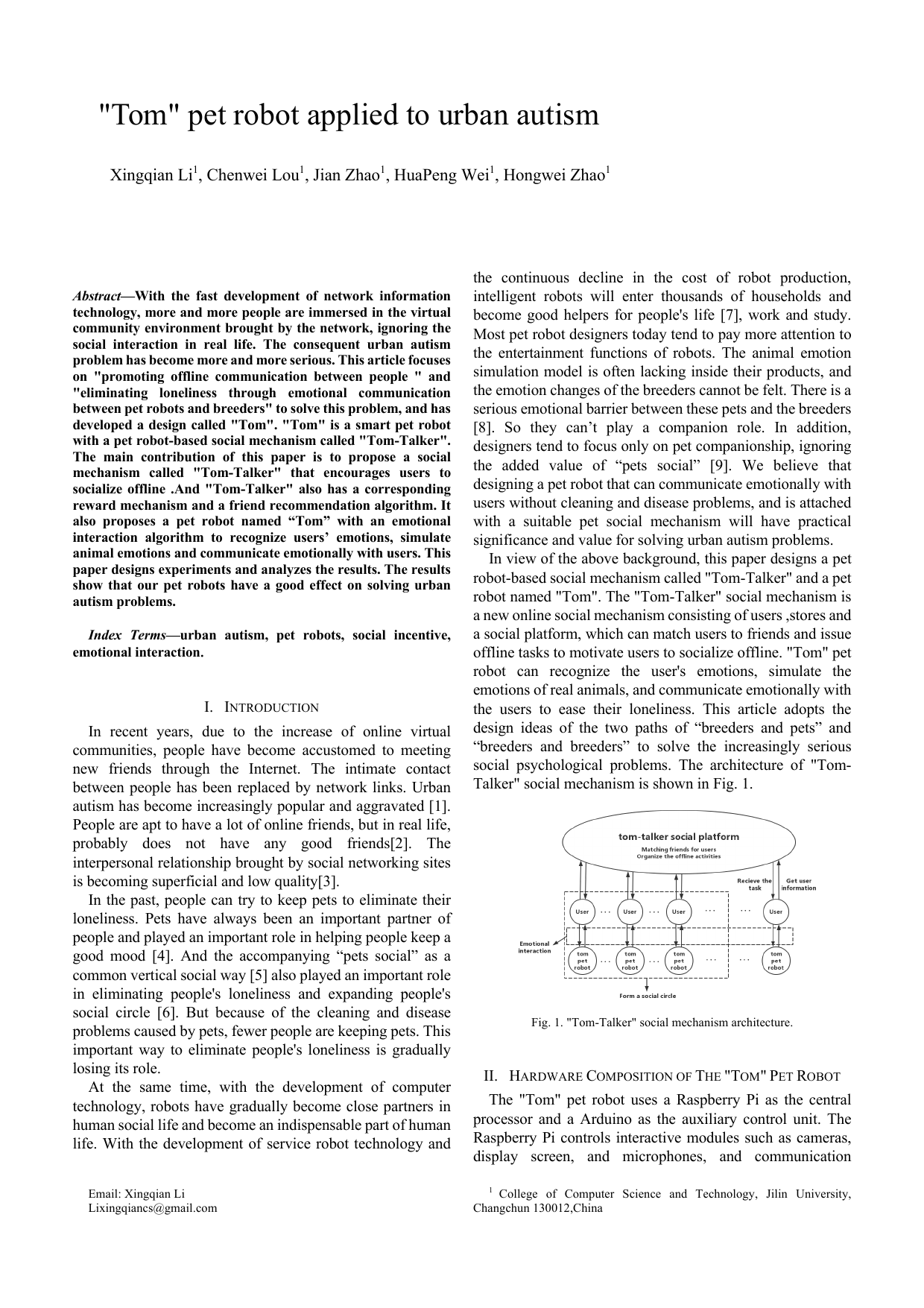
In view of the above background, this paper designs a pet
robot-based social mechanism called “Tom-Talker” and a pet
robot named “Tom”. The “Tom-Talker” social mechanism is
a new online social mechanism consisting of users ,stores and
a social platform, which can match users to friends and issue
offline tasks to motivate users to socialize offline. “Tom” pet
robot can recognize the user’s emotions, simulate the
emotions of real animals, and communicate emotionally with
the users to ease their loneliness. This article adopts the
design ideas of the two paths of “breeders and pets” and
“breeders and breeders” to solve the increasingly serious
social psychological problems. The architecture of “Tom-
Talker” social mechanism is shown in Fig. 1.
Fig. 1. “Tom-Talker” social mechanism architecture.
II. HARDWARE COMPOSITION OF THE “TOM” PET ROBOT
The “Tom” pet robot uses a Raspberry Pi as the central
processor and a Arduino as the auxiliary control unit. The
Raspberry Pi controls interactive modules such as cameras,
display screen, and microphones, and communication
1 College of Computer Science and Technology, Jilin University,
Changchun 130012,China
“Tom” pet robot applied to urban autism
Xingqian Li1, Chenwei Lou1, Jian Zhao1, HuaPeng Wei1, Hongwei Zhao1
modules such as Bluetooth, NFC, and WIFI. Arduino is
mainly responsible for data transmission and controls of
various environmental information acquisition sensors, such
a
…(Full text truncated)…
This content is AI-processed based on ArXiv data.