The Language of Biometrics: Analysing Public Perceptions
There is an increasing shift in technology towards biometric solutions, but one of the biggest barriers to widespread use is the acceptance by the users. In this paper we investigate the understanding, awareness and acceptance of biometrics by the general public. The primary research method was a survey, which had 282 respondents, designed to gauge public opinion around biometrics. Additionally, qualitative data was captured in the form of the participants’ definition of the term \textit{biometrics}. We applied thematic analysis as well as an automated Word Vector analysis to this data to provide a deeper insight into the perceptions and understanding of the term. Our results demonstrate that while there is generally a reasonable level of understanding of what biometrics are, this is typically limited to the techniques that are most familiar to participants (e.g., fingerprints or facial recognition). Most notably individuals’ awareness overlooks emerging areas such as behavioural biometrics (e.g., gait). This was also apparent when we compared participants’ views to definitions provided by official, published sources (e.g., ISO, NIST, OED, DHS). Overall, this article provides unique insight into the perceptions and understanding of biometrics as well as areas where users may lack knowledge on biometric applications.
💡 Research Summary
The paper “The Language of Biometrics: Analysing Public Perceptions” investigates how the general public understands, is aware of, and accepts biometric technologies. Using an online questionnaire, the authors collected responses from 282 participants recruited via convenience and snowball sampling on Twitter, LinkedIn, and Reddit. The survey gathered demographic data (age, gender, education, occupation) and asked respondents whether they had heard of, used, or would feel comfortable with a range of biometric modalities (fingerprint, palm, hand‑vein, face, retina, iris, signature, gait, typing, voice). Participants also ranked five scenarios (banking, airport, home, mobile device, online shopping) by perceived security need and indicated which biometrics they would accept in each context.
Quantitative analysis showed high familiarity and usage for fingerprints (≈92% heard of, ≈78% used) and facial recognition (≈78% heard of, ≈62% used). Awareness of behavioural biometrics such as gait, typing, and hand‑vein was low (under 30% heard of, under 10% used). Surprisingly, “signature” was frequently classified as a biometric, reflecting a common misconception. Comfort with data storage was higher for companies than for governments, especially for behavioural data, indicating privacy concerns. Statistical testing (Pearson chi‑square) revealed no significant correlations between demographic variables and biometric awareness, usage, or trust, likely due to the sample being skewed toward younger, male, highly educated, and IT‑oriented respondents.
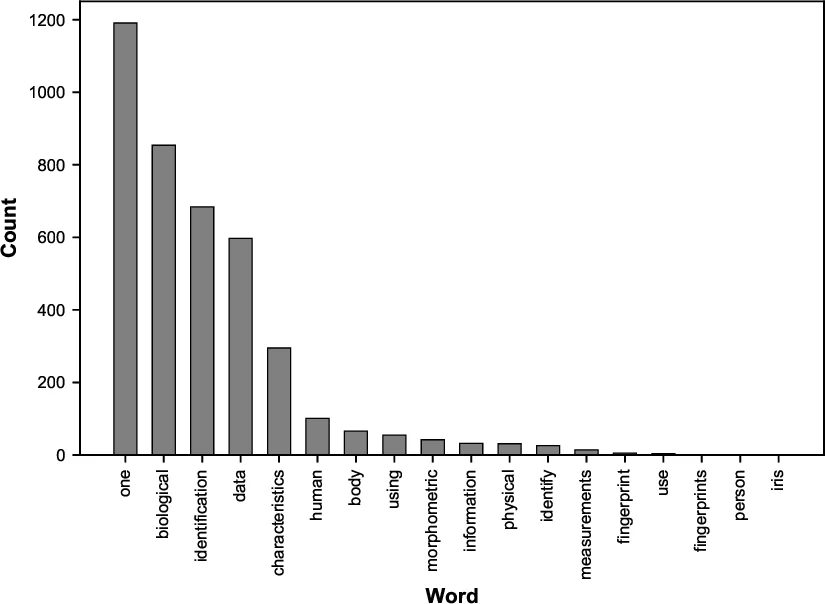
Qualitative analysis combined manual thematic coding of the open‑ended definitions with an automated Word2Vec vector model. Thematic analysis identified dominant concepts such as “security,” “convenience,” “physical traits,” and “data handling.” Word2Vec placed terms like “fingerprint,” “face,” and “security” in a tightly linked semantic cluster, while “gait,” “typing,” and “voice” formed peripheral, low‑frequency clusters, confirming the quantitative finding of limited public awareness of behavioural biometrics.
The authors compare their results with earlier studies (e.g., Furnell & Evangelatos 2010, Chan & Elliot 2015) and note that overall public knowledge of biometric technologies has increased, yet gaps remain, especially for emerging behavioural modalities. They discuss implications for designers and policymakers: education campaigns are needed to clarify what constitutes a biometric, especially to correct misconceptions such as treating signatures as biometrics. Transparent data‑handling policies and clear privacy safeguards are essential to build trust, particularly when government agencies are involved.
Limitations include the non‑representative sampling method, over‑representation of males (62%), participants under 45 (83%), and a high proportion of respondents with at least a bachelor’s degree (67%) and IT/computing occupations (27%). These biases may inflate overall awareness levels and obscure demographic effects.
In conclusion, the study provides a mixed‑methods snapshot of public perception of biometrics in 2019. While physical biometrics like fingerprints and facial recognition enjoy high recognition and acceptance, behavioural biometrics remain obscure and are associated with greater privacy concerns. The findings suggest that successful large‑scale deployment of biometric systems will require targeted user education, transparent governance of biometric data, and design choices that align with the public’s comfort levels across different application contexts.
Comments & Academic Discussion
Loading comments...
Leave a Comment