A 28/37/39GHz Multiband Linear Doherty Power Amplifier in Silicon for 5G Applications
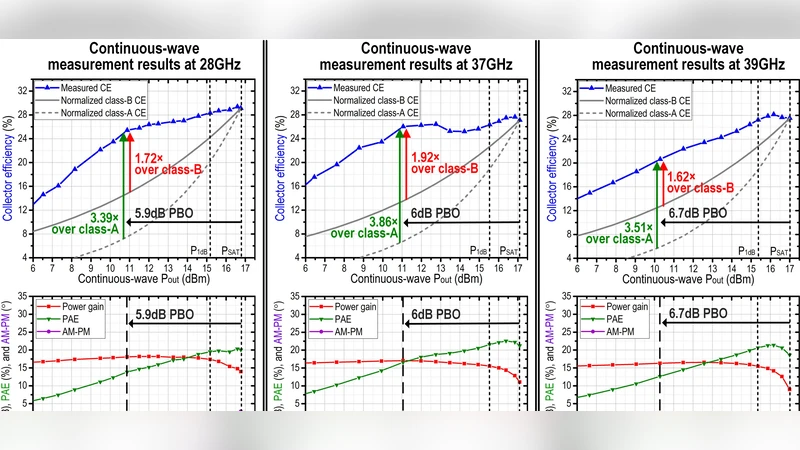
This paper presents the first multiband mm-wave linear Doherty PA in silicon for broadband 5G applications. We introduce a new transformer-based on-chip Doherty power combiner, which can reduce the impedance transformation ratio in power back-off (PBO) and thus improve the bandwidth and power-combining efficiency. We also devise a “driver-PA co-design” method, which creates power-dependent uneven feeding in the Doherty PA and enhances the Doherty operation without any hardware overhead or bandwidth compromise. For the proof of concept, we implement a 28/37/39-GHz PA fully integrated in a standard 130-nm SiGe BiCMOS process, which occupies 1.8mm2. The PA achieves a 52% -3-dB small-signal S21 bandwidth and a 40% -1-dB large-signal saturated output power (Psat) bandwidth. At 28/37/39GHz, the PA achieves +16.8/+17.1/+17-dBm Psat, +15.2/+15.5/+15.4-dBm P1dB, and superior 1.72/1.92/1.62 times efficiency enhancement over class-B operation at 5.9/6/6.7-dB PBO. Moreover, the PA demonstrates multi-Gb/s data rates with excellent efficiency and linearity for 64QAM in all the three 5G bands. This PA advances the state of the art for Doherty, wideband, and 5G silicon PAs in mm-wave bands. It supports drop-in upgrade for current PAs in existing mm-wave systems and opens doors to compact system solutions for future multiband 5G massive MIMO and phased-array platforms.
💡 Research Summary
The paper presents the first silicon‑based multiband millimeter‑wave (mmWave) linear Doherty power amplifier (PA) that simultaneously operates in the 28 GHz, 37 GHz, and 39 GHz bands, targeting broadband 5G applications. Implemented in a standard 130‑nm SiGe BiCMOS process, the PA occupies only 1.8 mm² and integrates a novel transformer‑based low‑loss, broadband Doherty power combiner together with a “driver‑PA co‑design” technique that creates power‑dependent uneven feeding without extra hardware.
Traditional two‑λ/4‑line Doherty combiners suffer from a rapidly increasing impedance transformation ratio (ITR) during power back‑off (PBO), which leads to higher passive loss and reduced bandwidth. By approximating the three‑λ/4‑line network with π‑networks and then collapsing the inductive and capacitive elements into two on‑chip transformers, the authors achieve a compact two‑transformer combiner. The key insight is that the ITR becomes proportional to the ratio Ropt/2RL, allowing a reduction of ITR by up to 2.4× at the 6‑dB PBO point. This dramatically improves passive efficiency in deep PBO and widens the usable frequency span.
The driver‑PA co‑design exploits the driver stage to introduce a controlled non‑linearity in the feed‑forward voltage, effectively turning on the auxiliary PA slightly earlier and keeping the main PA at higher current. Consequently, the optimal current ratio between main and auxiliary cells is achieved precisely at the desired PBO level (5.9–6.7 dB), yielding a second‑efficiency peak without any additional matching networks or switches.
Measured results confirm the design’s effectiveness. The PA delivers +16.8 dBm (28 GHz), +17.1 dBm (37 GHz), and +17 dBm (39 GHz) saturated output power, with +15.2 dBm, +15.5 dBm, and +15.4 dBm 1‑dB compression points respectively. The small‑signal –3‑dB bandwidth covers 52 % of the 3‑GHz span, while the large‑signal –1‑dB output‑power bandwidth reaches 40 %. At 5.9–6.7 dB PBO, the Doherty PA achieves 1.72×, 1.92×, and 1.62× efficiency improvement over a class‑B reference.
Digital modulation experiments demonstrate multi‑Gb/s data transmission with 64‑QAM. The PA maintains error vector magnitude below 5 % and adjacent channel power ratio better than –35 dB across all three bands, confirming excellent linearity alongside high efficiency.
Overall, the work delivers a compact, low‑loss, broadband Doherty PA that can be drop‑in upgraded into existing mmWave front‑ends, reducing board area, power consumption, and system cost. Its transformer‑based combiner and driver‑PA co‑design are scalable to future 5G/6G massive MIMO and phased‑array platforms, where multiband operation, high PBO efficiency, and wide instantaneous bandwidth are critical.
Comments & Academic Discussion
Loading comments...
Leave a Comment