Computation of Circular Area and Spherical Volume Invariants via Boundary Integrals
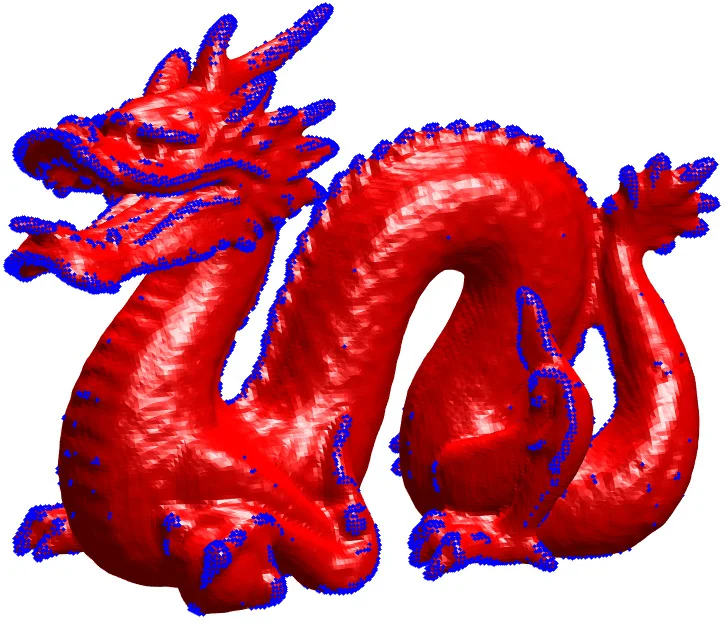
We show how to compute the circular area invariant of planar curves, and the spherical volume invariant of surfaces, in terms of line and surface integrals, respectively. We use the Divergence Theorem to express the area and volume integrals as line and surface integrals, respectively, against particular kernels; our results also extend to higher dimensional hypersurfaces. The resulting surface integrals are computable analytically on a triangulated mesh. This gives a simple computational algorithm for computing the spherical volume invariant for triangulated surfaces that does not involve discretizing the ambient space. We discuss potential applications to feature detection on broken bone fragments of interest in anthropology.
💡 Research Summary
**
The paper presents a unified framework for computing two geometric invariants—the circular area invariant for planar curves and the spherical volume invariant for closed surfaces—by converting volume or area integrals into boundary integrals using the Divergence Theorem.
In the planar case, the authors define the local circular area invariant (A_{C,r}(p)) as the Lebesgue measure of the intersection between the interior (\Omega) of a Jordan curve (C) and a disk of radius (r) centered at a point (p) on the curve. By introducing the vector field (V(x)=\frac12(x-p)) (which satisfies (\operatorname{div}V=1)), the area integral over (\Omega\cap D_r(p)) is rewritten as a sum of two line integrals: one over the portion of the curve inside the disk and another over the circular arc where the disk boundary meets the interior. The resulting formula (2.3)–(2.4) involves only integration along the curve, with the contribution from the circular arc expressed analytically in terms of the intersection angles (\theta_i). This representation readily handles multiple intersections and is directly applicable to discrete polygonal representations of curves.
For three‑dimensional surfaces, the spherical volume invariant (V_{S,r}(p)) is defined as the volume of (\Omega\cap B_r(p)), where (S=\partial\Omega) is a closed surface. The authors first try the same trick with (V(x)=x/n) but encounter an unwanted surface integral over the sphere (\partial B_r(p)). To eliminate it, they add a divergence‑free field (W=\nabla u) where (u) solves a Poisson problem with Neumann data chosen to cancel the sphere term. By allowing a singularity at the center, they take (u(x)=\alpha_n r^n \Phi(x)) with (\Phi) the fundamental solution of Laplace’s equation. This yields a clean expression (Theorem 1, Eq. 3.13)
\
Comments & Academic Discussion
Loading comments...
Leave a Comment