Topology of Networks in Generalized Musical Spaces
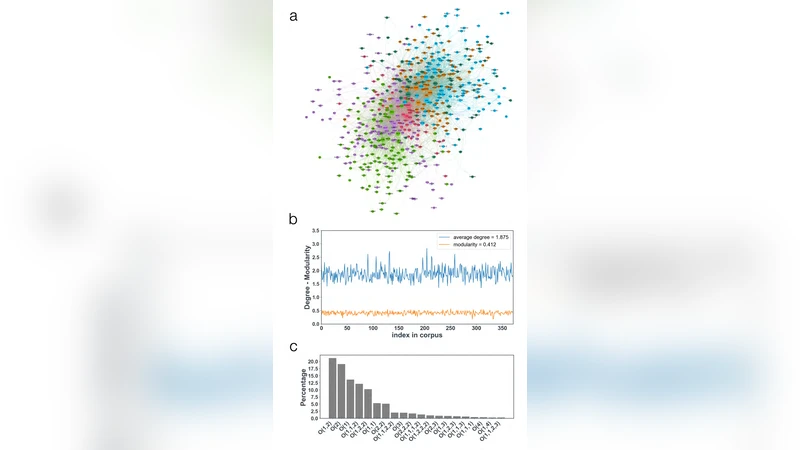
The abstraction of musical structures (notes, melodies, chords, harmonic or rhythmic progressions, etc.) as mathematical objects in a geometrical space is one of the great accomplishments of contemporary music theory. Building on this foundation, I generalize the concept of musical spaces as networks and derive functional principles of compositional design by the direct analysis of the network topology. This approach provides a novel framework for the analysis and quantification of similarity of musical objects and structures, and suggests a way to relate such measures to the human perception of different musical entities. Finally, the analysis of a single work or a corpus of compositions as complex networks provides alternative ways of interpreting the compositional process of a composer by quantifying emergent behaviors with well-established statistical mechanics techniques. Interpreting the latter as probabilistic randomness in the network, I develop novel compositional design frameworks that are central to my own artistic research.
💡 Research Summary
The paper proposes a novel framework that reconceptualizes musical structures—notes, chords, rhythms, melodies, and larger forms—as complex networks rather than points in a high‑dimensional geometric space. After a concise review of traditional music‑space models and their limitations in capturing perceptual similarity, the author outlines a systematic method for mapping musical elements to graph nodes and their relationships (intervallic distance, harmonic tension, rhythmic simultaneity, etc.) to weighted, directed edges. Multiple layers are constructed: a melodic layer captures sequential pitch transitions, a harmonic layer encodes simultaneous pitch sets and functional progressions, a rhythmic layer represents temporal alignments, and a form layer links larger sections.
The core of the study is a topological analysis of these networks using standard graph‑theoretic metrics. Betweenness and closeness centrality identify “hub” pitches or chords that dominate the flow of a piece; high betweenness often corresponds to tonal pivots such as dominant or tonic functions. Clustering coefficients reveal locally dense subgraphs that map onto motifs, themes, or tonal regions, explaining why listeners experience familiarity within those clusters. Modularity detection partitions the whole composition into relatively independent modules (e.g., exposition, development, recapitulation) and quantifies the strength of inter‑module connections, offering a quantitative measure of structural unity versus contrast.
Beyond pure topology, the author adopts a statistical‑mechanics perspective. Edge weights are interpreted as transition probabilities, allowing the calculation of network entropy and free‑energy analogues. Low‑entropy segments correspond to highly predictable, repetitive material, whereas high‑entropy regions signal abrupt modulations, novel rhythmic groupings, or unexpected harmonic shifts. Comparative analyses across genres—classical sonatas, jazz standards, electronic dance tracks—show distinct entropy and clustering signatures that align with established musicological descriptions (e.g., the high entropy and low clustering of many EDM tracks).
The most innovative contribution is a compositional design framework derived from these insights. A composer can pre‑define desired topological targets—specific centrality distributions, target entropy ranges, modularity levels—and employ algorithmic generation tools that iteratively adjust the network to meet those constraints. This approach bridges intuitive, human‑driven composition with data‑driven generative models, ensuring that the output not only satisfies statistical criteria but also aligns with perceptual expectations of tension, release, and thematic coherence.
Finally, the paper outlines future directions: empirical validation of the correlation between network metrics and listener perception through psychophysical experiments, development of real‑time composition interfaces that visualize and manipulate network topology on the fly, and large‑scale automated extraction of musical networks from corpora for clustering and style‑identification tasks. In sum, by treating music as a complex network, the work provides a rigorous, quantitative toolkit for analysis, similarity measurement, and creative generation, opening a promising interdisciplinary pathway between music theory, network science, and cognitive acoustics.
Comments & Academic Discussion
Loading comments...
Leave a Comment