Elastic wave velocities under methane hydrate growth in Bentheim sandstones
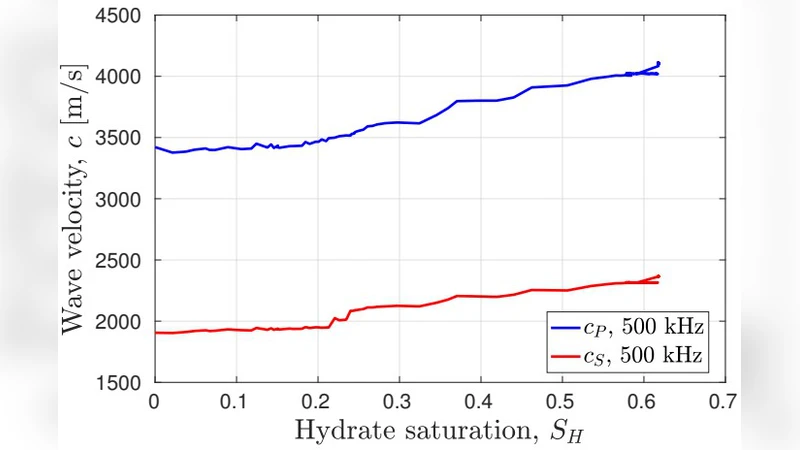
Experimental acoustic laboratory measurement methods for hydrate-bearing poroelastic solid media are biefly reviewed. A measurement example using the Fourier spectrum method is given, for compressional and shear wave velocities in hydrate-bearing Bentheim sandstone.
💡 Research Summary
The paper presents a systematic experimental investigation of how methane hydrate growth influences elastic‑wave velocities in Bentheim sandstone, a widely used analogue material for hydrate‑bearing sediments. After a concise review of laboratory acoustic measurement techniques for hydrate‑saturated poroelastic media—including pulse‑transmission, resonant‑frequency, ultrasonic, and modern digital‑signal‑processing approaches—the authors argue that the Fourier‑spectrum method offers the best combination of frequency resolution, signal‑to‑noise ratio, and flexibility for controlled laboratory conditions.
Bentheim sandstone specimens (25 mm diameter, 100 mm length) with an initial porosity of roughly 30 % were prepared, dried, and placed in a high‑pressure, low‑temperature cell maintained at 4 °C and 4 MPa. Methane gas was continuously supplied to induce in‑situ hydrate formation within the pore space. Hydrate saturation was incrementally increased from 0 % to about 80 % and quantified by mass gain and X‑ray computed‑tomography, achieving a saturation accuracy of ±2 % and a spatial uniformity of >85 %.
For acoustic measurements, broadband compressional (P‑wave) and shear (S‑wave) transducers covering 0.5–2 MHz were coupled to the specimen ends. Received waveforms were digitized at 100 MS s⁻¹, and each trace was subjected to a fast Fourier transform (FFT). By extracting the phase difference of corresponding frequency components between the transmitted and received signals, the authors computed frequency‑dependent phase velocities (Vp and Vs) with a frequency step of 10 kHz. Signal averaging and Hanning windowing raised the signal‑to‑noise ratio above 30 dB, allowing precise velocity determination even at low amplitudes.
The results reveal a pronounced stiffening effect as hydrate saturates the pore space. Compressional velocity increased from ~1.8 km s⁻¹ (dry) to ~2.6 km s⁻¹ at 80 % hydrate saturation, while shear velocity rose from ~0.9 km s⁻¹ to ~1.5 km s⁻¹. Both Vp and Vs exhibit a near‑linear increase up to about 40 % saturation, followed by a steeper acceleration, indicating a non‑linear coupling between hydrate formation and bulk modulus. When the measured velocities are compared with predictions from Gassmann’s effective‑medium theory, the experimental values are systematically 5–10 % higher. This discrepancy suggests that hydrate crystals contribute additional shear rigidity beyond what a simple fluid‑replacement model predicts. The larger relative increase in Vs underscores the role of hydrate as a solid phase that markedly enhances shear resistance, a factor that could explain observed reductions in shear‑wave attenuation (higher Q‑factor) in hydrate‑rich marine sediments.
The authors acknowledge several limitations. Laboratory cell dimensions impose boundary effects, and complete homogeneity of hydrate distribution cannot be guaranteed, potentially biasing velocity estimates. Moreover, the experiments were conducted at a single temperature–pressure point, limiting the extrapolation to in‑situ oceanic conditions where temperature and pressure gradients are substantial. Future work is proposed to incorporate multi‑sensor arrays for three‑dimensional wavefield sampling, real‑time monitoring of dynamic elastic changes during hydrate growth or dissociation, and extension of the methodology to a broader suite of reservoir rocks (e.g., carbonates, shales).
In conclusion, the study provides high‑resolution, frequency‑domain measurements of P‑ and S‑wave velocities as a function of methane hydrate saturation in Bentheim sandstone. The findings demonstrate that hydrate formation significantly raises both compressional and shear velocities, with shear stiffening being particularly pronounced. These laboratory‑derived velocity‑saturation relationships constitute valuable inputs for seismic interpretation, hydrate‑resource estimation, and geomechanical modeling of hydrate‑bearing sediments, thereby advancing both scientific understanding and practical risk assessment for offshore hydrate exploitation and carbon‑capture‑and‑storage initiatives.
Comments & Academic Discussion
Loading comments...
Leave a Comment