Winner-Take-All Computation in Spiking Neural Networks
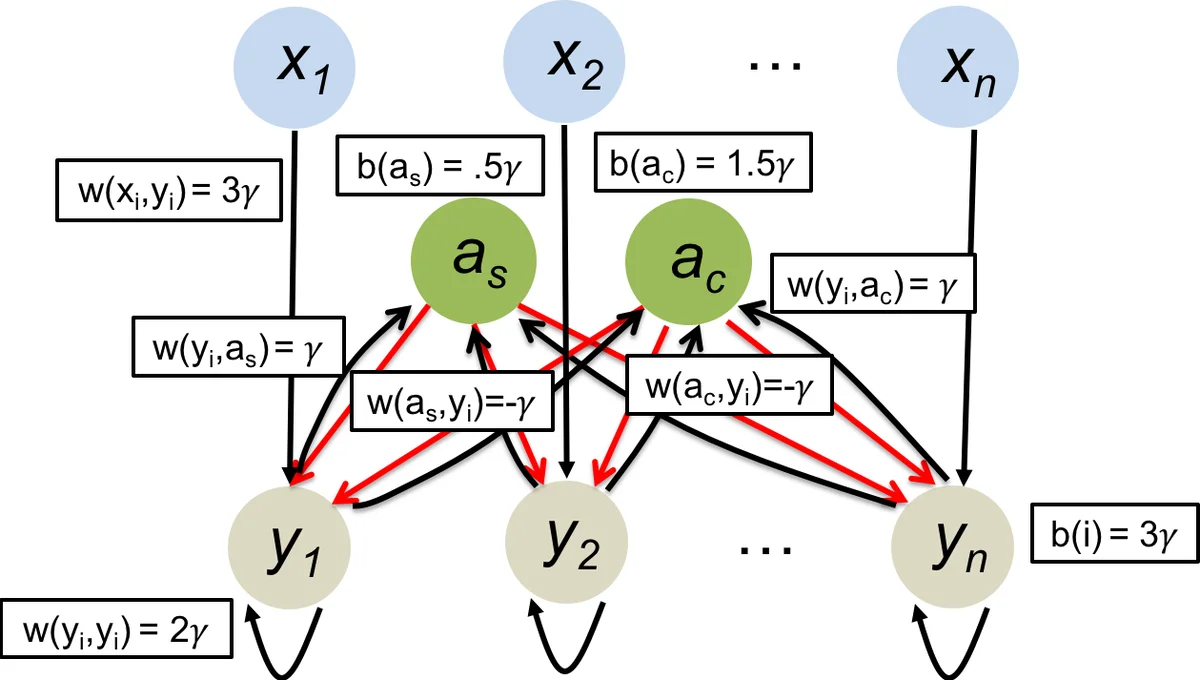
In this work we study biological neural networks from an algorithmic perspective, focusing on understanding tradeoffs between computation time and network complexity. Our goal is to abstract real neural networks in a way that, while not capturing all interesting features, preserves high-level behavior and allows us to make biologically relevant conclusions. Towards this goal, we consider the implementation of algorithmic primitives in a simple yet biologically plausible model of $stochastic\ spiking\ neural\ networks$. In particular, we show how the stochastic behavior of neurons in this model can be leveraged to solve a basic $symmetry-breaking\ task$ in which we are given neurons with identical firing rates and want to select a distinguished one. In computational neuroscience, this is known as the winner-take-all (WTA) problem, and it is believed to serve as a basic building block in many tasks, e.g., learning, pattern recognition, and clustering. We provide efficient constructions of WTA circuits in our stochastic spiking neural network model, as well as lower bounds in terms of the number of auxiliary neurons required to drive convergence to WTA in a given number of steps. These lower bounds demonstrate that our constructions are near-optimal in some cases. This work covers and gives more in-depth proofs of a subset of results originally published in [LMP17a]. It is adapted from the last chapter of C. Musco’s Ph.D. thesis [Mus18].
💡 Research Summary
This paper, titled “Winner-Take-All Computation in Spiking Neural Networks,” presents an algorithmic study of biological neural computation. The authors focus on understanding the fundamental trade-offs between computation time and network complexity within a simplified yet biologically plausible model.
The core of the work is the design and analysis of circuits that solve the Winner-Take-All (WTA) problem in a model of stochastic spiking neural networks (SNNs). In this model, neurons fire probabilistically based on their membrane potential, which is determined by weighted inputs from firing neighbors in the previous time step. Neurons are strictly excitatory or inhibitory, adhering to Dale’s principle, and all synaptic weights are fixed.
The WTA problem involves selecting a single “winner” from a set of n output neurons corresponding to n input neurons with identical firing rates. This symmetry-breaking task is a fundamental primitive believed to underpin functions like attention, competitive learning, and pattern recognition.
The primary contributions are efficient network constructions and matching lower bounds. First, the authors describe a family of networks using only two auxiliary inhibitory neurons. This “two-inhibitor construction” employs biologically inspired reciprocal excitation-inhibition and excitatory self-loops. It is self-stabilizing, converging from any initial state to a valid WTA configuration in O(log n) expected time, and with high probability in O(log n * log(1/δ)) time.
Second, they show that faster convergence is possible with more resources. By using O(log n) auxiliary inhibitory neurons, they design a network that converges in O(1) expected time and O(log(1/δ)) time with high probability. This demonstrates a clear trade-off: increased network complexity (more neurons) enables reduced computation time.
To establish the near-optimality of their constructions, the authors prove rigorous lower bounds. A key result is that no network can solve the WTA problem using just a single auxiliary neuron, as one neuron cannot simultaneously drive rapid convergence and maintain stability. Furthermore, they prove that any network with only two auxiliary neurons requires Ω(log n / log log n) time to solve WTA with constant probability, showing their two-inhibitor O(log n)-time construction is optimal up to a logarithmic factor.
Overall, this work bridges computational neuroscience and theoretical computer science. It provides a rigorous framework for analyzing neural computation, demonstrates how stochasticity can be harnessed algorithmically, and offers efficient, minimal neural implementations of a critical computational primitive. The results suggest mechanistic explanations for how biological systems might perform complex computations with limited inhibitory resources.
Comments & Academic Discussion
Loading comments...
Leave a Comment