Noidy Conmunixatipn: On the Convergence of the Averaging Population Protocol
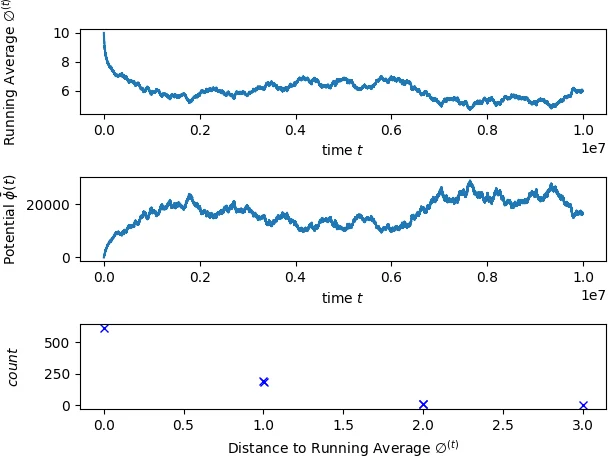
We study a process of \emph{averaging} in a distributed system with \emph{noisy communication}. Each of the agents in the system starts with some value and the goal of each agent is to compute the average of all the initial values. In each round, one pair of agents is drawn uniformly at random from the whole population, communicates with each other and each of these two agents updates their local value based on their own value and the received message. The communication is noisy and whenever an agent sends any value $v$, the receiving agent receives $v+N$, where $N$ is a zero-mean Gaussian random variable. The two quality measures of interest are (i) the total sum of squares $TSS(t)$, which measures the sum of square distances from the average load to the \emph{initial average} and (ii) $\bar{\phi}(t)$, measures the sum of square distances from the average load to the \emph{running average} (average at time $t$). It is known that the simple averaging protocol—in which an agent sends its current value and sets its new value to the average of the received value and its current value—converges eventually to a state where $\bar{\phi}(t)$ is small. It has been observed that $TSS(t)$, due to the noise, eventually diverges and previous research—mostly in control theory—has focused on showing eventual convergence w.r.t. the running average. We obtain the first probabilistic bounds on the convergence time of $\bar{\phi}(t)$ and precise bounds on the drift of $TSS(t)$ that show that albeit $TSS(t)$ eventually diverges, for a wide and interesting range of parameters, $TSS(t)$ stays small for a number of rounds that is polynomial in the number of agents. Our results extend to the synchronous setting and settings where the agents are restricted to discrete values and perform rounding.
💡 Research Summary
The paper studies a fundamental gossip‑based averaging protocol in the presence of additive noise. A population of (n) agents each holds an initial scalar value. In each discrete round a pair of agents is chosen uniformly at random (sequential model) or the whole population is partitioned into random pairs (synchronous model). The two agents exchange their current values, but the transmitted value is corrupted by an independent zero‑mean random variable (N) (typically Gaussian with variance (\sigma^{2})). After receiving the noisy message each agent updates its own value to the arithmetic mean of its previous value and the received (noisy) value. The protocol is memory‑light: each agent stores only a single scalar.
Two performance metrics are considered. The first, Total Sum of Squares (TSS), measures the squared distance of the current state from the initial average (\emptyset(0)=\frac{1}{n}\sum_{i}x_{i}(0)): \
Comments & Academic Discussion
Loading comments...
Leave a Comment