Cross-Sender Bit-Mixing Coding
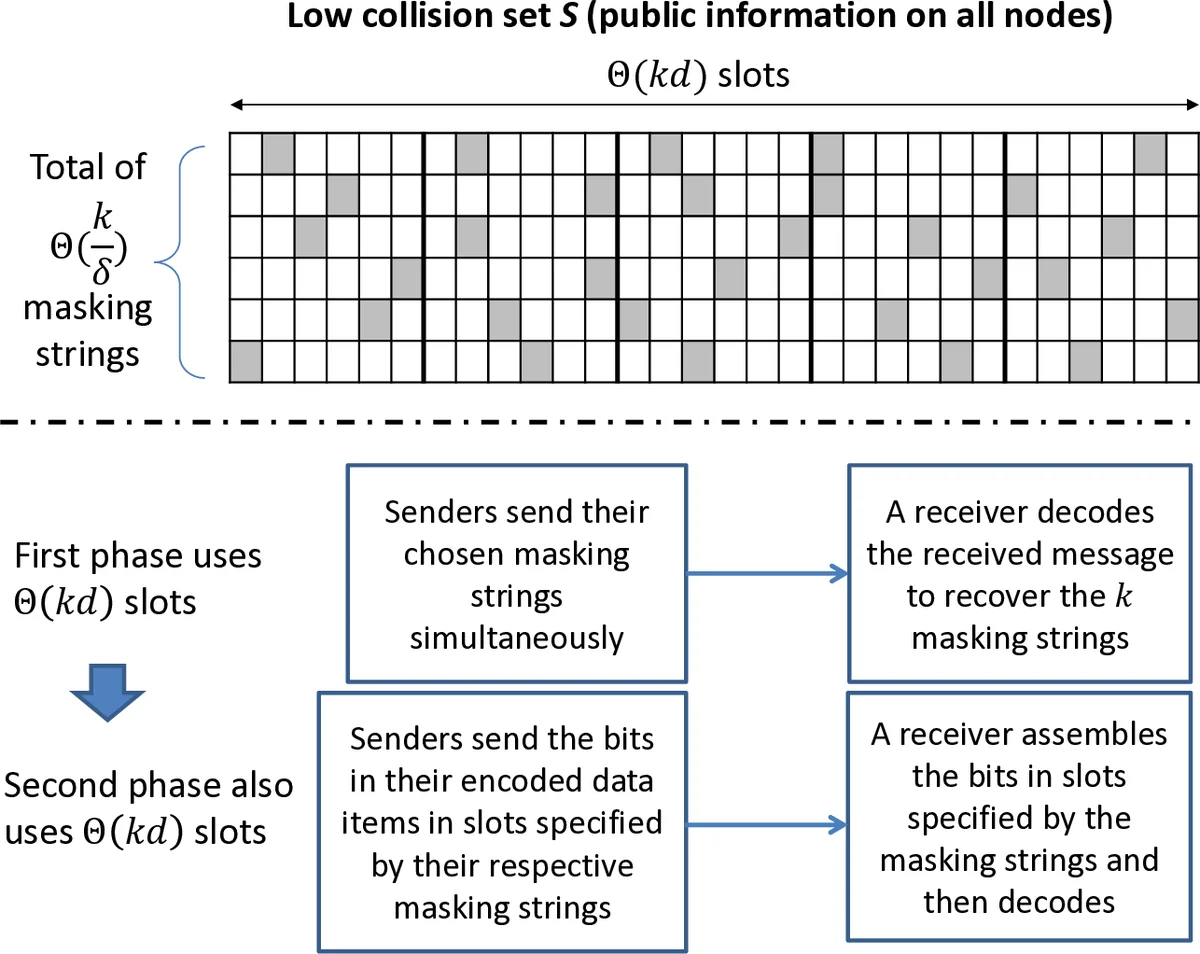
Scheduling to avoid packet collisions is a long-standing challenge in networking, and has become even trickier in wireless networks with multiple senders and multiple receivers. In fact, researchers have proved that even {\em perfect} scheduling can only achieve $\mathbf{R} = O(\frac{1}{\ln N})$. Here $N$ is the number of nodes in the network, and $\mathbf{R}$ is the {\em medium utilization rate}. Ideally, one would hope to achieve $\mathbf{R} = \Theta(1)$, while avoiding all the complexities in scheduling. To this end, this paper proposes {\em cross-sender bit-mixing coding} ({\em BMC}), which does not rely on scheduling. Instead, users transmit simultaneously on suitably-chosen slots, and the amount of overlap in different user’s slots is controlled via coding. We prove that in all possible network topologies, using BMC enables us to achieve $\mathbf{R}=\Theta(1)$. We also prove that the space and time complexities of BMC encoding/decoding are all low-order polynomials.
💡 Research Summary
The paper tackles a fundamental limitation of wireless networks that involve many simultaneous senders and receivers. Classical approaches rely on scheduling transmissions to avoid collisions, but even an optimal schedule can only achieve a medium utilization rate (R = O(1/\ln N)), where (N) is the total number of nodes. This bound, proved by Ghafari et al., stems from the incompatibility of per‑receiver optimal schedules when they must be merged into a global schedule; the resulting lower bound on total time is (\Omega(kd\ln N)) for a scenario where each receiver must obtain (k) packets of size (d) bytes. Consequently, as the network grows, the fraction of airtime that carries useful information vanishes.
To overcome this, the authors introduce Cross‑Sender Bit‑Mixing Coding (BMC), a scheme that completely abandons explicit scheduling. Each sender encodes its data into a binary codeword (the “bit‑mixing” code) and transmits the bits in a pre‑determined set of time slots. When multiple senders transmit in the same slot, their bits are superimposed at the physical layer; the paper assumes an OR‑channel model where the received bit is the logical OR of all transmitted bits. The collection of transmitted bits across all slots forms a binary matrix that can be interpreted as a non‑adaptive group‑testing (NAGT) or superimposed code matrix.
The key technical insight is that if the testing matrix satisfies certain sparsity and disjunctness properties—specifically, each column (sender) has a small number of ones and any two columns overlap in at most a constant number of rows—then the receiver can uniquely identify each sender’s original data from the OR‑superimposed observations. The authors prove that for any network topology, provided the number of neighbors per receiver (k) grows faster than (\log N) ((k = \omega(\log N))) and the packet size (d) grows faster than (\log^2 N) ((d = \omega(\log^2 N))), the decoding error probability can be made arbitrarily small. Under these conditions the total transmission time is (\Theta(kd)), which matches the per‑receiver lower bound and yields a constant utilization rate (R = \Theta(1)).
Complexity analysis shows that encoding each (d)-byte packet requires only (O(d\log N)) time (to map bits to the appropriate slots), and decoding can be performed in polynomial time with respect to (k) and (d). The paper presents concrete algorithms whose time complexity is (O((kd)^c)) for a small constant (c) (typically 2 or 3) and space usage linear in the size of the testing matrix. This contrasts sharply with earlier superimposed‑code constructions that either need exponential decoding time (e.g., (2^{\Theta(d)})) or achieve only sub‑optimal utilization (R = \Theta(1/k)).
A notable advantage of BMC is its minimal physical‑layer requirements. Unlike additive‑channel schemes such as CRMA or ZigZag, which need accurate channel coefficient estimation and complex linear‑combination decoding, BMC works with a simple OR‑channel that can be realized even on ultra‑low‑power radios (e.g., on‑off keying). This makes the approach suitable for dense sensor deployments, disaster‑recovery scenarios, vehicular ad‑hoc networks, and future smart‑grid communication where many devices transmit concurrently.
The authors also discuss related work in additive and XOR channels, all‑to‑all and one‑to‑all dissemination, and prior superimposed‑code/group‑testing literature. They argue that while many existing designs can achieve high throughput under specific assumptions, none simultaneously offers constant medium utilization, polynomial‑time decoding, and applicability to dense, low‑complexity wireless environments.
Limitations are acknowledged. The theoretical guarantees require (k) and (d) to be sufficiently large; performance for small neighborhoods or short packets is not covered. The OR‑channel abstraction may not capture real‑world impairments such as noise, synchronization errors, or non‑ideal hardware behavior. Moreover, the analysis assumes perfect slot synchronization among all senders, an issue that would need practical solutions in real deployments.
In summary, the paper presents a novel coding framework—Cross‑Sender Bit‑Mixing Coding—that eliminates the need for scheduling in multi‑sender, multi‑receiver wireless networks. By leveraging superimposed coding and non‑adaptive group testing principles, BMC achieves a constant medium utilization rate (R = \Theta(1)) across any network topology while keeping encoding and decoding computationally tractable. The work opens a new direction for designing high‑efficiency, low‑complexity MAC protocols, and suggests several avenues for future research, including experimental validation on real radio hardware, robustness to synchronization errors, and integration with existing network‑coding or capture‑effect techniques.
Comments & Academic Discussion
Loading comments...
Leave a Comment