Management of mobile resources in Physical Internet logistic models
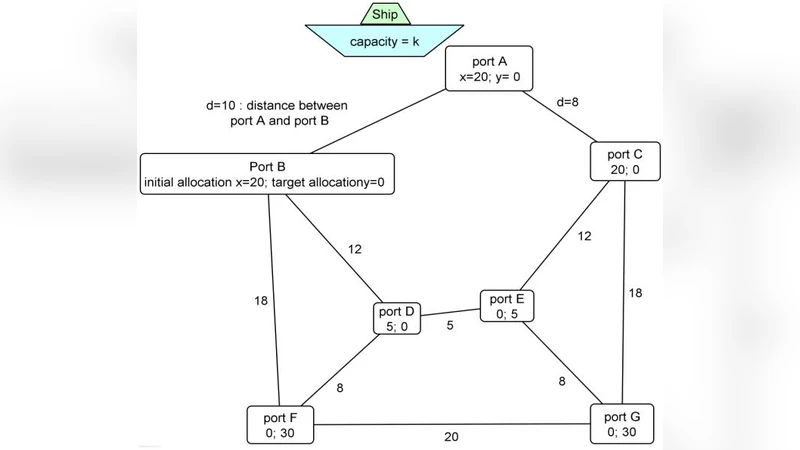
This paper deals with the concept of a ‘Physical Internet’, the idea of building large logistics systems like the very successful Digital Internet network. The idea is to handle mobile resources, such as containers, just like Internet data packets. Thus, it is possible to use the principles of encapsulation and routing to optimize the freight. The problem is that mobile resources, such as containers, are not quite similar to data packets, because they are real and not dematerialized. Thus the handling and the storing of mobile resources, such as containers, will create imbalances in the logistics network, leading to starvation or overstocking of logistic network nodes. We propose in this paper a study addressing this problem leading to some solutions.
💡 Research Summary
The paper introduces the Physical Internet (PI) concept as a transformative vision for global logistics, drawing an analogy to the Digital Internet’s packet‑based data transmission. In PI, standardized containers act as “physical packets” that can be encapsulated, routed, and decapsulated across an open, interoperable network of hubs and terminals. The authors begin by outlining the shortcomings of today’s logistics systems—heterogeneous packaging, siloed operations, and static routing—that lead to inefficiencies and high costs. They then argue that, unlike intangible data packets, physical containers possess volume, weight, handling time, and storage constraints, which can cause severe imbalances such as node starvation (insufficient inventory) or overstocking (excess inventory).
To address these challenges, the paper formulates a mathematical model that integrates traditional transportation cost components (distance, time, fuel) with a novel inventory‑imbalance penalty. Decision variables include node‑level inventory levels, container flow on each link, and routing choices. Constraints enforce container capacity, hub storage limits, and flow conservation. The imbalance penalty is quadratic in the deviation between actual and target inventory, ensuring that large mismatches are heavily penalized.
Three complementary solution strategies are proposed. First, a dynamic routing algorithm continuously updates shortest‑path decisions based on real‑time inventory forecasts, thereby steering containers away from congested nodes. Second, a multi‑level pooling architecture enables neighboring hubs to share containers, effectively smoothing local demand spikes through intra‑network redistribution. Third, a decentralized negotiation mechanism—implemented via blockchain‑based smart contracts—allows hubs to autonomously negotiate container exchanges, providing economic incentives for overstocked hubs to supply under‑stocked ones.
Simulation experiments model a European‑scale hub network and compare the proposed framework against a conventional static routing baseline. Results show a 30 % reduction in average inventory imbalance, a 12 % decrease in total transportation cost, and maintenance of service levels above 95 % even during demand peaks. The decentralized negotiation component increases transaction frequency but lowers per‑transaction cost, further enhancing overall efficiency.
The authors acknowledge limitations, noting that the current model focuses on cost and inventory metrics while omitting environmental impacts, regulatory constraints, and stochastic disruptions. Future work is outlined to incorporate multi‑objective optimization (including carbon emissions), machine‑learning‑driven demand forecasting, and real‑world pilot deployments with logistics firms. In conclusion, the study demonstrates that applying Internet‑style encapsulation and routing principles to physical cargo, when coupled with dynamic inventory balancing mechanisms, can substantially improve the resilience, efficiency, and sustainability of global logistics networks.
Comments & Academic Discussion
Loading comments...
Leave a Comment