Characterizing Energy Efficiency of Wireless Transmission for Green Internet of Things: A Data-Oriented Approach
The growing popularity of Internet of Things (IoT) applications brings new challenges to the wireless communication community. Numerous smart devices and sensors within IoT will generate a massive amount of short data packets. Future wireless transmi…
Authors: Hong-Chuan Yang, Mohamed-Slim Alouini
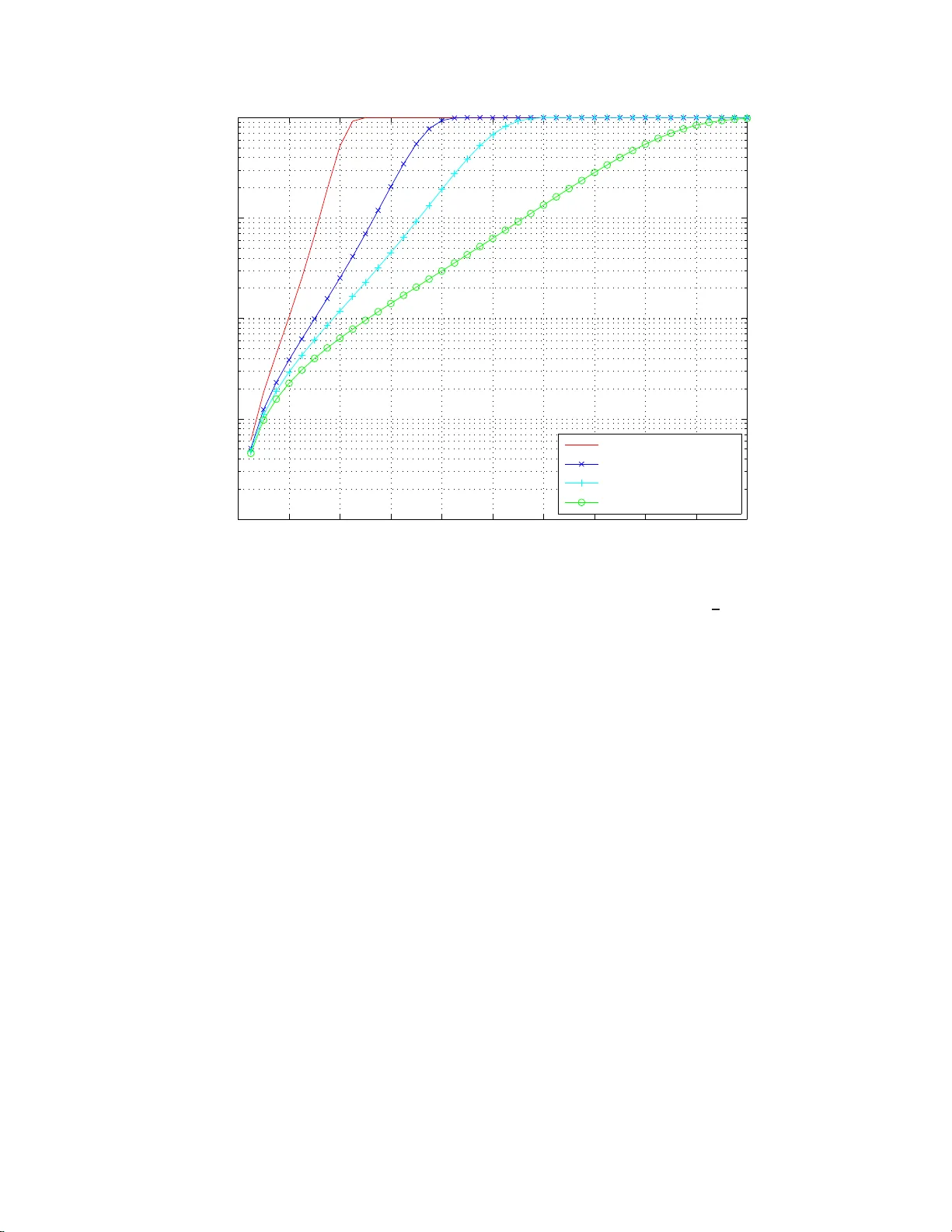
1 Characte rizing Ener gy Ef ficienc y of W ireless T ra nsmission for Green Internet of Thing s: A Data-Ori ented Approach Hong-Chuan Y ang, Senior Member , IEEE and Mohamed-Slim Alouini, F ellow , IEEE Abstract The gr owing popular ity of Interne t of Thing s (Io T) application s br ings new challenges to th e wireless commun ication commun ity . Numer o us smart devices an d sensors w ith in IoT will genera te a massi ve amount of short d ata packets. Future wireless transmission systems n eed to supp ort the reliable transmission of such small d ata w ith extremely high energy efficiency . In this article, we introduce a novel data-oriented appro ach for ch aracterizing the energy effi ciency of wireless transmission strategies for IoT application s. Specifically , we present new energy effi ciency performan c e limits targeting at individual data transmission sessions. Through preliminary an alysis o n two channel- a d aptive transmis- sion strategies, we develop se veral impor tant design g uidelines on gree n transmission of small data. W e also present sev eral pr omising futu re ap p lications o f the proposed data-oriented energy ef ficien cy characterizatio n. Index T erms Internet of Things, wireless commun ications, energy ef ficiency , fading chann els, adaptive transmis- sion. This work was supported i n part by an NSERC Discov ery Grant. H.-C. Y ang i s with the Department of Electrical and Computer Engineering, Uni versity of V ictoria, V ictoria, BC V8W 2Y2, Canada (e-mail: hy@uvic,ca). M.-S. Alouini is with the Comp uter , Electrical, and Mathematical Sciences an d Engineering (CEMSE) Division , King Abdullah Univ ersity of Science and T echno logy (KA UST), Thuwal 23955, Saudi Arabia ( e-mail : slim.al ouini@kaust.edu.sa). 2 I . I N T R O D U C T I O N The Internet of Things (IoT) wil l dram at i cally chang e the way we interact with the world. IoT extends the Internet to our daily objects, such as appli ances, cameras, li ghts, displ ays, and vehicles, by equipping them with micro-controllers, communication, and networking capability . Such extension will transform our daily life and enabl e many new applications, ranging from home automation and traffic management, to s mart g rids and m o bile health-care [1]. Furthermore, these conn ected devices will g enerate a large amount of data, the timely p rocessing of which will bring huge s ocial and ec onomical benefits. M eanwhile, several technical challenges need to be addressed to realize the full p o tential o f IoT . For example, the IoT needs to sup p ort dive rse application s cenarios , whi ch typ i cally have diverse service requirements [2]. Th e provision of IoT functionality will definitely increase the ove rall system cost, the justification of which requires suitable business model. Furthermore, the communicatio n and networking functions of IoT devices will necessarily cons ume extra ener gy . As the number of connected devices and sensors with in the IoT will be enormous, the overall energy consump tion of future IoT coul d be prohi bitive with con ventional transm ission strategies. As such, there is a pressing need for dev eloping green IoT technologies. W ireless transmissi on is the i d ea choice for connecting IoT de vices. Therefore, designing highly ener gy efficient w i reless transmission st rategies wil l be essential to the realization of green IoT . Ener gy efficienc y has alw ays been a serious concern for wireless systems si nce wireless devices typically hav e limited energy suppl y . V arious advance d transm i ssion technolo- gies, including channel adaptive transm ission [3] and cooperativ e relay transmission [4], [5], are dev eloped and deployed to support high data rate wireless servi ces with lo w energy cost. These transmissio n technolo g ies were typically design ed with the goal of enhancing or approaching t he capacity limits o f wi reless channels for a given transmission power , as the energy effic iency is usually quanti fied as the ratio of channel capacity over transmission power [6], [7]. On the other hand, most existing metrics characterize energy ef ficiency i n an av erage sense. Such characterization can not provide useful guidelin es t o t he energy efficienc y i mprovement for individual trans m ission sessions over IoT , which usuall y occur in a sporadic fashion. The IoT i ntroduces a p aradigm sh ift to wireless communicatio n s. M ost IoT appl i cations entails quick information exchanges from smart devices/sensors. These m achine-type terminals wil l sporadically access the networks for the transmis sion of sh o rt packets that contains metering 3 data, stat u s info rm ation, and remot e commands. These transmission sessions will hav e much shorter duration t han con ventional traffi cs, such as phone calls and video streaming. Con ventional transmissio n syst em design typi call y adopts a c hannel-oriented approach assum i ng a consistent and continuo u s data traffic and im p roves the a verage channel q uality with advanced t ransmis- sion technolo g ies. M eanwhile, such approach igno res the specifics o f individual transm ission sessions, such as t he traffic characteristics and the prev aili ng channel/network condition. When the transmiss ion sessions are short, the energy efficienc y achiev ed by individual sessi ons will var y dramatically as the result of the channel variation. T o further improve the energy ef ficienc y of wi reless transmission s ystems, especially for IoT applications , we need to optimall y design the transm i ssion strategies from the perspective o f i ndividual transmission sessions. Motiv ated by thi s intui tion, we propose a novel data -oriented approach for the energy ef fi- ciency o ptimization o f wireless transmiss ion strategies for IoT appl ications. Specifically , when a certain amount of data is av ailable for transm ission, w e op t imally decide th e t ransmission strategy for the highest possibl e ener gy ef ficienc y . The transmissi o n strategy will be adjusted for each data t ransm ission sessi o n according to t h e traffi c characteristics and the channel/network conditions. Intuitively , we expect that the average energy efficienc y of wi reless transmissio n will be further enhanced if the transmission strate gy is optimized for each transmission sessi on. In t his arti cle, we present an initial in vestigation on th is data-oriented approach for developing ener gy ef ficient transmissi on strategies. In particular , we int roduce two ne w data-oriented ener gy ef ficiency performance metri cs t argeting at individual data transm ission sessions. W e illustrate their analysis on two p opular channel adaptive transmi ssion strategies over fading channels. Finally , we discuss sever al prom ising future research directions with the data-oriented approach for green wireless transmi ssion system design and analys i s. I I . C O N V E N T I O NA L E N E R G Y E FFI C I E N C Y M E T R I C S Ener gy effic iency met ri cs are essential to t h e analysis and design of green communicatio n systems. They h elp assess and compare the energy cons umption of different designs and p rovide long-term researc h goals. Th e energy effic iency metrics for wireless commu n ication systems can be generally classified in to t wo categories: i ) network-lev el m etrics and ii) l ink-lev el m et ri cs. Network-le vel metrics characterize the energy ef ficiency of the whole syst em with the considera- tion of service covera ge. Examples include the ratio of coverage area to s ite po wer consumption with t h e unit of k m 2 /W att [8] and the ave rage power usage per service d ata rate p er coverage 4 area in W att/bp s /m 2 [9]. As many factors, including equipment choi ce, network structure, and facility arrangement, affe ct t he energy cons umption of a wireless network, t hese network-lev el metrics can not provide direct guideli nes to green desi g n of wireless t ransm ission system. Link-lev el m etrics typically focus on the ener gy efficienc y of a particular t ransmission link and quantify t he efficienc y of the transmiss i on system i n achieving a certain transm ission rate with respect to resource utilization. For e xample, the achie ved data rate per unit power consumpti on, with unit of bi ts/s/W att or equiv alently bit s /Joule, i s a wi dely used ener gy efficienc y metric [7]. This m etric was applied to the tradeoff analysis among differ ent syst em design parameters [6]. The radio efficiency m etric in m · bit/s/W att [10] considers bo th transmis s ion rate and transm ission distance. W ith the applicati o n of Shanno n capacity formula, the upper b o unds of these ener gy ef ficiency metrics can be ev aluated. On the other hand, t h ese m etri cs are t y pically defined for constant channel realizatio n w i th fixed transmission power and as such ca n not directly apply to fading wireless channels wit h time-varying channel gains. W e can generalize most link-lev el metrics to f ading wireless channels by applying the er godic capacity concept. Ergodic capacity characterizes the l argest possib l e average t ransmission rate that a wireless channel can support. Usi n g ergodic capacity , we can ev aluate the a verage ener gy ef ficiency of wireless t ransm ission over fading channels. In particular , the er godic capacity was utilized to ev aluate the area spectral efficienc y of cell ular systems [11]. The metric was later generalized to quantify the energy ef ficiency of poi nt-to-point transm ission w i th the consideration of affected area [12]. M eanwhile, these er godic capacity based metrics on can only characterize the ener gy ef ficiency of wireless transmiss ion in an aver age sense. The resulting analysis i s gen- erally applicable t o con ventional continuou s data traffi cs. The IoT in volves numerous machine- type terminals that generates sporadi c sm all data packets. The ener gy consum ption of indi vidual data transm ission session for t h ese small data var ies dramatically with the pre vailing channel realization. The realization of green IoT relies heavily on the ener gy efficienc y improvement for short transmis s ion sessions. T o further enhance the energy efficiency of wireless system for ‘small data’ transmis sion, we need to study wireless transmissi o n t echnologies from a ne w perspecti ve. In this article, we follow a data-orient ed approach and propose to characterize the energy effi ciency of wireless transmissio n for t he p erspectiv e of individual data transmi ssion sessio ns. More specifically , we raise the fol lowing fun d am ental qu estions: Given a certain amount of d ata to b e transmitted, what is the probabili ty t hat the amount of energy required for its successful transm ission is 5 greater than a th reshold leve l? Giv en the amount of a va ilable energy at t ransm itter , wh at is th e lar gest amou nt of data that can b e transmitted over t h e wireless channel reliably? The ans w ers to these questions will provide the v aluable design guid el i nes for the energy-ef ficient transmiss ion of small data. In the following, we in troduce two data-oriented energy effic iency met ri cs to address these desi g n questions. I I I . M I N I M U M E N E R G Y C O N S U M P T I O N The fundamental service requirement of green IoT applications is to reliably transmit a certain amount of data to its destination over a given channel in a high ly energy-ef ficient manner . W e define a data-oriented energy utilizatio n metric, namely min imum energy consum ption (MEC), as t h e mi nimum amount of energy required to transmit a certain amount of data over a wireless channel. Let H denote the amount of data to be transm itted. The MEC will be a fun ction of H , d eno t ed by E min ( H ) . F or a given H value, MEC will vary w i th the transmiss ion power , the channel bandwidth, the channel realization, and the adopt ed t ransmission s trategy . T o illustrate further , we consider the MEC analysis for two adaptive transmiss ion strategies o ver a point-to- point wireless link. W e assume that the channel introduce flat f ading. The noise spectral densit y at the receive r over the channel bandwidth B is N 0 , which leads a no i se power o f N 0 B . A. Continuous rate adaptation W e first consider the c ontinuous rate adaptation wit h c onstant power (CRA) transmis sion strategy . Specifically , the t ransmitter adapts the transmissi on rate with the channel condit ion while main taining constant t ransm ission power P t [13]. For the small data scenario, where H is relativ ely small , data transm i ssion wil l typically com p lete in a channel coherence time. Ap plying the Sha nnon capacity formu la, the maximum i nstantaneous data rate for reliable transmission is equal to B · log 2 (1 + P t g / N 0 B ) , where g is the instantaneous channel po wer gain. The minimum time duration to finish data transmis sion i s d et erm i ned as H / ( B log 2 (1 + P t g / N 0 B )) . W e can the calculate MEC as the product of the transmission po wer and the minimum t ransm ission t i me as E min ( H ) = P t H / ( B log 2 (1 + P t g / N 0 B )) , which varies with the ins tantaneous channel gai n g . T o address the earlier d esign questions, we define the ener gy o utage rate (EOR) as th e probability th at MEC for a certain amount of data is greater than a thresho ld energy amount . In particular , E OR is mathematically defined as EOR = Pr[ E min ( H ) > E th ] , where E th denotes 6 0 0.01 0.02 0.03 0.04 0.05 0.06 0.07 0.08 0.09 0.1 10 −3 10 −2 10 −1 10 0 Energy Threshold, J Energy Outage Rate B = 200 KHz, P t = 300 mW B = 400 KHz, P t = 300 mW B = 200 KHz, P t = 100 mW B = 400 KHz, P t = 100 mW Fig. 1. Energy outage rate of CRA ov er slow Rayleigh fading channel ( H = 50 kB, and g = -10 dB). the energy t hreshold. Equivalently , EOR can be calculated as the probability t hat th e per-bit ener gy consumpti on is greater than a threshold value E th /H . T h e EOR for dat a transmi ssion with CRA within a channel coherence ti me can be calculated as EOR cra = F g N 0 P t /B exp ln(2) H P t B E th − 1 , (1) where F g ( · ) denotes the CDF of the channel power gain g . As such, EOR serve s as an s tatistical characterization for the energy efficienc y experienced by individual data transm ission sessio n with CRA. Fig. 1 plots the EOR of CRA transmission ov er slow Rayleigh f ading channel as the function of the ener gy threshold E th for d i f ferent transmis s ion p arameter settings. W e set the data amount to 50 kB and the a verage channel power gain to -10 dB. W e can see that the EOR for all cases decreases with t he energy threshold. Larger channel bandwi dth help reduce the EOR for the same transmissio n power level, as expected by intuit i on. Meanwhi le, for the same channel bandwidt h , lar ger transmi ssion power leads t o larger EOR. T ypically , larger transm ission power help improve 7 the received SNR for the same channel realization, which allows for higher transmis sion rate with CRA and in turn reduces the time duration to finishing data transmission . The transmissio n time reduction is, howe ver , in logarithm with respect to P t . A s such, the MEC increases w i th P t , which leads t o high EOR. B. Continuous power adaptat ion Po wer adaptation is a po p ular adaptive transm ission strategy . H ere, we consi d er the continuous power adaptation with const ant rate (CP A) transmi ssion st rategy . In particul ar , the transmi t ter adapts t he transm i ssion power with the chann el condi t ion while maintain a con stant recei ved SNR, denoted by γ c , un d er the p eak power constraint P max (also k n own as t runcated channel in version [13 ]). Mathematically speaking, the transm i ssion power P t is set to γ c N 0 B /g when g ≥ g T = γ c N 0 B /P max , and 0 ot herwise. Such transm i ssion strategy can suppo rt error free transmissio n at rate B log 2 (1 + γ c ) when g ≥ g T . The ME C wit h CP A t ransm ission can be calculated as E min ( H ) = γ c N 0 g H log 2 (1 + γ c ) , (2) when g ≥ g T . W e can see th at MEC is in verse proportional to the channel gain g for CP A, whereas for CRA, MEC is approximately proportional to 1 / log 2 ( g ) . Power adaptation can achie ve better ener gy efficienc y than rate adaptation at t h e cost o f a certain probabil ity of transm ission outage. Note that when g < g T , t he t ransmitter with CP A will hold the transm ission until the channel condition improves, which may cause l ong delay . The EOR of CP A transmissio n can be calculated as the probability that E min ( H ) given i n (2) is greater than the ener gy threshold E th . Noting that the transmission will be held when g < g T , and as such, no transm ission ener gy is consum ed, the EOR for a certain amou n t of dat a with CP A can be eva luated as EOR cpa = F g γ c N 0 E th H log 2 (1 + γ c ) − F g ( g T ) / (1 − F g ( g T )) . (3) Fig. 2 illustrates the EOR performance of CP A over slow Rayleigh fading channels. In particular , we examine the ef fect o f peak transmis s ion power and target receiv ed SNR during transmissio n . W e can see t h at maintaining a h igher target recei ved SNR wit h CP A leads t o lar g er EOR. This can be explained by not ing from Eq . (2) that the MEC with CP A will increase with γ c . Another way to appreciate this beha vi or i s to note that higher γ c implies lar ger transmiss i on power during transm i ssion on average. W e als o observe from Fig. 2 that lar g er peak transmiss i on 8 0 0.01 0.02 0.03 0.04 0.05 0.06 0.07 0.08 0.09 0.1 10 −3 10 −2 10 −1 10 0 Energy Threshold, J Energy Outage Rate γ c = 16 dB, P max = 6 W γ c = 16 dB, P max = 3 W γ c = 10 dB, P max = 6 W γ c = 10 dB, P max = 3 W Fig. 2. Energy outage rate of CP A ov er sl o w Rayleigh fading channel ( H = 50 kB, B = 200 kHz, and g = -10 dB). power resul ts in larger EOR, esp eciall y wh en the ener gy threshold is large. With CP A, larger P max will l ead to larger prob ability of transmissi o n for the same targe t SNR. Whil e l eadin g to longer delay , small er P max will ensure that t h e system t ransmit only ov er mo re fa vorable channel condition and as such reduce the energy consu m ption. W e conclude that di f ferent P max values lead to di fferent tradeoffs between ener gy effic iency and transmissi on delay . I V . M A X I M U M I N F O R M A T I O N D E L I V E RY Most IoT devices are running on stringent energy budget. Many devices will b e p ower ed by energy harvesting from the ambient en vironm ent . Therefore, the ef ficient ut i lization of the limited ener gy resource for data transmissi o n is of critical i mportance for IoT devices. In this section, we characterize t h e energy efficienc y of individual data t ransm ission session from the information deli very perspectiv e. In particular , we define maximum inform at i on delivery (MID) as th e maximum amo unt of in formation th at can be reliably transmi tted with a given amoun t of energy . Such characterization would be instrument al t o the energy provision design for IoT 9 devices. Mathematically , we deno t e M ID by H max ( E ) , which is a functi on of the av ailable ener gy amount , denoted by E . Here, MID w i ll depends on th e channel bandwidt h, the channel realization, and the adopt ed t ransmission strategy . Note that MID can be applied to ev aluate the bits/joul e metric as H max ( E ) /E . W e illustrate the MID analysis again by considering CRA and CP A transm ission strategies over a point-to -point link for small data transmi ssion scenario. A. Continuous rate adaptation W ith CRA trans m ission, th e transmit t er can transmit conti n uously f or E /P t time period, where P t is the t ransm it power . If t h e amount of energy E is relatively s mall and E / P t is less than a channel coh erence tim e T c , then th e MID of CRA can be calculated as H max ( E ) = ( E /P t ) B log 2 (1+ P t g / N 0 B ) bits. The bits/jo u le ener gy ef ficiency becomes B log 2 (1+ P t g / N 0 B ) /P t , which is changi n g wi t h the inst antaneous channel gain g . In parti cul ar , H max ( E ) is approxim ately proportional to log 2 ( g ) for large g . When E i s large and E /P t spans multipl e T c ’ s , the MID with CRA i s determined as H max ( E ) = P N i =1 T c B log 2 (1 + P t g i / N 0 B ) , where N i s the number of T c ’ s and g i is the channel power gain during the i th T c . Here we assum ed block fading channel, where th e channel gain remains constant for one T c and changes t o an i ndependent value afterwards. Since M ID is generally varying with the channel realization, we define the information o utage rate (IOR) as the probabil ity that MID for a given am ount of ener gy E is less th an a t hreshold entropy value, denoted by H th . M at h ematically , IOR is given by Pr[ H max ( E ) < H th ] . App arently , the IOR analysis requires the statisti cs of H max ( E ) , which depends on the channel bandwidth, the channel statistics, and the adopted transmission strategy . For example, when E is small and E /P t is less than T c , the IOR with CRA can be calculated as IOR cra = F g N 0 P t /B exp( ln(2) H th P t E B ) − 1 . (4) For the scenario that E /P t in volves mul tiple T c ’ s , the IOR will be equ al to the probabili t y that MID i s l ess t h an H th , the ev aluatio n of which will requi res the distri bution of the sum of N independent random variables. Further in vestigation of IOR for CRA transm ission will be an interesting topic for future research. Fig. 3 plots the IOR of CRA transmissio n as the functio n of t h reshold entropy H th for differe nt transmissio n parameter sett ings over slow Nakagami f ading channel. The amount of ener gy a va ilable for transm ission usage is 80 mJ , whi ch we assume can o n ly s upport a transmiss i on 10 0 0.2 0.4 0.6 0.8 1 1.2 1.4 1.6 1.8 2 x 10 6 10 −4 10 −3 10 −2 10 −1 10 0 Threshold Entropy, bits Information Outage Rate B = 200 KHz, P t = 300 mW B = 400 KHz, P t = 300 mW B = 200 KHz, P t = 100 mW B = 400 KHz, P t = 100 mW Fig. 3. Information outage rate of ORA over slow Nakagami fading channel ( E = 80 mJ, m = 2, and g = -10 dB). duration of on e T c . W e can see that the IOR for all cases decrease with the threshold entropy . Lar ger channel bandwi dth helps reduce the IOR for the sam e transm ission po wer le vel, as expected by intuition. On th e other hand, similar to EOR performance, IOR increases with lar ger transmiss ion power for the same channel band width. T h is is due t o the fact t h at t he transmissio n time is reducing linearly with transmission p ower whereas the transmiss ion rate is increasing in logarithm with respect to P t . B. Continuous power adaptat ion W e now consider the MID analysis for CP A transmissi on strategy . Specifically , the t ransm it power is adapt iv ely set to m aintain a constant receiv e SNR of γ c while satisfying the peak po wer constraint P max . As su ch, th e transmissi on rate is fixed at B log 2 (1 + γ c ) with transm i t power γ c N 0 B /g when g ≥ g T and equal to zero ot h erwise. Assuming slow fading en vironment where E can o nly support transmiss ion over one channel coherence t ime, i.e. E g / ( γ c N 0 B ) < T c , the 11 0 0.2 0.4 0.6 0.8 1 1.2 1.4 1.6 1.8 2 x 10 6 10 −3 10 −2 10 −1 10 0 Threshold Entropy, bits Information Outage Rate γ c = 16 dB, P max = 5 W γ c = 16 dB, P max = 1 W γ c = 10 dB, P max = 5 W γ c = 10 dB, P max = 1 W Fig. 4. Information outage rate of CP A over slow Nakagami fading channel l ( E = 80 mJ, B = 200 kHz, m = 2, and g = -10 dB). MID can be calculated as H max ( E ) = E g γ c N 0 log 2 (1 + γ c ) . (5) W e can see that the M ID wi th CP A is linearly i ncreasing with channel po wer gain g . Essent ially , CP A transmission achiev es h igher ener gy ef ficiency than CRA at the cost of a certain probabilit y of transmi ssion outage. The IOR with CP A transmission can be calculated as the probability that H min ( E ) is less than H th . Noting that no transm i ssion po wer will be consum ed over a coherence t i me if the channel power gain g is less than g T , the IOR for a certain amount of ener gy with CP A can be ev aluated as IOR cpa = F g γ c N 0 E H th log 2 (1 + γ c ) − F g ( g T ) / (1 − F g ( g T )) . (6) Fig. 4 illustrates the IOR performance of CP A over sl ow Nakagami fading channels. W e again examine the ef fects of peak transmissi o n power and target recei ved SNR durin g transm ission. W e can see t h at maintaining a hi g her target recei ved SNR with CP A leads to larger information outage 12 rate. This beha vi or can be explained by noting t hat higher γ c implies lar ger transmission po wer during t ransmission on av erage. W e also observe from Fig. 4 that the peak transmiss i on power lev el has mi n imum effec t on IOR performance unless the entropy threshold is very s mall. Similar to EOR performance, the IOR performance degrades slightl y when P max increases. Smaller P max will ensure that the syst em transmits only over more fa vorable channel condition and reduce the transmissio n power consumption on ave rage. V . F U RT H E R C O N S I D E R AT I O N S The above proposed data-orient ed m et ri cs characterize the ener gy ef ficiency performance of individual data transmission s ess ions over fading wireless channels. In particular , ME C prescribes the smallest amou nt o f energy required for transmitti ng a certain amount of data over fading channels, wh ereas M ID signifies the l argest amou nt i nformation th at can be t ransm itted wit h a given amo unt of energy . Given the t i me-var ying nature of wi reless fading channels, these performance limit s are described in a st atistical s ense, in terms of EOR and IOR, respectiv ely . By specifying the best possib l e performance for i ndividual transmi s sion session, these limits will provide valuable guid elines t o the development of practical energy-ef ficient transmi ssion strategies for IoT application s . In previous sections, we illustrate the ener g y ef ficiency analysi s of contin u ous rate and contin- uous powe r adapt ive transm ission strategies based on MEC and MID m et ri cs. Both transmissio n strategies assu me a certain channel state inform ation (CSI) at the transmitter . The ener gy con- sumption associated with CSI acquisition was neglected in the analysi s. When the amount of data i s small, as in t h e ‘sm al l data’ scenario for IoT applications, t he extra energy needed for CSI provision at the transmitter may be com parable to the transm it energy consumption. Further analysis on the ov erall energy consumption at th e t ransm itter will be instrumental, especially for the comparis o n with transmissio n strategies requiring no CSI at the transmitt er . Adaptive modulation and coding (AMC) and automati c repeat request (ARQ) are two practical rate-adaptiv e transm ission strategies that explore limit ed feedback from t he receiv er . AMC adapts the transmi ssion rate for a certain reliabili ty requirement wh ereas ARQ enhance t he reli abi lity with retransm ission [13]. W it h the proposed d at a-orient ed energy effic iency metrics, we can compare t he energy efficienc y of AM C and A QR on th e common ground of energy cons umption per transmiss ion session. Such study will g enerate new design insights on energy ef ficient transmissio n strategies for the limited CSI at the transmi tter scenario. 13 The power consumptio n at the transmitter includes transm ission power and circuit power . The circuit power consumpti on is typically negligible compared with transmissi o n power for con ventional high power wireless transm ission over lo n g dist ance scenarios. Meanwhile, many IoT devices can not afford h igh transmi ssion power . In such scenarios, the circuit power may e ven dominates th e overall power consumption [14]. Furthermore, to maintain the same output power , the power consumptio n of RF amplifier may vary with t he chosen m odulation scheme, as different modulation s chem e will lead to differ ent RF ampl ifying efficienc y [15]. As s u ch, the energy ef ficiency analysis with these p ractical considerations will entail new challenges. Ener gy harvesting is an essential technology for green IoT and will pro vide IoT de vices with eternal power sup p l y . Meanwhi le, t he amo unt of energy that can be harvested o ver a certain time period varies cons iderably . The MID analysis together with the energy arri v al process characterization will be essential to the successful desig n of the energy-aw are scheduling algorithms. The general desig n goal is to ensure that the IoT devices will have suffi cient energy to complete their transmi ssion with h igh probability . W ith the data-oriented energy consumption analysis, we can analyze and compare the performance of di f ferent scheduli ng algorith m s for div erse tar get application s . V I . C O N C L U D I N G R E M A R K S In this article, we present a novel data-oriented approach for ener gy efficiency charaterization of wireless transm i ssion syst ems. W e target at the sm all data transmissio n scenario for IoT applications. In particular , we introduce t wo data-oriented performance limits on energy ef ficiency for arbitrary wireless data transmissi o n. As t heir initial application, we analyze two channel adaptiv e transm ission strategies and examine the ef fects of system parameters on their energy ef ficiency performance. W e observe that the data-oriented approach can bring int eresting ne w insights on green wireless transmissio n over fading chann els . This article serves as an i nitial introduction to the d ata-oriented approach for green wireless transmis sion design. There are many important aspects to be addressed, i n cluding the limited and no CSI at transm itter scenarios. W e expect t hat the data-oriented perspecti ve will stim ulate promi sing n ovel design of green wireless transmissio n strategies for IoT applications. R E F E R E N C E S [1] F . Xia, W . W ang, T . M. Bekele, and H. Liu, “Big scholarly data: A survey , ” IEEE Tr ansaction s on Big Data , vol. 3, no. 1, pp. 18–35, Mar . 2017. 14 [2] A. Zanella, N. Bui, A. Castellani, L. V angelista, and M. Zorzi, “Internet of things for smart cities, ” IEEE Internet of Things J ournal , vol. 1, no. 1, pp. 22–32, Feb 2014. [3] S.-G. Chua and A . J. Goldsmith, “ Adaptiv e coded modulation for fading channels, ” IEEE T rans. Commun. , vol. 46, no. 5, pp. 595–602, May 1998. [4] A. Sendonaris, E. Erkip, and B. Aazhang, “User cooperation di versity-part I: S ystem description, ” IEEE Tr ans. W ireless Commun. , vol. 51, no. 11, pp. 1927–1938, Nov . 2003. [5] J. N. Laneman, D. N. C. Tse, and G. W . W ornell, “Cooperativ e di versity in wireless networks: Efficient protocols and outage beha vior , ” IEEE Tr ans. Inf. Theory , vol. 50, no. 11, pp. 3062–3 080, Nov . 2004. [6] Y . Chen, S. Zhang, S. Xu, and G. Y . Li, “Fundamental trade-offs on green wireless networks, ” IEEE Communications Maga zine , vol. 49, no. 6, pp. 30–37, June 2011. [7] M. H. Al sharif, R. Nordin, and M. Ismail, “Surve y of green radio communications networks: techniques and recent adv ances, ” Journal of Computer N etworks and Communications , vol. 2013, 2013. [8] “Ener gy efficiency of wireless access network equipment, ” E TSI TS 102706 , Report, 2009, av ailable: http://www .etsi.org. [9] F . Richter , A. J. Fehske, and G. P . Fettweis, “Energy efficiency aspects of base stati on deployment strategies for cellular networks, ” in 2009 IEE E 70th V ehicular T echnolo gy Confer ence F all , Sept 2009, pp. 1–5. [10] L. Zhao, J. Cai, and H. Z hang, “Radio-ef ficient adaptiv e modulation and coding: Green commu nication perspecti ve , ” in 2011 IE EE 73r d V ehicular T echnolo gy Confer ence (V TC Spring) , May 2011, pp. 1–5. [11] M. S. Alouini and A. Goldsmith, “ Area spectral efficiency of cellular mobile radio systems, ” in 1997 IEEE 47th V ehicular T echnolo gy Confer ence. T echnolog y in Motion , vol. 2, May 1997, pp. 652–656 vol.2. [12] L. Zhang, H. C. Y ang, and M. O. Hasna, “Generalized area spectral efficiency : An effectiv e performance metric for green wireless communications, ” IEEE T ransa ctions on Communications , vol. 62, no. 2, pp. 747–757, February 2014. [13] A. Goldsmith, W ir eless Communications . Cambridge Univ ersity Press, 2005. [14] S. Cui, A. J. Goldsmith, and A. Bahai, “Energy-constrained modulation optimization, ” IEEE T rans. W ir eless Commun. , vol. 4, no. 5, pp. 2349–2 360, Sep. 2005. [15] T . H. Lee, The Design of CMOS R adio-F r equency Integr ated Circuits . Cambridge Univ ersity P ress, 1998.
Original Paper
Loading high-quality paper...
Comments & Academic Discussion
Loading comments...
Leave a Comment