Wireless Transmission of Big Data: Data-oriented Performance Limits and Their Applications
The growing popularity of big data and Internet of Things (IoT) applications bring new challenges to the wireless communication community. Wireless transmission systems should more efficiently support the large amount of data traffics from diverse ty…
Authors: Hong-Chuan Yang, Mohamed-Slim Alouini
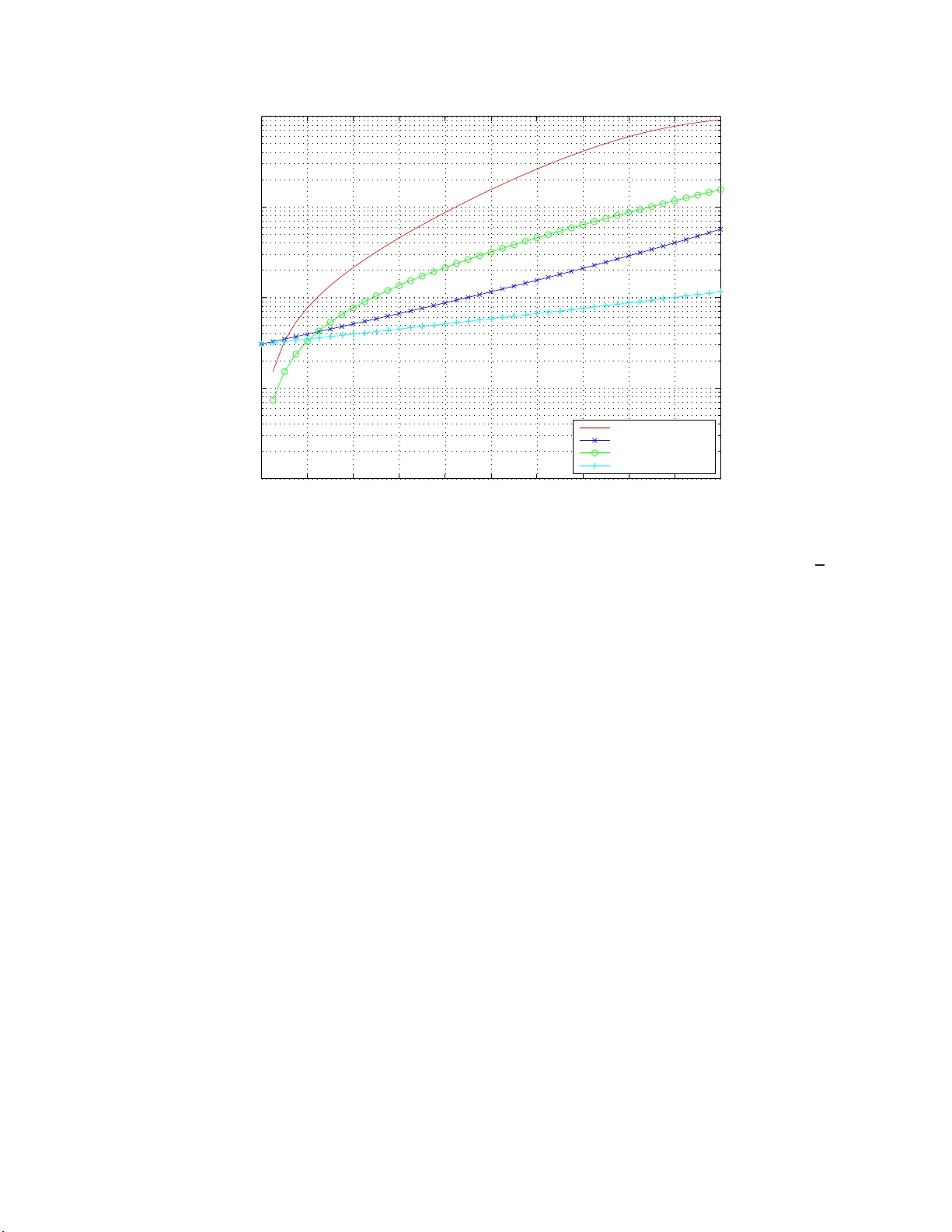
1 W ireless T ransmission of Big Data: Data-Ori ented Performance Limits and Th eir Applications Hong-Chuan Y ang, Senior Member , IEEE and Mohamed-Slim Alouini, F ellow , IEEE Abstract The growing popular ity of big data and Internet of Things (IoT) application s bring new challeng es to the wireless communicatio n commun ity . W ireless transmission systems should more effi ciently support the large amount of data traffics from div erse types o f info r mation sources. In this article, we introduce a novel data-oriented approach for the design and optim ization of wireless transmission strategies. Specifically , we define new perfo rmance metrics fo r ind ividual data transmission session and ap ply them to compare two popular channel-adap ti ve transmission strategies. W e dev elop se veral intere stin g and somewhat counterin tuitiv e ob servations on these tr ansmission strategies, which would not b e p ossible with conv entional app roach. W e also present several inter esting future research directions that are worth pursuing with the d ata-oriented appr oach. Index T erms Big data, Inter n et of Things, wireless commu nications, fading channels, adaptive tra n smission, transmission time, entropy and through p ut. I . I N T R O D U C T I O N W e are in a n era of big data. Data are generated and collected at an accelerating rate. The timely processing, deliv ery , a nd analysis of these data will bring huge s ocial and econom ic This work was supported in part by NSER C Discov ery Grant H.-C. Y ang is with the Department of Electrical and Computer Engineering, University of V ict oria, V ictoria, BC V8W 2Y2, Canada (e-mail: hy@uvic,ca). M.-S. Alouini is with the Computer , Electrical, and Mathematical Sciences and Engineering (CEMSE) Division , King Abdullah Univ ersity of S cience and T echnology (KA UST ), Thuwal 23955, Saudi Arabia (e-mail: slim.alouini@kaust.edu.sa). 2 benefit [1], [2]. W ith the intensive ongoi n g deployment of wireless communication systems , most big data will be transmitted over the air . In fact, smart mobi le devices contribute signi ficantly to the generation of big data. The ever -growing Internet o f Thin g s (IoT) devices serve as another source of big data for wireless transmissio n. The supp o rting of bi g data transmission presents sever al technical challenges to wireless sys tem design, including spectrum ef ficiency enhancement of radio access network (RAN), capacity provision of fronthaul/ b ackhaul li n ks, and network architecture i mprovement for traffic scalabil ity . T o effe ctiv el y support various big data and IoT appli cations, future wireless systems need to optimi ze their transmission strategies for a l ar g e amo unt of data from div erse sources. There ha ve been sig nificant development in d igital wireless transmission technol o gies over the past two d ecades. V ario u s advanced transmissio n technologies, in cluding multi ple antenna (MIMO/massive MIMO) transm i ssion [3], [4], channel adaptive t ransm ission [5], cooperativ e relay transmissi on [6], [7], cognitive radio transmi ssion [8], and extreme bandwidth transmis sion (e.g. millimeter-wa ve, terahertz , and optical wireless transmi ssion), are developed and deployed to meet the growing demand for hig h data rate w i reless services. These transmissi o n technolo- gies were typi cally des i gned wi th the goal of enhancin g or approaching the capacity limits of wireless channels, us u ally characterized by ergodic capacity and out age capacity . Ergodic capacity sp ecifies the upper limits of av erage transm ission rate over fading channels , whereas outage capacity corresponds to the largest i n stantaneous transmi ssion rate of the channel under a specific ou t age probability constraint. T h e rationale is t hat enhancing the channel quality wil l necessarily im prove the quality o f s ervice experienced by individual transmissi on session o n a verage. Such channel or iented approach worked quite effecti vely so far and has su ccessfully facilitate the deliver y of high-quality wi reless services. Current wireless s ystems typically apply the s am e transmi ssion st rategy to all transmi s sion sessions over the wi reless channel channel. W i th the appl i cation of advanced transm ission technologies, the properties of the channel, e.g . aver age data rate and ave rage error rate, wi ll be improved, whi ch usuall y transl ates to better a verage quality of service experienced by individual sessions. Such channel oriented desig n works perfectly well for transmiss i on sessions wi th long duration, such as phone call s and video streami n g. M eanwhile, the channel orient ed design ignores the specifics of individual transmission sessions, such as the traffic characteristics and the prev ail ing network/channel con d ition. When the transm ission sessi ons are short, th e quality of service experienced by in dividual sessions vary dramatically around the average. In particular , 3 it was recently shown that the transmissi o n ti me of a fixed amount o f data with adaptive transmissio n over fading channels vary cons iderably around its av erage [9]. W it h the growing popularity of IoT devices and big data applications, futu re wireless systems need to support increasing num ber of short transmi s sion sessions, in itiated for example b y sensor nodes. T o further im prove the ef ficiency of wireless transmissio n systems , especially for IoT and b ig data applications, we need to study wireless transmissi o n technol ogies from a new perspectiv e. In thi s article, we advoca te the perspectiv e of individual transmi s sion s ess ions. Intuitively , we expect that th e performance/efficienc y of wireless transmission can be further enhanced if the transm ission strategy is optim i zed for each transmi ssion sess ion based on the traffic characteristics and operating en vironment. Motiv ated by this intu i tion, we p rop ose a novel data- oriented approach for wireless transm ission system design. Specifically , when a certain amount of data is av ailable for t ransmission, we will decide the transmis s ion strategy in an optim al fashion. For example, shou l d power adaptation should be applied together with rate adapt ation or not? Should coo p erative relaying be activ ated or not? What m ultiple ant enn a transmi s sion structure should apply ? The transm ission strategy will be adju sted for each d ata transmissio n session according to the traffic characteristics and the channel/net work conditi o ns. Th e rationale for the data oriented approach i s that optim izing the transmissi o n strategy of individual sessions will directly i m prove t h e quality of service for them and will in turn enhance the transmiss i on ef ficiency of the overall sys t em. W e believe the propo s ed d ata-oriented approach will facilitate the design of effi cient transmission solutions for big data and IoT applicati o ns. There are many challenges to be addressed for the new data-oriented approach. W e first need to define sui t able metrics to quantify th e quality of service experienced by individual data transmissio n sess ion. W e also need to est ablish the performance limits from the data transmission perspectiv e and use them as guideline to optim ize the transmission strategy . In this article, we present some initial in vestigati o n of the data-orient ed approach. In parti cul ar , we introduce two new data-orient performance l imits for individual data transmission sess i ons. As an in itial application of these p erformance limi ts, we compare the performance of two popular channel adaptiv e transmissi o n st rategies over fading channels w h en the channel state inform ation is a va ilable at th e transmi tter . Finally , we discuss s e veral promising appli cation and futu re research directions for th e data-oriented approach. 4 I I . D A TA O R I E N T E D P E R F O R M A N C E L I M I T S Ergodic capacity and outage capacity are well-known p erformance lim i ts for wireless trans- mission over fading channels. Ergodic capacity appl ies to the scenario that the transmission will experience all p ossible fading states. It characterizes the lar g est possi b le transmiss i on rate that the channel can s upport over fast fading en vironm ent or extremely lo n g transmiss ion duration. Outage capacity , on the other h and , is applicable to slow fading en vironm ent and specifies the largest transm i ssion rate that the channel can suppo rt under a specific outage probabi lity requirement. In general, out age capacity specifies the instantaneous capacity limit , i.e. within a channel coherence time, over which the channel realization is highly correlated, whereas ergodic capacity dictates th e ave rage rate limit over a long duration, e.g. orders of magnitude l ar g er t han a coherence time. These channel-oriented performance lim its can not fully describe the quali ty of service experienced by individual data transmissio n session, especiall y for big data and IoT applications. The wireless transmissi o n of big data often in volve s multipl e channel coh erence time. Consi der , for example, the indoor transmission of an AR/VR video over IEEE 802.1 1ac W iFi. The typi cal file size of AR/VR videos is around 4 Gbits whereas th e peak download speed of 802.11ac can reach 2.5 Gbps. As such, the vid eo transm ission can finish in 1.6 second on av erage. The channel coherence time of typical operating en vironment for W iFi i s around 200 ms. Therefore, the transmissi on wi ll last for about eight coherence t ime p eriods. As another example, consider the outdoor transmissio n of high-quality im age over an L TE link. The file size of the image can be se veral hundred of Kbits after compression and the transmissio n speed of L TE link can reach up to Mbps. The transmission will last for about hundreds of milli seconds, which entails sev eral coherence time periods for a typical coherence time value of tens of mil liseconds for outdoor en vironment. Ergodic capacity can only characterize the quality of service experienced by a particular wireless transmi ssion session in an a verage sense. The actual transmi ssion service experienced by the data transmissi o n session depends hea vily on the prev aili ng channel realization. The effec tiv e transmissio n rate of particul ar sessio n wi l l vary dramatically aroun d the average rate. T o m ore ef fecti vely characterize the qualit y of transmissio n service, we raise the fol l owing questi ons: Giv en a certain amo u nt o f data to be transmit ted, what is the chance that it will be successfully transmitted with i n a fixed time duration? Given the av ailable temporal-spectral resource, what 5 is the largest amount of data th at can be transmitted over the channel reliably? Outage capacity characterizes instantaneous rate limit and is only applicable for transmissio n sessions that last less than one channel coherence time. Outage capacity can not be generalized to transmiss i on spanning mul tiple channel coherence time. T o effe ctiv e address t he above desi gn quest i ons, we need suitable n ew d ata-oriented p erformance metrics. In th e fol l owing, we present two new performance li mits. A. Minimum transmi ssion time The fundamental service requirement of many big data and IoT applications is t o transmit a certain amount of data to its destination in a timely fashion. As such, we define a data-oriented metric, mini mum transmission time (MTT), as the minim um time duration required to transmit a certain amount of data over wireless channels. Let H deno t e the amount of data to be transmitted. The M T T will be a function of H , denoted by T min ( H ) . For a given H value, MTT wi ll vary with the channel band w i dth, the channel realization , and the adopted transmission strategy . When H is relatively small and the data transmi ssion com pletes in one channel coherence time, M T T T min ( H ) depends on the inst ant aneous channel realization. W ith optimal rate adaption (ORA) [10], the maximu m transmiss ion rate over a channel coherence time is equal to B · lo g 2 (1 + γ ) , where B i s the channel bandwidth and γ is the instantaneous received SNR. M TT can t h en b e calculated as H /B log 2 (1 + γ ) , which will vary with the received SNR γ . When, on the other hand, H is very large and the data transm ission i n volves many coherence tim e, MTT can be calculated us i ng t he ergodic capacity of the channel, given b y C = R ∞ 0 B log 2 (1 + γ ) p γ ( γ ) dγ , as MTT = H/ C , which is a constant value. T o address t he earlier desi gn questions, we define the delay outage rate (DOR) as the proba- bility that MTT for a certain amount of data is greater t han a threshold du ration. In particular , DOR is mathematically given by DOR = Pr[ T min ( H ) > T th ] , where T th denotes the threshold duration. In informational theoretical sense, H represents the amou n t o f information cont ain ed in the data. T th can be related to t he delay requirement of the data to be transmitted. As such, DOR serves as an statistical measure for the quality of servi ce experienced by individual data transmissio n session. For example, the DOR for data transmission within a channel coherence time w i th ORA can be calculated as DOR ora = Pr γ < exp( H ln(2) B T th ) − 1 , (1) 6 which specifies the performance lower lim it for the transmi ssion ti me without power adaptation. When the data transmissio n last s mo re than one channel coherence time, as is the case for big data transmiss ion, D O R analysis becomes more challenging. Assumin g ORA over block fading, where the receiv ed SNR remains constant over each coh erence ti m e of T c and changes to an independent v alue afterwards, MTT is l ess than L · T c if P L l =1 T c B log 2 (1 + γ l ) > H , where γ l is the received SNR ov er the l t h T c . As such, the DOR for the case of T th = LT c can be calculated as DOR ora = Pr " L X l =1 T c B log 2 (1 + γ l ) > H # . (2) T o accurately e valuate the abov e probabil ity , we need t he statistical distribution of the sum of L independent random variables T c B log 2 (1 + γ l ) , which may be solvable using t he Fox H function [11]. The DOR analysis for general scenarios would be an interesting research problem for furt h er inv est igation. B. Maximum ent r opy t hr oughpu t W ireless communication system s accommodate th e service requirements of big data and IoT applications by all ocating certain spectral-tem p oral resource. The characterization of the amount of data that can be successfully transm i tted over a certain spectral-temporal resource block would be instrum ent al to th e desig n of resource allo cation algorithms. As such, we define maxim um entropy throughput (MET) as the maximum amount of information th at can be transmitt ed ov er a certain time duration and channel bandwidth. Mathematically , we denot e MET by H max ( T , B ) , which is a functi o n of the tim e duration T and the channel band width B . Here, T represents an arbitrary t ime duration, wit h value ranging from less th an one coherence ti me T c to many T c ’ s. For giv en T and B values, MET will depends on the channel realization and the adopted transmissio n strategy . For example, when T is larger than T c by order o f magnitude, M ET can be calculated as H max ( T , B ) = T C , where C is t he ergodic capacity of th e channel. On the other hand, if T is s m aller than T c and ORA is applied, then MET can be calculated using t h e instantaneous channel capacity as H max ( T , B ) = T B log 2 (1 + γ ) . The analy s is of MET for t he case th at T spans m ultiple T c will be m o re inv olved. Since MET is generally var ying with the channel realizatio n, we define the information outage rate (IOR) as t he probability that MET over a certain time duration is l ess than a thresho l d entropy value, d enoted by H th . Mathematically , IOR is gi ven by Pr[ H max ( T , B ) < H th ] . The IOR analysis 7 will be instrum ental t o th e design of ef ficient resource allocation algorithms. For data traf fic with stringent delay requirement, it i s desirable to allocate suf ficient temporal-sp ectral resou rce such that the data transmissi on can su ccessful l y complete within delay constraint with high probability . Apparently , the IOR analysis requires t h e statis tics of H max ( T , B ) , wh ich depends on the channel statistics and the adopted transmis sion strategy . For example, when T is very lar g e compared with T c , IOR will be equal to 0 if t h e channel ergodic capacity C is g reater than H th /T . Meanwhile, when T is less than T c , the IOR can be calculated, assuming that the system applies ORA, as IOR ora = Pr[ γ < exp( ln(2) H th B T ) − 1] . (3) For t he scenario that T inv olves m ultiple T c ’ s, the IOR w i ll be equal to the p robability that MET is less than H th , the ev aluation of which w i ll requires t he distribution of the sum of N independent random v ariables. Further in vestigati on of IOR will be an int eresting topi c for future research. I I I . T R A N S M I S S I O N S T R A T E G Y C O M PA R I S O N W I T H C S I T As an appli cati on of data-oriented performance lim its introduced in previous section, we now compare ORA and optim al power and rate adaptation (OPRA) strategies over a point-to-poi nt wireless channel. When th e full channel state informatio n is av ailable at the transmitter (CSIT), wireless transmissio n with ORA can achieve the ergodic capacity of fading channels. It has also been establi shed t h at OPRA transmi ssion can further enhance t he capacity of fading wireless channel with water filling power all o cation [10 ]. In particular , th e resulting OPRA capacity is considerably higher than t he er god ic capacity ov er low SNR region [12]. W ill OPRA transmission still o utperform ORA transmission from the perspective o f a particul ar data transmission sessio n? W e can apply data-oriented performance metrics introduced in previous section, i.e. DOR and IOR, to answer this question . The DOR and IOR with ORA over slow fading en vironm ent are given in Eq. (1) and Eq. (3), respectiv ely . W ith OPRA, the instant aneous channel capacity becomes B log 2 ( γ /γ T ) when the recei ved SNR is great than a th resh o l d SNR γ T and zero ot herwise. Th e threshold SNR γ T is determined to satisfy the av erage transmit power constraint with the o ptimal water -filling p ower allocation policy . As such, the DOR wit h OPRA for slow fading en vi ronment is calculated as DOR opra = Pr[ γ < γ T exp( H ln(2) B T th )] , (4) 8 0 0.01 0.02 0.03 0.04 0.05 0.06 0.07 0.08 0.09 0.1 10 −3 10 −2 10 −1 10 0 Delay Threshold, sec Delay Outage Rate ORA with H = 50 KB OPRA with H = 50 KB ORA with H = 100 KB OPRA with H = 100 KB Fig. 1. Delay outage rate of ORA and OP RA transmission over slo w Rayleigh fading channel ( B = 20 MHz, and γ = 6 dB). and the IOR for OPRA t ransmission ove r slow fading channel is determined as IOR opra = Pr[ γ < γ T exp( H th ln(2) B T )] . (5) Fig. 1 compares the DOR performance of ORA and OPRA transmiss ion strategies over slow Rayleigh fading chann el. In p arti cular , we plot DOR of both strategies as function of the delay threshold T th for d i f ferent data amount H . W e can see that for b oth choi ces of H values, there is a m i xed behavior between the DOR performance of ORA and OPRA. Specifically , when the delay threshol d is small, OPRA leads to smaller DOR than ORA. When the threshold duration becomes larger , the DOR w i th ORA transmissio n im proves and becomes much smaller th an that with OPRA. In fact, th e DOR of OPRA con ver ges to a fixed value w h en delay threshold becomes very large, which is equal to th e probabili ty o f no transmiss ion with OPRA. Fig. 2 illustrates the effect of t h e a verage recei ved SNR on the DOR performance. W e can see that when the aver age SNR is s m all, ORA always achie ve smaller DOR than OPRA, which holds the transmissio n with h i gher probability . When the av erage SNR increases, the DOR performance of OPRA im proves, but still is worse than t h at of ORA when the delay threshold is large. Note that from the con ventional er g odic capacity perspecti ve, OPRA considerably outperform ORA ov er 9 0 0.01 0.02 0.03 0.04 0.05 0.06 0.07 0.08 0.09 0.1 10 −3 10 −2 10 −1 10 0 Delay Threshold, sec Delay Outage Rate O R A w i t h a vg SN R = 0 dB O P R A w i t h a v g SN R = 0 dB O R A w i t h a vg SN R = 1 0 dB O P R A w i t h a v g SN R = 10 dB Fig. 2. Effect of average SNR on the delay outage rate of ORA and OPRA transmission ov er slow Rayleigh fading channel ( B = 20 MHz, and H = 50 KB). low SNR regime. W e observe from the DOR comp arison, howe ver , that O PRA is not always the better strategy from the perspectiv e of individual transm ission session . OPRA is preferred over ORA when the d elay requi rement is very st ringent or the channel quality is fav orable. W e now compare the IOR p erformance of ORA and OPRA t ransmission strategies over slow Rayleigh fading channel . In Fig. 3, we p lot IOR of bo t h strategies as functi on of the entropy threshold H th for differe nt t ime duration T . W e again obs erve a mixed behavior bet w een the IOR performance of ORA and OPRA. Specifically , when the entropy threshold i s small, ORA leads to s maller IOR value than OPRA. When the entropy th resho ld becomes larger , the IOR with ORA transm i ssion in creases and quickly becomes lar ger than t hat wit h OPRA. In fact, t h e IOR of OPRA steadily increases from a fixed value, which is equal to the probabili t y of no transmissio n , for bot h t i me duration values. Fig. 4 illu s trates the effe ct of the average recei ved SNR on the IOR performance. W e can see that when the ave rage SNR is small, ORA o u tperforms OPRA in terms of IOR for a wi der range of entropy thresho l d va lue. When the a verage SNR increases, the IOR performance of OPRA im p rove s significantly and i s bett er than that o f ORA 10 0 0.2 0.4 0.6 0.8 1 1.2 1.4 1.6 1.8 2 x 10 6 10 −4 10 −3 10 −2 10 −1 10 0 Threshold Entropy, bits Information Outage Rate ORA with T = 30 ms OPRA with T = 30 ms ORA with T = 60 ms OPRA with T = 60 ms Fig. 3. Information outage rate of O R A and OPRA transmission ov er slo w Rayleigh fading channe l ( B = 20 MHz, and γ = 6 dB). unless H th is extremely small. W e can concl u de from this comparison t h at from the perspective of individual transmiss ion session, OPRA transm ission strategy should be used ov er high SNR scenario and/or when a large amount of data i s to be transmitted. I V . F U RT H E R A P P L I C A T I O N S The ne w data oriented performance lim i ts characterize the performance of individual data transmissio n sessions over fading wireless channels. In parti cul ar , MTT prescribes the smallest transmissio n delay poss i ble when transm itting a certain amount of data over fading channels, where as M ET signifies the largest amount informat i on th at can be transmit ted over a tem p oral- spectral resource block. G iven the time-varying nature of wireless fading channel, these p er- formance l imits are described in a s tatistical sense, in terms of DOR and IOR, respectiv ely . By specifying th e best poss i ble performance for individual transm ission session , these perfor- mance limits will find m any imp ortant applications for the design and optimizatio n of wireless transmissio n strategies. 11 0 0.2 0.4 0.6 0.8 1 1.2 1.4 1.6 1.8 2 x 10 6 10 −4 10 −3 10 −2 10 −1 10 0 Threshold Entropy, bits Information Outage Rate ORA with avg SNR = 0 dB OPRA with avg SNR = 0 dB ORA with avg SNR = 10 dB OPRA with avg SNR = 10 dB Fig. 4. Effect of average SNR on the information outage rat e of ORA and OPRA transmission ov er slow Rayleigh fading channel ( B = 20 MHz, and T = 30 ms). In previous section, we com pared two channel adaptive t ransmission strategies for the slow fading scenario with CSIT usin g the data oriented m et ri cs. The design insight s developed therein can readily apply to th e transmissi on scheme opt imization for IoT traf fics, which are typi call y brief and sporadic. On t he oth er hand, b ig d ata applicati o ns tend t o generate large volume of data traffic s, t he transmiss ion of which may l ast mult iple channel coherence time. T h e data oriented analysis for big data traf fic wi ll be a challengin g but rew arding fut ure research t opic. An initial i n vestigation on the transmis sion tim e of big data with discrete rate adaptation ov er fading channels has been recently reported [9]. The data oriented approach can also apply to the desig n and optimi zation of practical trans- mission strategies wit h limit ed CSIT . Ad aptiv e modu l ation and codi ng (AMC) and automat i c repeat request (ARQ) are two pop ular transmission st rategies that explores limit ed feedback from the receive r . A M C adapts the transm ission rate for a certain reliability requirement whereas ARQ enhance the reliabilit y with retransmission. Th e joi nt desig n of AM C and ARQ has been in vestigated in the literature [13]. W ith the proposed data-oriented approach, we can study these 12 two t ransmission strategies and their joint design from a brand ne w perspectiv e. Such study will create new design insight s and leads to novel transmissi on strategy for the limited CSIT scenario. The MT T analysis characterizes t he lower limit for the transmiss ion time of practical data transmissio n . For point-to-po int link s , the transmissi o n ti m e is in verse proportional to the service rate of the transmission system. The queuing delay performance for wireless transmiss ion can be analyzed using the first-order and second-order statistics of transmiss i on t i me [14]. Our data- oriented characterization can apply to de velop the upper bound of the queuing performance ov er point-to-poin t link. Meanwhile, t ransmission time i s directly related to the channel occupancy of each transmi ssion session. The stati stical characterization of the transmissi o n can b e used to optimize random access protocols. The gro wing popularity of bi g data and IoT appl i cations will create an unprecedented amount of traf fic wi th d iv erse service requirement. T h e wireless s y stem need to app l y efficient resource allocation algorithm s to accommodate such new demands i n an effe ctiv e mann er . The MET characterization will provide valuable guidelines to the design and optimization of resource al l o- cation al g orithms. For example, 3GPP adopted the scheduled uplin k approach for IoT provisions, which in volves a random access stage for schedul i ng request [15]. Only terminals succeeded i n this stage wil l be allocated with resou rce block. Therefore, i t is critical to allocate sufficient resource bl ocks for each terminals su ch that their transmiss ion can finish with hi gh probability . W ith the dat a-orient ed approach, we can enhance the p erformance of such resource allocation algorithms. V . C O N C L U D I N G R E M A R K S In this article, we present a n ovel d ata-orient ed approach for wireless transmis sion syst em design and analysis. W e tar get at the transmiss ion strategy design and optimization for individual data transmissi o n session, according to the traffic characteristic and operating conditi on. In par - ticular , we introduce two data-oriented performance li mits to characterize arbitrary wireless data transmissio n . As their init ial appl i cation, we compare well-known channel adapti ve transmission strategies for CSIT scenario, namely ORA and OPRA. W e observe t h at whil e OPRA always outperform ORA from the er godic capacity perspective, OPRA is not alwa ys the preferred transmissio n strategy from the individual data transm ission session perspective. ORA can have a better chance to deliver the data to the destination over slow fading channel when the a verage 13 channel quality is poor . As such, the dat a-orient ed approach can bring in teresting new ins ights to wireless trans m ission over fading channels. This article serves as an i n itial introductio n to the data-oriented approach for wi reless trans- mission strategy design. There are m any im portant aspects to be addressed. The lim ited and no CSI at transmitt er scenarios are of practical interest. The data oriented characterization of big data transm ission requires further in vestigation. Finally , these characterization can b e readily applied to the queuing analy s is and resource allocati on for wireless s y stems. W e expect that the data-oriented design wil l greatly facilitate t h e design of efficient w i reless transmission strategies for b i g data and IoT applications. R E F E R E N C E S [1] T . Hu, E. B igelo w , J. Luo, and H. Kautz, “T ales of two cities: Using social media to und erstand idiosyncratic lifestyles in distinctiv e metropolitan areas, ” IEEE Tr ansactions on Big Data , vol. 3, no. 1, pp. 55–66, Mar . 2017. [2] F . Xia, W . W ang, T . M. Bekele, and H. Liu, “Big scholarly data: A survey , ” IEEE T ransactions on Big Data , vol. 3, no. 1, pp. 18–3 5, Mar . 2017 . [3] G. J. Foshini and M. Gans, “On limits of wi reless communications in a fading en vironment when using multiple antennas, ” W ir eless P ers. Commun. , pp. 311–335, Mar . 1998 . [4] E. Larsson, O. Edfors, F . Tufv esson, and T . Marzetta, “Massi ve MIMO for next generation wi reless systems, ” IEEE Commun. Mag. , v ol. 52, no. 2, pp. 186–195, Feb . 2014. [5] S.-G. Chua and A. J. Goldsmith, “ Adapti ve code d modulation for fading channels, ” IEEE T rans. Commun. , v ol. 46, no. 5, pp. 595– 602, May 1998. [6] A. Sendonaris, E. Erkip, and B. Aazhang, “User cooperation diversity-part I: System description, ” IEE E T rans. W ir eless Commun. , vo l. 51, no. 11, pp. 1927 –1938, Nov . 2003. [7] J. N. Laneman, D. N. C. Tse, and G. W . W ornell, “Cooperati ve div ersity in wireless networks: Efficient protocols and outage beha vior, ” IEEE Tr ans. Inf. Theory , vol. 50, no. 11, pp. 3062–308 0, Nov . 2004. [8] J. Mitola and G. Q. Maguire, “Cogniti ve radio: making software radios more persona l, ” IEEE T rans. W ireless C ommun. , vol. 6, no. 4, pp. 13–18, Aug. 1999. [9] W .-J. W ang, H.-C. Y ang, and M.-S. Alouini, “Wireless transmission of big data: A transmission time analysis ov er fading channel, ” IEE E T rans. W ir eless Commun. , pp. 1–11, 2018. [10] A. Goldsmith, W ir eless Communications . Cambridge Unive rsity Press, 2005. [11] F . Y ilmaz and M. S. Alouini, “Outage capacity of multicarrier systems, ” in 2010 17th Internationa l Confere nce on T elecommunications , April 2010 , pp. 260–265. [12] Z. Rezki and M. S. Alouini, “On the capacity of Nakagami-m fading channels wit h full channel state information at lo w SNR, ” IEEE W ir eless Communications Letters , vol. 1, no. 3, pp. 253–256, June 2012. [13] R. Sassioui, M. Jabi, L. Szczecinski, L. B. L e, M. Benjillali, and B. Pelletier , “HARQ and AMC: F riends or foes?” IEEE T ransactions on Communications , vol. 65, no. 2, pp. 635– 650, Feb 2017. [14] M. Usman, H. C. Y ang, and M. S. Alouini, “Extended delivery time analysis for cogniti ve pack et transmission with application to secondary queuing analysis, ” IE EE T ran s. W ir eless Commun. , vol. 14, no. 10, pp. 5300– 5312, Oct. 2015 . 14 [15] Y . P . E. W ang, X. Lin, A. Adhikary , A. Grovlen, Y . Sui, Y . Blank enship, J. Bergman, and H. S. Razaghi, “A primer on 3GPP narro wband Internet of things, ” IEEE Commun. Mag. , v ol. 55, no. 3, pp. 117–123, March 2017.
Original Paper
Loading high-quality paper...
Comments & Academic Discussion
Loading comments...
Leave a Comment