Solitons in Ideal Optical Fibers - A Numerical Development
This work developed a numerical procedure for a system of partial differential equations (PDEs) describing the propagation of solitons in ideal optical fibers. The validation of the procedure was implemented from the numerical comparison between the …
Authors: Eli, ro Rodrigues Cirilo, Paulo Laerte Natti
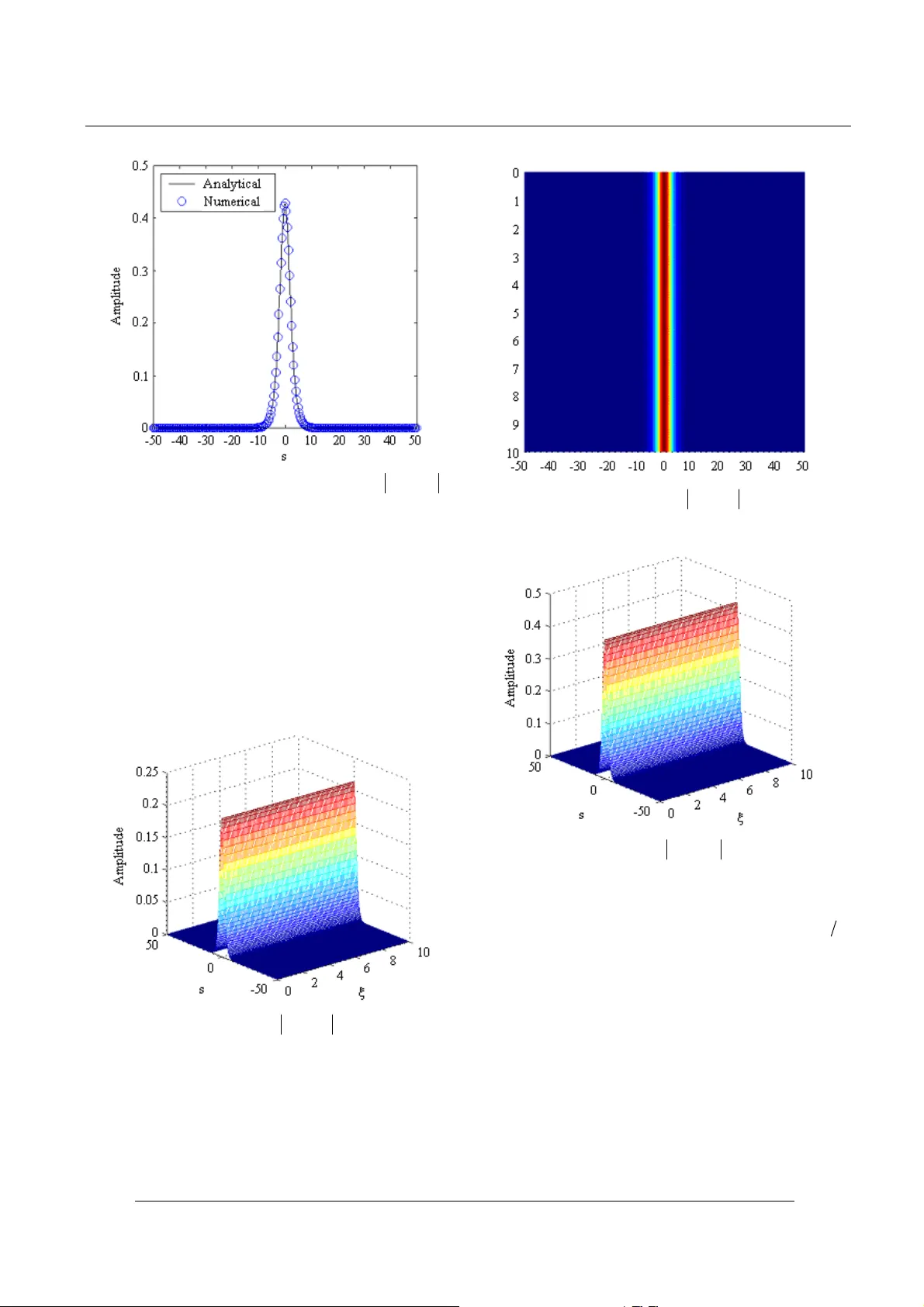
Semina: Ciências Exatas e Tecnológicas, Londrin a, v. 31, jan./jun. 2010 1 Solitons in Ideal Optic al Fibers – A Num erical Development Sólitons e m Fibras Ó ticas Ideais – U m Desenvolvimento Nu mérico Eliandro Rodrigues Cirilo 1 ; Paulo Laerte Natti 2 ; Neyva Maria Lopes Romeiro 3 ; Érica Regina Takano Natti 4 ; Camila Fogaça de Oliveira 5 1 Professor in the Mathematics Departament at Universidade Estadu al de Londrina; ercirilo@uel.br 2 Professor in the Mathematics Departament at Universidade Estadu al de Londrina; plnatti@uel.br 3 Professor in the Mathematics Departament at Universidade Estadu al de Londrina; nromeiro@uel.br 4 Professor in the Pontifícia Universidade Católica do P araná - Londrina; erica.natti@pucpr.br 5 Graduated in Mathematics from Universidade Estadu al de Londrina; ca_foga ca@yahoo.com.br Abstract This work developed a n umerical procedu re for a system of part ial differential equations (P DEs) describing the propagation of solitons in i deal opti cal fibers. The validation of the procedure was implemented from the numerical comparison between th e known analytical solutions of the P DEs system and those ob tained by using the numerical procedure developed. It was discovered that the procedure, based on the f inite difference method and relaxation Gauss-Seidel method, was adequate in d escribing the propagation of soliton waves in ideals optical fibers. Key words: Optical communication. Solitons. Finite diff erences. Relaxation Gauss-Seidel method. Resumo Este trabalho d esenvolveu um procedimento nu mérico para um sistema de eq uações diferenciais parciais (EDP ’s) que descreve a p ropagação de sólito ns em fibras óti cas ideais. A v alidação do pro cedimento foi i mplementada a p artir da comparação n umérica entre as s oluções analíticas conhecidas do siste ma de EDP’s e aquelas obtidas por me io do procedimento numérico desenvolvido. Verificou-se que o procedimento, baseado no método das difere nças finitas e no método de Gauss-Seidel com relaxação, mostrou-se adequado na d escrição da prop agação das ond as sóli tons em fibras óticas ideais. Palavras-chave: Comunicação ótica. Sóli tons. Diferença s finitas. Méto do de Gauss-Seidel com relaxaçã o. 1 Intr oduction In the las t d ecades, several exper iments were carried out aiming at trying to improve the capacities of the optical communication systems. The important issue i s how to compensate the dispersion and the nonlinearities in communication syste ms at l ong dista nces (t housands o f kilometers) or in h igh debt ground systems. A g ood technique that allo ws si multaneous compensation of such effects had already been p rop osed by Hasega wa and Tapper t, in 1973, though o nly after t he ap pearance of the optical amplifier could it be applied to p ractical systems (HASEGAW A; T APPERT, 1973 ). T his technique is based on the u se of o ptical pulses, whose ele ctrical field has the shape of a hyperb olic seca nt with some milli watts of p eak potency, and in the compensatio n o f the d ispersion by the optical fiber nonlinearities. Such pulses, called solitons, ar e capable of self-propagation, keeping their shape unchanged in a dispersive a nd non-li near environment, like the op tical fiber. (EILENB ERGER, 198 1; TAYLOR, 1 992). In the 198 0’s, the expe rimental develop ment of communication systems based on o ptical soliton s starte d. Mollenauer, Stolen and Gordon, in 1 980, conducted the first experimental ob servat ion of the bright solito n propa gation in optica l fibers. Hasegawa, i n 198 4, proposed that optical solitons co uld be used in long distanc e communication without the need o f repeating statio ns, including o verseas co mmunic ations (H ASEGAWA, 1984 ; PILIPET SKII, 2006). Since then, se veral experiments were conducted with the o bjective of i mproving t he transmi ssion capacit y of solito ns in optical fibers. E mplit et al., in 1987 , carried o ut the first e xperi mental ob servation o f the dark soliton pro pagation in optical fibers ( EMPLIT et al. , 198 7). Mollenauer and Smith, in 1988, transmitted soliton pul ses C IRILO , E. R.; N ATTI , P. L.; R OMEIRO , N. M. L.; T AKANO N ATTI , E. R.; D E O LIVEIRA , C. F. Semina: Ciências Exatas e Tecnológicas, Londrin a, v. 31, jan./jun. 2010 2 over 4,000 kilometers using a phenomenon called the Raman Effect to provide o ptical gain in the fiber (MOLLENAUE R; SMITH, 1988). In 1991, a Bell Labs research team transmi tted bright soliton s er ror-free at 2.5 gigabits per seco nd, over more than 14, 000 kilometers, using erb ium optical fiber ampli fiers (MOL LENAUER e t al., 19 91). I n 1998, T hierry Geor ges and his tea m at France Teleco m, combini ng op tical soliton s o f di fferent wavelengths, demonstrated data transmission of 1 terabit per seco nd (LE GUEN et al., 19 99). In 2000, the practica l use of solitons turned into r eality when Alget y Telec om, then locate d i n Lannio n, Fra nce, develop ed undersea telecommunicatio n equip ments for the transmi ssion of optical solito ns. In thi s time, intense resear ch was also conducted on the po ssibility o f usi ng vec tor soliton in optical co mmunications. The use of vector solitons in a birefringence fiber was predicted by Menyuk (MENYUK, 1997) and observed rece ntly (ZHANG et al., 2 008; T ANG et al., 20 08). In t his context o f op tical com munication via solito ns, an increase in t he number of p ublished works, with the aim o f overco ming t he several pro blems that have bee n found and improving the alread y prop osed methods has been verified. Such theoretica l and experi mental studies ap proach themes related to the soliton generatio n pr ocesses (MALOM ED et al., 2005; KUROKAWA; TAJIM A; NAKAJIMA, 2007), soliton propa gation processes (H ASEGAW A, 2000; LATAS; FERREIR A, 2 007; T SARAF; M ALOMED, 20 09) and solito n stab ility p rocesses (CHEN; ATAI, 19 98, DRIBEN; MAL OMED, 20 07) in optical fibers. In t his work, only the results abo ut scalar bri ght solitons, named simply a s solitons from now on, will be disc ussed. The study o f pro pagation and stabilit y of femto second optical solitons in fibers is a ffected by several disturbin g processes. Us ually, the most i mportant o nes are gro up velocity d ispersion and optical Kerr e ffect (i ntensity dependence of the refracti ve index). T aking o nly these into account, the pulse pro pagation is a soliton described by a system o f coupled nonline ar Schröd inger dif ferential equations (HASE GAWA; T APERT , 1973). To d escribe real-world fiber -optic system, it is more realistic to include further effects like power lo ss or Rayleigh scatter ing ( BÖHM; M ITSCHKE, 2007) , high- order dispersion and high-order nonlinearities (AGRAWA L, 19 95), solito n self-steep ening, Raman effect and sel f-frequenc y shi ft (LAT AS; FE RREIRA, 2007), polarizatio n-mode dispersio n (DRIB EN; M ALOMED, 2007), nonlinear phase noise ( LAU; K AHN, 2007), d efects or mends in t he optical fib er (TSARAF; MALOMED, 2009), among others. It sh ould be obser ved that the perturbed coupled nonlinear Schrödinger d ifferential equations syste ms, that describ e wave prop agation in real optical fibers, do not present analytical sol ution k nown in the literature. In th is work, aimi ng to study the propagation and th e stability of such waves, called quasi-soliton s, in real optical fibers, firstly a genera l n umerical pr ocedure is develop ed for the propagation of solitons in ideal optical fibers. It should be note d that, i n t he case o f id eal fibers, the analytical solution of the proble m is known, a nd thi s will allow the valida tion of the numeric al proced ure. In the literature there ar e several numeric al a pproaches whose ob jective is to describe the propagatio n of solitons in dielectrical en vironments, most of which use the finite difference method (ISMAIL, 2004; WANG, 20 05; CHEN, MALOMED, 20 09), the finite element method (D AG, 1999 ; I SMAIL, 20 08) and the split- step method (LIU, 2009). On the other hand, to solve numerically the resultin g system of equations, t he autho rs use various method s like Newton's method ( ISMAIL, 2008 ), Crank-Nicolson method (CHEN, MALOMED, 200 9), Runge-Kutta Method (REICH, 20 00), among other s. A r eview of the several numerical pr ocedures applied to de scribe the propagation of solitons in optical fibers is foun d in DEHGHAN and TALEEI (20 10). In this paper , to de scribe the p ropagation o f solitons waves in id eal optical fibers, a pro cedure based on the finite difference method and relaxation Gauss-Seidel m ethod is used. Sect ion 2 prese nts t he solito n anal ytical solutio ns for the c oupled nonlinear Sc hrödinger di fferential equation s system that describes t he pro pagation of waves i n ideal optical fibers. In the sequence, the ch aracteris tics of the soliton wave are co rrelated with the dielec trical prop erties of the ideal o ptical fibe rs. In Section 3 , a nu merical proced ure for this ideal PDE system i s developed. In Section 4, b y comparing the o btained n umerical results with the kno wn anal ytical res ults, the consistenc y of the developed numerical pro cedure is veri fied. I n Sect ion 5 , the main results of t his work are p resented. 2 Solitons in (2) χ dielectric fibers This section studies the coupl ed non -linear co mplex PD E system, ob tained fro m Maxwe ll’s equations, which d escribe the lo ngitudinal pro pagation o f t wo ele ctro magnetic waves (fundamental a nd second harmonic m odes) in ( ) 2 χ dielectrical op tical fibers (AGR AWAL, 1995 ). T he detailed mathematical modeling of t his PDE system can b e found in GALLEAS et al., 2003. T his coupled nonlinear d ifferential equations syste m is given b y ( ) 0 exp 2 2 1 2 1 2 1 = β ξ − + ∂ ∂ − ξ ∂ ∂ ∗ I a a s a r a I (1) ( ) 0 exp 2 2 1 2 2 2 2 2 = βξ + ∂ ∂ α − ∂ ∂ δ − ξ ∂ ∂ I a s a s a I a I , C IRILO , E. R.; N ATTI , P. L.; R OMEIRO , N. M. L.; T AKANO N ATTI , E. R.; D E O LIVEIRA , C. F. Semina: Ciências Exatas e Tecnológicas, Londrin a, v. 31, jan./jun. 2010 3 where 1 − = I is the imaginar y unit, ) , ( 1 s a ξ and ) , ( 2 s a ξ are complex variables that represent t he normalized a mplitudes of the electrical fields of the fundamental and second har monic waves, respectivel y, with ) , ( * 1 s a ξ and ) , ( * 2 s a ξ as their complex co njugates. The in dependent variable s has spatial dimensio n character, whereas the independent variable ξ has tempor al character. The r eal parameters α , β , δ and r , in (1) , are related with the diele ctrical p roperties of the optical fiber and should be adjusted so that the e xistence of solutio ns is possible (Y MAI et a l., 20 04). In t he limit ∞ → β , the coupled differential equations (1) u ncouple in Schrödinger’s non-linear equatio n (MENYUK ; SCHI EK; TORNER, 1994). T hus, the β quantity is a measure of t he generation rate of the second harmonic. The α q uantit y measures the relative dispersio n of t he group velocity dispersion (GVD) of fu ndamental and second har monic waves i n the op tical fiber. For values 1 > α , the seco nd harmonic wave ha s higher dispe rsion than the fu ndamental wave and for values 1 < α , it is the funda mental wave that has hig her disper sion. T he r quantit y is t he sig nal of the fundamental GVD wave. When 1 + = r , the fundamental wave is in normal dispersion regime, but if 1 − = r , the fundamental wave is in the ano malous dispersio n regime. Finally, t he parameter δ measures the di fference of group velocities of fu ndamental and second harmonic waves, so it accounts for the p resence of P oynting vector walk -off that occurs in birefringent med ia, when prop agation is not alon g the cr ystal optical axes. N otice that it i s po ssible to choose the charac teristics (velocity, width, amplitude, stability, etc.) of the wa ve to be propa gated in the optical fiber, selecting or pro posing materials with t he app ropriate α , , β δ and r die lectrical pro perties. In (GALLEA S et al., 2003) a d etailed descriptio n of th e interpretation of such dielectrica l q uantities is given , relating them wit h t he fiber optical p roperties. The PDE system (1) pr esents so litons solution s (GALLEAS et a l., 200 3), given b y × β + − α δ α − α ± = r r r a 2 ) 2 ( 2 3 2 1 × ξ − α δ − β + − α δ α − ± r r s r r 2 2 ) 2 ( 2 1 sech 2 2 − α δ − ξ α − β − α − − α α − δ s r I r r r r r r I 2 2 ) 2 ( ) 2 ( 2 ) 5 4 ( exp 2 2 (2) × β + − α δ − α = r r r a 2 ) 2 ( 2 3 2 2 × ξ − α δ − β + − α δ α − ± r r s r r 2 2 ) 2 ( 2 1 sech 2 2 − α δ − ξ β + α − β − α − − α α − δ s r I r r r r r r I 2 2 2 2 ) 2 ( ) 2 ( 2 ) 5 4 ( 2 exp 2 2 . (3) In (QUEI ROZ et al., 2006), a adapted numerical proced ure provided the numer ical solution o f (1), when 0 = δ . In the spec ific ca se of the pr opa gation o f solitons in special op tical fiber s, and i n opti mal situation s, the walk-off wave p henomeno n ca n b e d isregarded (ART IGAS; TORNER; AKHME DIEV, 1 999), which j ustifies ta king 0 = δ in such situations. H owever, in the case o f non-ideal optical fibers, situa tion i n which necessaril y 0 ≠ δ , a general numerical procedure to the system (1) shou ld be developed . T his nu merical d evelop ment is p resented in the next section. 3 Numerical model for the pr opagation of solitons in optical fibers The numerical sche me develo ped in this work to solve the PDEs system (1 ), con sists in app roximating the derivates b y finite di fference s and re solving the a lgebraic system re sulting fro m the discr etization, i mplicitly, b y means o f the relaxatio n Ga uss-Seidel method (SMI TH, 1990 ; SPERANDIO, MEN DES, M ONKEN, 2 003) . Figure 1: Computational domain of the propagation of the soliton waves. C IRILO , E. R.; N ATTI , P. L.; R OMEIRO , N. M. L.; T AKANO N ATTI , E. R.; D E O LIVEIRA , C. F. Semina: Ciências Exatas e Tecnológicas, Londrin a, v. 31, jan./jun. 2010 4 System (1) is numerical ly resolved in do main [ ] [ ] L L T s , , 0 − × = × ξ , where ℜ ∈ L T , . By discre tizing the variables ( ) ( ) i k a s a , 1 , 1 1 + ≡ ξ and ( ) ( ) i k a s a , 1 , 2 2 + ≡ ξ , for m ax ,..., 1 , 0 k k = and ni i ,..., 2 , 1 = , where m ax k is denominated the la st adva nce in ξ and ni the maximum number of p oints in s , the p ropagatio n do main o f the solitons w ave becomes d efined b y a discretized computatio nal network of ni k × m ax points, as repr esented in Figure 1 . Thus, b y means of the method of finite di fferences, appro aching the temporal der ivates b y p rogressiv e differences, a nd the spatial de rivates by central d ifference s (SMIT H, 1990), the follo wing linear systems are ge nerate d from the dif ferential eq uations ( 1), namely, ( ) ( ) [ ( ) + + + + − + = + 1 , 1 1 , 1 1 , 1 1 1 1 1 1 1 i k a A i k a A A i k a E W p ( ) ( ) ( ) ( ) ] β ξ − − I i k a i k a i k a A po exp , , , 2 * 1 1 1 (4) ( ) ( ) [ ( ) + + + + − + = + 1 , 1 1 , 1 1 , 1 2 2 2 2 2 2 i k a A i k a A A i k a E W p ( ) ( ) ( ) ( ) ] , exp , 1 , 2 1 2 2 β ξ + − I i k a i k a A po where ( ) 2 1 s r I A p ∆ + ξ ∆ = W E A A 1 1 = ( ) 2 1 2 s r A W ∆ = ξ ∆ = I A po 1 ( ) 2 2 s I A p ∆ α + ξ ∆ = ( ) 2 2 2 2 s s I A E ∆ α + ∆ δ = ( ) 2 2 2 2 2 s s I A W ∆ α + ∆ δ − = ξ ∆ = I A p 0 2 . In this work, the li near s ystem ( 4) is re solved b y means o f the rel axation Gauss-Seide l m ethod (SPERANDIO, MENDES , M ONKE N, 2003 ). Co nsider this linear system for ( ) i k a , 1 1 + , given explic itly b y ( ) ( ) [ ( ) + + + + = + 3 , 1 1 , 1 1 2 , 1 1 1 1 1 1 1 k a A k a A A k a E W p ( ) ( ) ( ) ( ) ] β ξ − − I k a k a k a A po exp 2 , 2 , 2 , 2 * 1 1 1 ( ) ( ) [ ( ) + + + + = + 4 , 1 2 , 1 1 3 , 1 1 1 1 1 1 1 k a A k a A A k a E W p ( ) ( ) ( ) ( ) ] β ξ − − I k a k a k a A po exp 3 , 3 , 3 , 2 * 1 1 1 ( ) ( ) [ ( ) + + + + = + 5 , 1 3 , 1 1 4 , 1 1 1 1 1 1 1 k a A k a A A k a E W p ( ) ( ) ( ) ( ) ] β ξ − − I k a k a k a A po exp 4 , 4 , 4 , 2 * 1 1 1 ... ( ) ( ) [ ( ) + + + − + = − + ni k a A ni k a A A ni k a E W p , 1 2 , 1 1 1 , 1 1 1 1 1 1 1 ( ) ( ) ( ) ( ) ] . exp 1 , 1 , 1 , 2 * 1 1 1 β ξ − − − − − + I ni k a ni k a ni k a A po It can be written in co mpact for m as ( ) ( ) ( ) [ ] , 1 , 1 1 , 1 1 , 1 1 1 1 1 1 1 1 + + + − + + = + i k a A i k a A B A i k a E W i p where ( ) ( ) ( ) ( ) β ξ − − = I i k a i k a i k a A B po i exp , , , 2 * 1 1 1 1 with 1 ,..., 2 − = ni i . Fro m the i nitial co nditio n ( ) i a , 0 1 , give n b y solito n solution (2), and i mposin g the conto ur co nditions ( ) 0 1 , 1 1 = + k a and ( ) 0 , 1 1 = + ni k a , for L sufficie ntl y large, ( ) ) 1 ( 1 , 1 + + n i k a is iterativel y calc ulate d by means of the equatio ns ( ) ( ) ( ) ( ) p n E n W n i n A i k a A i k a A B i k a 1 ) ( 1 1 ) 1 ( 1 1 1 1 ) 1 ( 1 1 , 1 1 , 1 , 1 + + + − + + = + + + + (5 ) until the sto p crite rion is ful filled, na mely, 6 ) ( 1 ) 1 ( 1 1 2 10 | ) , 1 ( ) , 1 ( | m ax − + − ≤ ≤ < + − + n n ni i i k a i k a , (6) where ( ) ( ) ( ) ( ) ( ) βξ − − = + + + + I i k a i k a i k a A B n n n po n i exp , , , ) 1 ( 2 ) 1 ( * 1 ) 1 ( 1 1 1 1 . This method consists in d eter mining ( ) ) 1 ( 1 , 1 + + n i k a b y using the alread y known componen ts of ( ) ) ( 1 1 , 1 n i k a + + and ( ) ) 1 ( 1 1 , 1 + − + n i k a , w ith the advanta ge of not r equiring C IRILO , E. R.; N ATTI , P. L.; R OMEIRO , N. M. L.; T AKANO N ATTI , E. R.; D E O LIVEIRA , C. F. Semina: Ciências Exatas e Tecnológicas, Londrin a, v. 31, jan./jun. 2010 5 the simultaneo us storage of the two vecto rs ( ) ) ( 1 1 , 1 n i k a + + and ( ) ) 1 ( 1 1 , 1 + − + n i k a at each step. Likewise, ( ) ) 1 ( 2 , 1 + + n i k a is resolved. Notice that, i n eq uations (5)-(6) , the value 0 . 1 = ω was used for t he parameter of relaxation (CIRILO et al. , 2008 ). Such val ue corr esponds to the optimal rela xation p arameter in re lation to the variations o f the dielectr ical para meters α , β and δ of s ystem (1). Figure 2 presents the flowchart of the numerical co de develop ed for the P DEs system (1). Figure 2: Flowchart of the numerical code d eveloped to obtain the numerical solitons solutions. 4 Numerical Results This section a nalyses the numerical c ode develop ed in the previous section, co mparing the obtained numerica l re sult with t he k nown ana lytical result (2-3), in fu nction of t he dielectrical p arameters α , β and δ of the studied model. In the simulations, a CP U with p rocessor AMD Athlon 64X2 Dual Core Processor 4400+, with 2.2 9 GHz and 1.00 GB of RAM memor y is used . In t he calculatio ns a toler ance factor of 6 10 0 . 1 − × was imposed. T he cod e was developed in FORTRAN. For the simulation s, t he values 1 − = r , 2 1 − = β , 4 1 − = α a nd 2 1 2 1 < δ < − were adopted. Such values are co mpatible with exper imental meas urements observed in commercial op tical fibers. Initially 0 = δ is considered. W hen 50 = L and 10 = T , from a discretization of 50 0 points i n inter val ] , [ L L − and of 2 10 0 . 1 − × = ξ ∆ , a significant agreeme nt i s veri fied between the numerica l a nd the a nalytical solutions, as observed in Fi gures 3 and 4. For all the co mputationa l domain, it was o btained that t he biggest difference betwee n the a nalytical a nd numerical so lutions, for the fu ndamental harmonic, was 3 10 5 . 1 − × . Likewise, the maximu m numerical error for t he second harmonic w as 3 10 7 . 2 − × . The to tal processing ti me was 1 10 5 . 1 − × seconds. Figure 3: Analytical and numerical solutions of ( ) s a , 1 ξ , in 10 = ξ , for 0 = δ . C IRILO , E. R.; N ATTI , P. L.; R OMEIRO , N. M. L.; T AKANO N ATTI , E. R.; D E O LIVEIRA , C. F. Semina: Ciências Exatas e Tecnológicas, Londrin a, v. 31, jan./jun. 2010 6 Figure 4: Analytical and numerical solutions of ( ) s a , 2 ξ , in 10 = ξ , for 0 = δ . The profile o f the fundamental har monic module, numerically obtai ned, is presented in Figure 5. From an upper vie w o f p lan s × ξ , see Figure 6, it is o bserved t hat the soliton re mains static in 0 = s , for all ξ . Likewise, t he profile of the second h armonic m od ule, also numericall y obtained, can b e obse rved in Figure 7 , whose upper view is shown i n Fi gure 8. These numerical results are consistent with the anal ytical results for eseen b y (G ALLEAS et al., 2003 ; YMAI et AL., 2 004) . Figure 5: Numerical solution of ( ) s a , 1 ξ , in all computational domain, for 0 = δ . Figure 6: Upper view of ( ) s a , 1 ξ for 0 = δ . Figure 7: Numerical solution of ( ) s a , 2 ξ , in all computational domain, for 0 = δ . Now the situatio n 0 ≠ δ is co nsidered . T aking 4 1 − = δ and the sa me pa rtition of 500 po ints in interval ] , [ L L − and 2 10 0 . 1 − × = ξ ∆ , the pro pagation of the solito n wave alo ng the fibe r is analyzed when 50 = L and 10 = T . The simulations c onducted sho wed that the bi ggest d ifference between the anal ytical a nd numeric al solutions, for the fundamental harmonic, was 3 10 1 . 7 − × . Lik e wise, for th e second har monic, the ma ximum err or was 3 10 5 . 7 − × . The total p rocessing ti me wa s 1 10 4 . 1 − × second s. Again, a relevant agree ment is observe d bet ween these sol utions, as observed in Figures 9 and 10. C IRILO , E. R.; N ATTI , P. L.; R OMEIRO , N. M. L.; T AKANO N ATTI , E. R.; D E O LIVEIRA , C. F. Semina: Ciências Exatas e Tecnológicas, Londrin a, v. 31, jan./jun. 2010 7 Figure 8: Upper view of ( ) s a , 2 ξ for 0 = δ . Notice that the maximum er rors b etween the n umerical and analytical solutions for 4 1 − = δ were sli ghtly superior to the ones ob tained for 0 = δ . This fact is due to the term s a ∂ ∂ δ 2 in (1 ), which is taken into account i n the nu merical calculations when 0 ≠ δ . In other words, the p resence o f this ter m in the numerical p rocedure generates ne w errors, due to the approximations, which propagate along th e computational domain, incrementin g the m aximum errors between the numerica l and an alytical solutions. Figure 9: Analytical and numerical solutions for ( ) s a , 1 ξ , in 10 = ξ , for 4 1 − = δ . Figure 10: Analytical and numerical solution s for ( ) s a , 2 ξ , in 10 = ξ , for 4 1 − = δ . Figures 11 and 13 p resent the profiles o f the fundamental harmonic and second harm onic modules, respecti vely, obtained numerically in all the c omputational do main, when 4 / 1 − = δ . Figure s 12 and 14 p resent the uppe r vie w of the propa gation of such waves alon g the co mputationa l domain. I n accord ance with the a nalytical results (YM AI e t al., 2004), fro m Figures 9 a nd 10, and fro m the upp er vie ws of the numerical so lutions in all the co mputational do main, presented in fig ures 12 and 14, it is verified that the solitons waves, when 0 ≠ δ , pro pagate in the sp atial di mension s . Figure 11: Numerical solution of ( ) s a , 1 ξ , in all computational domain, for 4 1 − = δ . C IRILO , E. R.; N ATTI , P. L.; R OMEIRO , N. M. L.; T AKANO N ATTI , E. R.; D E O LIVEIRA , C. F. Semina: Ciências Exatas e Tecnológicas, Londrin a, v. 31, jan./jun. 2010 8 Figure 12: Upper view of ( ) s a , 1 ξ for 4 1 − = δ . Figure 13: Numerical solution for ( ) s a , 2 ξ , in all computational domain, for 4 1 − = δ . Notice that, in the analytica l solutions (2-3), the velocity propa gation v of the solitons waves, in s , is given b y r r v vt s r r s − α δ = ⇒ − = ξ − α δ − 2 2 , (7) where it is explicit ly o bserved the depe ndence o f v o n δ . In the considered case, 0 4 1 < − = δ , with 1 − = r , 2 1 − = β , 4 1 − = α , it is noticed t hat t he soliton progressed in the po sitive directio n of s , as expected. Figure 14: Upper view of ( ) s a , 2 ξ for 4 1 − = δ . 5 Conclusions The numerical scheme d eveloped in this work, based on the f inite difference method, was shown to be relatively simple fro m the computational- mathematical p oint o f view, and adequate for th e obte ntion of t he numerical solitons solutions in idea l optical fibers. It is t he intentio n of t he following work s to d escribe th e behavior of the quasi-soli ton waves in non -ideal fibers, as well a s to describ e ho w the pr opagation and t he stab ility o f the soliton waves are af fected when p erturbati ves processes are considered in the PDEs studied b y YM AI et al. (200 4). It should be obser ved that, at this level, analytical solutions are not known, so that the theoretical studies should be conducted by means of nume rical procedures. As possible perturbatives p rocesses tha t affect t he pr opagation o f solitons in dielectr ical fibers, the follo wing are mentioned: 1. absorp tions of several t ypes due to inhomogeneities, molecules o f hydroge n a nd bubbles in t he fiber (RAGH AVAN; A GRAWAL, 2000 ; BÖHM; MITSCHKE, 2 007); 2. defects in t he manufacture o f the o ptical f iber like variations in the fiber dia meter, r ugosity, si nuosit y in the lo ngitudinal a xis, micro curvatures a nd mends in the link b y fusion with arc light (STROBE L, 2004; T SARAF; MALOMED, 2 009); 3. noises in the elec trical fie lds of the waves, for example, b y t he soliton pump ing proc ess, with the aim of co mpensating the a bsorp tion o f the optical fiber (WE RNER; D RUMMOND, 1993; LAU; KAHN, 200 7); C IRILO , E. R.; N ATTI , P. L.; R OMEIRO , N. M. L.; T AKANO N ATTI , E. R.; D E O LIVEIRA , C. F. Semina: Ciências Exatas e Tecnológicas, Londrin a, v. 31, jan./jun. 2010 9 4. high-order d ispersion and hig h-order nonlinearities (AGRAWA L, 1995) ; 5. Raman e ffect and self- frequency shift ( LATAS; FERREIRA, 20 07); 6. polariz ation-mode dispersion (DRIB EN; MALOMED, 200 7); among other disturbi ng processes. In this co ntext, the numerical procedure developed and validated i n this work is inten ded to be used to ap proach t he issue of propa gation and stab ility of soliton s in non-ideal optical fibers. Acknowledgements The author P . L. Natti thanks the Universida de Estadual de Londrina for the financial support ob tained by means of the P rogra ms FAEPE/20 05 and FAEPE/2 009. T he author C. F. de Oliveira t hanks the Universid ade Estadual de Londrina for the scholarships I C/UEL granted from August/2006 to July/2007 and from August/2008 to February/2009 . The author N.M.L. Ro meiro acknowledges CNPq-Brazil (National Council f or Scie ntific and Technological D evelopment) for the financial s upport to this research (CNP q 200 118/2009-9). Refer ences AGRAWAL, G. P . Nonlinear Fiber Op tics . New York: Academic Press, 1995. ARTIGAS, D.; TORNER, L.; AKHMEDIEV, N. N. Dynamics of quadratic soliton excitation. Optics Co mmunications , Amsterdam, v.162, n.4/6, p.347-356, apr. 1999. BÖHM, M. ; MITSCHKE, F. Solitons i n Lossy fibers. Physical Review A , New York, v.76, 063822, dec. 2007. CHEN, P . Y. P .; MAL OMED, B. A. Stabilization of spatiotemporal so litons in secon d-harmonic-generating media. Optics Communications , A msterdam, v.282, n.18, p.3804-3811, sep. 2009. CHEN, Y.; ATAI, J. Stability of fundamental solitons of cou pled nonlinear Schrödinger equation s. Opt ics Communications , Amsterdam, v.150, n.1/6, p.381-389 , may 1998. CIRILO, E. R.; NATTI, P. L.; ROMEIRO, N. M. L.; TAKANO NATTI, E. R. Determinação do parâmetro de relaxação ótimo num procedimento numérico de propagação d e sóliton s. RECEN - Revista Ciências Exatas e Naturais , Guarapuava, v.10, p.77-94, jan. 2008. DAG, I. A quadrati c B-spline fi nite element method for solving nonlinear Sc hrödinger equation. Computer Methods in A pplied Mechanics and Engineering , Amsterda m, v.174, n .3, p .247-258, may 1999. DEHGHAN, M.; TALEEI, A. A compact split-step finite difference method for solving th e non linear Schrödinger equations with constant and variable coefficients. Compu ter Physics Communications , Amsterdam, v.181, n.1, p.43-51, jan. 2010. DRIBEN, R.; MALOMED, B.A. Soliton stabili ty against polarization-mode-dispersion in the split-step system. Optics Communications , Amsterdam, v.271, n.1, p.228-235, jan. 2007. EILENBERGER, G. Soliton : Mathematical Methods for Physicist . Heidelberg: Springer-Verlag, 1981. EMPLIT, P.; HAMAIDE, J. P .; REYNAUD, F.; FROEHLY, C.; BARTHELEMY, V. Picosecond steps and dark pulses through nonlinear single mode fibers. Opti cs Communications , Amsterdam, v.62, n.6, p.374-379, jun. 1987. GALLEAS, W.; YM AI, L. H.; NATTI, P. L.; NATT I, E. R. T. Ondas do tipo sólitons em guias dielétricos. Revista Brasileira de Ensino de Física , São Paulo, v.25, n .3, p.294-304, sep. 2003. HASEGAWA, A.; TAPPERT, F. Transmission of station nary nonlinear op tical pulses in d ispersive dielectric fibers. I. Anomalous dispersion. Applied Ph ysics Letters , New York, v.23, n.3, p.142-144, aug. 1973. HASEGAWA, A. Numerical stu dy of optical soliton transmission amplified period ically by the stimuled Raman process. Applied Optics , New York, v.23, n.19, p.3302-3309, oct. 1984. HASEGAWA, A. Massive WDM and T DM so liton transmission systems: a ROSC symposium . Dordrecht: Kluver Academic Publishers, 2000. ISMAIL, M. S. Nu merical sol ution of cou pled n onlinear Schrödinger equationnby Galerkin method. Mathematics and Computers in Simulation , Amsterdam , v.78, n.4, p.532-547, aug. 2008. KUROKAWA, K.; TAJIMA, K.; N AKAJIMA, K. 10 -GHz 0.5p s pulse generation in 1000-nm ban d in P CF for hi gh-speed optical communication. Journal of Lightwave T echnology , New Jersey, v.25, n.1, jan. 2007. LATAS, S .C.V.; FERR EIRA M .F.S. Sta ble soliton propagation with self-frequency shit. Mathematics and Computers in Simulation , Amsterdam, v.74, n.4/5, p.37 9-387, 2007. LAU, A. P . T.; KAHN, M. S ignal design and detection in presence o f no nlinear phase n oise. Journal o f Light wave Technology , New Jersey, v.25, n.10, oct. 2007. LE GUEN, D.; DEL BUR GO, S. ; MOULINARD, L.; GROT, D.; HENRY, M. ; FAVRE, F.; GEORGES, T. N arrow band 1.02 Tbit/s (51 ×20 Gbit/s) soli ton DWDM transmission over 1000 km of stand ard fiber with 1 00 km ampli fier spans. In: OFC-199 9 - Optical Fiber Commun ication Con ference , and In : IOOC-1999 - International Conference o n Integrated Optics a nd Optical Fiber Communication . San Diego, Technical D igest Volume Supplement, p.PD4/1-PD4/3, 1999. C IRILO , E. R.; N ATTI , P. L.; R OMEIRO , N. M. L.; T AKANO N ATTI , E. R.; D E O LIVEIRA , C. F. Semina: Ciências Exatas e Tecnológicas, Londrin a, v. 31, jan./jun. 2010 10 LIU, X . Adaptative higher-order split-step Fourier algorithm for simulating lightwave pro pagation in optical fiber. Optics Communications , Amsterdam, v.282, n.7, p.1435-1439, apr. 2009. MALOMED, B. A.; M IHALACHE, D.; WISE, F.; TORNER, L. Spatiotemporal optical solitons. Jou rnal of Optics B , Bristol, v.7, n.5, p.R53-R72, may 2005. MENYUK, C. R.; S CHIEK, R.; TORNER L. Solitary waves du e to ( ) ( ) 2 2 : χ χ cascading. Journal of Optics of the Society American B – Optical Physics , Washington, v.11, n.12, p.2434- 2443, dec. 1994. MENYUK, C. R Nonlinear pulse-propagation in birefringent optical fibers. IEEE Jou rnal of Quantum Eletronics , New Jersey , v.23, n.2, p.174-176, feb. 1987. MENYUK, C. R Nonlin ear pulse- propagation in b irefringent optical fibers. I: Equal prop agation amplitudes. Optics Letters , W ashington, v.12, n.8, p.614-616, aug. 1987; MENYUK, C. R Non linear pulse-propagation in birefringent o ptical fibers. II. Arbitrary amplitudes. Journal of Optics of the Society American B – Opt ical Physics , Washington, v.5, n.2, p.392-402, feb. 1988. MOLLENAUER, L. F .; STOLEN, R. H.; GORDON, J. P. Experimental ob servation of picosecond pulse n arrowing and solitons in o ptical fibres. Physical Review Letters , Ne w York, v.45, n.13, p.1095–1098, sep. 1980. MOLLENAUER, L. F.; SMITH, K. Demonstration of solitons transmission over more than 4000 km in fiber with loss periodically co mpensated by Raman gain. Op tics Letters , Washington, v.13, n.8, p.675-677, aug. 1988. MOLLENAUER, L. F.; NEUBELT, M. J.; H ANER, M.; LICHTMAN, E.; EVANGEL IDES, S.G.; NYMAN, B. M. Demonstration o f error-free solitons transm ission at 2 .5 Gbit/s over more than 14000 km. Elect ronics Letters , Herts, v.27, n .23, p.2055-2056, oct. 1991. PILIPETSKII, A. N. High-capacity undersea long-haul system. IEEEE Journal o f Selected Topics in Quantum Eletronics, v.12, n.4, p.484-496, jul. 2006. QUEIROZ, D. A.; NATTI, P. L.; ROMEIRO, N. M. L.; TAKANO N ATTI, E. R. Um desenvolvimento numérico nas equações d inâmicas de só litons em guias de ond as. Semin a – Ciências Exatas e Tecnológicas , Londrina, v.27, n .2, p.121-128, jun. 2006. RAGHAVAN, S.; AGRAWAL, G. P. S patiotemporal soliton s in inhomogeneous non linear media. Optics Communications , Amsterdam, v.180, n.4/6, p.77-382, jun. 2000. REICH S . Mu lti-simpletic Runge-Kutta methods for hamiltonian wave eq uations. Journal o f Compu tational Physics , Amsterdam, v.157, n.2, p.473-499, jan. 2000. RIBEIRO, J. A. J. Característi cas da P ropagação e m Fibras Ópticas. Revista Telecomunicações - Ina tel , Santa Rita do Sapucaí, v.2, n.1, p.1-16, mar. 1999. SMITH, G. D. Numerical S olution of Partial Differential Equations: Fin ite Difference Methods. New York: Oxford University Press, 1990. SPERANDIO, D.; MENDES, J. T.; MONKEN, L . H. Cálculo numérico: características matemáticas e comp utacionais do s métodos numéricos . São P aulo: Prentice Hall, 2003. STROBEL, O. A. Fi ber-optic transmission – an overview. Revista Telecomunicações - Inatel , San ta Rita do Sapucaí, vol.7, n .2, p .1- 9, dec. 2004. TANG, D.Y.; ZHANG, H.; ZHAO, L.M.; WU,X . Observation of high-order polarization-locked vector solito n in a fiber laser. Physical Review Letters , New York, v.101, 153904, oct. 2008. TAYLOR, J. R. Op tical solitons – Theory and experiments . Cambridge: Cambridge University Press, 1992. TSARAF, Y.; MALOMED, B. A. Transmission of return-to-zero pulses in a opt ical s plit-step system based on reflecting fiber4 gratings. Op tics Co mmunications , Am sterdam, v.282, n.19, p.3957-3963, oct. 2009. WERNER, M . J.; DRUMMOND, P . D. Simulton solutions for the parametric ampli fier. Journ al of the Optical Society of America B – Op tical ph ysics , Washington, v.10, n.12, p .2390-2393, dec. 1993. YMAI, L. H.; GALLEAS, W.; NATTI, P . L.; N ATTI, E. R. T. Estabilidade de sólitons em fibras óticas dielétricas d e tipo ( ) 2 χ . Revista Ciências Exa tas e Naturais , Guarapuava, v. 6, n. 1, p. 9- 30, jan. 2004. ZHANG, H.; TANG, D.Y.; ZHAO, L.M.; TAM, H.Y. Induced soliton formed by cross-pol arization coup ling in a birefringent cavity fiber laser. Optics Letters , Washington, v.33, n .20 p.2317 - 2319, oct. 2008.
Original Paper
Loading high-quality paper...
Comments & Academic Discussion
Loading comments...
Leave a Comment