Community Detection in Social Network using Temporal Data
Social networks facilitate the social space where actors or the users have ties among them. The ties and their patterns are based on their life styles and communication. Similarly, in online social media networks like Facebook, Twitter, Myspace etc., multiple users belong to multiple specific communities. The social network represents large real-world directed social graphs. Detection of communities or clusters from these graphs is a problem of considerable research interest. The communities are formed using the neighboring nodes that have common edges and common attributes. Most of the existing community detection algorithms usually consider node contents to analyze the attributes of community. Some algorithms use the links between the nodes to determine the dense regions in the graph. But utilizing both the edge content and the vertex content to detect community are yet to be considered and verified, since the traditional extraction methods of vertex and edge data do not consider the connectivity among the nodes. This paper presents an Interlinked Spatial Clustering Model (ILSCM) which provides relevant content selection and extraction of the temporal topics for identifying the betweenness among the nodes based on the context keys to detect community.
💡 Research Summary
The paper introduces the Interlinked Spatial Clustering Model (ILSCM), a novel approach for community detection in social networks that simultaneously leverages vertex (user profile) and edge (interaction) information while explicitly incorporating temporal topics. Traditional community detection methods typically rely either on node attributes or on structural density measures, often ignoring the rich semantics embedded in edges such as comments, likes, shares, tags, and timestamps. Moreover, existing models rarely distinguish between stable, everyday topics and bursty, event‑driven topics, which hampers the detection of communities formed around time‑sensitive events.
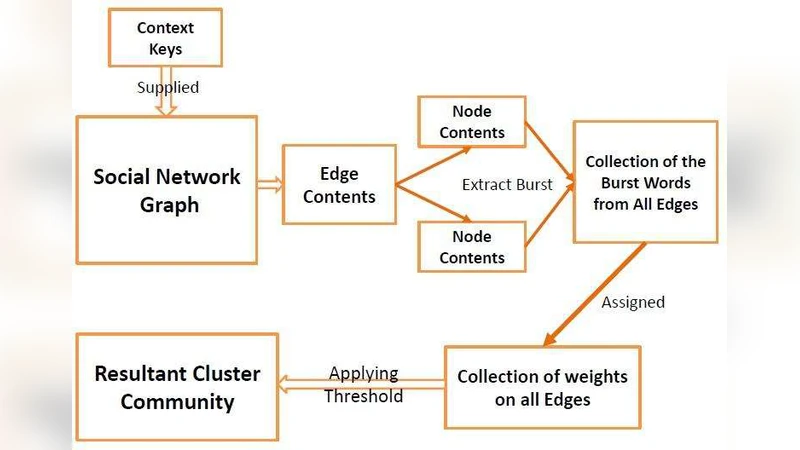
ILSCM addresses these gaps through a four‑step pipeline. First, a user supplies one or more “context keys” that represent the event or theme of interest (e.g., “Independence Day”). A search function f_s(C_k) scans the entire graph and extracts, for every edge (v_x, v_y), a set of burst words B_xy that are strongly associated with the given context key during a specific time window. The cardinality of B_xy is used as a weight w_xy for that edge, reflecting the intensity of the temporal topic on the connection. Second, all edge weights are assembled into an adjacency matrix, effectively turning the graph into a weighted network where edge strength encodes temporal relevance. Third, betweenness centrality (or a similar closeness measure) is computed on this weighted graph, producing a betweenness score for each node pair. Fourth, a predefined threshold θ is applied: edges whose weight exceeds θ are retained, and the induced subgraph R_G = (V_r, E_r) is declared a community.
The authors illustrate the method with a small example consisting of ten edges, showing how burst‑word extraction, weight assignment, adjacency‑matrix construction, and betweenness calculation lead to a clear subgraph that corresponds to users sharing a common event‑related interest. The paper also surveys a wide range of related work—including unified temporal topic models, BIGCLAM, CESNA, and various overlapping‑community algorithms—highlighting that none of these prior approaches simultaneously exploit edge content and temporal burst detection.
In the discussion, the authors acknowledge several limitations: (1) the need for manual selection of context keys, (2) the reliance on a fixed threshold that may require tuning for each dataset, and (3) the absence of large‑scale experiments to validate scalability. They propose future directions such as automated keyword extraction, adaptive threshold learning, and extensive benchmarking on networks with millions of nodes and edges.
Overall, ILCSM offers a promising framework for detecting event‑driven communities, especially in scenarios where rapid information diffusion (e.g., breaking news, natural disasters, holidays) creates distinct temporal patterns. By integrating vertex attributes, edge semantics, and bursty temporal signals into a unified clustering process, the model aims to produce more accurate and semantically meaningful community partitions than traditional methods.
Comments & Academic Discussion
Loading comments...
Leave a Comment