Motion correction in cardiac perfusion data by using robust matrix decomposition
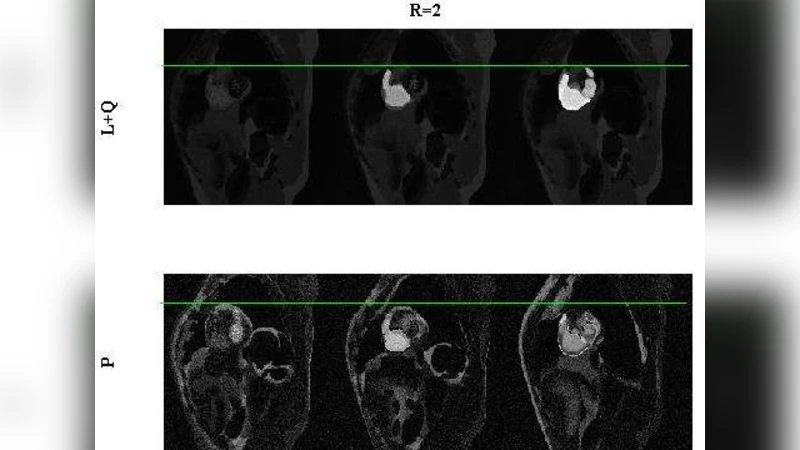
Motion free reconstruction of compressively sampled cardiac perfusion MR images is a challenging problem. It is due to the aliasing artifacts and the rapid contrast changes in the reconstructed perfusion images. In addition to the reconstruction limitations, many registration algorithms under perform in the presence of the rapid intensity changes. In this paper, we propose a novel motion correction method that reconstructs the motion free image series from the undersampled cardiac perfusion MR data. The motion correction method uses the novel robust principal component analysis based reconstruction along with the periodic decomposition to separate the respiratory motion component that can be registered, from the contrast intensity variations. It is tested on simulated data and the clinically acquired data. The performance of the method is qualitatively assessed and compared with the existing motion correction methods. The proposed method is validated by comparing manually acquired time-intensity curves of the myocardial sectors to automatically generated curves before and after registration.
💡 Research Summary
The paper addresses a long‑standing challenge in cardiac perfusion magnetic resonance imaging (MRI): obtaining motion‑free image series from highly undersampled data that simultaneously exhibits severe aliasing artifacts and rapid contrast changes. Conventional compressed‑sensing (CS) reconstructions can mitigate undersampling artifacts but struggle when the signal intensity varies quickly across time, while standard image registration algorithms often fail because the large intensity fluctuations obscure the underlying anatomical correspondence. To overcome these intertwined problems, the authors propose a novel motion‑correction pipeline that integrates Robust Principal Component Analysis (RPCA) with a periodic decomposition of the respiratory motion component.
Core methodology
The raw perfusion data are first arranged as a matrix (X\in\mathbb{R}^{N_{pixels}\times N_{time}}), where each column corresponds to a frame in the dynamic series. RPCA decomposes this matrix into a low‑rank component (L) and a sparse component (S) by solving
\
Comments & Academic Discussion
Loading comments...
Leave a Comment