Discovering and Proving Infinite Pochhammer Sum Identities
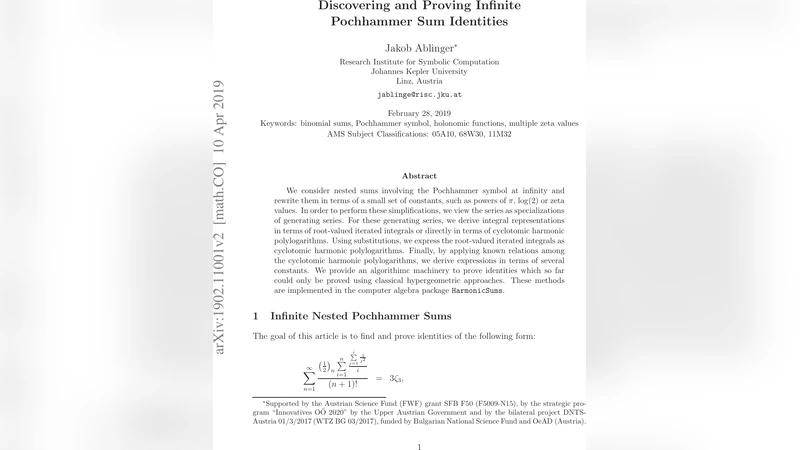
We consider nested sums involving the Pochhammer symbol at infinity and rewrite them in terms of a small set of constants, such as powers of $\pi,$ $\log(2)$ or zeta values. In order to perform these simplifications, we view the series as specializations of generating series. For these generating series, we derive integral representations in terms of root-valued iterated integrals or directly in terms of cyclotomic harmonic polylogarithms. Using substitutions, we express the root-valued iterated integrals as cyclotomic harmonic polylogarithms. Finally, by applying known relations among the cyclotomic harmonic polylogarithms, we derive expressions in terms of several constants. The methods are implemented in the computer algebra package HarmonicSums.
💡 Research Summary
The paper presents a systematic, computer‑algebraic framework for evaluating infinite nested sums that involve the Pochhammer symbol (x)n. The authors treat such sums as specializations of generating functions: the original series ∑{n≥1}a_n is obtained as the limit x→1 of the generating series ∑_{n≥1}x^n a_n. Because generating functions of holonomic sequences are holonomic functions, the method first derives a holonomic recurrence for the coefficient sequence a_n. This recurrence is then translated into a linear differential equation for the generating function. Initial values are computed either directly or retrieved from a database, and the differential equation is solved using the d’Alembertian/Liouvillian solver built into the HarmonicSums package. The solution is expressed as an iterated integral over hyper‑exponential letters.
The next step converts these hyper‑exponential iterated integrals into cyclotomic harmonic polylogarithms. The basic building blocks are functions f_{b}^{a}(x)=x^b/Φ_a(x), where Φ_a is the a‑th cyclotomic polynomial. By suitable variable substitutions the authors eliminate root‑valued integrals and rewrite the result as H_{m_1,…,m_k}(1), i.e., cyclotomic harmonic polylogarithms evaluated at 1. These objects generalize ordinary harmonic polylogarithms and include many known constants as special cases.
Finally, a large pre‑computed database of algebraic relations among cyclotomic polylogarithms (weights up to 12 for harmonic polylogarithms and up to 6 for cyclotomic ones) is used to reduce the H‑expressions to a minimal set of constants: powers of π, logarithms of small integers, zeta values ζ(k), Catalan’s constant C, and polylogarithms Li_k(½). The authors provide three concrete algorithms that implement the whole pipeline: (1) generating‑function construction, (2) conversion to cyclotomic polylogarithms, and (3) constant reduction. All steps are automated in the Mathematica‑based HarmonicSums package, with commands such as ComputeGeneratingFunction, SolveDE, and SpecialGLToH.
The paper demonstrates the method on a variety of non‑trivial examples. One highlighted identity is ∑_{n≥1} (−½)^n S₁(n) /
Comments & Academic Discussion
Loading comments...
Leave a Comment