Resource Allocation Algorithm for V2X communications based on SCMA
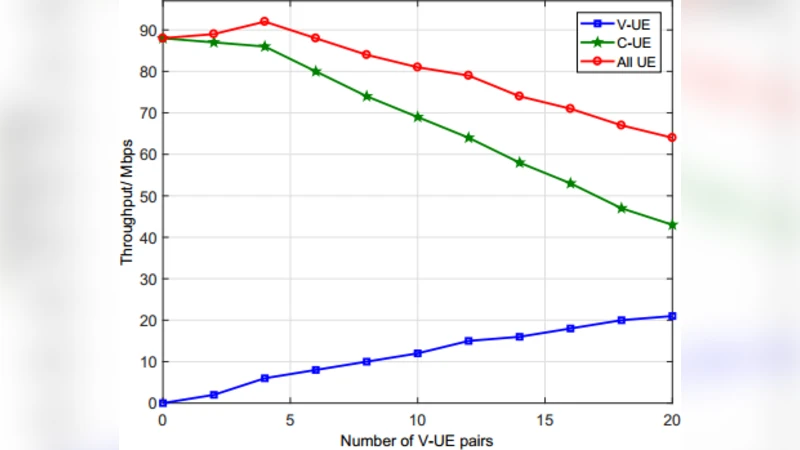
In this paper, we propose a resource allocation algorithm for V2X communications based on Sparse Code Multiple Access(SCMA). By analyzing the interference model in the V2X scenario, we formulate the problem which deals with resource allocation to maximize the system throughput. A graph color-based user cluster algorithm combined with resource allocation algorithm based on both result of clustering and SINR is presented to solve the problem. The simulation results indicate that the throughput performance of system based on SCMA is superior to which based on OFDMA, and the proposed algorithm can improve the system throughput and the number of access users.
💡 Research Summary
The paper addresses the pressing challenge of resource allocation for vehicle‑to‑everything (V2X) communications in dense, high‑mobility environments. Traditional solutions such as IEEE 802.11p and LTE‑based device‑to‑device (D2D) either suffer from limited spectral efficiency or severe interference when V2V links reuse cellular resources. To overcome these limitations, the authors propose a novel algorithm that combines Sparse Code Multiple Access (SCMA), a non‑orthogonal multiple access (NOMA) scheme, with a graph‑coloring based clustering method and a SINR‑driven resource‑matching procedure.
System model
A single‑cell hybrid network is considered, comprising cellular users (C‑UEs) that communicate with the base station (BS) in the uplink (V2I) and vehicle users (V‑UEs) that exchange data directly (V2V). C‑UEs employ SCMA, mapping log₂ D bits onto M‑dimensional sparse codewords. The overload factor OF = J/L (with J codebooks and L resource blocks) allows multiple C‑UEs to share the same RB, increasing the number of supported users. V‑UEs reuse the same RBs allocated to C‑UEs but use orthogonal multiple access among themselves to limit intra‑V‑UE interference.
Interference and optimization
When a V‑UE pair reuses a C‑UE’s RB, three interference paths appear: (i) C‑UE transmission to the BS interferes the V‑UE receiver, (ii) V‑UE transmitter interferes the BS, and (iii) V‑UE‑to‑V‑UE interference among reused pairs. The authors formulate the SINR for each C‑UE and V‑UE, introduce binary reuse indicators, and impose minimum‑SINR and maximum‑power constraints. The objective is to maximize the sum‑rate of the cell, yielding a mixed‑integer non‑linear programming problem that is NP‑hard.
Proposed two‑stage heuristic
-
Graph‑coloring based clustering: Each V‑UE pair is a node in an interference graph; an edge connects two nodes if they would interfere when sharing the same RB. The algorithm colors the most interfered node first, then proceeds in descending order of interference degree, assigning the smallest feasible color (cluster) that avoids conflicts. The number of colors corresponds to the number of clusters, and the goal is to minimize it.
-
SINR‑based resource allocation: After clustering, C‑UEs are sorted by descending SINR. The algorithm iteratively assigns the RB of the highest‑SINR C‑UE to a V‑UE cluster. For each assignment it recomputes the SINR of all involved users; if every V‑UE in the cluster satisfies its minimum‑SINR requirement, the allocation is kept and the algorithm proceeds to the next cluster. Otherwise the cluster tries the next C‑UE’s RB. This continues until all clusters are allocated or no feasible RB remains.
Simulation setup
Parameters reflect a realistic 5G scenario: cell radius 250 m, carrier frequency 2 GHz, system bandwidth 20 MHz, C‑UE transmit power 20 dBm, V‑UE transmit power 17 dBm, noise density –174 dBm/Hz, V2V link distance 25 m. SCMA settings are L = 4 RBs, M_c = 2 non‑zero elements per codeword, and J = 6 codebooks (overload factor 1.5).
Results
- SCMA vs OFDMA: With the same number of RBs, SCMA yields higher average throughput because the overload factor permits more simultaneous users.
- Effect of clustering: The graph‑coloring step successfully separates highly interfering V‑UE pairs, limiting the degradation of C‑UE throughput caused by V‑UE reuse.
- Overall system sum‑rate: As the number of V‑UE pairs grows, total throughput initially rises (more V‑UE traffic) but eventually falls when interference dominates. The proposed algorithm tracks the optimal operating point, achieving higher sum‑rate than baseline schemes that lack clustering or SINR‑aware allocation.
Contributions and limitations
The paper’s main contribution is the integration of SCMA with a graph‑theoretic clustering mechanism to manage V2X resource reuse, demonstrating measurable gains in both throughput and supported user count. Limitations include the single‑cell assumption, the requirement of perfect CSI at the BS, and the restriction that V‑UEs must remain within the same cell. Future work should extend the framework to multi‑cell coordination, dynamic traffic patterns, latency‑sensitive QoS metrics, and provide a detailed computational‑complexity analysis for real‑time implementation in 5G NR.
In summary, the study provides a promising direction for enhancing V2X communications by leveraging SCMA’s overload capability together with intelligent interference‑aware clustering and SINR‑driven resource allocation.
Comments & Academic Discussion
Loading comments...
Leave a Comment