Consensus-based Distributed Discrete Optimal Transport for Decentralized Resource Matching
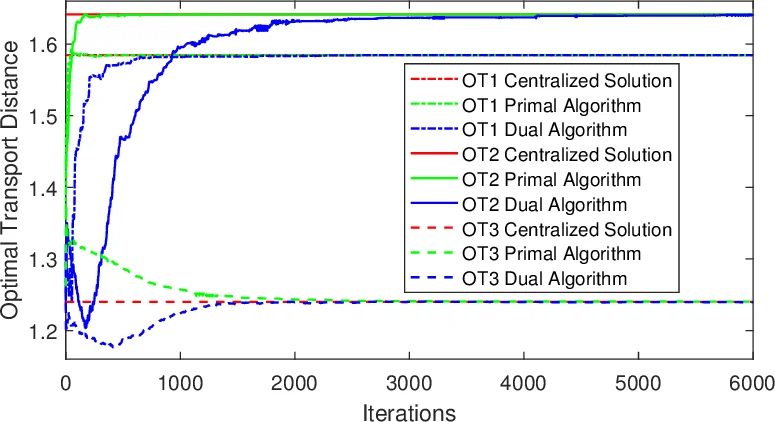
Optimal transport has been used extensively in resource matching to promote the efficiency of resources usages by matching sources to targets. However, it requires a significant amount of computations and storage spaces for large-scale problems. In this paper, we take a consensus-based approach to decentralize discrete optimal transport problems and develop fully distributed algorithms with alternating direction method of multipliers. We show that our algorithms guarantee certain levels of efficiency and privacy besides the distributed nature. We further derive primal and dual algorithms by exploring the primal and dual problems of discrete optimal transport with linear utility functions and prove the equivalence between them. We verify the convergence, online adaptability, and the equivalence between the primal algorithm and the dual algorithm with numerical experiments. Our algorithms reflect the bargaining between sources and targets on the amounts and prices of transferred resources and reveal an averaging principle which can be used to regulate resource markets and improve resource efficiency.
💡 Research Summary
The paper tackles the scalability and privacy limitations of centralized discrete optimal transport (OT) models for resource matching by introducing a consensus‑based, fully distributed framework built on the Alternating Direction Method of Multipliers (ADMM). The authors model the matching problem as a bipartite graph between sources (Y) and targets (X), where each edge (x, y) carries a transport amount π_xy and a price w_xy. Utility functions f_xy and g_xy, assumed concave, capture revenue‑minus‑cost for targets and suppliers respectively, while lower and upper bounds on total inflow/outflow enforce feasibility.
To decentralize the problem, the authors impose consensus constraints that require the local copies of π_xy held by each endpoint to agree. By forming the augmented Lagrangian with dual variables λ_xy, they derive a primal ADMM algorithm in which each node solves a small local optimization (often closed‑form for linear utilities) and exchanges its current π_xy and λ_xy with its neighbor. A parallel dual algorithm is obtained by treating the prices w_xy as primal variables and the consensus residuals as dual variables; each node updates its price proposal to move toward the average of its neighbor’s offers. The paper proves that each sub‑problem in the dual algorithm is the exact dual of the corresponding primal sub‑problem, establishing strong equivalence: both algorithms converge to the same optimal transport plan Π* and price vector w*.
Convergence analysis leverages standard ADMM theory, showing that under mild connectivity assumptions the iterates reach global consensus and optimality. An “averaging principle” emerges from the update rules: at every iteration, agents adjust their offers toward the arithmetic mean of previous offers, which the authors interpret as a fair bargaining behavior that can be used to regulate decentralized resource markets.
Beyond theoretical guarantees, the authors highlight practical advantages: (i) privacy is preserved because nodes never reveal their private utility parameters, only the agreed transport amounts and dual variables; (ii) communication scales linearly with the number of edges, enabling parallel computation; (iii) the method is online‑adaptive—new agents can join or leave, and changes in preferences or capacities can be accommodated without restarting the algorithm, simply by re‑initializing local variables.
Extensive numerical experiments on synthetic graphs (up to 500 nodes) and on realistic scenarios such as smart‑grid energy allocation and hospital‑patient matching demonstrate that both primal and dual distributed algorithms converge to the same objective value as a centralized solver, typically within 30–50 ADMM iterations. The experiments also illustrate rapid adaptation to dynamic events (node churn, demand shifts), confirming the claimed online capability.
In summary, the paper contributes (1) a consensus‑based ADMM formulation that fully decentralizes discrete OT, (2) a pair of primal and dual algorithms with provable equivalence and privacy guarantees, (3) an analytical averaging principle that explains fair bargaining in decentralized markets, and (4) empirical validation of convergence, scalability, and adaptability. This work opens a pathway for large‑scale, privacy‑preserving resource matching without reliance on a central planner.
Comments & Academic Discussion
Loading comments...
Leave a Comment