Training Multi-Speaker Neural Text-to-Speech Systems using Speaker-Imbalanced Speech Corpora
When the available data of a target speaker is insufficient to train a high quality speaker-dependent neural text-to-speech (TTS) system, we can combine data from multiple speakers and train a multi-speaker TTS model instead. Many studies have shown …
Authors: Hieu-Thi Luong, Xin Wang, Junichi Yamagishi
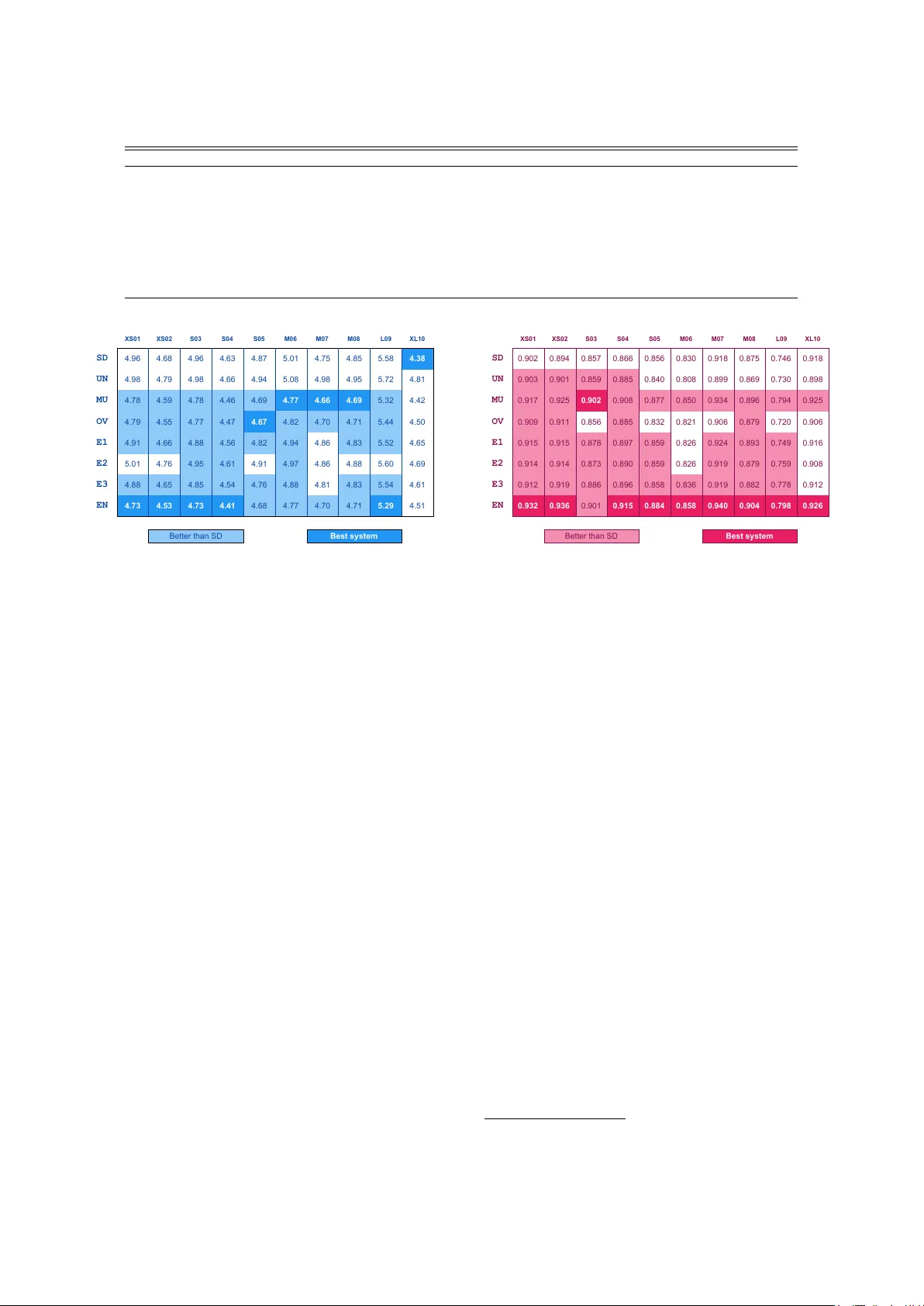
T raining Multi-Speaker Neural T ext-to-Speech Systems using Speaker -Imbalanced Speech Corpora Hieu-Thi Luong 1 , 2 , Xin W ang 1 , J unichi Y amagishi 1 , 2 , 4 , Nobuyuki Nishizawa 3 1 National Institute of Informatics, T okyo, Japan 2 SOKEND AI (The Graduate Univ ersity for Advanced Studies), Kanaga wa, Japan 3 KDDI Research Inc., Saitama, Japan 4 Uni versity of Edinb urgh, Edinb urgh, UK { luonghieuthi,wangxin,jyamagis } @nii.ac.jp, no-nishizawa@kddi-research.jp Abstract When the av ailable data of a target speaker is insuf ficient to train a high quality speaker -dependent neural text-to-speech (TTS) system, we can combine data from multiple speakers and train a multi-speaker TTS model instead. Many studies hav e sho wn that neural multi-speaker TTS model trained with a small amount data from multiple speakers combined can gen- erate synthetic speech with better quality and stability than a speaker -dependent one. Ho wever when the amount of data from each speaker is highly unbalanced, the best approach to make use of the excessi ve data remains unknown. Our experiments showed that simply combining all av ailable data from ev ery speaker to train a multi-speaker model produces better than or at least similar performance to its speaker-dependent counterpart. Moreov er by using an ensemble multi-speaker model, in which each subsystem is trained on a subset of av ailable data, we can further improve the quality of the synthetic speech especially for underrepresented speakers whose training data is limited. Index T erms : speech synthesis, multi-speaker modeling, im- balanced corpus, ensemble learning 1. Introduction Recent advances in statistical parametric speech synthesis re- search have produced synthetic speech indistinguishable from natural speech when a model is trained with a large and high quality speech corpus [1, 2]. Howev er to scale the technology to multiple voices and reduce the production cost, the ability to build TTS systems from a smaller and less refined corpus is cru- cial. As data sparsity is the major challenge for this task, many schemes hav e been proposed to alle viate it. If the speech corpus is created from scratch, the sentence corpus used for recording could be carefully designed to ensure a balanced cov erage of linguistic units [3, 4]. A less refined speech corpus, such as a corpus of found data, can also be used by filtering out utter- ances deemed unfit [5, 6]. A data selection scheme can also be applied on legacy corpora to remove redundant samples [7, 8]. In another approach, we could combine speech data from man y speakers and train a multi-speaker TTS system [9]. Recent neural acoustic models are capable of achie ving high performance for both single speaker modeling [2] and multi-speaker modeling [10, 11] tasks. The multi-speaker model is simple to set up [12, 13] and can generate more stable speech wav eforms than those of the speaker-dependent model when the amount of the target speaker’ s data is limited [10]. Latorre et al. [14] compared the performances of multi- speaker and single-speaker models using different amounts of data and reported similar results for v arious conditions. In these multi-speaker experiments [11, 14], the number of utterances contributed by each speaker is kept perfectly or roughly bal- anced. In this paper, we are interested in finding the best strat- egy to train a multi-speaker model using an existing speaker - unbalanced corpus. Class imbalance is a common issue faced by many classi- fication systems because real-world data are usually predomi- nated by the normal classes while lacking samples of the abnor- mal classes. Man y techniques ha ve been proposed to tackle this problem. Over -sampling and under-sampling are simple and ef- fectiv e approaches to obtain synthetically balanced corpus [15]. In this paper , we use the same techniques to prepare the train- ing set for a multi-speaker acoustic model. Moreov er , we pro- pose using an ensemble model, which combines predictions of multiple subsystems, to produce a better prediction itself. Our ensemble acoustic model for speech synthesis shares the same spirit as the ensemble deep learning system for speech recogni- tion [16]. In section 2 of this paper, we describe our methodology for multi-speaker acoustic and the ensemble models. Section 3 provides details about the experimental conditions and Section 4 presents both objective and subjective ev aluation results of our proposal. W e conclude in Section 5 with with a brief summary and mention of future work. 2. Multi-speaker and ensemble models 2.1. Multi-speaker model f or speaker -imbalanced corpus In this paper we adopt the same auto-re gressiv e neural-network acoustic model used in our prior publication [1]. By appending a one-hot v ector speaker code to e very frame of the linguistic in- put x , we created a multi-speaker model that can generate mul- tiple v oices simply by changing the speaker code. The method is simple b ut effecti ve and does not depend on the network ar- chitecture [13, 17]. This essentially means that all parameters of the network are shared among all training speakers e xcept the bias of the first hidden layer: h 1 = tanh( W 1 x + c 1 + b ( k ) ) (1) where h 1 is the output of the first hidden layer containing m units, W 1 ∈ R m × m and c 1 ∈ R m × 1 are common parame- ters shared among all speakers, and b ( k ) ∈ R m × 1 is a speaker- specific bias projected from the speaker’ s one-hot v ector . tanh is the non-linear activ ation function of the first hidden layer . As most of the network parameters are shared and stochas- tically trained with combined data, using an imbalanced cor- pus might produce a model that is over -trained on the major- ity speakers while under-trained on the minority . T o test this hypothesis we apply resampling techniques, which are widely used to create synthetically balanced datasets [18, 15]. Here, Mode l 1 Mode l 2 Mode l 3 Combination fun ctions Linguistic feat ur es A coustic feat ur es Output Input Figure 1: Ensemble multi-speaker acoustic model used for our in vestigation. we can choose to perform under-sampling [18] of the majority speakers, over -sampling of the minority speakers [19], or a lit- tle of both [15]. While these techniques are commonly used for classification tasks, we applied them in the conte xt of training a multi-speaker neural acoustic model. 2.2. Linear ensemble for acoustic featur e inference In addition to the resampling techniques, we also investig ate using stacking [20, 21] to combine the predictions of several systems in the hope of further reducing the mismatch between generated and real-life samples. Ensemble learning is a method of using multiple models to obtain a better performance; it is used in many other research fields [22]. For example, Deng and Platt [16] performed a linear combination of the original speech-class posterior probabilities provided by subsystems at the frame lev el for automatic speech recognition (ASR). Their ensemble model capitalizes on the div ersity of neural network architectures to provide di verse prediction outputs. Our ensemble model, shown in Fig.1, shares many traits with the model proposed in [16] for ASR. T o create diverse sub- systems, we used the same network architecture in each subsys- tem but trained them on different data subsets randomly sam- pled from a training corpus. This strategy is more straightfor- ward than creating subsystems with varied network architec- tures [16, 23]. Moreover we take a much simpler and non- parametric approach for the combination functions to test our hypothesis. Deterministic a verage-based combination functions are defined to combine the output of the subsystems. As the two main acoustic features used in our experiments are mel- generalized cepstral coefficients (MGCs) and fundamental fre- quency (F0), we define the combination functions as follo ws: • Combination function f or MGC : As the MGCs at each frame are continuous values, our ensemble model sim- ply computes the average of the MGCs produced by the subsystems. • Combination function f or F0 : Because the F0 is a con- tinuous value at a voiced frame but a discrete symbol (i.e., un voiced flag) at an un voiced frame, we first decide whether one frame is voiced or un voiced by voting. If most of the subsystems generated voiced F0s values, we take the av erage F0 value as the ensemble model’ s out- put. Otherwise, the output F0 is set to un voiced. 3. Experiments 3.1. Dataset and features Our experiments are data-driven and we seek to identify the best approach to train a speech synthesis system from an imbalanced speech corpus. The corpus we used contained utterances from ten female Japanese speakers, who are professional or at least familiar with voice acting work. The number of utterances of each speaker ranged from 1,000 to 10,000. After processing and removing utterances unsuitable for speech synthesis, we split the remaining data into training, v alidation and testing sets, as displayed in T able 1. As we applied a sampling technique to create a synthetic speaker -balanced corpus, the number of unique utterances of each speaker obtained from these sampling sessions are also included in T able 1. The acoustic features used in our experiments consist of 60-dimensional Mel-generalized cepstral coef ficients (MGC) and 511-bin quantized mel scale fundamental frequency (F0) plus one bin for the un voiced case. These features are ex- tracted from 48-kHz speech w aveform using 25-ms windo w and shifting 5 ms each frame. Linguistic features consist of typ- ical Japanese linguistic information such as phonemes, moras (syllabic unit), part-of-speech tags, interrogativ e intention, and pitch-accent. The final linguistic features are encoded as a 265- dimensional vector for each frame including duration informa- tion extracted from forced-alignment with the acoustic feature sequence, which is obtained using an external systems. 3.2. Model configurations W e adopted the same architecture described in our pre vious publication [1] for the acoustic models. A shallow autoregres- siv e network (SAR) [24] is used to model MGC and a deep au- toregressi ve network (D AR) [25] is used for quantized mel scale F0. The SAR contains two 512-unit non-linear feedforward lay- ers followed by two 256-unit bi-directional layers, and linear output layer . Similarly , the D AR contains tw o 512-unit feedfor - ward layers, a 256-unit bi-directional recurrent layer and a 128- unit uni-directional recurrent layer that recei ves a feedback link from the previously generated samples and a linear layer that maps to the desired output. For the multi-speaker model, a 10- dimensional one-hot vector representing speakers is appended to e very frame of the linguistic sequence. The acoustic model is trained using stochastic gradient with the utterance order shuf- fled to make sure the model learns the optimal representation for all speakers. A speaker -independent W aveNet vocoder [26] was trained using the combined training data of all speakers. This model contained 40 dilated layers similar to the original W aveNet [27]. It was directly trained using the natural MGC and quantized mel-scale F0s from all the speakers, without speaker one-hot vectors. The target waveform had a sampling rate of 16 kHz and was quantized using the 10-bit µ -law standard. 3.3. Strategies for handling unbalanced cor pus The main in vestigation in this paper is which methodology ef- ficiently uses an imbalanced multi-speaker corpus to improv e performance for the generated speech of all speakers inv olved. Multiple strategies are compared in the e xperiments: • SD : The con ventional speaker-dependent models, each of which is trained using one target speaker’ s data listed in T able 1. This is our baseline strategy . • UN : A multi-speaker model trained with an under- T able 1: Data sets of tar get speak ers. Speaker ID XS01 XS02 S03 S04 S05 M06 M07 M08 L09 XL10 T raining (unique utterances): Speaker -Dependent 735 994 1393 1568 1749 3024 3983 4364 5516 8750 Sampling 1 st 728 938 1227 1341 1444 1901 2088 2179 2320 2532 Sampling 2 nd 729 955 1214 1340 1442 1892 2074 2185 2312 2516 Sampling 3 rd 722 944 1242 1329 1418 1916 2122 2186 2325 2554 Ensemble (Sampling 1+2+3) 735 994 1391 1559 1742 2869 3541 3807 4424 5630 V alidation 50 50 50 50 50 50 50 50 50 50 T esting 100 100 100 100 100 100 100 100 100 100 XS01 XS02 S03 S04 S05 M06 M07 M08 L09 XL10 SD 4.96 4.68 4.96 4.63 4.87 5.01 4.75 4.85 5.58 4.38 UN 4.98 4.79 4.98 4.66 4.94 5.08 4.98 4.95 5.72 4.81 MU 4.78 4.59 4.78 4.46 4.69 4.77 4.66 4.69 5.32 4.42 OV 4.79 4.55 4.77 4.47 4.67 4.82 4.70 4.71 5.44 4.50 E1 4.91 4.66 4.88 4.56 4.82 4.94 4.86 4.83 5.52 4.65 E2 5.01 4.76 4.95 4.61 4.91 4.97 4.86 4.88 5.60 4.69 E3 4.88 4.65 4.85 4.54 4.76 4.88 4.81 4.83 5.54 4.61 EN 4.73 4.53 4.73 4.41 4.68 4.77 4.70 4.71 5.29 4.51 Better than SD Best system Figure 2: Mel-ceptral distortion (smaller is better). sampled corpus containing 753 × 10 utterances. Each speaker contributes 735 utterances to this corpus, where 735 is the number of utterances from speaker XS01, who has the least amount of training data. • MU : The con ventional multi-speaker models trained with all the data from every speaker, i.e., all 32,076 training utterances from the original corpus. • OV : A multi-speaker model trained with an ov er-sampled corpus. W e used all utterances and then sampled more from minority speakers so that each got the same fre- quency in training. The amount of training data is 8,750 × 10 utterances. • E1 , E2 , E3 : Multi-speaker models trained with resam- pled corpora. In total, 3,000 utterances are sampled with replication from each speaker . The number of training utterances is 3,000 × 10, and the number of unique utter- ances obtained in each sampling session is listed in T able 1. • EN : A non-parametric ensemble model. W e simply com- bined the generated acoustic features obtained from the E1 , E2 and E3 models using the combination functions discussed in Section 2.2. 4. Evaluations 4.1. Objective e valuations Figure 2 shows mel-cepstral distortion between the generated and natural MGC while Fig.3 shows correlation between the generated F0 sequence inferred from the quantization output and the natural sequence. These figures show objective results separately for each speaker with color codes indicating the best system as well as the system which is better than the SD base- XS01 XS02 S03 S04 S05 M06 M07 M08 L09 XL10 SD 0.902 0.894 0.857 0.866 0.856 0.830 0.918 0.875 0.746 0.918 UN 0.903 0.901 0.859 0.885 0.840 0.808 0.899 0.869 0.730 0.898 MU 0.917 0.925 0.902 0.908 0.877 0.850 0.934 0.896 0.794 0.925 OV 0.909 0.911 0.856 0.885 0.832 0.821 0.906 0.879 0.720 0.906 E1 0.915 0.915 0.878 0.897 0.859 0.826 0.924 0.893 0.749 0.916 E2 0.914 0.914 0.873 0.890 0.859 0.826 0.919 0.879 0.759 0.908 E3 0.912 0.919 0.886 0.896 0.858 0.836 0.919 0.882 0.778 0.912 EN 0.932 0.936 0.901 0.915 0.884 0.858 0.940 0.904 0.798 0.926 Better than SD Best system Figure 3: F0 corr elation (bigg er is better). line. Even though objective ev aluations do not directly reflect the quality of synthetic speech perceiv ed by humans, they do demonstrate the potential of the proposed methods. The under-sampling strategy UN with data pooled from 10 speakers does not seem to have any significant improv ement ov er the baseline SD even for minority speaker XS01, whose entire data is included in UN . This result suggests that a multi- speaker model is not always better than the single speaker model, especially when the amount of pooled data is still lim- ited. The over -sampling strategy OV is better than SD overall, but there is noticeable degradation in the case of majority speak- ers in terms of the F0 correlation metric. The conv entional multi-speaker model MU shows consistent improvements over the baseline SD for most speakers. W e conclude that simply pooling the data of all speakers is a reasonable strategy . The sampling strategies E1 , E2 , and E3 seem to be better than the baseline SD b ut worse than MU . The performances v ary for each session due to the stochastic nature of the sampling method. Surprisingly simply combining the generated features of E1 , E2 , and E3 using the average functions described in Sec- tion 2.2 produced the a better result than each individual subsys- tem. In general, the ensemble strategy EN had the best results. Note that the amount of unique utterances from majority speak- ers (XL10, L09, etc.) used for the ensemble model is significant lower than the SD and MU due to the random sampling artifact, as shown in T able 1. 4.2. Subjective e valuations W e conducted a subjective listening test with samples synthe- sized using SD , MU and EN strategies 1 . Recorded speech is not included in our test, but we use W av eNet vocoder to synthesize 1 Samples are av ailable at https://nii- yamagishilab. github.io/sample- tts- speaker- imbalanced/ 0 25 50 75 100 *ALL MU SD 0 25 50 75 100 XL10 L09 *M08 M07 *M06 *S05 *S04 *S03 *XS02 *XS01 (a) MU-SD 0 25 50 75 100 *ALL EN SD 0 25 50 75 100 XL10 *L09 *M08 M07 *M06 *S05 *S04 *S03 *XS02 *XS01 (b) EN-SD 0 25 50 75 100 *ALL EN MU 0 25 50 75 100 XL10 *L09 *M08 *M07 *M06 *S05 S04 *S03 XS02 *XS01 (c) EN-MU Figure 4: AB prefer ence test results for TTS samples of thr ee strate gies. speech from natural acoustic features as the reference, namely a copy synthesis strategy CO . All samples are normalized us- ing the sv56 program. Each strategy contains 1,000 utterances, 100 utterances per speaker . W e prepared a simple AB pref- erence test in which a participant was asked to answer which sample sounds better between two presented. The presented samples are spoken by the same speaker with the same con- tent and duration but generated from different strategies. W e compared four pairs: MU-SD , EN-SD , EN-MU and the anchor test EN-CO . Each session contains one unique sentence from each of the ten target speakers, which make 40 questions in to- tal. The question orders and sample positions are shuffled to prev ent cognitiv e bias. Each paid participant could do ten ses- sions at most. W e gathered answers from 997 sessions (three are discarded for incompleteness) provided by 175 participants 0 25 50 75 100 *ALL EN CO 0 25 50 75 100 *XL10 *L09 *M08 M07 *M06 *S05 S04 *S03 *XS02 *XS01 Figure 5: Anchor AB pr efer ence test results for copy synthesis and ensemble strate gy samples. to ev aluate performance of the proposed methods. The results are calculated on both a per speaker and per strategy basis. The preference results of the TTS samples are shown in Figure 4, where (*) indicates systems whose results are statisti- cally significant according to the 95% confidence le vel of an e x- act binomial test. Between the multi-speaker model and single model, the result is in fa vor of the MU o ver the SD , as presented in Fig.4(a). When considering each speaker separately , we can see that speak ers with less data benefit the most from the multi- speaker model, while speakers with the most data do not seem to suffer any performance degradation. A similar pattern can be seen between the ensemble model and the single model (as in Fig.4(b)), with an even stronger improvement observed with the EN strategy . Figure 4(c) shows direct comparisons between the multi-speaker model MU and the ensemble model EN . W e obtained statistically significant results favoring EN for many speakers except for M07, who fared best with the MU strategy . The results of speaker XS02, S04 and XL10 while not signif- icant but do seem to fa vor EN as well. T o conclude, our pro- posed ensemble strategy sho wed significant impro vements o ver the conv entional multi-speaker model. The trade-off is the in- creased number of parameters as well as increased training and inference times due to the fact that multiple models are required. The anchor test between our proposed strategy EN and the copy synthesis CO is shown in Fig.5. As expected CO dominated, with statistically significant results for all cases e xcept speakers S04 and M07. 5. Conclusions W e inv estigated the effect of a speaker-imbalanced corpus on the performance of a neural multi-speaker acoustic model. The results sho wed that simply combining all the a vailable data without an y resampling led to a well-rounded performance for all speakers in volved. Moreover the multi-speaker model greatly benefited from a simple ensemble setup with just three subsystems sharing the same network structure but trained on different subsets of a corpus obtained through the sampling method. The one disadvantage is that the ensemble setup in- creases the number of parameters and the inference times. For future work, we plan to distill knowledge from an ensemble teacher network to a singular-structure student to inherit the good performance while av oiding increased parameters and processing times [23]. W e also intend to introduce div ersity to the network structure along with diversity in training data in order to capitalize on the strengths and reduce the weaknesses of different netw ork structures [22]. 6. References [1] H.-T . Luong, X. W ang, J. Y amagishi, and N. Nishizawa, “Inv es- tigating accuracy of pitch-accent annotations in neural network- based speech synthesis and denoising effects, ” in Proc. INTER- SPEECH , 2018, pp. 37–41. [2] J. Shen, R. Pang, R. J. W eiss, M. Schuster, N. Jaitly , Z. Y ang, Z. Chen, Y . Zhang, Y . W ang, R. Skerry-Ryan, R. A. Saurous, Y . Agiomyrgiannakis, and Y . W u, “Natural TTS synthesis by conditioning W aveNet on Mel spectrogram predictions, ” in Pr oc. ICASSP , 2018, pp. 4779–4783. [3] W . Zhu, W . Zhang, Q. Shi, F . Chen, H. Li, X. Ma, and L. Shen, “Corpus building for data-driven tts systems, ” in Pr oc. IEEE W orkshop on Speech Synthesis , 2002, pp. 199–202. [4] B. Bozkurt, O. Ozturk, and T . Dutoit, “T ext design for tts speech corpus building using a modified greedy selection, ” in Proc. EU- R OSPEECH , 2003. [5] E. Cooper, X. W ang, A. Chang, Y . Levitan, and J. Hirschberg, “Utterance selection for optimizing intelligibility of tts voices trained on asr data. ” in Proc. INTERSPEECH , 2017, pp. 3971– 3975. [6] K.-Z. Lee, E. Cooper , and J. Hirschberg, “ A comparison of speaker-based and utterance-based data selection for text-to- speech synthesis, ” in Proc. INTERSPEECH , 2018, pp. 2873– 2877. [7] M. Podsiadło and V . Ungureanu, “Experiments with training corpora for statistical text-to-speech systems. ” in Proc. INTER- SPEECH , 2018, pp. 2002–2006. [8] F .-Y . Kuo, S. Aryal, G. Degottex, S. Kang, P . Lanchantin, and I. Ouyang, “Data selection for improving naturalness of tts v oices trained on small found corpuses, ” in Proc. SLT , 2018, pp. 319– 324. [9] J. Y amagishi, B. Usabaev , S. King, O. W atts, J. Dines, J. Tian, Y . Guan, R. Hu, K. Oura, Y .-J. W u, K. T okuda, R. Karhila, and M. Kurimo, “Thousands of voices for hmm-based speech synthesis–analysis and application of tts systems built on vari- ous asr corpora, ” IEEE T rans. Acoust., Speech, Signal Process. , vol. 18, no. 5, pp. 984–1004, 2010. [10] Y . Jia, Y . Zhang, R. J. W eiss, Q. W ang, J. Shen, F . Ren, Z. Chen, P . Nguyen, R. Pang, I. L. Moreno, and Y . W u, “T ransfer learning from speaker verification to multispeaker text-to-speech synthe- sis, ” arXiv preprint , 2018. [11] Y . Chen, Y . Assael, B. Shillingford, D. Budden, S. Reed, H. Zen, Q. W ang, L. C. Cobo, A. T rask, B. Laurie et al. , “Sample efficient adaptiv e text-to-speech, ” arXiv preprint , 2018. [12] Y . Fan, Y . Qian, F . K. Soong, and L. He, “Multi-speaker model- ing and speaker adaptation for dnn-based tts synthesis, ” in Pr oc. ICASSP , 2015, pp. 4475–4479. [13] Y . Zhao, D. Saito, and N. Minematsu, “Speaker representations for speaker adaptation in multiple speakers BLSTM-RNN-based speech synthesis, ” in Proc. INTERSPEECH , 2016, pp. 2268– 2272. [14] J. Latorre, J. Lachowicz, J. Lorenzo-T rueba, T . Merritt, and T . Drugman, “Effect of data reduction on sequence-to-sequence neural tts, ” in Proc. ICASSP , 2019, p. to be appeared. [15] N. V . Chawla, K. W . Bowyer , L. O. Hall, and W . P . K egelmeyer , “SMO TE: synthetic minority over-sampling technique, ” J. Artif. Intell. Res , vol. 16, pp. 321–357, 2002. [16] L. Deng and J. C. Platt, “Ensemble deep learning for speech recognition, ” in Proc. INTERSPEECH , 2014, pp. 1915–1919. [17] N. Hojo, Y . Ijima, and H. Mizuno, “DNN-based speech synthesis using speaker codes, ” IEICE T . Inf. Syst. , vol. 101, no. 2, pp. 462– 472, 2018. [18] M. Kubat and S. Matwin, “ Addressing the curse of imbalanced training sets: one-sided selection, ” in Pr oc. ICML , 1997, pp. 179– 186. [19] N. Japkowicz, “The class imbalance problem: Significance and strategies, ” in Pr oc. ICAI , 2000, pp. 111–117. [20] D. H. W olpert, “Stacked generalization, ” Neural networks , vol. 5, no. 2, pp. 241–259, 1992. [21] L. Breiman, “Stacked regressions, ” Machine learning , vol. 24, no. 1, pp. 49–64, 1996. [22] Y . Ren, L. Zhang, and P . N. Suganthan, “Ensemble classification and regression-recent developments, applications and future di- rections, ” IEEE Comput. Intell. Mag. , vol. 11, no. 1, pp. 41–53, 2016. [23] Y . Chebotar and A. W aters, “Distilling knowledge from ensem- bles of neural networks for speech recognition. ” in Pr oc. INTER- SPEECH , 2016, pp. 3439–3443. [24] X. W ang, S. T akaki, and J. Y amagishi, “ An autoregressi ve recur- rent mixture density network for parametric speech synthesis, ” in Pr oc. ICASSP , 2017, pp. 4895–4899. [25] ——, “ Autoregressiv e neural f0 model for statistical parametric speech synthesis, ” IEEE/ACM T rans. Audio, Speech, Language Pr ocess. , vol. 26, no. 8, pp. 1406–1419, 2018. [26] T . Hayashi, A. T amamori, K. Kobayashi, K. T akeda, and T . T oda, “ An inv estigation of multi-speaker training for wavenet vocoder , ” in Pr oc. ASRU , 2017, pp. 712–718. [27] A. van den Oord, S. Dieleman, H. Zen, K. Simonyan, O. V inyals, A. Grav es, N. Kalchbrenner, A. Senior , and K. Kavukcuoglu, “W avenet: A generative model for raw audio, ” arXiv preprint arXiv:1609.03499 , 2016.
Original Paper
Loading high-quality paper...
Comments & Academic Discussion
Loading comments...
Leave a Comment