Video Game Development in a Rush: A Survey of the Global Game Jam Participants
Video game development is a complex endeavor, often involving complex software, large organizations, and aggressive release deadlines. Several studies have reported that periods of “crunch time” are prevalent in the video game industry, but there are few studies on the effects of time pressure. We conducted a survey with participants of the Global Game Jam (GGJ), a 48-hour hackathon. Based on 198 responses, the results suggest that: (1) iterative brainstorming is the most popular method for conceptualizing initial requirements; (2) continuous integration, minimum viable product, scope management, version control, and stand-up meetings are frequently applied development practices; (3) regular communication, internal playtesting, and dynamic and proactive planning are the most common quality assurance activities; and (4) familiarity with agile development has a weak correlation with perception of success in GGJ. We conclude that GGJ teams rely on ad hoc approaches to development and face-to-face communication, and recommend some complementary practices with limited overhead. Furthermore, as our findings are similar to recommendations for software startups, we posit that game jams and the startup scene share contextual similarities. Finally, we discuss the drawbacks of systemic “crunch time” and argue that game jam organizers are in a good position to problematize the phenomenon.
💡 Research Summary
This paper investigates how video‑game development teams operate under extreme time pressure by surveying participants of the Global Game Jam (GGJ), a 48‑hour hackathon. The authors formulate four research questions (RQs) concerning requirements capture and evolution, quality assurance (QA) practices, adoption of software‑engineering methods, and correlations between familiarity with agile/lean practices and perceived success.
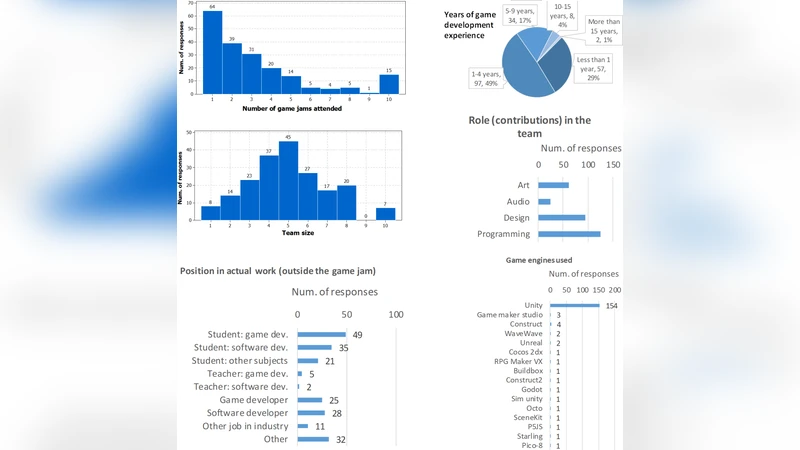
A questionnaire comprising five sections (background, expectations, QA, development practices, and success perception) and 16 items (both closed‑ and open‑ended) was designed following established survey guidelines. After a pilot with 13 respondents, the final instrument was administered in person at a GGJ site in Malmö (January 2017) and promoted via the official GGJ Twitter account. Convenience sampling yielded 198 valid responses out of a potential 36,401 registered participants (response rates 0.54 %–1.15 %).
RQ 1 – Requirements Management
The most common technique for initially capturing game expectations was “iterative brainstorming” (≈68 % of respondents). When expectations changed during the jam, teams primarily relied on “team meetings, informal chats, and verbal communication” (≈55 %). This reflects a lightweight, feedback‑driven approach rather than formal requirements documentation.
RQ 2 – Quality Assurance
During development, the dominant QA activities were regular communication (stand‑up meetings, continuous chat) and internal playtesting. External testing was virtually absent due to time constraints. At the end of the jam, teams assessed the final product through player feedback, live demos, and self‑scoring, again emphasizing rapid, experience‑focused validation.
RQ 3 – Development Practices
From a pre‑defined list of 22 practices, the most frequently reported were continuous integration, minimum viable product (MVP), scope management, version control, and stand‑up meetings. These practices align with agile and lean principles that prioritize small increments, rapid feedback, and automation, but they are applied in a highly ad‑hoc, low‑overhead fashion suitable for a 48‑hour sprint. Additional informal techniques such as paper prototyping and hand‑drawn storyboards were also common.
RQ 4 – Correlations
Statistical analysis revealed a weak positive correlation (r≈0.22) between self‑reported familiarity with agile methods and perceived success in the jam, while lean familiarity showed no significant relationship. Thus, knowledge of agile practices alone does not guarantee success under such severe time constraints.
Discussion and Implications
The authors argue that GGJ teams resemble early‑stage software startups: they operate under high uncertainty, rely on rapid prototyping, and adopt lightweight processes. Consequently, practices proven effective in startups—clear “Definition of Done,” automated build pipelines, and lightweight definition of user stories—could be transplanted into game jams to improve both quality and productivity without adding substantial overhead.
The paper also revisits the broader “crunch time” phenomenon, noting that a game jam is a voluntary, short‑term version of crunch. Organizers are in a unique position to highlight the health risks of sustained overtime and to promote healthier work habits through guidelines, mentorship, and optional “well‑being” checkpoints.
Limitations
The study’s reliance on convenience sampling and a low response rate limits the generalizability of the findings. The sample may be biased toward participants who are more engaged with online communities or more inclined to complete surveys. Moreover, the self‑reported nature of the data introduces potential recall bias.
Future Work
The authors suggest expanding the survey to multiple GGJ editions, incorporating longitudinal tracking of teams, and comparing results with other rapid‑development contexts (e.g., hackathons in other domains). They also propose deeper qualitative investigations (e.g., ethnographic observation) to capture nuanced decision‑making processes that surveys cannot fully reveal.
In summary, the study provides empirical evidence that game‑jam teams predominantly use ad‑hoc, communication‑centric methods, adopt a subset of agile/lean practices, and experience only a modest link between agile familiarity and success. These insights bridge the gap between academic software‑engineering research and the practical realities of fast‑paced game development, offering actionable recommendations for both practitioners and organizers seeking to mitigate the negative aspects of crunch while preserving the creative intensity that makes game jams valuable.
Comments & Academic Discussion
Loading comments...
Leave a Comment