Is multiplexed off-axis holography for quantitative phase imaging more spatial bandwidth-efficient than on-axis holography?
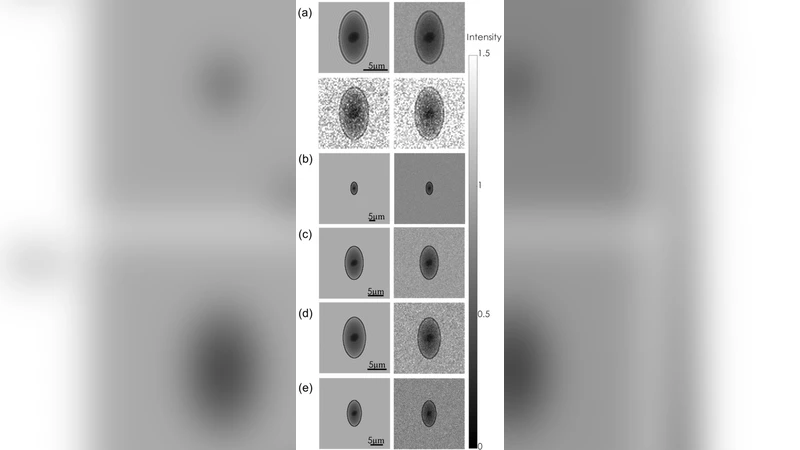
Digital holographic microcopy is a thriving imaging modality that attracts considerable research interest due to its ability to not only create excellent label-free contrast, but also supply valuable physical information regarding the density and dimensions of the sample with nanometer-scale axial sensitivity. Three basic holographic recording geometries currently exist, including on-axis, off-axis and slightly off-axis holography, each of them enabling a variety of architectures in terms of bandwidth use and compression capacity. Specifically, off-axis holography and slightly off-axis holography allow spatial hologram multiplexing, enabling compressing more information into the same digital hologram. In this paper, we define an efficiency score used to analyze the various possible architectures, and compare the signal-to-noise ratio and mean squared error obtained using each of them, determining the optimal holographic method.
💡 Research Summary
The manuscript presents a systematic comparison of three canonical digital holographic microscopy (DHM) recording geometries—on‑axis, off‑axis, and slightly off‑axis—with a particular focus on spatial bandwidth efficiency and quantitative phase‑retrieval performance. The authors begin by revisiting the fundamental interferometric formation of holograms. In on‑axis DHM the reference and object beams propagate collinearly, so the recorded intensity contains overlapping low‑frequency (DC) and high‑frequency (object‑reference interference) components. This overlap forces the use of phase‑shifting or complex‑filtering algorithms to separate the terms, and the spatial frequency support of the hologram is limited because the carrier frequency is essentially zero. Consequently, the on‑axis configuration exhibits low bandwidth utilization: the entire sensor area is devoted to a single information channel.
Off‑axis DHM introduces a deliberate tilt θ between the reference and object beams. This tilt translates the interference term away from the origin in the Fourier domain, creating a distinct carrier frequency that can be isolated with a simple band‑pass filter. The separation of the carrier from the DC term enables single‑shot phase reconstruction without phase‑shifting. Moreover, because the carrier frequency can be chosen arbitrarily (subject to the sensor’s Nyquist limit), multiple carriers with different θ values can be multiplexed within the same hologram. Each carrier encodes an independent channel—different illumination wavelengths, polarizations, or temporal snapshots—thereby compressing more information onto the same pixel array. Slightly off‑axis DHM adopts a very small tilt, preserving most of the on‑axis simplicity while still providing a modest carrier for easier filtering; it is essentially a compromise between the two extremes.
To quantify the trade‑off between information density and spectral occupancy, the authors define an “efficiency score” (E):
\
Comments & Academic Discussion
Loading comments...
Leave a Comment