Mutex-based Desanonymization of an Anonymous Read/Write Memory
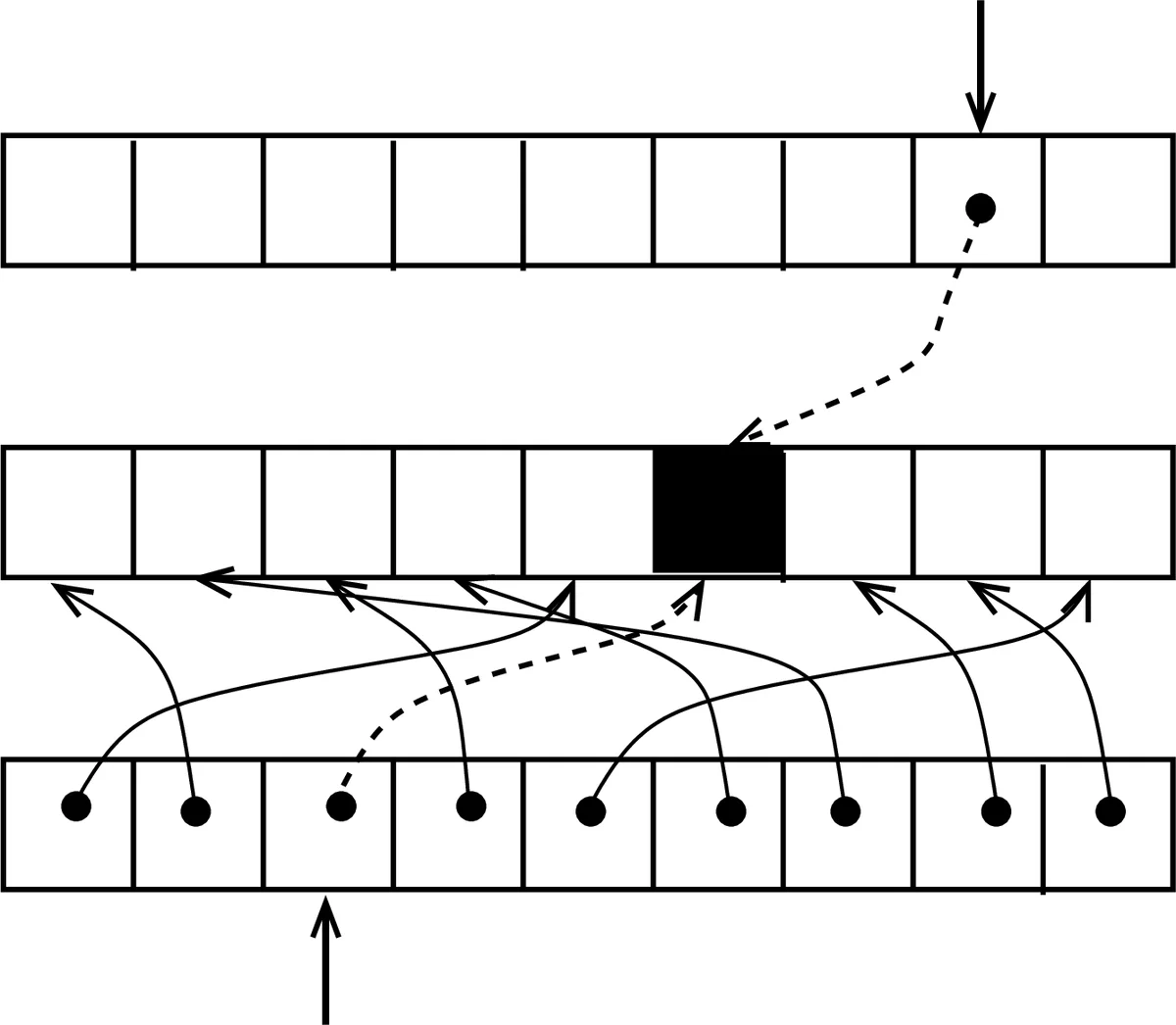
Anonymous shared memory is a memory in which processes use different names for the same shared read/write register. As an example, a shared register named $A$ by a process $p$ and a shared register named $B$ by another process $q$ can correspond to the very same register $X$, and similarly for the names $B$ at $p$ and $A$ at $q$ which can correspond to the same register $Y\neq X$. Hence, there is a permanent disagreement on the register names among the processes. This new notion of anonymity was recently introduced by G. Taubenfeld (PODC 2017), who presented several memory-anonymous algorithms and impossibility results. This paper introduces a new problem (new to our knowledge), that consists in “desanonymizing” an anonymous shared memory. To this end, it presents an algorithm that, starting with a shared memory made up of $m$ anonymous read/write atomic registers (i.e., there is no a priori agreement on their names), allows each process to compute a local addressing mapping, such that all the processes agree on the names of each register. The proposed construction is based on an underlying deadlock-free mutex algorithm for $n\geq 2$ processes (recently proposed in a paper co-authored by some of the authors of this paper), and consequently inherits its necessary and sufficient condition on the size $m$ of the anonymous memory, namely $m$ must belongs to the set $M(n)={m:$ such that $\forall \ell: 1<\ell \leq n:~ \gcd(\ell,m)=1}\setminus {1}$. This algorithm, which is also symmetric in the sense process identities can only be compared by equality, requires the participation of all the processes; hence it can be part of the system initialization. Last but not least, the proposed algorithm has a first-class noteworthy property, namely, its simplicity.
💡 Research Summary
The paper tackles a novel problem in the domain of shared memory concurrency: “desanonymization” of an anonymous read/write memory. In an anonymous memory system each process accesses the same physical register through a distinct logical name, determined by an adversarial permutation unknown to the processes. Consequently, there is no a priori agreement on register identifiers, which hinders the direct application of classic concurrent algorithms that assume a common address space.
The authors formalize the desanonymization task as follows: given n asynchronous processes and m anonymous atomic registers, each process must compute a local bijective mapping map_i : {1,…,m}→{1,…,m} such that for every index y, the register accessed by process p_i at SM_i
Comments & Academic Discussion
Loading comments...
Leave a Comment