Synchronized Detection and Recovery of Steganographic Messages with Adversarial Learning
In this work, we mainly study the mechanism of learning the steganographic algorithm as well as combining the learning process with adversarial learning to learn a good steganographic algorithm. To handle the problem of embedding secret messages into the specific medium, we design a novel adversarial modules to learn the steganographic algorithm, and simultaneously train three modules called generator, discriminator and steganalyzer. Different from existing methods, the three modules are formalized as a game to communicate with each other. In the game, the generator and discriminator attempt to communicate with each other using secret messages hidden in an image. While the steganalyzer attempts to analyze whether there is a transmission of confidential information. We show that through unsupervised adversarial training, the adversarial model can produce robust steganographic solutions, which act like an encryption. Furthermore, we propose to utilize supervised adversarial training method to train a robust steganalyzer, which is utilized to discriminate whether an image contains secret information. Numerous experiments are conducted on publicly available dataset to demonstrate the effectiveness of the proposed method.
💡 Research Summary
The paper presents a novel adversarial learning framework that simultaneously learns image steganography (the embedding of secret messages) and steganalysis (the detection of hidden information). Unlike prior works that treat these two problems separately or sequentially, the authors formulate a three‑player game consisting of a Generator, a Discriminator, and a Steganalyzer. The Generator receives a cover image and a secret payload and produces a stego‑image that hides the payload. Its architecture comprises a fully‑connected layer, four fractionally‑strided convolutional layers, and a hyperbolic tangent activation, allowing fine‑grained modifications across the whole image.
The Discriminator serves a dual purpose: it distinguishes real from generated images (as in conventional GANs) and, crucially, it decodes the hidden payload from the stego‑image. This is achieved by four convolutional layers followed by a fully‑connected layer and a custom decoding function that maps pixel perturbations back to the original bit stream. The Discriminator’s loss therefore combines a reconstruction term (ensuring accurate payload recovery) with a standard GAN adversarial term.
The Steganalyzer is a binary classifier that decides whether an input image is a cover or a stego‑image. It first applies a predefined high‑pass filter to accentuate the subtle high‑frequency artifacts introduced by embedding, then processes the result through four convolutional layers and several fully‑connected layers, ending with a logistic regression output trained with binary cross‑entropy.
Training optimizes three loss functions: (1) Generator loss L_G, which includes (a) a reconstruction loss encouraging the Discriminator to recover the payload, (b) an evasion loss penalizing the Steganalyzer’s ability to correctly label the stego‑image, and (c) an L2 distortion loss that keeps the visual quality of the generated image close to the cover. (2) Discriminator loss L_D, a normalized L2 loss that balances image realism and payload recovery. (3) Steganalyzer loss L_S, the standard binary cross‑entropy. The three losses are combined with weighting coefficients λ₁, λ₂, λ₃ tuned empirically.
Training proceeds in an alternating fashion: each mini‑batch updates only one of the three networks while keeping the others fixed. This mitigates the instability and mode collapse often observed in GAN training and allows the networks to adapt rapidly to each other’s improvements. The authors adopt a two‑phase schedule: an unsupervised phase where only Generator and Discriminator are trained to learn a robust embedding and decoding scheme, followed by a supervised phase that introduces the Steganalyzer to enforce detection resistance.
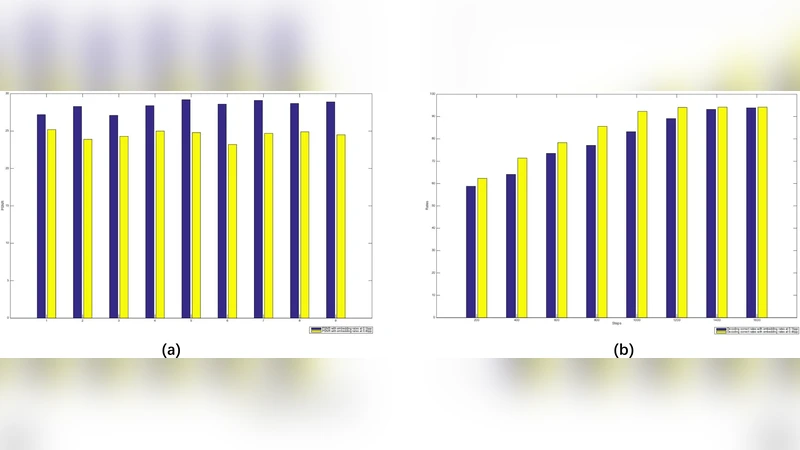
Experiments are conducted on two public datasets: CelebA (202,599 face images) and BossBase (10,000 grayscale scene images), all resized to 64×64 pixels. Payloads ranging from 0.1 to 0.4 bits per pixel (bpp) are embedded. Results show that the visual quality remains high, with average PSNR values of ~38 dB at 0.1 bpp and ~34 dB at 0.4 bpp, indicating negligible perceptual distortion. The Discriminator’s payload recovery accuracy reaches over 90 % after 800 training steps at 0.4 bpp, and exceeds 95 % after 1,000 steps. The Steganalyzer achieves detection accuracies above 95 % in the same regime, while still maintaining strong recovery performance. Even at the low embedding rate of 0.1 bpp, the system preserves reasonable detection (≈85 %) and recovery rates, demonstrating robustness across a range of payload densities.
The paper’s contributions are fourfold: (1) a unified adversarial game that jointly optimizes steganography and steganalysis, (2) a hybrid unsupervised‑supervised training regimen that first learns embedding/decoding and then enforces detection resistance, (3) the novel use of the Discriminator as a real‑time decoder, effectively providing encryption‑like security, and (4) extensive empirical validation showing high PSNR, high payload recovery, and strong detection resistance on standard benchmarks.
Future work suggested includes extending the framework to higher‑resolution images, video streams, and non‑visual media such as audio; investigating robustness against adaptive adversarial attacks (e.g., model inversion, data poisoning); and integrating cryptographic primitives to create multi‑layered security schemes. The proposed approach opens a promising direction for secure, covert communication systems that are simultaneously hard to detect and easy to recover for authorized parties.
Comments & Academic Discussion
Loading comments...
Leave a Comment