Robust NFP generation for Nesting problems
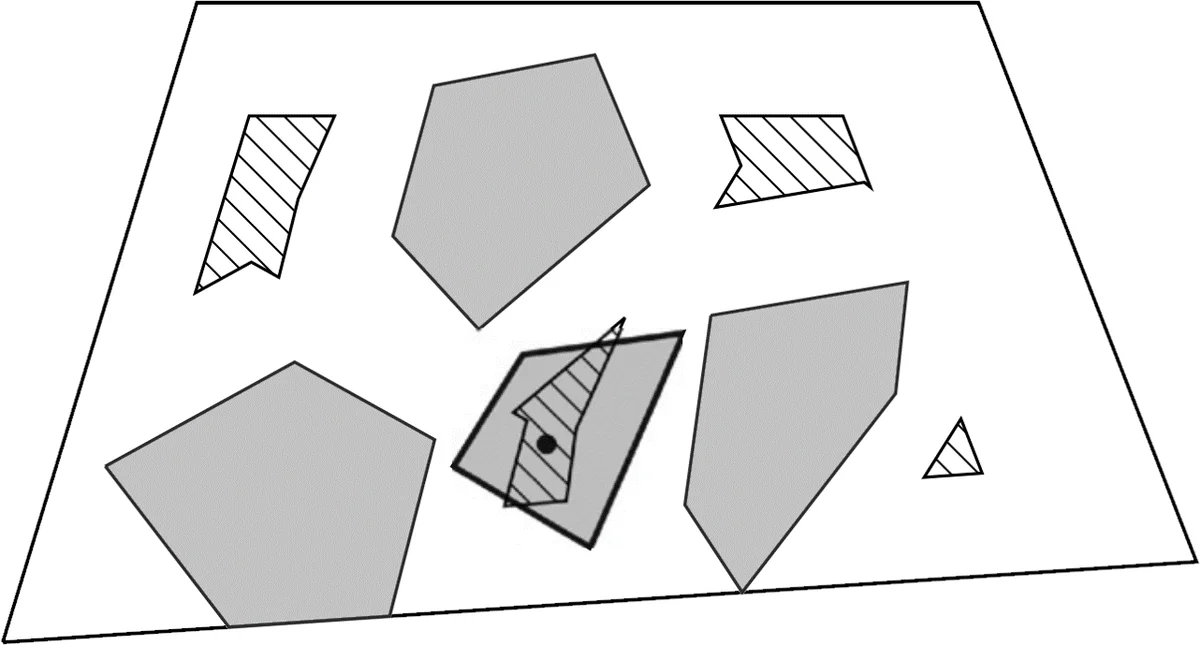
Cutting and packing problems arise in a large variety of industrial applications, where there is a need to cut pieces from a large object, or placing them inside a containers, without overlap. When the pieces or the containers have irregular outline, the problem is classified as a Nesting problem. The geometrical challenges of the Nesting problem are addressed by focusing on the geometric aspect of the 2D pieces and containers involved. The challenges of the geometrical component are mainly derived from the complexity of the pieces, due to high number of vertices, which is common when dealing with real world scenarios. This complexity is challenging for current algorithms to process efficiently and effectively, leading to high computational cost and less satisfactory results, particularly when dealing with overlap verification operations. Usually, when tackling Nesting problems, the overlap verification process between two objects is done through the use of a structure known as No-Fit-Polygon (NFP). In this work, the generation of the NFP is achieved through a simple algorithm which produces a simplified shape while reducing numerical precision errors and fully representing the region that forms the NFP including positions with perfect fits.
💡 Research Summary
**
The paper addresses a fundamental bottleneck in irregular‑piece nesting problems: the generation of robust No‑Fit‑Polygons (NFPs) that are used to test overlap between two polygons. While NFPs are a well‑known tool for converting a two‑polygon overlap test into a point‑in‑polygon test, existing methods for constructing them suffer from numerical precision issues, difficulty handling narrow concavities, holes, and “perfect‑fit” or “perfect‑slide” configurations, and they become prohibitively expensive when many orientations of the pieces must be considered.
The authors begin with a concise introduction that frames nesting as a critical industrial task in sectors such as leather, sheet‑metal, furniture, and shipbuilding, emphasizing that real‑world parts often contain thousands of vertices. They then review three dominant families of NFP generation techniques: (1) sliding (orbital) algorithms, which simulate a piece sliding around another but lose contact in narrow passages and accumulate floating‑point errors; (2) slope‑diagram approaches, which work well for convex polygons but need artificial edges for concave shapes; (3) Minkowski‑sum and polygon‑decomposition methods, which decompose each polygon into convex sub‑polygons and merge the resulting partial NFPs, a step that is computationally heavy and numerically fragile. The review also mentions the Collision‑Free Region (CFR) concept, which represents the feasible placement region as a single polygon but still struggles with degenerate cases.
To overcome these limitations, the paper proposes a new pipeline that can be summarized in five stages:
-
Convex Decomposition – Any off‑the‑shelf convex‑decomposition algorithm is used to split each input polygon into a set of convex components. The authors argue that the number of components and vertices does not affect the final NFP complexity; it only influences the one‑time preprocessing cost.
-
Partial NFP Generation via Slope Diagrams – For every pair of convex components (one from each piece) a partial NFP is generated using a slope‑diagram technique similar to Bennell & Oliveira (2008). Because the components are convex, the algorithm is exact and free from the numerical drift that plagues sliding methods.
-
Intersection and Mid‑point Enrichment – All pairwise intersections between partial NFPs are computed, and every edge of every partial NFP is bisected, inserting a new vertex at its midpoint. This enrichment creates a dense set of vertices that will later allow a clean graph‑based extraction of outlines and holes.
-
Graph Construction and Pruning – The enriched vertices and edges are turned into a directed graph where edges follow the counter‑clockwise orientation of each convex partial NFP. Duplicate edges are collapsed, and any vertex that lies strictly inside another partial NFP (and does not belong to the outer boundary) is removed together with its incident edges. This step eliminates all interior vertices, leaving only the skeleton of the full NFP, including any zero‑area features that correspond to perfect fits or perfect slides.
-
Outline, Hole, and Degenerate Feature Extraction – Starting from the vertex with the smallest X coordinate (and smallest Y among ties), the algorithm walks the graph by always choosing the incident edge that makes the smallest angle with a vertical reference line. This walk yields the outermost contour. Remaining sub‑graphs are classified as holes, perfect‑fit points (isolated vertices), or perfect‑slide loops (closed zero‑area circuits). Finally, the graph is converted back into a polygonal representation with explicit outer boundary, interior holes, and degenerate features.
The key contributions of the work are:
-
Numerical Robustness – By relying on convex decomposition and exact slope‑diagram calculations, the method avoids the floating‑point drift that afflicts sliding algorithms, especially in narrow concavities or when pieces are large relative to the coordinate precision.
-
Complete Feature Capture – The algorithm naturally discovers holes, perfect‑fit placements, and perfect‑slide placements, which many prior approaches either miss or treat as special cases requiring extra logic.
-
Scalability – The expensive convex‑decomposition step is performed once per piece; all subsequent NFP construction is linear in the number of convex component pairs and in the number of vertices generated by the enrichment step. Consequently, the approach is well‑suited for industrial scenarios with thousands of parts and many orientations, where pre‑computing NFPs for each orientation becomes feasible.
-
Implementation Simplicity – The pipeline consists of well‑understood geometric primitives (convex decomposition, edge intersection, midpoint insertion, graph traversal) and does not require sophisticated Boolean operations on polygons, making it easier to integrate into existing nesting software.
Although the paper does not present extensive empirical benchmarks, the authors provide a qualitative complexity analysis indicating that the proposed method can reduce NFP generation time by an order of magnitude compared with classic sliding algorithms, especially when dealing with high‑vertex count parts.
In the concluding section, the authors outline future work: extending the technique to three‑dimensional irregular packing (where the analogue of NFP is a No‑Fit‑Polyhedron), handling continuous rotations by incremental updates of the NFP rather than full recomputation, and conducting large‑scale industrial case studies to quantify savings in material waste and computational resources.
Overall, the paper delivers a coherent, mathematically sound, and practically oriented solution to a long‑standing problem in nesting optimization, offering a pathway toward faster, more reliable, and more feature‑complete overlap verification in real‑world manufacturing environments.
Comments & Academic Discussion
Loading comments...
Leave a Comment