This One Simple Trick Disrupts Digital Communities
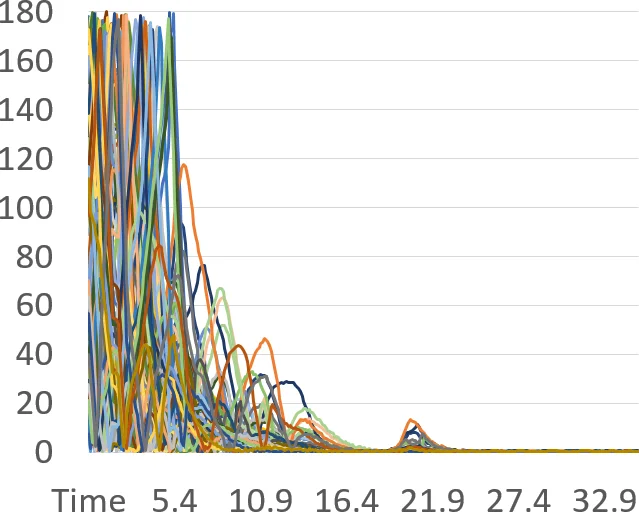
This paper describes an agent based simulation used to model human actions in belief space, a high-dimensional subset of information space associated with opinions. Using insights from animal collective behavior, we are able to simulate and identify behavior patterns that are similar to nomadic, flocking and stampeding patterns of animal groups. These behaviors have analogous manifestations in human interaction, emerging as solitary explorers, the fashion-conscious, and members of polarized echo chambers. We demonstrate that a small portion of nomadic agents that widely traverse belief space can disrupt a larger population of stampeding agents. Extending the model, we introduce the concept of Adversarial Herding, where bad actors can exploit properties of technologically mediated communication to artificially create self sustaining runaway polarization. We call this condition the Pishkin Effect as it recalls the large scale buffalo stampedes that could be created by native Americans hunters. We then discuss opportunities for system design that could leverage the ability to recognize these negative patterns, and discuss affordances that may disrupt the formation of natural and deliberate echo chambers.
💡 Research Summary
The paper presents an agent‑based simulation that models human interaction in a high‑dimensional “belief space,” a subset of information space representing opinions. Drawing on animal collective‑behavior models such as flocking, schooling, and stampeding, the authors define three behavioral archetypes for digital agents: nomadic explorers, flocking fashion‑followers, and stampeding echo‑chamber members. Agents move according to a Reynolds‑style Boids algorithm adapted to up to ten dimensions, with key parameters including velocity, heading, and a Social Influence Horizon (SIH) that determines how far an agent looks to align with neighbors. A small SIH encourages exploration (nomadic behavior), while a large SIH produces strong alignment and rapid convergence into dense clusters (stampeding).
Simulation experiments show that inserting a modest proportion (≈5‑10 %) of nomadic agents that traverse the belief space widely can significantly disrupt the formation of large, highly cohesive stampeding clusters. The nomads continuously inject diverse viewpoints, preventing the system from locking into a single polarized direction.
The authors then extend the model to incorporate “Adversarial Herding,” where malicious actors (herders) amplify the influence of selected agents (or synthetic sockpuppets) by increasing their weight beyond the default value. This creates a self‑sustaining runaway polarization they term the “Pishkin Effect,” analogous to historic buffalo stampedes driven over cliffs. In this scenario, even a tiny number of herders can force the majority of agents into a stampeding state, after which exploratory behavior is effectively suppressed.
The paper situates its contribution within prior work on animal models of collective motion, opinion dynamics, information‑retrieval manipulation, and game‑theoretic analyses of cooperation. It argues that the mathematical commonality of consensus formation across physical and cognitive domains justifies applying Boids‑style rules to belief spaces.
From a design perspective, the authors propose monitoring SIH‑related metrics and influence weights to detect early signs of polarization, and deliberately fostering nomadic‑type agents through platform features that promote exposure to diverse or neutral content. They also suggest limiting the amplification power of suspected herders (e.g., by down‑weighting their posts or flagging coordinated inauthentic behavior).
In conclusion, the study demonstrates that simple, biologically inspired rules can generate realistic digital‑community dynamics, that a minority of exploratory agents can act as a stabilizing force, and that adversarial amplification can overturn this balance, leading to extreme echo chambers. Future work is outlined to explore non‑linear belief spaces, multi‑network interactions, and validation against real‑world social‑media data.
Comments & Academic Discussion
Loading comments...
Leave a Comment