Generalized Network Dismantling
Finding the set of nodes, which removed or (de)activated can stop the spread of (dis)information, contain an epidemic or disrupt the functioning of a corrupt/criminal organization is still one of the key challenges in network science. In this paper, we introduce the generalized network dismantling problem, which aims to find the set of nodes that, when removed from a network, results in a network fragmentation into subcritical network components at minimum cost. For unit costs, our formulation becomes equivalent to the standard network dismantling problem. Our non-unit cost generalization allows for the inclusion of topological cost functions related to node centrality and non-topological features such as the price, protection level or even social value of a node. In order to solve this optimization problem, we propose a method, which is based on the spectral properties of a novel node-weighted Laplacian operator. The proposed method is applicable to large-scale networks with millions of nodes. It outperforms current state-of-the-art methods and opens new directions in understanding the vulnerability and robustness of complex systems.
💡 Research Summary
The paper tackles the problem of network dismantling under realistic, heterogeneous node removal costs. While traditional dismantling assumes unit cost for every node, the authors introduce a generalized formulation where each node i carries an arbitrary non‑negative cost w_i, reflecting factors such as monetary price, protection level, or centrality. The objective is to find a minimum‑cost set S whose removal fragments the network so that the largest remaining connected component does not exceed a prescribed size C.
To address this NP‑hard problem, the authors construct a novel node‑weighted Laplacian L_w. Starting from the adjacency matrix A and a diagonal cost matrix W, they define a weighted edge matrix B = A·W + W·A – A and then L_w = D_B – B, where D_B contains the row sums of B. The dismantling cost can be expressed as the quadratic form vᵀL_wv with binary indicator vector v ∈ {+1, –1}ⁿ, and minimizing this form yields an upper bound on the optimal cost.
Because the binary optimization is intractable, the authors relax v to real values, leading to a classic spectral relaxation: the optimal relaxed solution is the second smallest eigenvector v^(2) of L_w (the Fiedler vector of the weighted Laplacian). Nodes with non‑negative entries are placed in one partition, the rest in the other, and the process recurses until all components are smaller than C.
For large graphs, directly computing v^(2) is prohibitive. The authors introduce a power‑Laplacian operator \tilde L = 6 d_max² I – L_w, where d_max is the maximum degree. By repeatedly applying \tilde L to a random unit vector orthogonal to the trivial eigenvector, the vector converges exponentially to v^(2). This procedure runs in O(n·log² n) time and requires only matrix‑vector multiplications.
After the spectral split, a fine‑tuning step maps the problem to a weighted vertex‑cover on the cut edges between the two partitions. Existing approximation algorithms for vertex cover are used to select a small additional set of nodes that guarantees the cut cost respects the original weighted formulation.
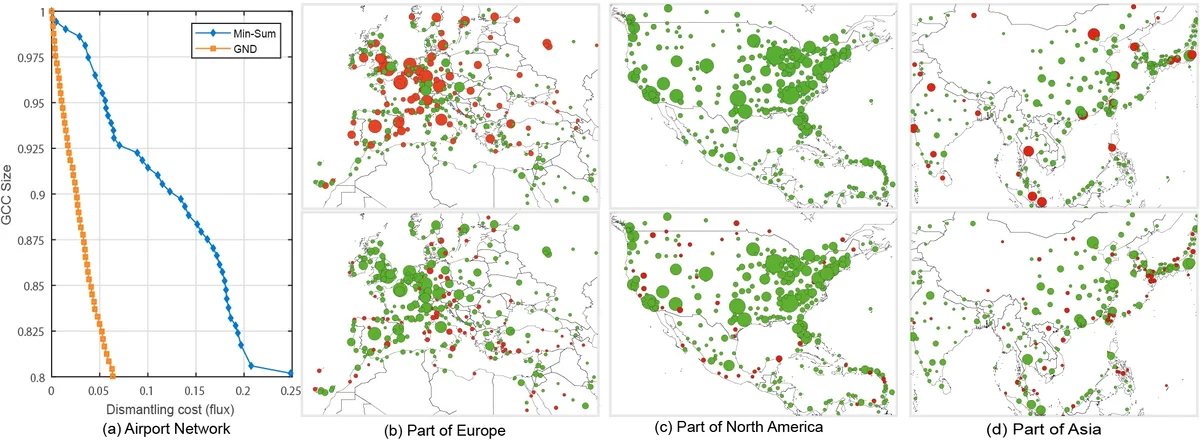
Empirical evaluation on four real‑world networks—including an online social network, a crime network, a corruption network, and a political blog network—demonstrates that the proposed Generalized Network Dismantling (GND) method outperforms state‑of‑the‑art approaches such as Min‑Sum and random removal, especially when costs are proportional to node degree. GND achieves substantially smaller giant component sizes for the same total removal cost, while avoiding expensive removal of high‑degree hubs.
The work contributes (i) a formal definition of cost‑aware network dismantling, (ii) a node‑weighted graph‑cut objective linked to the spectrum of L_w, (iii) an efficient power‑iteration based spectral approximation with provable convergence, (iv) a practical fine‑tuning via weighted vertex cover, and (v) extensive validation showing superior performance on large, heterogeneous networks. These results open new avenues for cost‑effective intervention strategies in epidemiology, misinformation control, and disruption of illicit networks.
Comments & Academic Discussion
Loading comments...
Leave a Comment