Budget-constrained Edge Service Provisioning with Demand Estimation via Bandit Learning
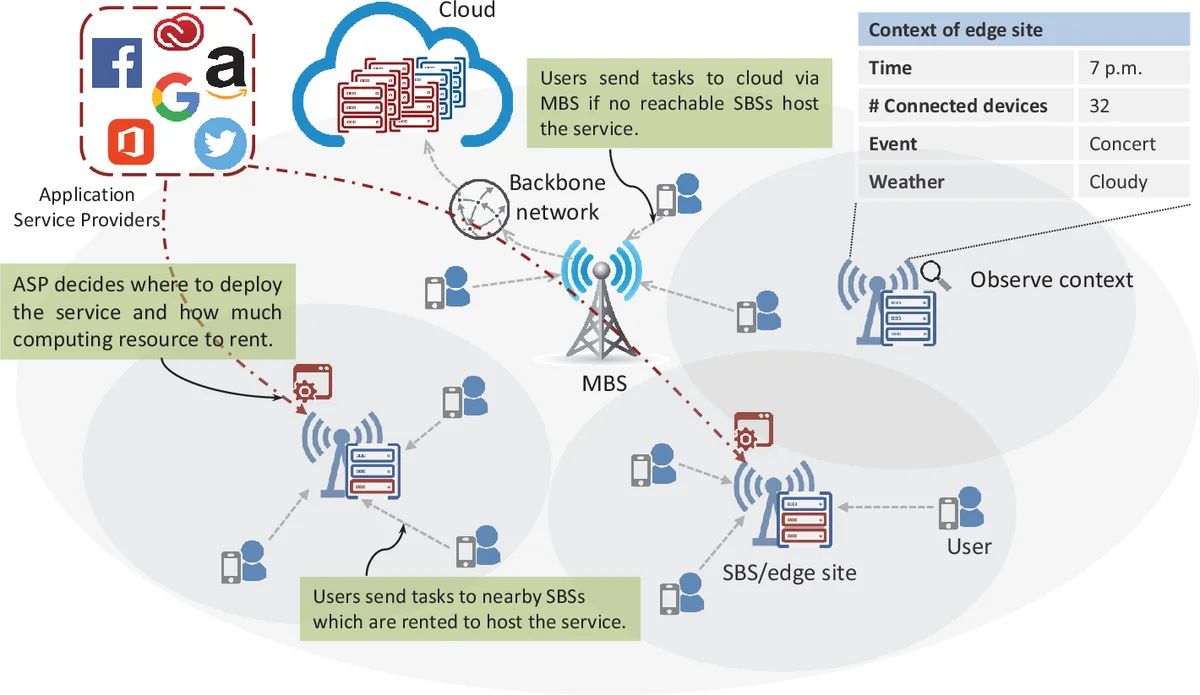
Shared edge computing platforms, which enable Application Service Providers (ASPs) to deploy applications in close proximity to mobile users are providing ultra-low latency and location-awareness to a rich portfolio of services. Though ubiquitous edge service provisioning, i.e., deploying the application at all possible edge sites, is always preferable, it is impractical due to often limited operational budget of ASPs. In this case, an ASP has to cautiously decide where to deploy the edge service and how much budget it is willing to use. A central issue here is that the service demand received by each edge site, which is the key factor of deploying benefit, is unknown to ASPs a priori. What’s more complicated is that this demand pattern varies temporally and spatially across geographically distributed edge sites. In this paper, we investigate an edge resource rental problem where the ASP learns service demand patterns for individual edge sites while renting computation resource at these sites to host its applications for edge service provisioning. An online algorithm, called Context-aware Online Edge Resource Rental (COERR), is proposed based on the framework of Contextual Combinatorial Multi-armed Bandit (CC-MAB). COERR observes side-information (context) to learn the demand patterns of edge sites and decides rental decisions (including where to rent the computation resource and how much to rent) to maximize ASP’s utility given a limited budget. COERR provides a provable performance achieving sublinear regret compared to an Oracle algorithm that knows exactly the expected service demand of edge sites. Experiments are carried out on a real-world dataset and the results show that COERR significantly outperforms other benchmarks.
💡 Research Summary
The paper addresses the problem faced by an Application Service Provider (ASP) that must provision edge services under a limited operational budget while the demand at each edge site is unknown and varies over time and space. The authors formulate this as an Edge Resource Rental (ERR) problem consisting of three intertwined tasks: (1) learning the stochastic service demand at each edge site from scratch, (2) deciding which sites should host the service in a given time slot, and (3) determining how much computational resource (CPU capacity) to rent at each selected site, all subject to a global budget constraint.
To solve ERR, the authors cast it into a Contextual Combinatorial Multi‑armed Bandit (CC‑MAB) framework. Each edge site provides side‑information (context) such as time of day, local event indicators, or user density, which influences the expected demand. An “arm” corresponds to renting a specific amount of CPU at a particular site, and multiple arms can be pulled simultaneously, forming a combinatorial decision. The reward of a chosen arm set is defined as the net utility: the latency reduction achieved by serving requests at the edge minus the incurred rental cost.
The proposed algorithm, Context‑aware Online Edge Resource Rental (COERR), operates in discrete time slots. In each slot COERR observes the current context of all sites, updates demand estimates and confidence intervals using past observations (e.g., via Hoeffding bounds), and then solves a budget‑constrained knapsack‑type optimization to select the arm set that maximizes an upper confidence bound on expected utility. This mechanism balances exploration (choosing sites with high uncertainty) and exploitation (choosing sites with high estimated utility). The per‑slot optimization is NP‑hard; the authors employ a polynomial‑time approximation algorithm and incorporate its approximation error into the regret analysis.
Theoretical contributions include: (i) a general regret bound for any estimator and parameter setting, showing that total regret grows sublinearly with the horizon; (ii) a concrete sublinear regret bound (O(T^α) with α<1) when using sample‑mean estimators and appropriately decaying exploration rates; and (iii) an analysis of how approximation in the per‑slot knapsack solution adds only a linear term proportional to the approximation factor. Consequently, COERR is provably asymptotically optimal compared to an Oracle that knows the true expected demands.
Empirical evaluation uses real service‑request traces from the Grid Workloads Archive. Experiments vary budget levels, context dimensionality, and compare COERR against random rental, fixed‑ratio rental, a non‑contextual UCB bandit, and the Oracle. Results show that COERR achieves 15‑30 % higher utility than the baselines and reaches about 92 % of the Oracle’s performance, with the advantage becoming more pronounced under tighter budgets. The study also discusses extensions to multi‑ASP scenarios, dynamic pricing, and non‑linear utility functions.
In summary, the paper presents a novel, theoretically grounded online algorithm for budget‑constrained edge service provisioning that jointly learns demand patterns and makes combinatorial rental decisions using contextual information, and validates its effectiveness on realistic workloads.
Comments & Academic Discussion
Loading comments...
Leave a Comment