An Extended Dynamical Equation of Motion, Phase Dependency and Inertial Backreaction
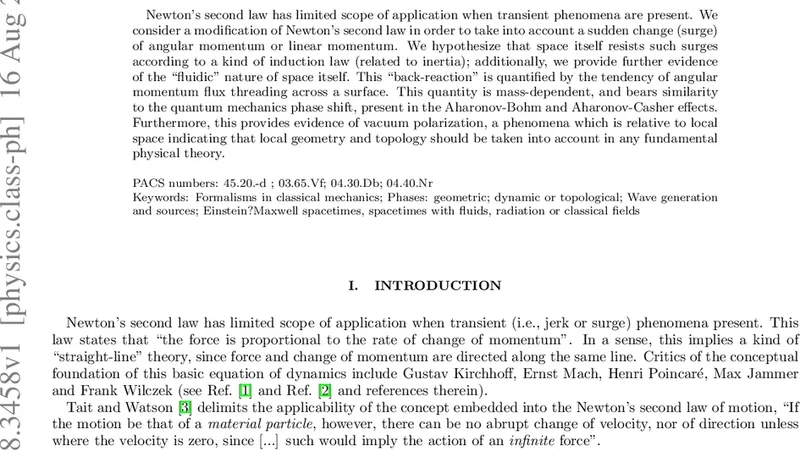
Newton’s second law has limited scope of application when transient phenomena are present. We consider a modification of Newton’s second law in order to take into account a sudden change (surge) of angular momentum or linear momentum. We hypothesize that space itself resists such surges according to a kind of induction law (related to inertia); additionally, we provide further evidence of the “fluidic” nature of space itself. This “back-reaction” is quantified by the tendency of angular momentum flux threading across a surface. This quantity is mass-dependent, and bears similarity to the quantum mechanics phase shift, present in the Aharonov-Bohm and Aharonov-Casher effects. Furthermore, this provides evidence of vacuum polarization, a phenomena which is relative to local space indicating that local geometry and topology should be taken into account in any fundamental physical theory.
💡 Research Summary
The paper begins by pointing out a well‑known limitation of Newton’s second law: it assumes a smooth, continuous relationship between force and acceleration and therefore fails to capture the dynamics of systems that experience abrupt changes in linear or angular momentum. The authors argue that when a “surge” in momentum occurs—such as a sudden torque, an impulsive spin‑up, or a rapid change in direction—the traditional F = ma formulation does not account for the transient response of the surrounding space itself. To remedy this, they propose an “inertial induction” hypothesis, drawing an analogy with electromagnetic induction. Just as a time‑varying current induces a magnetic field, a time‑varying momentum flux is hypothesized to induce a reactive “back‑reaction” in the vacuum.
The central new quantity introduced is the angular‑momentum flux, defined as
\
Comments & Academic Discussion
Loading comments...
Leave a Comment