Deterministic Communication in Radio Networks
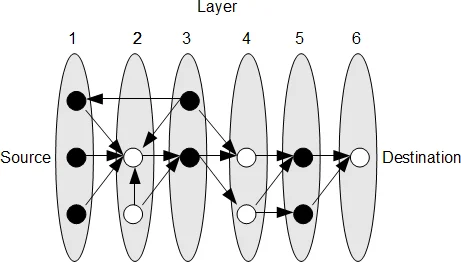
In this paper we improve the deterministic complexity of two fundamental communication primitives in the classical model of ad-hoc radio networks with unknown topology: broadcasting and wake-up. We consider an unknown radio network, in which all nodes have no prior knowledge about network topology, and know only the size of the network $n$, the maximum in-degree of any node $\Delta$, and the eccentricity of the network $D$. For such networks, we first give an algorithm for wake-up, based on the existence of small universal synchronizers. This algorithm runs in $O(\frac{\min{n, D \Delta} \log n \log \Delta}{\log\log \Delta})$ time, the fastest known in both directed and undirected networks, improving over the previous best $O(n \log^2n)$-time result across all ranges of parameters, but particularly when maximum in-degree is small. Next, we introduce a new combinatorial framework of block synchronizers and prove the existence of such objects of low size. Using this framework, we design a new deterministic algorithm for the fundamental problem of broadcasting, running in $O(n \log D \log\log\frac{D \Delta}{n})$ time. This is the fastest known algorithm for the problem in directed networks, improving upon the $O(n \log n \log \log n)$-time algorithm of De Marco (2010) and the $O(n \log^2 D)$-time algorithm due to Czumaj and Rytter (2003). It is also the first to come within a log-logarithmic factor of the $\Omega(n \log D)$ lower bound due to Clementi et al.\ (2003). Our results also have direct implications on the fastest \emph{deterministic leader election} and \emph{clock synchronization} algorithms in both directed and undirected radio networks, tasks which are commonly used as building blocks for more complex procedures.
💡 Research Summary
The paper addresses two fundamental communication tasks—broadcasting and wake‑up—in the classical model of ad‑hoc radio networks with unknown topology, no collision detection, and only local knowledge of the network size n, the maximum in‑degree Δ, and the eccentricity D. Existing deterministic solutions rely heavily on selective families or radio synchronizers, which either require global coordination or incur large overheads when nodes start at different times. Consequently, the best known deterministic wake‑up time is O(n log²n) and broadcasting runs in O(n log n log log n) or O(n log²D), still far from the Ω(n log D) lower bound.
The authors introduce two new combinatorial constructs. First, they prove the existence of universal radio synchronizers with delay function g(k)=O(n log n log k log log k) for any possible in‑degree k. By employing these synchronizers, they devise a deterministic wake‑up protocol that activates the whole network within
O(min{n, DΔ}·log n·log Δ / log log Δ)
time steps. This improves the previous O(n log²n) bound across all parameter ranges, especially when Δ is small.
Second, they develop the notion of block synchronizers. A block synchronizer groups time slots into fixed‑size blocks and within each block applies a selective‑family‑like transmission schedule. They show that block synchronizers of size O(log D·log log(DΔ/n)) exist. Embedding this structure into a broadcast algorithm yields a deterministic broadcasting time of
O(n·log D·log log(DΔ/n))
which is within a log‑log factor of the Ω(n log D) lower bound and beats the prior best O(n log n log log n) and O(n log²D) algorithms. When Δ≤n, the bound simplifies to O(n·log D·log log D), giving near‑linear performance for shallow networks (D=O(1)) and for sparse networks where D·Δ≈n.
The paper also discusses immediate implications for higher‑level tasks. Since deterministic leader election can be performed in O(log n) times the broadcast cost, the new broadcast algorithm leads to a leader‑election time of
O(n·log n·log D·log log(DΔ/n))
which improves the state‑of‑the‑art for both directed and undirected networks, particularly when D is small. Similarly, the wake‑up protocol yields leader election and clock‑synchronization algorithms with time
O(min{n, DΔ}·log²n·log Δ·log log Δ)
which are the fastest known deterministic solutions in the considered model.
Methodologically, the existence proofs for both synchronizer types follow a probabilistic method: random assignments to transmission slots are shown to satisfy the required covering properties with positive probability, and the arguments are refined to keep the size of the objects polylogarithmic in the relevant parameters. Although the constructions are non‑explicit, they can be turned into deterministic algorithms using standard derandomization techniques, as discussed in related work.
In summary, the paper makes three major contributions: (1) a universal radio synchronizer that yields an O(min{n, DΔ}·log n·log Δ / log log Δ) wake‑up algorithm; (2) a block synchronizer framework that enables deterministic broadcasting in O(n·log D·log log(DΔ/n)) time, essentially optimal up to a log‑log factor; and (3) direct corollaries for leader election and clock synchronization that improve all previously known deterministic bounds. These results close a long‑standing gap between upper and lower bounds for deterministic communication in unknown radio networks and open avenues for further research on explicit constructions and extensions to models with collision detection or randomization.
Comments & Academic Discussion
Loading comments...
Leave a Comment