Water Distribution System Design Using Multi-Objective Particle Swarm Optimisation
Application of the multi-objective particle swarm optimisation (MOPSO) algorithm to design of water distribution systems is described. An earlier MOPSO algorithm is augmented with (a) local search, (b) a modified strategy for assigning the leader, and (c) a modified mutation scheme. For one of the benchmark problems described in the literature, the effect of each of the above features on the algorithm performance is demonstrated. The augmented MOPSO algorithm (called MOPSO+) is applied to five benchmark problems, and in each case, it finds non-dominated solutions not reported earlier. In addition, for the purpose of comparing Pareto fronts (sets of non-dominated solutions) obtained by different algorithms, a new criterion is suggested, and its usefulness is pointed out with an example. Finally, some suggestions regarding future research directions are made.
💡 Research Summary
This paper presents an enhanced Multi-Objective Particle Swarm Optimization algorithm, termed MOPSO+, for the design of Water Distribution Systems (WDS). The work addresses a classic engineering optimization problem: determining pipe diameters to minimize total cost while maximizing network resilience.
The authors build upon a baseline MOPSO algorithm by integrating three key enhancements: (1) A local search (LS) scheme that operates as a memetic component. It explores the neighborhood of existing non-dominated (ND) solutions in the discrete decision space (altering one pipe’s diameter index by ±1) to refine and expand the Pareto front. This LS strategically focuses on less-crowded regions of the objective space to improve solution diversity and quality. (2) A modified leader assignment strategy within the PSO framework to guide particle movement more effectively. (3) An improved mutation operator to better balance exploration and exploitation throughout the optimization run.
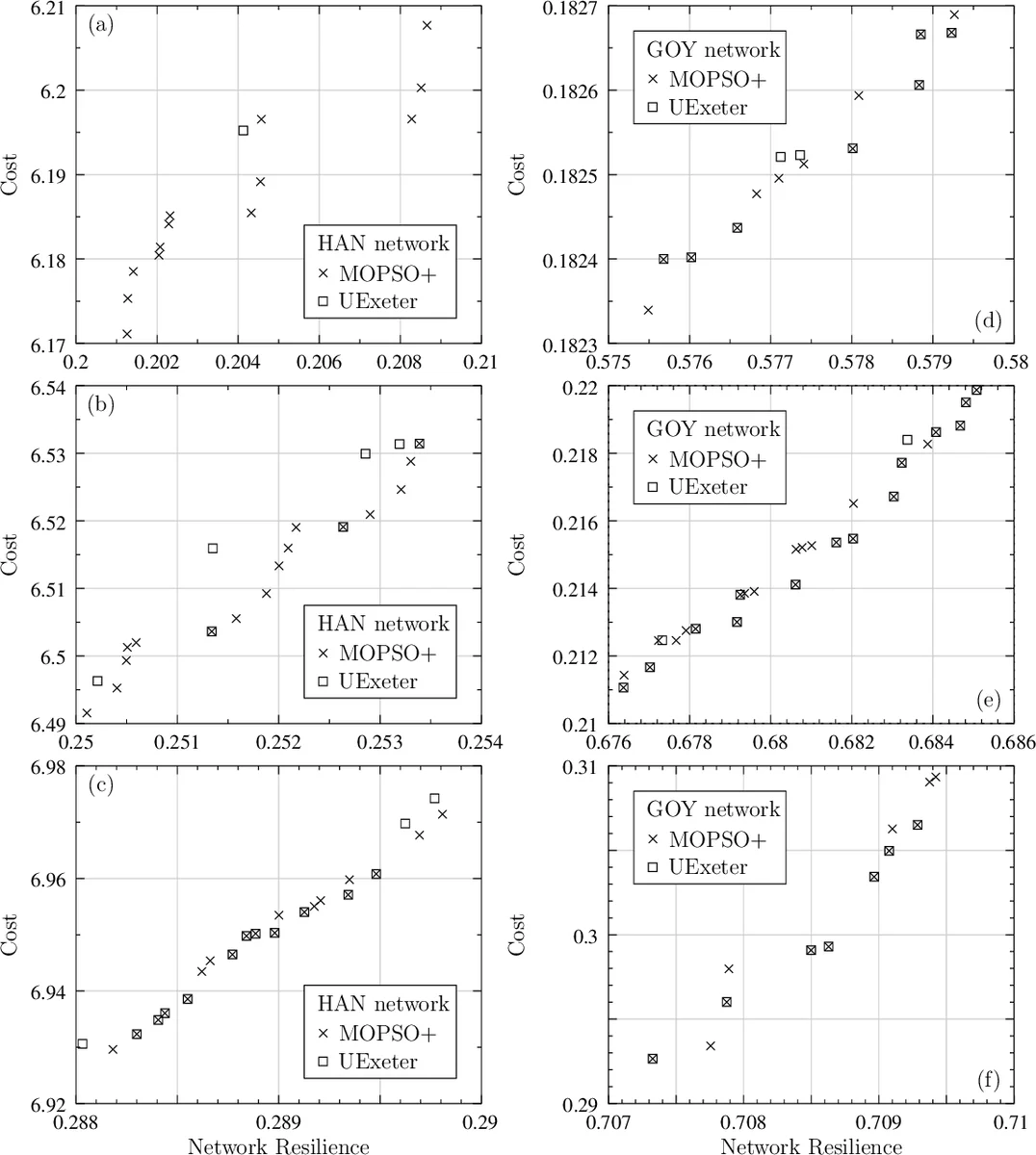
A significant methodological contribution is the proposal of a new criterion for comparing Pareto Fronts (PFs), particularly suited for discrete problems like WDS where the true Pareto front is unknown. Instead of relying on metrics designed for continuous spaces (e.g., generational distance, spacing), the authors suggest analyzing the composition of the combined PF from two algorithms. They define and count Unique solutions (contributed by only one algorithm), Common solutions (contributed by both), and Rejected solutions (dominated in the combined set). This framework provides a clear, practical answer to whether one algorithm’s results subsume and improve upon another’s.
The performance of MOPSO+ is rigorously evaluated on five medium-scale benchmark WDS problems from the literature (TLN, NYT, BLA, HAN, GOY). In every case, the algorithm discovers new ND solutions that were not part of the previously established “best-known” Pareto fronts, demonstrating its superiority in exploring the design space. The paper also acknowledges the computational cost of the exhaustive local search for very large-scale problems (exemplified by the PES network) and suggests directions for future work, such as implementing a more selective local search.
In conclusion, the study demonstrates that the hybrid MOPSO+ algorithm, combining global PSO search with targeted local exploitation and incorporating specific algorithmic refinements, forms a robust and effective optimizer for complex, discrete, multi-objective WDS design problems. It successfully generates a superior set of trade-off solutions, offering decision-makers a wider range of optimal design choices.
Comments & Academic Discussion
Loading comments...
Leave a Comment