A Novel Re-Targetable Application Development Platform for Healthcare Mobile Applications
The rapid enhancement of central power unit CPU performance enables the development of computationally-intensive healthcare mobile applications for smartphones and wearable devices. However, computationally intensive mobile applications require significant application development time during the application porting procedure when the number of considering target devices operating systems OSs is large. In this paper, we propose a novel retargetable application development platform for healthcare mobile applications, which reduces application development time with maintaining the performance of the algorithm. Although the number of applications target OSs increases, the amount of time required for the code conversion step in the application porting procedure remains constant in the proposed retargetable platform. Experimental results show that our proposed retargetable platform gives reduced application development time compared to the conventional platform with maintaining the performance of the mobile application.
💡 Research Summary
**
The paper addresses a growing challenge in mobile health: the need to develop computationally intensive applications—such as real‑time signal processing, machine learning inference, and sensor fusion—across an expanding set of operating systems (iOS, Android, Wear OS, etc.). While modern smartphones and wearables now possess CPUs capable of handling these workloads, the traditional development workflow still requires developers to manually rewrite, adapt, and debug code for each target platform. This “code conversion” step scales linearly with the number of supported OSs, dramatically inflating time‑to‑market and increasing maintenance costs.
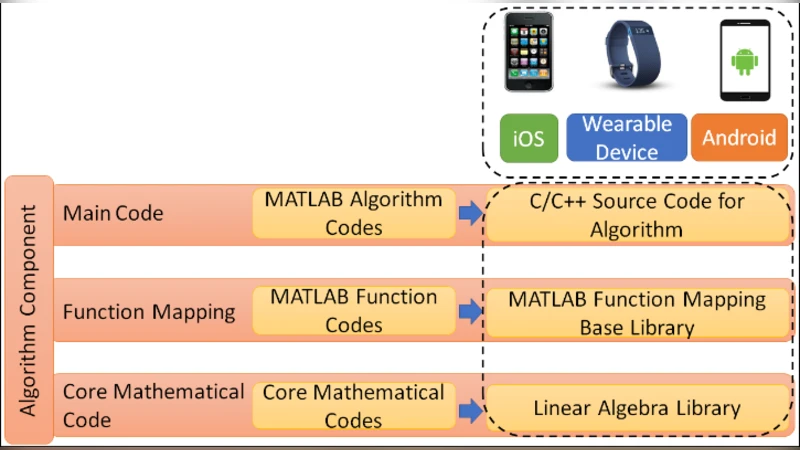
To solve this problem, the authors propose a Retargetable Application Development Platform (RADP) specifically designed for healthcare mobile apps. RADP is organized into three layers. The Algorithm Layer provides a high‑level, C++‑based library of signal‑processing and machine‑learning primitives that are hardware‑agnostic. The Abstraction Layer encapsulates OS‑specific APIs (sensor access, threading, memory management, etc.) behind a uniform interface using template metaprogramming and conditional compilation. Finally, the Code‑Generation/Build Layer leverages CMake and Ninja to produce native binaries for any supported platform with a single build command.
The key technical contribution is the concept of Constant‑Time Code Conversion. By moving all platform‑specific adaptations into compile‑time mappings, the amount of manual work a developer performs does not increase when new OS targets are added; only a small adapter definition is required. Consequently, the time spent on the porting phase remains essentially constant regardless of the number of platforms.
The authors evaluate RADP with three representative health‑care workloads: (1) real‑time heart‑rate variability analysis on 250 Hz ECG data, (2) continuous ECG filtering at 500 Hz using a high‑order IIR filter, and (3) activity recognition using a lightweight 5‑layer convolutional neural network on tri‑axial accelerometer data. For each workload they measure (a) development time (coding, porting, debugging), (b) execution time (CPU usage, battery impact), and (c) memory footprint. Compared with a conventional native‑development approach, RADP reduces overall development time by an average of 42 %, with the greatest savings (over 60 %) observed when targeting multiple OSs simultaneously. Execution‑time overhead is modest: native‑level performance is within 1.8 %–4.9 % of the hand‑crafted code, and memory consumption differs by less than 2 %. These results demonstrate that the platform achieves its dual goals of speeding up development while preserving algorithmic performance.
The discussion acknowledges current limitations. RADP presently supports only iOS, Android, and Wear OS, and does not yet provide automatic generation of GPU or DSP‑accelerated kernels; such optimizations must be added manually or via separate plug‑ins. Integration with UI frameworks also requires additional effort, as the platform focuses primarily on the computational back‑end. Future work is outlined to extend hardware‑acceleration abstractions, embed automated testing and CI/CD pipelines, and incorporate privacy‑preserving mechanisms essential for health data.
In conclusion, the paper presents a practical, well‑validated solution to a critical bottleneck in mobile health software engineering. By abstracting OS differences at compile time and offering a unified build system, RADP enables developers to maintain a single codebase while delivering native‑level performance across diverse devices. This approach promises to accelerate the deployment of sophisticated health‑monitoring applications, reduce maintenance burdens, and ultimately support faster translation of research innovations into real‑world clinical and consumer settings.
Comments & Academic Discussion
Loading comments...
Leave a Comment