Low-Latitude Aurorae during the Extreme Space Weather Events in 1859
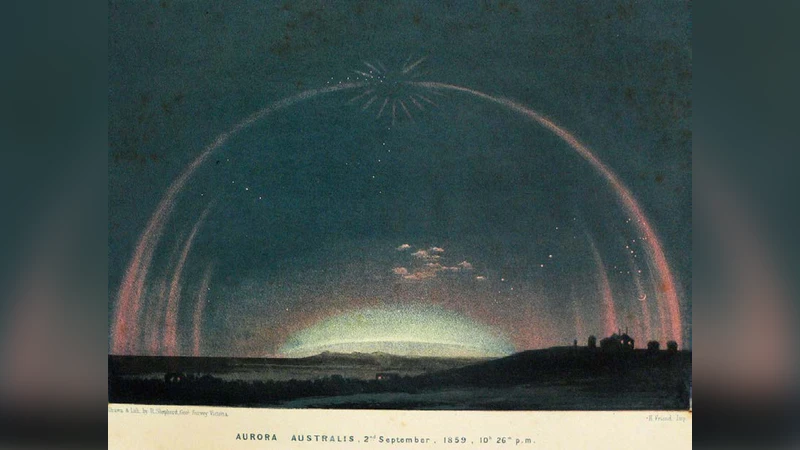
The Carrington storm (September 1/2, 1859) is one of the largest magnetic storms ever observed and it has caused global auroral displays in low-latitude areas, together with a series of multiple magnetic storms during August 28 and September 4, 1859. In this study, we revisit contemporary auroral observation records to extract information on their elevation angle, color, and direction to investigate this stormy interval in detail. We first examine their equatorward boundary of “auroral emission with multiple colors” based on descriptions of elevation angle and color. We find that their locations were 36.5 deg ILAT on August 28/29 and 32.7 deg ILAT on September 1/2, suggesting that trapped electrons moved to, at least, L1.55 and L1.41, respectively. The equatorward boundary of “purely red emission” was likely located at 30.8 deg ILAT on September 1/2. If “purely red emission” was a stable auroral red arc, it would suggest that trapped protons moved to, at least, L~1.36. This reconstruction with observed auroral emission regions provides conservative estimations of magnetic storm intensities. We compare the auroral records with magnetic observations. We confirm that multiple magnetic storms occurred during this stormy interval, and that the equatorward expansion of the auroral oval is consistent with the timing of magnetic disturbances. It is possible that the August 28/29 interplanetary coronal mass ejections (ICMEs) cleared out the interplanetary medium, making the ICMEs for the Carrington storm on September 1/2 more geoeffective.
💡 Research Summary
The paper revisits contemporary eyewitness accounts of auroral displays surrounding the Carrington event of September 1–2 1859, together with the preceding and following magnetic disturbances on August 28–29 and September 4. By extracting explicit descriptions of elevation angle, colour, and viewing direction, the authors convert each observation into a magnetic latitude (ILAT) and then into an L‑shell value, which quantifies how far earthward the trapped particle populations extended during the storms.
For the “multicolour aurora” (green, blue, violet components) the reconstructed equatorward boundary lies at 36.5° ILAT (≈ L 1.55) on August 28/29 and at 32.7° ILAT (≈ L 1.41) on September 1/2. The “purely red aurora”, interpreted as a stable auroral red arc, is placed at 30.8° ILAT (≈ L 1.36) on September 1/2. Because multicolour aurorae are generated primarily by tens‑to‑hundreds‑keV electrons, while red arcs are produced by hundreds‑keV to MeV protons, these latitude limits provide separate lower bounds on the equatorward reach of electron and proton populations. The inferred L‑values are modest compared with the extreme Dst ≈ ‑850 nT often quoted for the Carrington storm, suggesting that the auroral observations give a conservative estimate of the storm’s magnetic intensity.
The authors then compare the auroral timing with magnetic observatory records from the same period. Sharp depressions in the horizontal component (H) are evident on August 28 and September 1, confirming that at least two distinct, intense interplanetary coronal mass ejections (ICMEs) struck Earth. Importantly, the August 28/29 ICME likely “cleared out” the ambient solar wind, reducing plasma density and magnetic turbulence ahead of the September 1/2 ICME. This pre‑conditioning would have increased the geoeffectiveness of the Carrington‑day ICME, allowing it to drive the electron and proton populations farther earthward and to produce the observed low‑latitude aurorae. Such a scenario aligns with modern numerical studies showing that successive CMEs can interact, with the leading CME evacuating the interplanetary medium and the trailing CME delivering a more potent magnetic impulse.
The colour‑based distinction also yields insight into the particle energy spectrum. Multicolour aurorae, visible at latitudes as low as 32.7° ILAT, imply that electrons of at least several tens of keV were injected into the inner magnetosphere, while the red arc at 30.8° ILAT indicates that protons of several hundred keV to MeV were present. The simultaneous equatorward expansion of both electron‑ and proton‑driven emissions demonstrates that the storm’s ring current and plasma sheet were highly energized, consistent with the large, rapid magnetic field depressions recorded at low‑latitude observatories.
Overall, the study reframes the Carrington event not as a single isolated CME impact but as a complex sequence of solar eruptions. The August 28/29 ICME set the stage by evacuating the near‑Earth solar wind, and the September 1/2 ICME delivered a more geoeffective magnetic structure that drove the inner magnetosphere to unprecedentedly low L‑shells. By grounding historical narrative in quantitative auroral geometry, the authors provide a robust, observation‑based lower bound on storm intensity and highlight the value of low‑latitude auroral records for reconstructing extreme space‑weather events. This work therefore enriches our understanding of the Carrington storm’s dynamics and offers a methodological template for future analyses of historic geomagnetic disturbances.
Comments & Academic Discussion
Loading comments...
Leave a Comment