Reedy categories and the $Theta$-construction
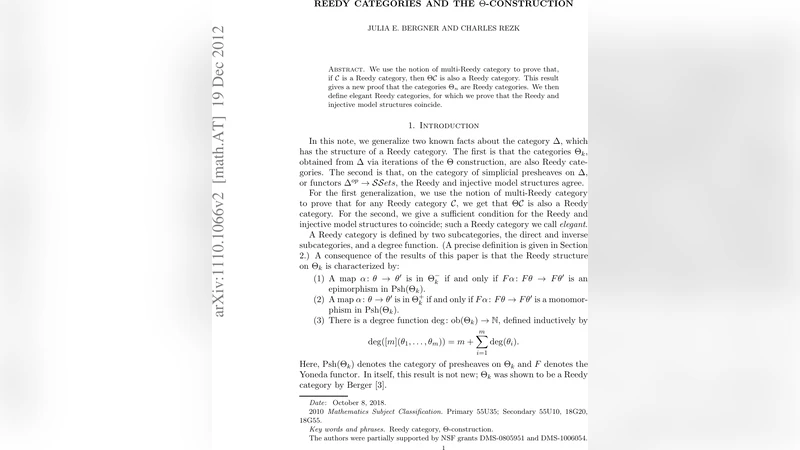
We use the notion of multi-Reedy category to prove that, if $\mathcal C$ is a Reedy category, then $\Theta \mathcal C$ is also a Reedy category. This result gives a new proof that the categories $\Theta_n$ are Reedy categories. We then define elegant Reedy categories, for which we prove that the Reedy and injective model structures coincide.
💡 Research Summary
The paper introduces a novel categorical framework called a multi‑Reedy category and uses it to establish that the Θ‑construction preserves the Reedy property. Classical Reedy categories are defined by a degree function together with two sub‑categories of “raising” (𝒞⁺) and “lowering” (𝒞⁻) morphisms, requiring every morphism to factor uniquely as a lowering map followed by a raising map. While this structure works well for many low‑dimensional examples, it becomes restrictive when one wishes to handle higher‑dimensional combinatorial objects such as trees, disks, or iterated cell complexes.
To overcome this limitation the author equips each object with several independent degree functions indexed by a set I. For each i∈I there are corresponding sub‑categories 𝒞⁺_i and 𝒞⁻_i satisfying the usual Reedy axioms, and the various degree systems are required to be compatible in a precise sense: a morphism that is lowering for one degree must decompose in a way that respects the other degree structures, and the collection of degrees induces a global partial order on objects. When I is a singleton the definition collapses to the ordinary Reedy notion, so the new concept genuinely generalises the classical one.
With this machinery in hand the paper turns to the Θ‑construction. Given a category 𝒞, Θ𝒞 is built by taking finite rooted trees whose vertices are labelled by objects of 𝒞 and whose edges are labelled by morphisms of 𝒞, then freely generating a category whose objects are such labelled trees and whose morphisms are tree‑wise composites of the underlying 𝒞‑morphisms. The construction was originally introduced by Joyal and Tierney to produce the family of categories Θₙ (Θⁿ 1), which serve as combinatorial models for n‑fold ∞‑categories.
The central theorem of the paper states:
If 𝒞 is a multi‑Reedy category, then Θ𝒞 is a Reedy category.
The proof proceeds in two main stages. First, the author defines a degree on a labelled tree by combining the depth of the tree with the multi‑degrees of the vertex labels. This yields a well‑defined global degree function on objects of Θ𝒞. Second, the author constructs the raising and lowering sub‑categories of Θ𝒞 by lifting the corresponding sub‑categories of 𝒞 to the tree level: a morphism of trees is declared “lowering” if it is lowering at every vertex with respect to each degree component, and similarly for “raising”. The compatibility conditions of the multi‑Reedy structure guarantee that any tree morphism admits a unique factorisation into a lowering part followed by a raising part, and that this factorisation respects the global degree. Consequently Θ𝒞 satisfies the Reedy axioms.
An immediate corollary is a new, conceptually simpler proof that each Θₙ is a Reedy category. In the classical approach one must verify the Reedy axioms by a painstaking induction on the dimension of cells. Here the author observes that Θₙ = Θⁿ 1 arises by iterating the Θ‑construction starting from the terminal category 1, which trivially carries a multi‑Reedy structure (there is only one object and one morphism, so any degree assignment works). By induction on n, the theorem guarantees that each intermediate Θᵏ is Reedy, and therefore Θₙ is Reedy for all n.
Beyond the preservation result, the paper introduces the notion of an elegant Reedy category. Elegance imposes two extra constraints on a Reedy category (𝒞,𝒞⁺,𝒞⁻,deg):
- Every morphism can be uniquely expressed as an augmentation (a map that raises degree) followed by a reduction (a map that lowers degree).
- Augmentations and reductions never change the degree across different “layers”; they operate strictly within a fixed degree level.
These conditions are satisfied by many familiar Reedy categories, including Δ (the simplex category) and the Θₙ’s. The author proves that in an elegant Reedy category the Reedy model structure (where cofibrations are generated by the lowering maps and fibrations by the raising maps) coincides with the injective model structure (where cofibrations are monomorphisms and fibrations are objectwise fibrations). In other words, the two standard model structures on the diagram category 𝒞̂ become identical. This result is significant because it eliminates the need to choose between two different homotopical frameworks when working with diagrams indexed by an elegant Reedy category; the homotopy theory is unambiguous.
The paper concludes with several remarks and directions for future work. The multi‑Reedy framework suggests that other combinatorial constructions—such as the dendroidal category Ω, the category of opetopes, or various “disk‑like” categories—might also be shown to preserve the Reedy property under suitable Θ‑type operations. Moreover, the class of elegant Reedy categories appears to be broader than previously recognised, and a systematic classification could yield new model‑categorical tools for higher‑dimensional algebraic topology and ∞‑category theory.
In summary, the author provides (i) a robust generalisation of Reedy categories via multi‑degrees, (ii) a clean proof that the Θ‑construction sends multi‑Reedy categories to Reedy categories (hence a new proof that Θₙ are Reedy), and (iii) the identification of elegant Reedy categories as precisely those for which the Reedy and injective model structures agree. These contributions deepen our understanding of the combinatorial foundations underlying higher‑dimensional categorical and homotopical structures.
Comments & Academic Discussion
Loading comments...
Leave a Comment