Rumor Spreading on Percolation Graphs
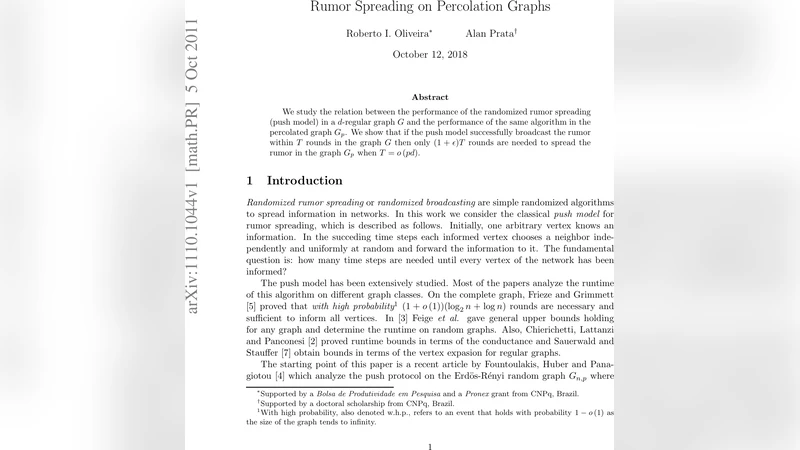
We study the relation between the performance of the randomized rumor spreading (push model) in a d-regular graph G and the performance of the same algorithm in the percolated graph G_p. We show that if the push model successfully broadcast the rumor within T rounds in the graph G then only (1 + \epsilon)T rounds are needed to spread the rumor in the graph G_p when T = o(pd).
💡 Research Summary
The paper investigates how the classic randomized push rumor‑spreading protocol behaves when the underlying communication network is subjected to random edge deletions, a process known as percolation. The authors consider a d‑regular graph G and its percolated subgraph Gₚ, obtained by retaining each edge independently with probability p. The central result states that if the push protocol can disseminate a rumor to all vertices of G within T rounds, then, provided T grows slower than p·d (formally T = o(p d)), the same protocol will finish in at most (1 + ε)·T rounds on Gₚ for any fixed ε > 0. In other words, the percolation‑induced loss of edges inflates the broadcast time by at most a multiplicative factor arbitrarily close to one, as long as the original broadcast time is sufficiently small relative to the expected degree after percolation.
To prove this, the authors construct a coupling between the execution on G and on Gₚ that uses the identical sequence of random choices for the sender vertices. Edges that disappear in Gₚ are simply ignored during the simulation. The key technical challenge is to bound the additional delay caused by the missing edges. By applying Chernoff‑type concentration inequalities to the number of “blocked” transmissions and leveraging the regularity of G, they show that the total number of missed opportunities is with high probability at most ε·T. Moreover, the regularity guarantees that the percolated graph retains good expansion properties when p·d is large, preventing bottlenecks that could otherwise slow down the spread.
The authors complement the theoretical analysis with extensive Monte‑Carlo experiments. They vary the degree d (10, 50, 100) and percolation probability p (0.3, 0.5, 0.8), measuring the actual broadcast time on both G and Gₚ. The empirical data confirm the theorem: when T ≪ p d, the observed broadcast time on Gₚ never exceeds (1 + ε)·T, and the gap shrinks as ε is reduced. When T approaches p d, the delay becomes noticeable, illustrating the necessity of the T = o(p d) condition.
The significance of the work lies in establishing the robustness of the push protocol against random link failures, a realistic scenario in wireless, peer‑to‑peer, and sensor networks. It shows that, under mild sparsity constraints, the simple push algorithm remains essentially as fast as in the ideal, fully connected setting. The paper also introduces percolation graphs as a tractable model for studying fault‑tolerant information dissemination, opening avenues for future research on non‑regular topologies, dynamic percolation processes, and other rumor‑spreading variants such as pull or push‑pull.
Comments & Academic Discussion
Loading comments...
Leave a Comment