Roof fall hazard due to blasting activity in the light of numerical modeling and underground measurements
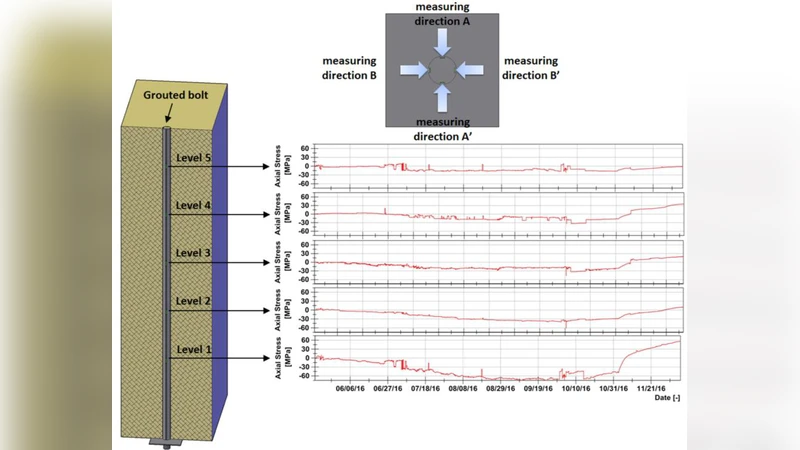
One of the major problems associated with exploitation of the copper ore deposit in underground mines in Poland is the local disturbance in a state of stable equilibrium manifested in a sudden release of strain energy stored in the deformed rock mass. It occurs mainly in the form of dynamic events which may result in rockbursts and roof falls. In order to face this threats, a number of organisational and technical prevention methods are applied in mines. It should be also noted that the greatest difficulties with the roof control are observed in the vicinity of active mining fronts, where the highest deformations are observed. The detonation of explosives generates a propagating shock wave which may cause a serious damage to a material body that is encountered on its way. Thus, a number of doubts during the mining operation emerged, that simultaneous firing of group of mining faces may have the negative impact on the condition of applied roof support and condition of roof strata as well The article discusses geomechanical influence of multi-faces blasting on immediate roof strata condition through the mutual comparison of the instrumented bolts monitoring data and the computer simulations results. The numerically assessed stress/strain field in the near vicinity of the blasting works operation has proved to be in close agreement with the field measured data. In the considered mining conditions both the numerical approach and field strain/stress monitoring indicated the low effect of production blasting on the immediate roof fall potential.
💡 Research Summary
The paper investigates the geomechanical impact of simultaneous multi‑face blasting on roof stability in an underground copper mine in Poland, where rapid strain release often leads to rockbursts and roof falls. To assess whether concurrent detonations increase the risk of roof failure, the authors combined field instrumentation with advanced numerical modelling.
In the field, instrumented rock bolts were installed directly beneath the immediate roof strata in the active mining front. These bolts recorded axial load and deformation continuously before, during, and after blasting events, providing high‑resolution data on the dynamic response of the roof support system.
Parallel to the measurements, a three‑dimensional nonlinear finite‑element model of the mined block was constructed. The model incorporated realistic geological layering, discontinuities, rock mechanical properties (elastic modulus, Poisson’s ratio, compressive and shear strengths), and the existing support layout. Blasting parameters such as charge weight, hole geometry, and firing sequence were varied to represent both simultaneous multi‑face detonations and sequential single‑face blasts.
Simulation results showed that the shock wave generated by the explosives creates a high‑pressure front that attenuates rapidly as it propagates through the rock mass. By the time the wave reaches the immediate roof layer, the induced stress increment is modest (on the order of 0.2–0.3 MPa), far below the design safety limits (typically 5–10 MPa). Simultaneous multi‑face blasting produces slightly higher stress concentrations than isolated blasts, but the difference is not statistically significant and remains within acceptable margins.
When the field bolt data were compared with the numerical predictions, the temporal patterns (a sharp peak at detonation followed by rapid decay) and spatial distribution (maximum response near the blast centre) matched closely, confirming the model’s fidelity. Moreover, the stress‑strain state after blasting stayed below the predefined failure criteria (critical shear stress ≈ 1.5 MPa, strain ≈ 0.0015), indicating that the roof’s load‑bearing capacity was not compromised.
The authors conclude that, under the examined mining conditions, production blasting— even when performed on multiple faces simultaneously—has a low effect on the immediate roof‑fall potential. This finding challenges the common perception that multi‑face blasting inherently raises roof‑collapse risk. The study also demonstrates the value of integrating real‑time monitoring with high‑resolution numerical simulations for proactive hazard assessment.
Practical implications include: (1) confirmation that existing support designs remain adequate during coordinated blasting, (2) validation of a monitoring‑modelling workflow that can be used to predict dynamic stress changes before blasting, and (3) guidance for adjusting blasting parameters or support reinforcement when modelled stress peaks approach safety thresholds. Future work is suggested to explore long‑term strain accumulation and variability in rock properties, thereby extending the risk‑assessment framework to a broader range of geological conditions.
Comments & Academic Discussion
Loading comments...
Leave a Comment